Connect with us

News

EU grants candidate status to Ukraine as US ships weapons

Published

on

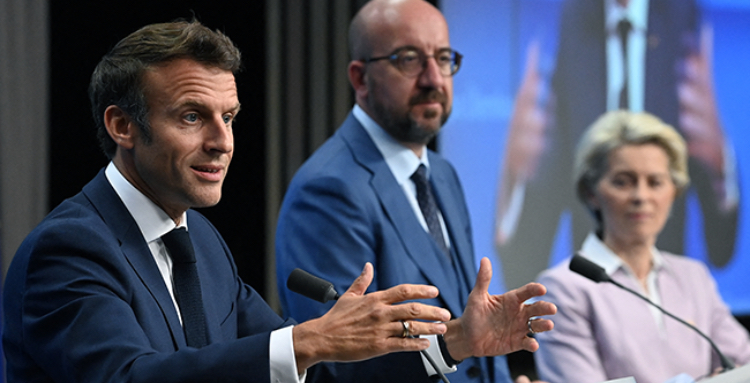
France’s President Emmanuel Macron (L), President of the European Council Charles Michel (C) and President of the European Commission Ursula von der Leyen (R) attend a press conference during an European Council in Brussels on June 23, 2022. JOHN THYS / AFP

European Union leaders granted candidate status Thursday to Ukraine and Moldova in a strong show of support against Russia’s invasion, as the United States said it was sending Kyiv more high-precision rocket systems.

The West’s latest attempts to rally behind Ukraine came as Russia closed in on key cities in the country’s embattled east and prompted growing global concerns with restrictions in gas and grain exports.

Ukraine’s President Volodymyr Zelensky hailed the EU decision on his country and Moldova as “a unique and historic moment”, although the two former Soviet republics face a long path before joining the bloc and its benefits of free movement and a common market.

“Ukraine’s future is within the EU,” said Zelensky, who had been working the phones for weeks.

“We will win, rebuild, enter the EU and then will rest. Or probably we will not rest.”

French President Emmanuel Macron said that the decision by EU leaders sent a “very strong signal” to Russia that Europeans support the pro-Western aspirations of Ukraine.

President Vladimir Putin had declared Ukraine to be part of Moscow’s sphere and insisted he was acting due to attempts to bring the country into NATO, the Western alliance that comes with security guarantees.

European powers before the invasion had distanced themselves from US support for Ukraine’s NATO aspirations and EU membership is at least years away.

Ukraine and Moldova will have to go through protracted negotiations and the European Union has laid out steps that Kyiv must take even before that, including bolstering the rule of law and fighting corruption.

Weapons to fight Russian gains

The White House announced that it was sending another $450 million in fresh weapons to Ukraine including new High Mobility Artillery Rocket systems, which have been at the top of Kyiv’s wish list.

The so-called Himars system can simultaneously launch multiple precision missiles at an extended range.

An initial four units have already been delivered, with Ukrainian soldiers being trained to operate the equipment, after President Joe Biden’s administration said Kyiv had offered assurances it would not fire into Russia.

Ukraine’s needs have been increasingly urgent as Russia — which failed to take Kyiv immediately after invading on February 24 — advances in the east, tightening its grip on strategically important Severodonetsk and its twin city Lysychansk across the Donets river.

Taking the cities would give Moscow control of the whole of Lugansk, allowing Russia to press further into the Donbas region and potentially farther west.

Ukraine acknowledged Thursday that it had lost control of two areas from where it was defending the cities, with Russian forces now closer to encircling the industrial hubs.

Britain’s defence ministry said some Ukrainian units had probably been forced to withdraw “to avoid being encircled”.

“Russia’s improved performance in this sector is likely a result of recent unit reinforcement and heavy concentration of fire,” it said in its latest intelligence update.

A representative of pro-Russian separatists in Ukraine told AFP the resistance of Ukrainian forces trying to defend Lysychansk and Severodonetsk was “pointless and futile.”

“At the rate our soldiers are going, very soon the whole territory of the Lugansk People’s Republic will be liberated,” said Andrei Marochko, a spokesman for the army of Lugansk.

The Russian army also said Thursday that its bombings in the southern city of Mykolaiv had destroyed 49 fuel storage tanks and three tank repair depots, after strikes killed several Ukrainian troops Wednesday.

‘Only grannies left’

The northeastern city of Kharkiv near the Russian border was nearly empty on Wednesday, AFP reporters said, a day after shelling by Moscow’s forces killed five people there.

“Last night the building next to mine collapsed from the bombardment while I was sleeping,” said Leyla Shoydhry, a young woman in a park near the opera house.

Roman Pohuliay, a 19-year-old in a pink sweatshirt, said most residents had fled the city.

“Only the grannies are left,” he said.

In the central city of Zaporizhzhia, women were training to use Kalashnikov assault rifles in urban combat as Russian forces edged nearer.

“When you can do something, it’s not so scary to take a machine gun in your hands,” said Ulyana Kiyashko, 29, after moving through an improvised combat zone in a basement.

‘Weaponising’ grain and gas

Western officials have also accused Russia of weaponising its key exports of gas as well as grain from Ukraine, contributing to global inflation and rising hunger in the world.

“We are very clear that this grain crisis is urgent, that it needs to be solved within the next month,” British Foreign Secretary Liz Truss said on a visit to Turkey.

“Otherwise we could see devastating consequences,” she said.

Ukraine’s Foreign Minister Dmytro Kuleba urged African nations to pressure Russia for a safe route for grain.

“African capitals matter and they do influence Russia’s position,” he told African journalists.

A US official warned of new retaliatory measures against Russia at the Group of Seven summit being attended by Biden in Germany starting Sunday.

Germany ratcheted up an emergency gas plan to its second alert level, just one short of the maximum that could require rationing in Europe’s largest economy, after Russia slashed its supplies.

“Gas is now a scarce commodity,” Economy Minister Robert Habeck told reporters, urging households to cut back on use. Demand for gas is lower in the summer but shortages could cause heating shortages in the winter.

France is aiming to have its gas storage reserves at full capacity by early autumn, and will build a new floating methane terminal to get more energy supplies by sea, Prime Minister Elisabeth Borne said.

A Kremlin spokesman reiterated its claim that the supply cuts were due to maintenance and that necessary equipment from abroad had not arrived

Comments

News

Ajimobi’s Legacy Still Guides Us, Oladele Urges Oyo APC Unity

Published

on

A chieftain of the All Progressives Congress in Oyo State and aspirant for the Irepo/Oorelope/Olorunsogo Federal Constituency seat in the 2027 general elections, Hon. Bosun Oladele, has called on members of the party and the wider progressive family in the state to embrace unity in order to preserve and advance the legacy of the late former Governor, Senator Abiola Ajimobi.

Oladele made the appeal on Thursday as political associates, loyalists and admirers marked the remembrance of the former governor, whose administration was widely associated with the popular slogan, “Koseleri.”

In a statement he personally issued,  the federal lawmaker hopeful described Ajimobi as a visionary leader whose passion for development transformed Oyo State and left an enduring footprint in its political history.

According to him, the annual remembrance of the late governor offers an opportunity for progressives to reflect on the ideals, discipline and commitment that defined Ajimobi’s leadership.

“It is that time of the year to remember the passion that once drove the developmental strides of the Pace Setter State, the centre of politics in Nigeria and a state renowned for many firsts,” Oladele said.

He noted that although the former governor had departed, his contributions to governance and public service remain fresh in the minds of many residents and party faithful.

“Oyo State still misses his sharp mind, problem-solving abilities, oratory prowess, focused leadership and developmental initiatives. His style of governance inspired confidence and demonstrated what purposeful leadership could achieve,” he stated.

Oladele stressed that Ajimobi’s legacy should continue to serve as a source of inspiration for members of the APC, urging them to close ranks and work towards a common goal.

“Even though he is gone, his legacy gives the progressive family in Oyo State hope that the future he envisioned for our dear state remains achievable through oneness and unity of purpose.

“I therefore call on all members of the APC and the progressive family at large to join hands, put aside differences and work together towards winning future elections as part of efforts to actualise the developmental aspirations our departed leader had for Oyo State,” he added.

The APC stalwart also prayed for the repose of Ajimobi’s soul and sought divine strength for his family, particularly his widow, Ambassador Florence Ajimobi, as she continues to shoulder public and private responsibilities.

He expressed optimism that Oyo State would once again witness progressive governance driven by visionary leadership, inclusiveness and a shared commitment to the welfare of the people.

Continue Reading

News

Senate passes state police bill, governors to appoint CPs

Published

on

The Senate on Wednesday passed a bill seeking to amend the 1999 Constitution to establish state police services across the country, a major milestone in ongoing efforts to decentralise policing and tackle Nigeria’s worsening security challenges.

The proposed legislation introduces a dual policing framework comprising a Federal Police Service and State Police Services, effectively replacing the existing structure under which policing is exclusively controlled by the Federal Government through the Nigeria Police Force.

The bill was passed after Senate Leader, Opeyemi Bamidele, presented its general principles on the floor of the Red Chamber.

It subsequently scaled second reading, underwent a rigorous clause-by-clause consideration and was passed for third reading after securing the support of more than two-thirds of the senators.

A key provision of the constitutional amendment empowers governors to appoint Commissioners of Police for their respective states, subject to confirmation by the state Houses of Assembly.

Clause 17 of the bill provides that a State Police Service shall be headed by a Commissioner of Police appointed by the governor on the recommendation of the National Police Council and confirmed by the House of Assembly of the state.

The proposed law further defines the operational relationship between governors and state police commands, allowing governors to issue lawful written directives of a general policy nature to Commissioners of Police on matters relating to the maintenance of public safety and order within their states.

To address widespread concerns over possible abuse of the proposed policing structure, lawmakers incorporated safeguards aimed at protecting political freedoms and civil liberties.

The bill expressly states that a state Commissioner of Police shall not arrest, detain, investigate or deploy force against any individual, political party or group merely for criticising the government, except in accordance with the law.

The provision is intended to prevent state police formations from being used to intimidate political opponents, activists, journalists and other dissenting voices while ensuring that all actions taken conform with due process.

The amendment also empowers the Federal Police Service to temporarily intervene in the internal security affairs of a state where there is an actual or imminent breakdown of public order or public safety which the state police are unable or unwilling to contain.

Such intervention must be authorised in writing by the President, who is required to state the grounds, territorial scope, functions and duration of the operation.

The President must also notify the governor, the Speaker of the state House of Assembly, the National Police Council and the National Assembly within 48 hours of the commencement of the intervention.

The bill further provides that no federal intervention shall continue beyond a period to be prescribed by an Act of the National Assembly unless approved by a resolution of the Senate.

The Senate’s approval came barely a day after President Bola Tinubu transmitted the bill to the National Assembly as part of his administration’s efforts to reform Nigeria’s security architecture.

According to the President, the proposed amendment is designed to provide a legal framework for a dual policing structure that would allow states to establish and operate their own police services alongside the federal police.

Tinubu said the proposal is a critical component of ongoing efforts to reorganise the country’s policing system, enhance security and better protect citizens, adding that communities, municipalities and local government areas would play more active roles in policing responsibilities under the new arrangement.

The renewed push for state police comes amid growing concerns over insecurity, banditry and mass kidnappings across parts of the country.

Supporters of the proposal argue that decentralised policing would strengthen grassroots intelligence gathering, deepen community-based security initiatives and ensure quicker responses to crimes and emergencies.

Critics, however, have cautioned against possible political interference by governors, funding challenges and the risk of exacerbating ethnic or communal tensions.

Tinubu had earlier described state police as inevitable in addressing the nation’s security challenges and urged lawmakers to fast-track constitutional amendments aimed at bringing the proposal to fruition.

Continue Reading

News

Tinubu sends state police bill to Senate

Published

on

President Bola Tinubu has transmitted a Constitution Alteration Bill to the Senate seeking the establishment of state police as part of efforts to reform Nigeria’s security architecture.

The proposed legislation, contained in a communication dated June 15, 2026, was read during plenary on Tuesday by Senate President Godswill Akpabio.

Tinubu said the bill was aimed at providing a legal framework for a dual policing structure that would allow states to establish and operate their own police services alongside the Nigeria Police Force.

According to the President, the proposed amendment forms a key component of ongoing efforts to restructure the country’s policing system to improve security and enhance the protection of lives and property.

He explained that under the arrangement, communities, municipalities and local government areas would play more active roles in policing, enabling local authorities to detect suspicious activities and promptly relay intelligence to security agencies.

Following the presentation, Akpabio referred the bill to the Senate Committee on Constitution Review and directed it to report back on Wednesday.

Speaking on the importance of community-based policing, the Senate President said local authorities were better placed to identify security threats and support proactive responses by law enforcement agencies.

“You will know when foreigners infiltrate Nigeria and alert security agencies so they can react proactively rather than reactively,” he said.

Akpabio expressed optimism that sustained collaboration between the executive and legislative arms would ensure the successful passage and implementation of the initiative.

He disclosed that the process would be undertaken in phases through constitutional amendments and subsequent Acts of Parliament.

“We will do it in two phases through alteration and an Act of Parliament. There will be a lot of safeguards; let us come and do this important task. It is extremely important that we come tomorrow,” he said.

The Senate President also informed lawmakers that plenary would not entertain other major business following the death of a member of the House of Representatives, Yahaya Tongo of Gombe State.

Similarly, the Senate Leader urged senators to attend the next sitting, stressing the significance of the proposed state police framework.

“We need a minimum of two-thirds of members to vote on constitutional alterations. The issue of state police is non-partisan and cuts across geopolitical zones and interests,” he said.

The latest development came barely two weeks after the Senate passed an executive bill on state police for second reading.

Akpabio said the fresh Constitution Alteration Bill transmitted by the President builds on the earlier proposal and seeks to provide the constitutional foundation necessary for the establishment and operation of state police services across the country.

Continue Reading

Advertisement

Entertainment

Advertisement

MegaIcon Magazine Facebook Page

Advertisement

MEGAICON TV

Advertisement

Trending