Opinion
Bawa, FFK, Shehu: Of slump, slum and somersault
Published
5 years agoon
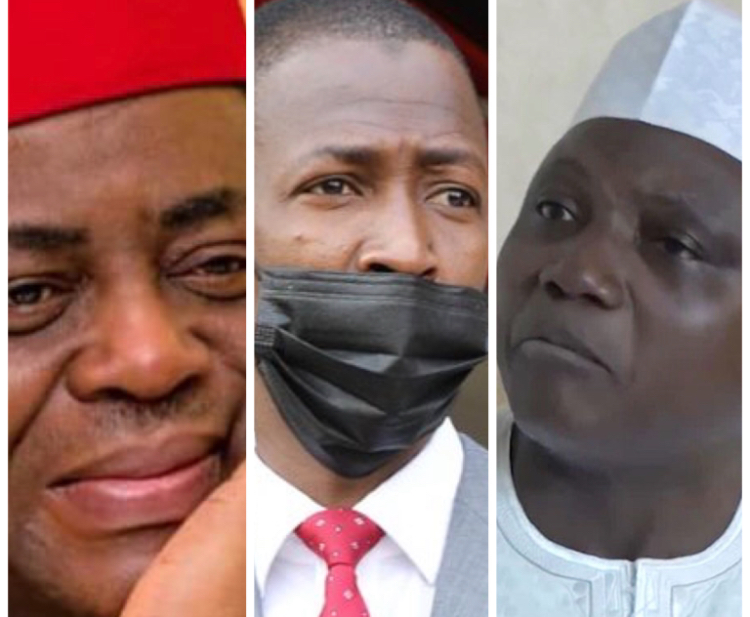
Last Thursday, when the Chairman of the Economic and Financial Crimes Commission, (EFCC) reportedly slumped at the Presidential Villa, Abuja, the story of the late enfant terrible of Oyo State politics, Busari Adelakun, sidled into my memory. Media reports said that Bawa slumped at an occasion commemorating the National Identity Day.
Same last week, Nigeria was back to her English class session. Occasionally, some fortuitous occurrences force this country, a product of Mrs. Flora Shaw’s taxonomic ingenuity, to go learn some basic language meanings. This time, Nigeria had to contend with the difference or differences between “slump” and “somersault.” Questions that confronted Nigeria and needed answers were, in their specifics, what exactly does anyone mean when they say something/someone had slumped or somersaulted? What is a slum? Is a slum a slum because it bears stench akin to Bethlehem’s – Jesus birthplace’s manger – or it is a stench because it has the noxious smell of sewage?
While on the podium speaking on the importance of digital identification, Bawa was said to have manifested physical signs of delirium. From the video of the event in circulation, the EFCC chair momentarily contorted his face like one struck by an unseen lightning. It was not clear whether this was due to exhaustion or an emotional trauma. He had painfully recounted the death of an employee of the commission he didn’t name. Upon walking away from the stage and taking his seat, Bawa was said to have fallen. Assisted up by Minister of Communications and Digital Economy, Isa Pantami, Bawa was spirited out of the hall. In confirming the incident, EFCC, through its spokesman, Wilson Uwujaren, said the fall was a mere “incident” where Bawa “felt unwell and had to return to his seat.”
I just recently re-read Peter Morton-Williams’ anthropological study of the Ogboni, the dreaded ancient Yoruba secret cult, entitled The Yoruba Ogboni cult in Oyo. Apart from its outline of the potency of blood in sacrifices and oath, written way back in 1960, Morton-Williams’ is a study in what probably drives interests in secret societies and why the elite take unqualified voyage into it, in spite of rapacious embrace of Christianity and Islam. It also explains why the Ogboni still has controlling importance in Yoruba religious organization, centuries after it was established.
If you add this to analyses of celebrated poet, Gabriel Okara’s Piano and Drums, a poem that evocatively brings out the effects of clashes between Western and African cultures, you will realize the reason and nature of some snide comments attributed to Bawa’s slump on the social media. It is why pastors visit the Sangoma, babalawo or dibia on weekdays and speak in tongues at the pulpit on Sunday in African churches. As news of his slump trended on social media, some commentators asked if the young EFCC czar was being pursued by some traducers who were angling for his seat.
As is the nature of Africans who never believed disasters, calamities, sicknesses or diseases have singularly physical, biological connotations without corresponding metaphysical underlining, many of the commentators didn’t believe that the EFCC boss slumped because he merely “felt unwell.”
Adelakun was a firebrand politician of the Second Republic, a politician who fellow politicians could ignore only at their peril. First, he enfolded traditional African Yoruba culture and symbols of rituals into modern practice of politics. He demonstrated this in his politics and never hid the fact that he was in touch with rituals. Born in the Ejioku area of Ibadan, Adelakun began peddling his political trade from the days of the Action Group of the First Republic. When the Unity Party of Nigeria (UPN) was founded, he became trapped in the turbulent politics of the era which was just a transpose of the earlier republic. He actually began his politics from the Ibadan Peoples Party (IPP) days, with the stormy petrel, Adelabu Adegoke in charge. After the republic was collapsed by a military coup which dissolved it aftermath the chaos of the Western region, Adelakun went back to farming and also joined a farmer’s union, becoming its president.
Barely educated though, in 1979, Governor Bola Ige of Oyo State appointed Adelakun commissioner for local government.
He was redeployed to the health ministry two years after. Adelakun however exited the UPN under a chaotic circumstance and, with Sunday Michael Afolabi, joined a faction opposed to Ige. He later decamped to the National Party of Nigeria (NPN), swearing to dislodge Ige, which he accomplished. To achieve this, he supported and eventually achieved the enthronement of Chief Victor Omololu Olunloyo as governor to replace Ige.
While leaving the two ministries he was commissioner, Adelakun became a mythical figure due basically to how he flaunted his grips of esotericism and the deep metaphysics of traditional Africa. He was reported to have famously sworn that since any cloth worn by Ipin leaf could never be worn by any human being again on earth, no one could step into the office he was leaving. Ipin is a leaf that farmers dread in the forest like a plague. Bodily contact with it was akin to being bitten by a scorpion.
True to his boast, Adelakun’s immediate successor in the Ministry of Local Government and Chieftaincy, Lasisi Olatunbosun, died shortly after being sworn in. The trope that gained traction was even that Olatunbosun’s buttocks got irretrievably glued to the seat Adelakun used in office. Again, his successor as commissioner in the Ministry of Health also died, allegedly of stroke. In Yorubaland, until of recent, stroke was held to be a metaphysical attack that was always the handiwork of traducers. Jailed in 1984 by the Buhari military regime, Adelakun took ill in prison and died at the Lagos University Teaching Hospital. Some people believed that his death was quickened by his inability to offer propitiations to grooves and gods who gave him his mythical legend.
Aside the slump of the EFCC Bawa, not a few things have been slumping and doing acrobatics in Nigeria recently; acrobatics like the famous Atilogwu dancers’. Like the Nigerian Naira, for example. Right now, the Naira has snatched the most notorious of national infamies available. The way Almighty Naira kisses the canvass, rather than a cry, it provokes laughter and enchantment one gets while watching Atilogwu. Some hilarious economic analysts claim that the Naira’s somersault is like a kiss of death. The Naira is engaged in one of the most flip-flop numeric dances of a national currency ever in the history of a nation.
One minute, the Naira is standing ramrod on its feet (though you would be right to say Naira lost its ramrod posture since the early 2000s or so, and has shamelessly lay prostrate, especially since the coming of this government). The next minute, that ramrod posture vanishes, in a meteoric rise that makes you remember Hubert Ogunde’s famous song, Iye le o ma wo. Ogunde, in that track, sang that the person who fixes his gait on a bird will in the next minute see feathers at the bird’s talon. Never the bird again – iye le o ma wo lehin eye o, e o l’eye ri… Ogunde was probably trying to localize Greek philosopher, Heraclitus’ famous dictum.
Because no two situations are exactly same, Heraclitus then surmised that you cannot step into same river twice, simply because life is woven round a tapestry called change. It is so bad that if Godwin Emefiele; sorry, the Nigerian Naira, greets you “good morning,” you have to look through the window to confirm. Naira’s duplicity could be benumbing. When you think you see an outwardly shining currency, bearing the totems of a people bound in freedom, peace and unity, all you see are feathers… a currency as light as feather or is at best a mirage, holding the values of what my people describe as a mere idandan.
Pardon my scant sense of hierarchical positioning. Long before the Naira, the Muhammadu Buhari government’s sense of taxonomy was the first to do acrobatics. With blood flowing from victims of notorious Fulani herders on the streets of the Southwest, Southeast, Northwest and some parts of the South-South, a furious Buhari couldn’t stand the bloodshed. What! He shouted. Then rockets of fire began to sound somewhere across the River Niger bridge. There was also some burning, some maiming and hoopla gone haywire. Then Buhari sat by the panes of his imperial castle in Aso Rock and decreed a label. Those who downed military fighter jets in the Northwest, who kill in their hundreds, who rape multiple of our children, are just bandits, Buhari proclaimed. Those “dots in a circle” children are terrorists, sons of Osama Bin Laden, so said the imperial taxonomist. QED.
Bothered by the success that advocates of separatism are recording, especially in getting the United Nations to listen to their plea that they are consistently being bayoneted by the Fulani-led government of Nigeria, Buhari somersaulted into what is called the fallacy of generalization. This fallacy is a pitfall in logic and reasoning that results from a faulty umbrella covering of an issue. It is an informal fallacy where an argumentator draws a conclusion about a phenomenon based on one or few instances of that phenomenon, by jumping into a wonky conclusion.
That same Thursday last week, presidential spokesman, Garba Shehu, said that Buhari was “shock(ed) to see ‘Yoruba Nation’ advocates throwing their lot in with the Indigenous People of Biafra (IPOB) and organising ‘increasingly violent rallies in Nigeria.” He said that “IPOB is a designated terrorist organization,” and “has now publicly revealed a 50,000 strong paramilitary organisation. It regularly murders security services and innocent civilians, with a significant uptick of violent attacks this year. And it is currently attempting to hold Nigerian states hostage with orders to stay at home under threat of terror. Without doubt, Nigerians and the entire world will judge Yoruba Nation by the company it keeps.”
This somersault or slump of the Buhari government is phenomenal and equal to a governmental performance of what I call a labeling gymnastics. While what unites both Yoruba nation agitators and IPOB is known to be that both want separate countries peacefully carved out of Nigeria, while Yoruba advocates have never been known to have shed even a pint of blood, IPOB dissociates itself from the maladies of the region in the name of Biafra. Even at that, none of the two has a quarter of the notoriety of bandits whom Buhari, in his taxonomic somersault, is cladding in the euphemism of banditry, to avoid western nations’ assault on it, probably.
That same week had barely ended when Femi Fani-Kayode, former Aviation Minister, literally swallowed his own vomit by joining the All Progressives Congress, (APC) a political party he had always viscerally attacked. Responding to the posting of this dispiriting news on Facebook last week by presidential media adviser, Femi Adesina, I could only borrow late Professor Pius Adesanmi’s quip on another slump by a top-rate media icon when he merely wrote “And Jesus wept” to qualify the calamitous somersault into the slum.
Slumping and somersaulting into the slum are regular features in Nigeria. Whether the slump is that of taxonomy for selfish purpose by Buhari or it is a moral somersault like that of Fani-Kayode or it is even a literal slump like Bawa, or the calamitous somersault of the Naira into the abyss, values are compromised. It is as if we are a country where morality is on sabbatical.
Dr Adedayo, a lawyer and media expert writes from Ibadan, Oyo state
You may like
Opinion
Oyo, Osun Petrol Price War: Why Fair Competition Should Matter
Published
1 day agoon
October 22, 2026By
Mega IconThe decision by some filling stations in Oyo and Osun states to sell petrol at lower prices than their competitors has brought renewed attention to pricing practices in Nigeria’s downstream petroleum sector and, more importantly, to what consumers stand to gain when competition is allowed to work.
Investigations and enquiries into petrol prices in the two states revealed differences in pump prices, with some independent petroleum marketers (IPM) selling Premium Motor Spirit (PMS), popularly known as petrol, for about ₦1,375 per litre, while some competing stations charged about ₦1,385 per litre.
Although the difference is just ₦10 per litre, the savings are meaningful for motorists, commercial transport operators, artisans, traders and other residents who depend on petrol to earn a living.
For a commercial driver buying 40 litres, for instance, the price difference amounts to ₦400. For small businesses that rely on petrol-powered generators, repeated purchases at lower prices could provide some relief amid the rising cost of living. Across thousands of consumers and multiple purchases, modest savings can become a substantial reduction in household and business expenses.
However, findings from the enquiries suggest that some independent marketers who had previously sold petrol at relatively lower prices later adjusted their pump prices to match those of competing stations.
The development has prompted questions about what influences pricing decisions in the two states and whether consumers are being allowed to benefit fully from competition among petroleum marketers.
Information obtained during engagements with some marketers, who spoke on condition of anonymity, also indicated that the leadership of the Independent Petroleum Marketers Association of Nigeria (IPMAN) in the two states had expressed displeasure over the decision by some members to sell petrol below the prices charged by other filling stations.
The circumstances surrounding the reported position of the association’s leadership, however, require clarification from the relevant IPMAN officials. Their response is necessary to establish the facts, understand the basis of the reported concerns and give the association an opportunity to state its position.
THE CASE FOR FAIR COMPETITION
At the heart of the matter is a question that directly affects consumers: should a petroleum marketer who can legitimately sell petrol at a lower price be discouraged from doing so simply because competitors are charging more?
The answer should be guided by evidence, legality and consumer welfare. In a competitive market, businesses generally make pricing decisions based on their operating costs, supply arrangements, margins and commercial objectives. Where a marketer can sustainably offer a lower price while meeting all applicable regulatory, product-quality and safety requirements, consumers should be able to consider that option.
Fair competition is not merely a benefit to individual buyers. It creates pressure on businesses to control costs, improve efficiency and offer better value. A lower price from one marketer can encourage others to review their own costs and pricing decisions, potentially producing wider benefits for customers.
This does not mean that every low-priced offer is automatically sustainable or that marketers should ignore the economic realities of running their businesses. Differences in supply costs, transportation, location and other expenses may legitimately result in different pump prices.
The issue, therefore, is not whether every filling station should sell petrol at the same price. It is whether businesses can compete fairly, transparently and within the law, without undue pressure to abandon commercially viable prices that benefit consumers.
Any intervention that prevents legitimate price competition should be supported by clear evidence and a lawful, consumer-focused justification. Otherwise, the likely result is a narrower range of choices and less pressure on sellers to offer better prices.
THE BURDEN ON ORDINARY RESIDENTS
For many households and small businesses, petrol prices go beyond what appears on a filling station’s price board. Higher fuel costs can increase transportation fares, the cost of moving goods and the expense of running generators and other equipment.
Traders may have to spend more transporting their goods to markets, while commercial drivers face pressure from rising operating costs. Such expenses can eventually be passed on to consumers through higher prices for goods and services.
Against this background, any legitimate opportunity to reduce fuel expenses deserves serious attention.
Allowing genuine competition among petroleum marketers could offer some relief, particularly where consumers have access to reliable information about prices and can choose where to buy their fuel. The ability to compare prices is itself an important part of a functioning market.
At the same time, price differences should be examined in context. A lower pump price alone does not establish wrongdoing by competing stations, just as a higher price does not automatically amount to exploitation. Reliable evidence about supply costs, market conditions and the conduct of the parties concerned is needed to reach a fair conclusion.
The central point remains clear: where lower prices are lawful, sustainable and supported by quality and safety compliance, consumers should not be deprived of the benefit merely because uniformity is more convenient for sellers.
STAKEHOLDERS MUST CLARIFY THE ISSUES
The reported concerns over lower pump prices in Oyo and Osun call for open engagement among IPMAN leadership, independent marketers and other relevant stakeholders.
IPMAN officials in both states should be given the opportunity to explain whether any concerns were raised about members selling petrol below prevailing local prices and, if so, the reasons behind those concerns.
Independent marketers, on their part, should be prepared to explain how they arrive at their pump prices and demonstrate that their pricing practices are commercially sustainable and comply with relevant requirements.
The relevant regulatory authorities also have a role to play in ensuring that petroleum products meet quality and safety standards and that market participants operate within the applicable legal framework. They should also remain alert to any conduct that unlawfully restricts competition or misleads consumers.
No stakeholder should be condemned solely on the basis of an unverified allegation. Equally, concerns that could affect consumers’ access to competitively priced fuel should not be dismissed without proper examination.
A balanced approach requires both scrutiny and restraint: lower prices should be tested against evidence, while attempts to suppress legitimate competition should also face appropriate questions.
CONSUMERS SHOULD NOT BE LEFT OUT
Ultimately, the debate over petrol prices in Oyo and Osun should not become a contest between filling station owners. The interests of consumers must remain central.
Petroleum marketers need a business environment in which they can operate sustainably, recover legitimate costs and earn reasonable returns. Consumers, however, also deserve a marketplace where they can make informed choices and benefit from genuine competition.
If a filling station can lawfully and sustainably sell quality petrol at a lower price, that decision should be assessed on its merits rather than opposed simply because neighbouring stations charge more. Competition should not be treated as a problem merely because it exposes differences in pricing.
The way forward lies in transparency, fair competition and constructive engagement among stakeholders.
For residents struggling with the cost of transportation, food and other necessities, even modest savings matter. Ensuring that legitimate competition is allowed to work could help ease some of that pressure, while proper oversight can protect consumers from unsafe products and unsustainable practices.
The relevant question is whether all parties are prepared to put a fair and transparent marketplace ahead of unnecessary disputes over pricing. Consumers should not be asked to pay more simply to preserve uniformity where lawful competition can deliver better value.
Opinion
Governor Seyi Makinde’s Media Chat: A Hundred And Twenty Minutes Of Trash Talk | By Sola Abegunde
Published
1 week agoon
October 13, 2026By
Mega IconI knew that Governor Makinde would provide us with a hundred and twenty minutes of comic relief and at the same time, I knew he is bound to commit unforced errors which would further expose his shenanigans.
The outgoing Governor of Oyo state did not disappoint on both fronts.
Personally, I understand the need for him to have one final valedictory Media Chat.
The atmosphere might be too hot for him to even think of such luxury after the general election in 2027. So, if he’s got the opportunity now, why not take a shot at it?
I must however say that the Governor displayed his insensitivity right from the choice of the Studio the Chat was aired.
Shortly before the Media Chat commenced, I came across a release signed by the Chairman of the Nigeria Union of Journalist, NUJ, BCOS Chapel, Com. Ademola Balogun.
Com. Balogun was full of lamentations concerning the very terrible state of the Oyo state Broadcasting Corporations, BCOS.
He was of the very strong opinion that the BCOS should have meaningful opportunities to cover Government activities.
He also called on Governor Seyi Makinde to empower the BCOS to invest in modern studio, transmitting equipment, digital broadcasting facilities and online platforms.
Com. Ademola spoke extensively about Staff welfare and other issues.
Sadly, while Governor Seyi Makinde has been consistent in empowering a particular Radio station, the Broadcasting Corporations of Oyo state, BCOS has been dying slowly.
Unfortunately, I have no good news for Com. Ademola. His lamentations will definitely fall on stone deaf ears. It is too late for Governor Makinde to change his ways. I just pray that the Governor would not wake up one day and sold off whatever remains of the Corporation.
That is just by the way. Let me address Governor Makinde’s Media Chat for whatever it is worth. The Governor spent a whole two hours venting anger and spreading outright lies and half-truths.
I am surprised that Governor Makinde has not seen any reason for him to have a second thought about his awkward and reckless comments about the Law Profession.
I am saying this because, for the second time, his Deputy was sitting closely beside him and yet, he felt like it was humorous for him to take a dig at Senator Sarafadeen Abiodun Alli, the All Progressives Congress, APC Gubernatorial candidate, regarding his misconceived failure as a Law practitioner.
He repeated the ignorant and reckless comments about Senator Alli, not being a Senior Advocate of Nigeria and for that reason, according to Governor Seyi Makinde, the Oyo South Senator is not an accomplished Legal Practitioner.
He had made that same reckless comments a couple of weeks ago and at that time also, the Deputy Governor was beside him!
The respectable man is an accomplished Lawyer of many years of experience, who had trained a lot of successful Lawyers.
I also wonder, how people like Dr. Nureni Adeniran and Olasunkanmi Olaleye, who are also Lawyers and have been working with Governor Seyi Makinde over the years would feel about those reckless comments coming from their Boss.
If you want to follow Governor Seyi Makinde’s reasoning, if you are a teacher and you did not rise to the status of a School Principal or Head teacher, then, you’re a failure.
If you are a Military Personnel and you didn’t rise to the position of a General, you’re a failure!
Any time I saw the Governor arguing in this regard, I always asked myself if he was actually himself, because, for me, only a drunkard is capable of reasoning in that manner, or, perhaps, some young elements who had taken so much banned substances.
I have carefully analyzed the 120 minutes Media Chat and I saw that Governor Seyi Makinde spent so much time treating two issues.
The first, being his frustration about his perceived betrayal by president Bola Ahmed Tinubu and the second being his failed attempt to rewrite the Constitution of Nigeria regarding the financial autonomy for Local Governments.
The birthday boy tried to work him through the crisis at the Circular Road, but it was obvious that the main reasons behind Governor Makinde’s Media Chat were grounded on his firm beliefs that Tinubu breached certain agreements with him and others in 2023 and his warped opinion about how the Local Governments should operate within our Federation.
Let’s start with Governor Seyi Makinde’s allegations against Tinubu.
According to him, in 2023, an agreement was signed between certain individuals, including himself.
He said there was an agreement that a Government of National Unity would be formed by president Tinubu after he won the presidential election of 2023 and that he and the Governor of Lagos state, Babajide Sanwo-Olu were signatories to that agreement.
According to him, president Tinubu was not a signatory to the agreement but he was informed after the agreement was signed!
He went further to say that on the strength of that agreement, he presented Bimbo Adekambi as a Ministerial nominee because the president had earlier told him that he wanted to appoint the Minister for Budget and Planing from Oyo state.
To his chagrin and disappointment, president Tinubu settled for Bayo Adelabu and asked him to own the nomination of the former Minister for power, a request he claimed he rejected.
He therefore concluded that all the Ministers nominated from the South West are from Bourdilon.
I have carefully analyzed this confession by Governor Seyi Makinde and I have a few questions for him.
Why is it that Governor Seyi Makinde is the only one complaining about a breached agreement?
Why did it take him all these long to come out with this fact?
What was the criteria for the nomination of Bimbo Adekambi? Did he just take a random decision to choose Adekambi without a prior relationship between the two of them or what?
How does Governor Seyi Makinde want to convince any right thinking person that he believed an agreement would be binding on Tinubu on the strength of Governor Sanwo-Olu’s alleged signature?
For me, that doesn’t make any sense, most especially, for an ” accomplished Engr” like Seyi Makinde!
I am surprised that Governor Makinde leaves out what he benefited from the alignment with Tinubu in 2023.
Remove the alignment with Tinubu in 2023, Seyi Makinde was a goner and the fact that he was able to secure a second term in office ought to have been enough for him.
I am also surprised that Governor Makinde didn’t understand that he was advertising his penchant for serial betrayal and greed when he was relating the events that shaped his re-election in 2023.
It was all about him and the decisions he took, not only affected the Peoples Democratic Party, PDP alone, it also affected certain candidates of his party during the first ballot in 2023.
Now, to the issue of Local Government Autonomy.
Governor Seyi Makinde is a very funny individual. He was very clear about his position on Local Government Autonomy in 2023.
His position was that he never even believed in their existence and I was amused when the birthday boy was saying that despite his position on Local Government Autonomy in 2023, he was still able to win in 31 Local Governments, signifying the fact that the people of Oyo state believed Governor Makinde’s explanations.
I am extremely happy that Governor Seyi Makinde has not changed his opinion on how Local Governments should operate within the Federating units.
He is still stuck on the fact that the 33 Local Governments in Oyo state should be appendages to the State Government, even, in spite of the Judgment of the Supreme Court granting them full financial autonomy.
I am shocked that Governor Seyi Makinde could attempt to confuse what happened between the Lagos state Government when Tinubu was Governor of the state and the Federal Government during Obasanjo’s period, with the illegalities he has been perpetuating with the resources 33 Local Governments.
There is a clear distinction between both scenarios.
In the case of Tinubu as Governor of Lagos state, the Lagos state Government created more Local Governments and the Federal Government was of the opinion that the state Government was wrong to have done so.
As a result of this misunderstanding, the Federal Government stopped the monthly allocations for the Local Governments in Lagos state and it led to a Judicial dispute.
In the end, the Supreme Court held that the Local Governments created by the Lagos state Government were incohate, but it faulted the Federal Government for withholding the monthly allocations belonging to the Local Governments in Lagos state.
Lagos state Government thereafter recognized and administered the newly created Local Governments as Local Government Development Areas and many states have since copied the template, including Oyo state.
In the present scenario, the president, through the Attorney general of the Federation approached the Supreme Court and sought to secure full financial autonomy for the 774 Local Governments and the Supreme Court agreed to the request.
I have been asking myself, why is it that Governor Seyi Makinde is having problems with that judgement?
The monthly allocations released to the 33 Local Governments are released against their names.
Is Governor Seyi Makinde saying that it is proper for a Governor to still be the supervisor for the 33 Local Governments?
How does the judgment of the Supreme Court translate to the Federal Government trying to take control of the 774 Local Governments?
Yorubas will always say that a dog can not stand watch over two different buildings. ( Aja kii roro, ko so ojule meji po).
I was also surprised to hear Governor Seyi Makinde talking about the fact that, instead of full financial autonomy for the Local Governments, he preferred to discuss about how the Local Governments could be empowered to survive without monthly allocations from Abuja.
Haba! Governor Makinde!! Gently now.
You are depriving the Local Governments of their entitlements and you except them to thrive. How would that happen?
Why didn’t we start with the state? Can Oyo state survive without monthly allocations?
I think everyone can now see that Bimbo Adekambi as Governor, would never allow the Local Governments to breathe.
On the other hand, Senator Sarafadeen Abiodun Alli has promised to guarantee full financial autonomy for the 33 Local Governments and the implementation of the policy requires no rocket science. All it requires is the will.
There is an existing judgment of the Supreme Court which has outlined the steps to be taken by any willing state Government.
Sarafa Alli only needs to direct relevant stakeholders at the Local Governments to comply with the judgment and that is the end of the matter.
What is so difficult in that, if you are not covetous?
I might have to do this piece in series but I will like to warn the residents of the Circular Road.
You heard Governor Seyi Makinde. He is promising you nothing.
My only problem with him is his attempts to shift the blame of the chaos he orchestrated at the Circular Road on the late Governor Abiola Ajimobi.
He even said that that the Government of Ajimobi defrauded residents of the Circular Road!
Sometimes, people like Governor Seyi Makinde needs no one to enchant them. Their character is an enchantment on itself.
If you’re saying that the Governments of the late Ajimobi defrauded residents of the Circular Road, is Bimbo Adekambi not an integral part of that Government and that is before you begin to ask the Governor for proofs.
I enjoyed Governor Seyi Makinde’s valedictory Media Chat, while looking forward to the new era awaiting him next year.
My father used to tell us that the mouth of the liar does not ooze blood. ( Enu opuro kii seje).
By the way, I saw that Governor Seyi Makinde never mentioned anything about the report of the Judicial Commission of Inquiry into the abduction of Teachers and Pupils of Yawota and Esinele communities of Oriire Local Government.
How far now?
Sola Abegunde.

Opinion
Re: Adekambi vs Alli: Dr. Olanrewaju’s Descent To Soliloquizing | Sola Abegunde
Published
3 weeks agoon
October 1, 2026By
Mega Icon
I have read Dr. Sulaimon Olanrewaju’s piece titled ” Adekambi vs Alli: Between Substance And Sensationalism” and it offers me a lot of entertainment.
Dr. Sulaimon Olanrewaju is a seasoned Journalist no doubt. Very brilliant mind, but, he needs a lecture on politics and governance.
No matter how educated or professional you could be, if you lack basic knowledge about raw politics and governance at different tiers of Government, you are bound to struggle like a fish out of the water each time you attempt to defend certain positions.
Very obviously, Dr. Olanrewaju doesn’t know how a Local Government should operate on a normal situation, even, before the Judgment of the Supreme Court obtained by president Bola Ahmed Tinubu.
I will refer Dr. Olanrewaju to a document titled ” Financial Memorandum for Local Governments”.
That document speaks to how funds belonging to the Local Governments could be legally spent.
It will also provide accurate information about the roles and powers of the Local Government Chairmen, Head of Local Government Administration, the Finance and General Purposes Committee, F&GPC, how approvals for funds, projects and how contracts are signed at the Local Government level.
Had it been that Dr. Olanrewaju had proper information, I am sure that he wouldn’t have advertised his ignorance the way he did, in the argument about Financial autonomy for Local Governments which Senator Sarafadeen Abiodun Alli is promising.
He would also have known that his Principal, Governor Seyi Makinde had been engaged in criminal activities in the manner he had been withdrawing and spending resources belonging to the 33 Local Governments illegally since 2019.
Perhaps I need to repeat this for emphasis sake. There is no Law that empowers a state Governor to withdraw money belonging to the Local Governments for the execution of projects on behalf of the Local Governments.
The fact that the monthly allocations for the 33 Local Governments would have to drop on a joint account does not confer any authority on a state Governor to illegally withdraw and spend same.
It is the responsibility of the F&GPC for each of the Local Governments to identify projects it wants to execute, approve funds for same and if the funds are beyond the approving limits of the F&GPC, it will seek approval from the Governor through the office of the Commissioner for Local Governments.
If the project would be executed as a contract, it is the sole responsibility of the HLGA to sign the contract agreement.
That is what Senator Sarafadeen Abiodun Alli is saying. That he would not make illegal withdrawals from the Local Governments funds. That he will allow the F&GPC for the 33 Local Governments to function without hinderance. That he will allow the Career officers to do their duties assigned to them by Law.
If Governor Seyi Makinde doesn’t believe in the existence of the Local Governments and he is not hiding this fact and Sarafa Alli is saying, I believe in a functional and free Local Government, where is the sensationalism in that?
Truth hurts. Dr. Olanrewaju can not, through his essay, which I consider an afterthought, rewrite the fact that, his Principal publicly declared that he doesn’t believe in the existence of the Local Governments, not to talk of allowing them to function freely.
I am surprised that Dr. Olanrewaju is of the opinion that Senator Sarafadeen Abiodun Alli is not saying what he would do differently.
I know that the Special Adviser on Media to Governor Seyi Makinde is not deaf. Neither is he blind or dumb. He is only being hypocritical.
How else does the Allied People’s Movement, APM and its Gubernatorial candidate want the All Progressives Congress, APC Gubernatorial candidate to say what he is going to do differently?
On this issue of Financial autonomy for Local Governments, Sarafadeen Alli is saying, contrary to the illegalities of the past seven years plus, he will not concern himself with the responsibilities that are ordinarily that of the Local Governments.
On Education, he has declared that he will ensure that we go back to the 30 Pupils per classroom policy of the former Governor, Senator Rasidi Adewolu Ladoja, now, H. I . M, Oba Senator Rasidi Adewolu Ladoja.
He said he will revive the Broadcasting Corporations of Oyo state, BCOS which is gasping for breath under Governor Seyi Makinde.
He was emphatic about the fact that he would set up a Committee to review the crisis created at the Circular Road by Governor Seyi Makinde within 72 hours when he is elected as the Governor of Oyo state.
He said he would review the sales and handing over of our Farm Settlements to Estate Developers amongst other promises.
On these issues, what are the clear positions taken by Adekambi?
If Dr. Olanrewaju wants us to believe his cock and bull stories about the performance of the 33 Local Governments under Seyi Makinde, I challenge him to ask his Principal to publish the statement of income and expenditures for the 33 Local Governments in the past seven years plus.
He should give us a breakdown of the total figure of the monthly allocations received on behalf of the 33 Local Governments, the breakdown of salaries and allowances paid, the number of projects executed, identities of the contractors who handled projects, the contract agreements, total figure of the Internally Generated Revenues, IGR received by the Local Governments and the VAT.
In the absence of these vital information, which I am certain they will never dare to make public, I want to humbly suggest that Dr. Olanrewaju should go and update his knowledge about how certain things are done.
MEGAICON TV
2027: Omidiji Donates Bus to Strengthen Oyo APC Mobilisation
Alli to Makinde: Your Presidential Bid Dead on Arrival
Trending
-
Politics4 weeks agoAPM Rally: APC Tackles Makinde Over Use of ‘CAF-Rejected’ ₦5.5bn Stadium
-
Politics1 week agoDIPHTHERIA OUTBREAK: ALLI QUERIES ₦9.9BN IMPACT FUNDS AS OYO LAGS IN CHILD VACCINATION
-
Politics2 weeks ago2027: Oseni condemns attack on campaign train, demands probe
-
Politics4 weeks agoPhotos: APC youths welcome Adedeji with massive crowd in Saki, Ogbomoso