Connect with us

Opinion

My Osun State story

Published

on

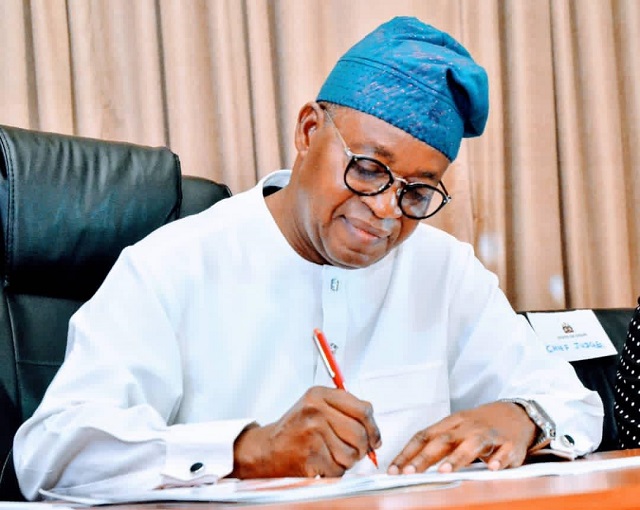
Governor Adegboyega Oyetola of Osun State

On Friday, July 2, 2021, I had the opportunity of taking a shuttle back into my past. I had met Chief Akinwande Akinola, former Managing Director of International Breweries Limited, Ilesa at the Ibadan Recreation Club’s conferment of Merit Awards on recipients, among whom was Akinola. While the din of music was blasting the ears, I walked up to the podium ingenuously called the “high table” in Nigeria to meet Akinola, now an octogenarian. After exchanging measured pleasantries, the type you give a stranger, I asked him if he could still recollect knowing me.

He cast my face a futile scan and made frantic efforts to decode who the stranger was. Losing the battle of recognition, he announced, “I can’t recognize you, sir.” Then, silently, like the whoosh of an evening wind, I announced to him: “Some 35 years ago, sir, I was your messenger at the International Breweries, Ilesa.” You can imagine the incredulity that coated the face of the old man.

Osun State, for me, holds both nostalgia and history of my growing up years. That history suffered violence a few years ago when my schools lost their names and uniforms. Thank God, we have them back. From St. Johns Primary School in Ikire where I began, to Ajangbala D.C. Primary School in Iwo which I left in 1979, Akinorun Grammar School in Ikirun where I began my secondary education, to Cherubim and Seraphim High School, Ilesa where I finished my secondary school and The Polytechnic, Esa-Oke where I began my Ordinary National Diploma, I am always ready to duel whoever chooses to call me anything but a stakeholder in Osun State matters. On Saturdays in Ikirun those days for instance, it was time to hawk plastics for my mother, walking from Ikirun to Inisa and down to Iragbiji. Last week, I was back to the Ikirun, Iragbiji road on an excursion to my past. It was like a transmogrification and transfixion. Suddenly, I was hawking plastics again.

I had cause to ply that route a couple of years ago. It bore the colour of decadence of road infrastructure that litters the whole of Nigeria today; and indistinguishable from the craters that have been the people’s lot. Last week, however, the road had received its own transformation. Like what I saw in November 2017 when I went to witness a friend’s PhD reception on the Gbongan, Osogbo road. Immediately I left the Gbongan overhead bridge, with the exception of a few kilometers that were passable, the rest was grueling. I learnt the 29 kilometer stretch of road had been awarded by the immediate past government which did its best and left the rest for the people to grapple with. It was a very loud complaint about that road that cost a high court judge her job under the last government.  Last week, however, when I breezed into Osogbo, after four years, I met that road, up to Ode Omu, wearing some garment of life adorned it by the Governor Adegboyega Oyetola government.

I was in Osogbo to honour a friend and sister. But I felt I should complete the voyage into my past by touching the beacons that marked out my life trajectory: Ikirun, Iragbiji and Ilesa. From Osogbo, I was asked to take the Kelebe to Iragbiji road, home of Iragbiji Grammar School, the school that, in connivance with rivals like Ebedi Grammar School and Kiriji Memorial College, Igbajo, used to give my Akinorun Gramms a tough time in those days in inter-school football fiesta. The freshly done Osogbo-Iragbiji road is historic. It was tasting asphalt for the first time since Adam and Eve. I had earlier driven through the almost completed Flyover bridge at Olaiya in Osogbo via Alekuwodo road area. From Iragbiji, I went to Ilesha, through Oromu, Oke Iyin and to the Ilesa Roundabout Okeoye to Irojo and down to Ilesa/Akure Expressway. Those days, while Baba Adedara Ar’unra L’oja Oba, the Adamo music legend, played draft game along this St. Margaret road, we used to go look at the iconic Adamo musician. This was at a time Adedara was engaged in a huge tiff with Akanbi Aliyu and the very visceral track from Aliyu – alara jiju, yei le, yei po era – the man with skin laced with craw-craw; this is mind-boggling!

Like millions who regained their almae matres from where the last government dumped them, I have a soft spot for the incumbent governor. And I pray for him each time I think of Kerubu –  students’ inflexion of our school’s name – and its Lazarus experience. So when I read the Commissioner for Works, Remi Omowaiye’s claim in a national newspaper interview last week that his principal, Governor Oyetola, would trounce the likely governorship candidate of the PDP, for next year’s governorship ticket, it occurred to me that the opposition should take Omowaye’s claim with all seriousness. Osun is no doubt retrieving itself from its recent past. One quiet man is sitting there silently rewriting Osun’s developmental history.


Dr.  Adedayo, a lawyer and media expert writes 


Comments

Opinion

Repete or Regret: APC’s Moment of Truth in Ibadan North

Published

on

File photo of Hon. Khalil Mustapha Adegboyega (Repete)

The All Progressives Congress (APC) in Oyo State stands on the edge of a consequential decision—one that may define not only its fortunes in Ibadan North Federal Constituency but also its broader political relevance in the state.

As the countdown to the party primaries intensifies, the question before APC leaders is no longer routine. It is strategic. It is urgent. And it is decisive: will the party align with the clear preference of the people or risk repeating costly political miscalculations?

At the centre of this debate is Hon. Khalil Mustapha Adegboyega, widely known as Repete—a name that has, over time, evolved from a political identity into a grassroots phenomenon.

A Candidate Rooted in the People

In contemporary Nigerian politics, where voter awareness is rising and expectations are shifting, candidates are increasingly judged not by promises but by presence. On this scale, Adegboyega stands tall.

His political journey is marked by consistent engagement with constituents—far beyond the optics of election seasons. From youth empowerment initiatives that provide practical skills and startup support, to sustained interventions in healthcare access for the elderly and indigent, his footprint across Ibadan North reflects a model of leadership anchored on service.

Unlike the transactional approach that often defines political relationships, Adegboyega’s connection with the people appears organic—built on trust, accessibility, and continuity. These are not mere campaign attributes; they are political assets.

The Danger of Political Disconnect

History offers the APC a clear lesson: parties that ignore grassroots sentiment often pay a heavy electoral price. The imposition of candidates perceived as distant or untested has, in several instances, resulted in voter apathy, internal dissent, and eventual defeat at the polls.

Ibadan North presents no exception.

With opposition parties closely monitoring the APC’s internal dynamics, any misstep in candidate selection could provide a ready opening. A divided house, coupled with a candidate lacking widespread acceptance, is a formula the opposition is well-positioned to exploit.
The implication is straightforward: this is not merely about party loyalty; it is about electoral viability.

Echoes from the Grassroots

Across the length and breadth of Ibadan North—markets, motor parks, religious centres, and community gatherings—a consistent pattern emerges in political conversations. The name “Repete” resonates with familiarity and acceptance.

Such organic support is not easily manufactured. It is cultivated over time through visible impact and sustained presence. For a party seeking electoral certainty in a competitive environment, this level of grassroots validation is not just desirable—it is critical.

A Test of Leadership and Judgment

For the APC leadership in Oyo State, the moment calls for clarity of purpose. Decisions driven by narrow interests, personal alignments, or short-term calculations may carry long-term consequences.

The task, therefore, is to balance internal considerations with external realities. Elections are ultimately decided by voters, not by party caucuses. A candidate who commands public confidence offers the strongest pathway to victory.

The Stakes Are Clear

Ibadan North is too strategic a constituency for experimentation. The cost of error is not limited to a single seat; it extends to party cohesion, credibility, and future positioning within the state’s political landscape.

In this context, the argument for Adegboyega is less about sentiment and more about strategy. His visibility, acceptability, and record of engagement place him in a strong position to consolidate support and mobilise voters effectively.

Conclusion: A Choice with Consequences

As the APC moves closer to its primaries, the decision before it is both simple and significant: align with a candidate who reflects the mood of the electorate or risk conceding advantage to a watchful opposition.

In politics, moments such as this often separate foresight from hindsight.
For APC in Ibadan North, this may well be one of those defining moments.


Aderibigbe Akanbi, a political analyst, writes from Ibadan.

Continue Reading

Opinion

Ibarapa East: Yusuf Ramon’s Quest for Responsive Representation

Published

on

Hon. Yusuf Abiodun Ramon

As the road to 2027 gradually unfolds across Oyo State, political conversations are shifting from routine permutations to deeper questions about competence, generational leadership, and measurable impact. In Ibarapa East, that conversation has found a new voice in Yusuf Abiodun Ramon — a Lanlate-born technocrat whose entry into the race for the State House of Assembly is redefining what representation could mean for the constituency.

In a political environment often dominated by familiar faces and conventional calculations, Ramon presents a profile shaped by technical discipline, structured thinking, and solution-driven engagement. His professional background, anchored in analytical precision and systems management, forms the foundation of his public service aspiration.

For him, representation must move beyond ceremonial presence to practical responsiveness — laws that reflect local realities, oversight that protects public resources, and advocacy that translates into visible development.

Ramon argues that the future of Ibarapa East lies in leadership that listens deliberately, plans strategically, and delivers measurably. He speaks of strengthening rural infrastructure, expanding youth-driven economic opportunities, and institutionalising transparency as core pillars of his agenda. In his view, governance must not merely be symbolic; it must be structured, accountable, and people-centred.

Rooted in Ile Odede, Isale Alubata Compound, Ward Seven of Ibarapa East Local Government, and maternally linked to Ile Sobaloju, Isale Ajidun Compound, Eruwa, Ramon’s story is not one of distant ambition but of lived experience. He is, in every sense, a son of the soil — shaped by the same roads, schools, and economic realities that define daily life in Ibarapa East.

“I was born here. I grew up here. I understand our struggles, our strengths, and our untapped potential,” he says. “Representation must go beyond occupying a seat; it must translate into preparation, competence, and genuine commitment to development.”

His academic journey mirrors that philosophy of steady growth. He began at Islamic Primary School, Lanlate (1995–2001), proceeded to Baptist Grammar School, Orita Eruwa (2001–2007), and later earned a National Diploma in Mechanical Engineering Technology from Federal Polytechnic, Ilaro, between 2009 and 2011. Refusing to plateau, he advanced his intellectual horizon and is now completing a Bachelor of Science in Business Administration at the University of Lagos. “Education,” he reflects, “is continuous capacity building. Leadership today requires both technical knowledge and administrative insight.”

That blend of engineering precision and managerial training has defined a professional career spanning more than a decade. Shortly after his diploma, Yusuf joined Mikano International Limited as a generator installer, gaining hands-on experience in industrial power systems — a sector central to Nigeria’s infrastructural backbone. He later transitioned into telecommunications at Safari Telecoms Nigeria Limited, where he received specialized training in Industrial, Scientific, and Medical radio bands, strengthening his expertise in network operations.

In 2013, he became a Field Support Engineer at Netrux Global Concepts Ltd., then a leading ISM service provider in Nigeria. Over four formative years, he immersed himself in telecom infrastructure deployment and maintenance, mastering field coordination, logistics management, and real-time technical problem-solving.

Since July 2017, he has served as a Field Support Engineer with Specific Tools and Techniques Ltd., a power solutions firm providing services to major operators including MTN Nigeria and Airtel Nigeria. In that capacity, he operates at the frontline of ensuring energy reliability and network uptime — responsibilities that demand discipline, accountability, and systems thinking.

For political observers in Ibarapa East, this trajectory matters. It reflects more than résumé credentials; it speaks to a mindset anchored in efficiency, coordination, and measurable outcomes — qualities increasingly demanded in legislative representation.

Beyond the private sector, Ramon’s political exposure is neither sudden nor superficial. A loyal member of the progressive political family in Lagos, he once served as a personal assistant to a former lawmaker, gaining practical insight into legislative procedure and constituency engagement. Within his community, he has quietly extended financial support to small-scale entrepreneurs and students — modest but consistent interventions rooted in personal responsibility.

“My interest is my people,” he states firmly. “Ibarapa East deserves strategic, responsive, and capable leadership at the State Assembly. We must move from rhetoric to results.”

Across the constituency — from Lanlate to Eruwa — development priorities remain clear: youth employment, vocational empowerment, rural road rehabilitation, stable power supply, agricultural value-chain expansion, improved educational standards, and stronger lawmaking that directly reflects community needs.

Political analysts argue that Ramon’s technocratic background positions him uniquely at the intersection of policy formulation and practical implementation. At a time when national discourse increasingly favours competence over grandstanding, his profile resonates with a broader generational shift toward performance-driven governance. His engineering discipline reinforces problem-solving; his business training strengthens administrative understanding; his grassroots roots anchor his empathy.

For Ibarapa East, the 2027 election cycle may represent more than a routine democratic exercise. It may mark a recalibration of expectations — a demand for representation that understands both the soil beneath its feet and the systems that drive modern development. As political alignments gradually crystallize in Oyo State, Yusuf Abiodun Ramon’s declaration signals the arrival of a candidate seeking to translate private-sector structure into public-sector impact.

One thing is clear: the conversation about the future of Ibarapa East has begun — and it is now framed around competence, credibility, and capacity.


Oluwasegun Idowu sent in this piece from Eruwa, Ibarapa East LG, Oyo State

Continue Reading

Opinion

Flying on Trust: How Ibom Air’s Reliability Became Its Winning Strategy

Published

on

An Ibom Air aircraft at the airport.

“In a sky where delays are normal, one airline flies with precision and trust. Ibom Air shows that reliability can be a strategy”.

In Nigeria’s skies, where flight delays and cancellations are often taken as routine, Ibom Air has quietly rewritten the rules. From the moment it launched in June 2019, the Akwa Ibom State–owned carrier has treated reliability not as a bonus, but as a core strategy—turning punctuality, discipline, and operational excellence into a competitive edge that passengers can count on.

While most airlines chase rapid expansion or flashy promotions, Ibom Air has chosen consistency. Flights depart on schedule, disruptions are minimal, and communication with passengers is clear and timely. This predictability has quickly earned the airline a loyal following among business travellers, professionals, government officials, and families for whom time is invaluable.

The airline’s approach is methodical. Every flight is treated as a commitment, and operational decisions are guided by structured planning, not improvisation. This discipline underpins everything from scheduling to fleet management, ensuring passengers experience flying without surprises.

Central to this model is Ibom Air’s modern fleet. Its Airbus A220-300 and Bombardier CRJ-900 aircraft are fuel-efficient, comfortable, and rigorously maintained to meet both manufacturers’ specifications and the regulatory standards of the Nigerian Civil Aviation Authority and international aviation bodies. Safety here is a culture, not a compliance exercise.

Cabin cleanliness and aircraft health are equally prioritized. Passengers consistently step into neat, hygienic, and professionally maintained cabins, reinforcing confidence and comfort even before take-off. In a sector where small details signal operational quality, Ibom Air’s standards speak volumes.

Technology quietly drives reliability across operations. From booking and check-in to flight coordination and customer service, modern systems enhance efficiency, reduce disruptions, and ensure smooth communication. These tools allow the airline to anticipate challenges rather than merely react.

R–L: Dr. Solomon Oroge, a consultant, and Mr. Idowu Ayodele, journalist and media practitioner, aboard an Ibom Air flight.

Service delivery follows the same disciplined pattern. Pilots, cabin crew, engineers, and ground staff operate under strict professional standards. Courtesy is paired with efficiency, and calm, structured service ensures passengers feel confident throughout their journey.

The Ibom Flyer loyalty programme reflects this structured approach, rewarding consistent passengers and fostering long-term engagement. It turns reliability into a tangible benefit for frequent flyers.

From its hub at Victor Attah International Airport, Uyo, Ibom Air serves major Nigerian cities including Lagos, Abuja, Port Harcourt, Calabar, and Enugu, while extending its reach to West Africa with flights to Accra, Ghana. Expansion is deliberate, prioritizing sustainability over rapid growth that could compromise service quality.

Measured growth allows the airline to maintain operational excellence and service consistency even as demand increases—a strategy that contrasts sharply with competitors whose rapid expansion often strains resources.

Mr. Idowu Ayodele, journalist and media practitioner, pictured inside an Ibom Air aircraft.

Beyond commercial success, Ibom Air has become a national example. It has created employment, stimulated tourism, and strengthened regional connectivity, projecting a positive image of Nigerian aviation at a time when confidence in the sector is often fragile.

The airline has also challenged assumptions about government-owned enterprises. By combining professional management with operational autonomy, it demonstrates that public investment can achieve efficiency, accountability, and competitiveness.

Reliability, in the case of Ibom Air, is than a promise—it is a deliberate business philosophy. It shapes operations, informs decisions, and builds passenger trust consistently.

Technology, discipline, and attention to detail converge to produce an airline that works. Every element, from fleet maintenance to cabin service, supports the promise that Ibom Air delivers what it advertises—without surprises.

In a market where uncertainty has been the norm, Ibom Air has shown that consistency can be a strategic advantage. Passengers no longer fly with anxiety; they fly with confidence, knowing their schedules will hold and service will meet expectations.

Ultimately, Ibom Air is not just an airline—it is a model of operational excellence in Nigerian aviation. By prioritizing reliability over spectacle, discipline over improvisation, and planning over shortcuts, it sets a benchmark for the industry and a standard for passengers: in the skies, predictability is priceless


Idowu Ayodele – Journalist, Ibadan, Oyo State
0805 889 3736 | megaiconpress@gmail.com


Continue Reading

Advertisement

Entertainment

Advertisement

MegaIcon Magazine Facebook Page

Advertisement

MEGAICON TV

Advertisement

Trending