Connect with us

News

Africa spends $35 billion on food imports each year, AfDB boss reveals

Published

on

• Over 800 million people worldwide suffering from hunger


WITH over 800 million people worldwide suffering from hunger and more than two billion affected by malnutrition, food insecurity remains a real threat to global development.

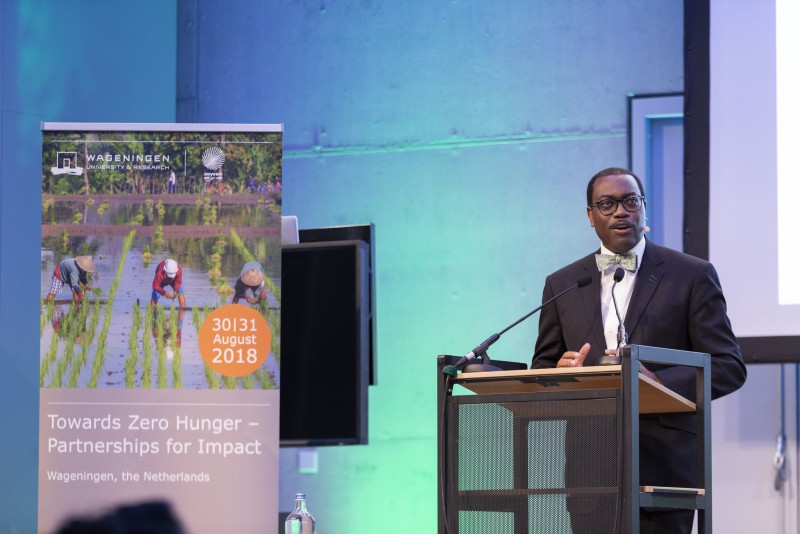
Adesina, who is making a global pitch for renewed visionary leadership and strategic alliances, “the future of food in the world will depend on what Africa does with Agriculture.”

The African Development Bank, which he leads, envisions a food secure continent which uses advanced technologies, creatively adapts to climate change, and develops a whole new generation of what he describes as ‘agripreneurs’ – empowered youth and women who he expects to take agriculture to the next level.

By 2050, an additional 38 million African will be hungry. The paradox of lack in the midst of plenty, and Africa’s growing youth bulge are some of the reasons why Adesina’s sense of urgency is resonating with numerous government, private sector, and multilateral leaders during recent European and Asian trips. The banker and 2017 World Food Prize Laureate will be the first to admit that he considers himself the ‘evangelist-in-chief’ for a food secure Africa.

Africa continues to import what it should be producing, spending $35 billion on food imports each year, a figure that is expected to rise to $110 billion in 2025 if present trends continue.

A few days later, Adesina joined Rockefeller Foundation President Raj Shah, Unilever CEO Paul Polman, and 2018 World Food Prize nominees Lawrence Haddad and David Navarro, among other prominent global academic, development, and agriculture experts at Wageningen University and Research, in the Netherlands, to make the case for urgent collective action by State and non-State players to accelerate Africa’s agricultural growth and transformation.

https://iso.keq.mybluehost.me/african-development-bank-launches-coding-for-employment-program/


Africa receives only 2 percent of the $100 billion annual revenues from chocolates globally. Adesina tells his audience that “adding value to what nations produce, is the secret to their wealth. Producing chocolate instead of simply exporting cocoa beans does not require rocket science.”

To expand opportunities for youth, women, and private sector players, Adesina is on a global mission to promote and seek support for the bank’s  Affirmative Finance for Women in Africa (AFAWA) program which aims to mobilize $3 billion to support women entrepreneurs who historically lack access to finance, land, and land titles; a $300 million ENABLE Youth program to develop the next generation of agribusiness and commercial farmers for Africa; and a new global investment marketplace, the African Investment Forum, which will be held in Johannesburg November 7-9.

In separate meetings with Sigrid A.M. Kaag, Minister for Foreign Trade and Development Cooperation, in the Hague; Peter van Mierlo, CEO of the Dutch Entrepreneurial Development Bank (FMO), key private sector players, and members of the Dutch Foreign Affairs Advisory Council, Adesina said Africa and its partners must seize unprecedented opportunities for innovative partnerships and increased development impact.

Mierlo believes, “a huge benefit for Africa is that it can skip development cycles that often almost all developed countries had to go through, by deploying new technologies such as artificial intelligence and robotics in agriculture”.

In a continent where more than 640 million are without electricity, Adesina says the private sector is key to Africa’s development in Africa’s energy and agriculture sectors.

“If Africa is going to turn the tide of irregular migration, this is critical. There are three ways in which we can collaborate: either through the NEPAD Infrastructure Project Preparation Facility, Africa 50 – a private equity institution which has raised more than US$ 850 million from 22 countries, and the new Africa Investment Forum.”

Adesina, recognizes that the lack of electricity is Africa’s biggest development impediment. The Bank’s new and ambitious Desert-to-Power initiative which aims to generate 10,000MW of power across Africa’s Sahel region will be critical to reducing migration and climate change impacts. We will do this through a blended finance mechanism with guarantees”, Mr. Adesina said.

https://iso.keq.mybluehost.me/korea-announces-5-billion-financial-package-for-africa-at-afdb-annual-meetings/

Speaking to a High-level Roundtable of Dutch Business Leaders at the Netherlands Enterprise Agency (RVO), informed key private sector leaders that “governance structures and business regulatory environments are changing in Africa. Indeed, several African countries have already made significant progress in improving their general business and investment environments. Africa is doing better than some of the Asian countries,” he reminded his audience. “In the energy sector, the African Development Bank is investing $12 billion over the next 5 years, with the goal of leveraging $40-50 billion; and an additional $US 24 billion, over ten years, in agriculture to implement its Feed Africa Strategy.”

Agriculture steadily taking center-stage

The strategy is already bearing fruit with the establishment of Staple Crop Processing Zones in several African countries, including Ethiopia, Togo, Democratic Republic of Congo, and Mozambique, with a plan to reach 15 countries in a few years.

Strategically located in and around rural farming communities Adesina says “these agriculture zones will form the nucleus of a new wave of agro-industries and greenfield ventures, attracting agripreneurs, biotechnology firms, intellectual and capital investments. They will also ensure that foods are processed and packaged right where they are produced, rather than in urban centers far removed from centers of production.”

Described as a visionary optimist by many colleagues, Adesina believes the bank’s policies and investments will help turn rural areas from zones of economic misery into zones of economic prosperity.

Comments

News

Presidency Backs World PR Forum, Onanuga Urges Better Nigeria Image

Published

on

The Presidency has thrown its weight behind the 2026 World Public Relations Forum scheduled to hold in Abuja from November 15 to 21.

The Special Adviser to the President on Information and Strategy, Bayo Onanuga, gave the assurance on Wednesday when the planning committee of the forum visited him at the State House, Abuja.

The delegation was led by the President of the Nigerian Institute of Public Relations, Dr Ike Neliaku.
The forum, which has the theme,

“Deepening Responsible Communications,” is expected to attract about 3,000 delegates from 126 countries.
Onanuga said the hosting of the global event was a major opportunity for Nigeria to showcase its culture and present the country’s story to the international community.

He, however, expressed concern about the negative picture of Nigeria often presented by some Nigerians, especially on social media.

According to him, the forum should be used to correct misconceptions about the country and give foreign visitors a better understanding of Nigeria.

“You see, as a Nigerian, I always feel very odd when you read online the kind of things our people put out in the public space. They say negative things about this country,” Onanuga said.

He added, “This is a great opportunity for us to correct those things of concern to people. For me, I’ve seen the conference as something that will be good for our country, and it should be supported.”

Earlier, Neliaku said the delegation visited Onanuga to seek the support of the Presidency for the successful hosting of the forum.

He said Nigeria was the first African country to secure the hosting rights, adding that the event would provide an opportunity to showcase the country’s rich cultural heritage.

Neliaku noted that Mexico, India and Germany had hosted the forum at different times.

He disclosed that participants at the Abuja event would sign an agreement to be known as the “Abuja Declaration.”

The NIPR president also announced that the President of Zambia, Hakainde Hichilema, would deliver the keynote address at the forum.

He added that President Bola Tinubu would receive a Lifetime Award of Excellence in Reforms during the event.

The Chairman of the Planning Committee, Dr Suleiman Haruna, said preparations were already in top gear.
Haruna said the committee was working with media organisations and security agencies to ensure a successful hosting of the delegates.

Also speaking, a member of the committee and Director-General of Strategic Communications to the Nasarawa State Government, Yakubu Lamai, disclosed that the state government was building a Public Relations University.

He said the project was part of efforts to strengthen the public relations profession and boost confidence in Nigeria among international participants.

A veteran broadcaster and member of the delegation, Moji Makanjuola, said the forum would be inclusive, with women and persons with disabilities adequately represented.

Makanjuola appealed to the Presidency to support the event, stressing that Nigeria must be ready to receive participants from around the world.

“We have to be ready as Nigerians to receive the world; it is a Nigerian thing, it is not for the Ministry,” she said.

The World Public Relations Forum is expected to bring together public relations practitioners, communication experts, policymakers and other stakeholders from across the world to discuss responsible communication and the future of the profession.

Continue Reading

News

FG adds 208MW to national grid, upgrades Ijora, Apapa substations

Published

on

The Federal Government has commissioned upgraded transmission substations at Ijora and Apapa Road in Lagos, adding a combined 208 megawatts of bulk transmission capacity to the national grid.

The projects, inaugurated by the Minister of Power, Joseph Tegbe, are expected to boost electricity supply to major industrial, commercial and residential areas across Lagos.

At the Ijora 132/33kV transmission substation, two new 100MVA transformers have raised the installed capacity from 90MVA to 230MVA, providing an additional 112MW of bulk transmission capacity.

The upgrade is expected to improve power supply to Ijora, Costain, Oyingbo, Customs and adjoining communities within the franchise area of the Eko Electricity Distribution Company.

At the Apapa Road transmission substation, two new 60MVA transformers and modern Gas Insulated Switchgear were installed and energised, increasing the facility’s capacity from 60MVA to 180MVA and adding another 96MW to the transmission network.

The Apapa project is considered particularly important because the area hosts major ports, maritime businesses, logistics companies, warehouses and manufacturing industries. The additional capacity is expected to increase the bulk electricity available to EKEDC for distribution to Apapa Causeway, Ijora, Amukoko, Ajegunle, Apapa Wharf, Tin Can Island and surrounding communities.

Speaking at the commissioning, Tegbe said the projects were part of the Federal Government’s efforts to tackle structural challenges in the nation’s electricity sector.

He said expanding transmission capacity was essential to ensuring that electricity generated was effectively delivered to areas where demand was highest.

According to him, rapid population growth, industrial expansion and increased commercial activities had put considerable pressure on existing power infrastructure, resulting in suppressed load and constrained electricity supply.

Tegbe said reliable electricity remained central to Nigeria’s economic transformation, adding that the administration’s ambition of building a $1tn economy could not be achieved without adequate and dependable power supply.

The Managing Director and Chief Executive Officer of the Transmission Company of Nigeria, Sule Ahmed Abdulaziz, described the projects as a significant investment in strengthening the country’s transmission network. He said the Apapa project was supported by the Japan International Cooperation Agency, while the Ijora intervention received support from the World Bank in partnership with TCN.

Abdulaziz called for similar interventions to rehabilitate and upgrade other critical sections of the national transmission network. He said continued investment in the network was necessary to ensure that improvements in power generation translated into better supply for homes and businesses.

The Federal Government said the additional 208MW would improve grid stability and strengthen electricity supply to some of Lagos’ most important commercial and industrial corridors, with the projects expected to support businesses and communities that depend heavily on reliable power.

Continue Reading

News

Nasarawa, firm sign $2m lithium deal

Published

on

Nasarawa State Governor, Abdullahi Sule, on Friday presided over the signing of a $2m supplementary lithium agreement between the state government and Diamond New Energy.

The agreement, signed at the Nasarawa State Governor’s Lodge in Abuja, followed Sule’s recent visit to China and is aimed at securing raw materials for the company’s lithium processing operations in the state.

Speaking at the ceremony, Sule said the agreement would protect the interests of both the state and the company while ensuring that the factory remained operational and workers retained their jobs.

He said, “By keeping your factory operational, we ensure that you continue to get raw material. That is the essence of this agreement.”

The governor added that the state’s decision to secure the necessary licence was also intended to protect its interests in the mining operations.

“We are going to keep your factory functional, and we also have an interest as licence owners in whatever you are doing in your company. More importantly, the people you have employed will remain employed,” Sule said.

The governor urged Diamond New Energy to maintain a peaceful relationship with its host communities and contribute to their development, stressing that the cooperation of the communities was important to the success of the investment.

He further disclosed that payments due to the state under the agreement would be made directly to Nasarawa Mining Company Limited in foreign currency, with the terms subject to periodic review.

Earlier, the Commissioner for Environment and Natural Resources, Margaret Elayo, commended the investors for their commitment to Nasarawa State.

Elayo expressed optimism that the partnership would encourage more investors to consider the state as a destination for mineral development and other investments.

The Managing Director and Chief Executive Officer of the Nasarawa State Investment Development Agency, Ibrahim Abdullahi, said the latest agreement was an extension of the exclusive mining cooperation agreement signed between the state government and the company in 2024.

According to him, the earlier agreement contributed to the completion of what he described as the largest lithium processing refinery in West Africa.

He said the supplementary agreement would further strengthen investor confidence and allow the continued supply of lithium materials from the state government’s mining block to the refinery.

Abdullahi said the arrangement would also create more employment opportunities for youths and women in the state.

“This supplementary agreement gives credence to these issues. It further gives confidence to the investor to do even more within Nasarawa State,” he said.

He added that the agreement would provide an immediate financial benefit to the state, with Nasarawa expected to receive $2m upon signing, while further revenues would accrue according to the terms of the agreement.

A representative of Diamond New Energy, David Siong, said the company remained committed to deepening its operations in Nasarawa State through local processing of mineral resources, job creation and economic development.

Siong said the company believed in the further development and deep processing of Nasarawa’s mineral resources, adding that it looked forward to continued support from the state government.

Also at the ceremony, the Attorney-General and Commissioner for Justice, Isaac Danladi, presented copies of the deed of assignment between Nasarawa Mining Company Limited and Ganfeng Lithium Industry Limited.

Danladi explained that the deed transferred the mining rights and interests of Nasarawa Mining Company within 3.5 mining cadastral units located at Endo, Nasarawa Local Government Area, to Ganfeng Lithium Industry Limited.

He said the transfer followed a review of the terms by the parties involved.

The signing ceremony was witnessed by officials of the state Ministry of Justice, Ministry of Environment and Natural Resources, NASIDA, Diamond New Energy and Ganfeng Lithium Industry Limited.

Continue Reading

Advertisement

Entertainment

Advertisement

MegaIcon Magazine Facebook Page

Advertisement

MEGAICON TV

Advertisement

Trending