Opinion
Wayward Ways and Means, epidemic kidnapping
Published
3 years agoon
We are about to witness a mud-fight between two gods of integrity. In a Nigeria where the mantra is, if you see something, say something, Minister of Finance and Coordinating Minister of the Economy, Wale Edun, elected to say something. And he did say something last Wednesday. “We talked about inflation, where has it come from? It’s come from eight years of just printing money. And the issue is that that money was not matched by productivity…For eight years, the weak were left to their own devices. It is the privileged few that took everything” he said while appearing before the Senate Committee on Finance.
Edun’s appearance in the senate was a total shellacking of the administration of Mai Gaskiya, Muhammadu Buhari. Falling short of naming that government one in same frame with Ali Baba And the Forty Thieves, Edun accused Buhari of every conceivable economic malfeasance, finally heaping the blame of Nigeria’s current economic regression at his doorsteps. He went ahead to promise that the Tinubu government would audit the N22.7 trillion ways and means advance which the Buhari regime incurred.
Bashir Ahmad, former media aide to Buhari, was however of the opinion that blame-shoveling was bad politics. Comparatively, he said, the PDP was better at dressing its stench in pleasant deodorant. Posting on X, Ahmad wrote: “I often wonder why, as a government, we concentrate more on amplifying the faults of the previous administration rather than acknowledging its numerous achievements. The PDP seems to have a more skilful approach to politics than we do in the APC…it’s rare to find instances where President Yar’adua’s (PDP) government criticized President Obasanjo’s (PDP) or where President Jonathan’s (PDP) government faulted President Yar’adua’s (PDP).”
What they cooked that burnt down the house of Nigeria is gradually exposing itself. Get your popcorn and be ready for the rumble in the jungle. When someone tries to hide behind their finger, my people compare them to the exact scenario that both Bola Tinubu and Buhari find themselves today. Their story is perfectly told in the Epa and Aja tale. The tick, which the Yoruba call Epa, is a parasitic member of the Arachnida family of insects. Arachnids are a class of joint-legged arthropods which include, among others, spiders, scorpions, ticks, mites, etc. As parasites, they feed on mammals, birds, and sometimes reptiles and amphibians. They feed on the blood of their hosts by attaching to them firmly with their proboscis. In consuming their blood, ticks satisfy their nutritional requirements. When a tick parasitizes its hosts, it acts as vector through which serious diseases that affect humans and animals are transmitted into the host. Eventually, while the tick is satisfying its survival quest, the host will suffer either diseases or anemia and eventually die. So, when Epa assumes that it is killing the host; take for instance, Aja, the dog, unbeknown to it, it is killing itself. The day the dog dies, the tick dies too. Yoruba express this as Epa npa’ra e, o l’ohun npa’ja.
Though he may right now be sunk in the pastime of feeding his cows in Daura, the truth is, Muhammadu Buhari’s self-imposed title of Mai Gaskiya may be on its way out of the retired General’s lapel. There is an ongoing attempt to deconstruct him as either the most naïvely inept Nigerian president to have lived or the imbecilic landlord who opened his house to burglars and watched while they looted his treasure. Buhari’s own political party, the APC-led government, is spearheading this deconstruction. So, should his successor, living through the mantra of “see something, say something” which has seized the information highway today, keep sealed lips and not disclose alleged massive theft of Nigerian patrimony that it is privy to? Should Tinubu see the wound on the sole of his foot as one that has familial imprimatur and thus walk loose with it? Should he say something about the massive theft that went on during the Buhari government which he has information about or say nothing? Minister of Finance and Coordinating Minister of the Economy, Wale Edu, chose the latter.
Either as blame-shoveling or “saying something when something is seen”, Buhari looks like he is in a very bad shape, image-wise. He has unfortunately landed in the hand of a successor government that is ready to scapegoat anything in sight to justify its inertia. Already, it is clear to everyone that if there is one thing in surplusage from this government today, it is blame-shoveling and immense capacity to reverse itself. In the last nine months, we have seen the government blame everybody, everything but itself for its inability to do the magic it advertised so ebulliently during the campaigns. COVID-19, Godwin Emefiele, PDP, Buhari and all what ought-nots have suffered this victimhood of government’s antics. Edun and this government have also blamed Emefiele’s alleged reckless spending of the overdraft that the Buhari government collected from the CBN as largely accounting for the food and security crises that Nigeria is battling. Right now, Nigeria is seeking Interpol’s help to arrest three suspects alleged to have stolen the sum of $6.2m from the CBN, using Buhari’s forged signature. They are believed to have done this in cahoots with Emefiele who is on trial on 20-count charges. My haunch is that, if Emefiele has his days in court, the courtroom will explode like Hiroshima did and the matter may drift off like a fog, similar to the Sambo Dasuki security fund scandal. In the same vein, this government has reversed itself so effortlessly on policies it advertised with glee, like Jay Jay Okocha did on the field of play. The last reverse was the annual levy it imposed on expatriates which it revoked pre-beginning last week.
For an administration like the Tinubu government that is tottering in pitch darkness and fumbling for a way out, the eternal wisdom in the tale of the tick and dog seems self-explanatory and self-evident. The “Epa npa’ra e…” presents in a number of nuggets. First is that, it can come in the form of the question that has been asked repeatedly: How can the Tinubu government, and virtually all its runners, divorce themselves from the 8-year colossal wastage and failure of the Buhari government? The president, like a nursing mother, hunchbacked Buhari into power and gave him the wings with which he flew. Until a railway line halved them into their two separate ways, Tinubu defended every of the Buhari policies with the vigour of a matador. From insecurity, Fulani herders’ rapacious bloodletting, (where are the cows?) to dwindling economy and every allied matter of state policy, Tinubu was there for Buhari. Bayo Onanuga, Special Adviser to the president, has almost had the mucus dripping out of one of his nostrils flip inside the second as he struggles to claim that Tinubu never requested Buhari to enter the forest of the brave – the Igbo igbale. So, for the Tinubu government, through Edun last week, to surgically try to separate itself from the Buhari government will be akin to an Epa which is trying to kill the Aja. Edun, with froth metaphorically foaming out of his mouth, attempted to do that last week.
Unfortunately for the government, head or tail, it loses. This is even if it listens to the self-centered counsel of Ahmad and elects to make the calamity wrought by the Buhari government a family affair. Its situation would be comparable to that of a man all alone inside a bunker who decides to allow a stench-like fart escape from his buttock. He, all alone, will bear the stench. How reconcilable would it be for Tinubu to say that the Buhari he deodorized as recently as December last year, as emanating “from the rarest phylum of virtuous servant-leaders,” whose emergence could be likened to that of “leaders…(that) happens only by divine orchestration,” a man of “absolute and undiluted integrity” had now been discovered to have sat on a government that is surrounded by a mass of maggots?
We were still battling the waywardness found in the Buhari government’s Ways and Means when, as usual, Nigeria relapsed into its perennial orgy of massive kidnap of school pupils. The latest happened last Thursday at the Government Secondary School and LEA Primary School, Kuriga, Kaduna State. About 280 pupils and teachers were said to have been abducted by bandits. This has triggered national outrage. The bandits were reported to have invaded the Kuriga area of the Chikun Local Government Area of Kaduna State by shooting at their victims in a Gestapo manner. As usual of Nigerian Aso Rock Villa, government is flexing its effeminate muscles and throwing threats into the sky. Sub-nationals and individuals too have tethered their usual empathy offering at the grove of this rapacious god of banditry.
The incessant incidences of kidnapping in Nigeria have grown into a hydra. They have become a source of national threat. Nigeria, according to researchers, boasts of a phenomenally large public and private schools which are nearly 97,000, the largest in Africa. Its primary education sector, according to Aly Verjee and Chris Kwaja, is roughly equivalent in size to the 98,000 public elementary and secondary schools in the United States. Today, these schools are under severe threat from terrorists.
The above-named scholars collated the history of Nigeria’s bloodletting. According to them, in their research work entitled An Epidemic of Kidnapping: Interpreting School Abductions and Insecurity in Nigeria (African Studies Quarterly Volume 20, Issue 3, October 2021) beginning from 2014, “the small, non-descript town of Chibok in Borno State in northeast Nigeria” earned the notoriety worldwide with the abduction of 276 girls. Since then, Nigerian northern schools have known no peace. Though the abduction sparked global outrage, Nigerian governments have moved on nevertheless. The Chibok abduction which was the cusp upon which the APC government wove its political campaign to seize power from Jonathan in the 2015 election was hung on, contributed immensely to the defeat of Jonathan. He was accused of mishandling the kidnapping. However, some top persons in this government were alleged to have organized it to embarrass Jonathan. Buhari thereafter campaigned on a pedestal of promise to restore security to Nigerians.
The scholars’ collation of the spate of kidnappings is frightening. According to them, before Chibok, other kidnaps were carried out though they attracted less media campaign. This was because the AC, CPC alignment and realignment was afoot and the masters of media orchestration in the AC had not aligned with the Buhari CPC. In 2013, 41 students and one teacher were shot/burned alive at the Mamudo Government Secondary School in Yobe State. Same year, another 44 students and teachers were murdered in a separate incident at the College of Agriculture, Gujba, about 120km east of Mamudo, reported Verjee and Kwaja. Similarly, in February 2014, another educational institution in Yobe State, which happened to be the fourth, was attacked. After the attack, 59 students were killed at the Buni Yadi Federal Government College, 30km south of Gujba. This was followed by the Chibok abductions in April 2014. With Buhari, the man who flaunted his epaulettes as a military general in civilian attire now in office, 110 girls got abducted from the Government Girls Science Technical College in Dapchi, Yobe State in February 2018.
December of that year, said Verjee and Kwaja, saw another mass abduction in Buhari’s home state of Katsina. More than 300 boys were forcefully taken out of the Kankara Government Science Secondary School. Equally, on December 19 of that same year, 18 students of an Islamic school in Dandume, close to Kankara, were detained by a kidnapping group, while in February, 2021, 42 people, which included 27 students, were kidnapped from the Government Science College in Kagara, Niger State. On February 26, figures bandied, of between 279 and 317 students, were kidnapped from the Government Girls Secondary School in Jangebe, Zamfara State. In March 2021, there were two further mass abductions and three attempted abductions, all in Kaduna State. On March 11, 39 students were abducted from the Federal College of Forestry Mechanization in Mando. A tip-off to the Nigerian Army averted the kidnap on March 13 of pupils of the Turkish International Secondary School, Rigachikun. On April 20 of same year, 20 students and three staff of Greenfield University in Chikun, Kaduna State were abducted. Five of them got killed by their captors. Plateau State was to get its own share on April 29 when four students were abducted from the King’s School, in Gana Ropp, Barkin Ladi. Then, on May 30, 136 children and several teachers were taken from the Salihu Tanko Islamic School in Tegina, Niger State. In June, 103 students were abducted from the Federal Government Girls College in Birnin Yauri, Kebbi State and on July 5, 121 children were abducted from the Bethel Baptist High School in Maramara, Kaduna State. So many more that space would not allow us reel into happened as figures provided by Verjee and Kwaja.
It will appear that, under Tinubu, Nigeria has entered its season of kidnap epidemic again. In the paper under discourse, Verjee and Kwaja made some recommendations that I found to be very profound. The first is that successive Nigerian governments have conflated the social challenge of kidnap for security challenges and as such, have solely treated school abductions as security problems which needed to be solved solely by military response. Government does this by fortifying the schools. In doing this, Nigeria is merely treating symptom rather than a national disease. Why it is impossible to get a let out of this is that, first, due to the large scale of Nigeria’s education system, deployment of soldiers and police in the protection of schools can never work.
Rather, according to Verjee and Kwaja, government must first address the trust deficit that exists between state security actors and the people. A very meager percentage of Nigerians perceive state security actors as credible. They have always had a checkered history of corruption and violence. There is a profound belief out there that Nigeria’s top security chiefs do not want insecurity to end due to the money they make from it. This perception fuels further fear of militarization and repression, leading to predatory behavior of state security actors.
Whatever it will take, Nigeria must get to solve the pandemic of school kidnappings. The audaciousness of its perpetrators and the seeming combine of many forces in carrying out the kidnappings make it very complex to get rid of. We must as well realize that this epidemic is just a tiny fraction of Nigeria’s political economy of violence. We have always had an ineffective and underperforming state, as well as sparse economic opportunities which have been fueling the school kidnappings. Already, the Kaduna government has rented private negotiators to secure the release of the kids. At the end of the day, multiple of millions of Naira would be paid to these no-gooders and like the boulder of Sisyphus, in no long a time, the terrorists will strike again. And Nigeria will begin another round of sorrow, tears and blood.
Opinion
G-WAGON: Dare Adeleke, A Liar’ll Steal; Why’re You Desperate To Conceal The Truth? | Maroof Asudemade
Published
2 weeks agoon
November 6, 2026By
Mega IconI have read Dare Adeleke’s rather vacuous response to my article on Governor Seyi Makinde’s presentation of a brand-new Mercedes-Benz G-Wagon 500 to the President-General of the Central Council of Ibadan Indigenes (CCII), Barrister Sulaimon Ajeniyi Ajewole. Unfortunately, beneath the insults, name-calling on my person and his apparent eye-service desperation to impress his political benefactor, there is hardly any substance worth engaging.
Adeleke devoted considerable space to calling me a drunken, lowly writer. Yet, in all his verbal gymnastics, he conspicuously failed to address the fundamental questions raised in my article. Has Governor Makinde paid the statutory salaries and entitlements of the Olubadan of Ibadanland, Oba Rashidi Adewolu Ladoja, and the Alaafin of Oyo, Oba Akeem Owoade, since their ascension to the respective thrones? Has his administration provided them with official vehicles, as expected under the applicable government arrangements? These were the issues Adeleke ought to address not my personality.
If he had any credible answers to these questions, he would have provided them. Instead, he chose to exhibit his wrakness as an intellectually exhausted defender. He resorted to abusing the messenger when he couldn’t dismantle the message.
However, there is one particularly interesting aspect of Dare Adeleke’s response that deserves immediate correction. He lied that Governor Makinde spent N1 billion on the completion of the Olubadan Palace. Is he sure he’s not addicted to stealing as a liar? The financial contributions towards the completion of the palace came from multiple sources, including the 11 local governments in Ibadanland, each of which contributed N50 million, amounting to N550 million.
Governor Makinde contributed N250 million. The governor’s contribution was N250 million, not N1 billion! Why would Adeleke inflate the governor’s contribution from N250 million to N1 billion? Is he so desperate to manufacture an impressive record for his political principal that figures have become expendable? Or does he imagine that exaggerating the governor’s generosity will make the unanswered questions of ridiculing our royal fathers disappear?
The 11 local governments of Ibadanland have a responsibility towards the Olubadan institution. Their contributions towards the palace should not be presented as a personal sacrifice by Governor Makinde. They are contributions made by public institutions to an institution that belongs to the people of Ibadanland.
Even more disturbing is Adeleke’s inane argument that because Makinde contributed money towards completing the Olubadan Palace, the governor deserves appreciation rather than criticism. This argument betrays a shocking failure of Adeleke to distinguish between governmental responsibilities and statutory obligations.
Let us even assume, for the sake of argument, that Makinde personally spent N1 billion on the palace. How does constructing or completing a building discharge the government’s obligation to pay the statutory salaries and entitlements of the Olubadan and the Alaafin? How does a palace building become a substitute for official vehicles? Are these royal fathers supposed to live in beautiful palaces while their statutory entitlements remain unpaid?
By Adeleke’s ‘logic’, Governor Makinde could build a magnificent headquarters for the Nigeria Labour Congress and subsequently refuse to pay workers their salaries, expecting the labour movement to applaud him for his generosity. Would that be acceptable? Could the government substitute office buildings for workers’ wages? Dare Adeleke is glaringly a peripheral thinker!
A building is a capital project. Salaries and official entitlements are separate obligations. Since Adeleke knew he could not understand this elementary distinction, he should have smelt his argument before presenting it to the public. His defence is not only logically defective; it is intellectually sour.
More importantly, the completion of the Olubadan Palace was not the subject of my article. I did not dispute the governor’s contribution. I questioned the apparent contradiction between his extravagant generosity towards the CCII President-General and the allegations of neglect concerning the official entitlements of the Olubadan and the Alaafin. Adeleke has not answered that question. He has merely introduced an unrelated expenditure in an attempt to divert attention.
I have no objection to Governor Makinde giving G-Wagons, aeroplanes or even private jets to people he loves, provided he does so with his personal resources. He is entitled to his private generosity. But public accountability should not cease because a governor is generous to his friends, associates or political admirers. The issue is not his freedom to give birthday presents. It is his responsibility to discharge governmental obligations.
As for Adeleke’s unnecessary personal attacks, I refuse to dignify his descriptions of me as a drunken or lowly writer with an elaborate defence. Neither description reflects my personality, and neither alters the substance of my argument. He only needs to be aware that despite his opinion of me as a drunken, lowly writer, I am his better by far as a family man and a responsible father – two essential duties he has failed in. I will also not allow his inability to sustain an intelligent argument to dictate the level of my engagement.
I am upset with Dare Adeleke for not living up to his claim of belonging to Oja’ba. He lacks the intellectual discipline, street wisdom and argumentative dexterity traditionally associated with the historic Ibadan community. His response has demonstrated an unfortunate deficit in all three. “Dare ò m’èsì, ó tún gọ!”
There is also something deeply incongruous about Adeleke’s pretentious defence of Governor Makinde. Those familiar with the undercurrents of Oyo politics may find his public posturing rather amusing. He presents himself as an unquestioning defender of the governor, yet political hypocrisy has a way of concealing its true colours beneath an appearance of loyalty. If the human stomach were transparent like a calabash, perhaps the governor would have a clearer view of Dare Adeleke as the green snake lurking beneath the green grass.
But my concern remains the dignity of the Olubadan and Alaafin institutions, not Adeleke’s political theatrics. He has had an opportunity to answer straightforward questions. He failed. He has had an opportunity to correct the allegations with verifiable facts. He avoided them. Instead, he manufactured a N1 billion contribution, inflated the governor’s generosity and attempted to intimidate a critic with insults.
Let me therefore restate the questions he could not answer: Has Governor Makinde paid the statutory salaries and entitlements of the Olubadan and the Alaafin since their ascension? Has he provided them with their official vehicles in accordance with applicable government policy? If yes, let Adeleke produce the evidence. If no, let him explain why.
A G-Wagon cannot answer questions about unpaid salaries. A palace cannot substitute for statutory entitlements. And N1 billion in political propaganda cannot turn N250 million into N1 billion. Dare Adeleke may choose to defend Makinde with insults, exaggerations and emotional outbursts. I will continue to interrogate the administration with facts, logic and questions that public officeholders owe the people answers to.
The dignity of the Olubadan and the Alaafin is far more important than Adeleke’s desperate attempt to earn political applause. And no amount of name-calling will make me abandon the responsibility of holding those in power accountable.
Opinion
OYO AHEAD: Senator Alli Blueprint for Oyo Renewal | Muji Armstrong-Bello
Published
2 weeks agoon
November 6, 2026By
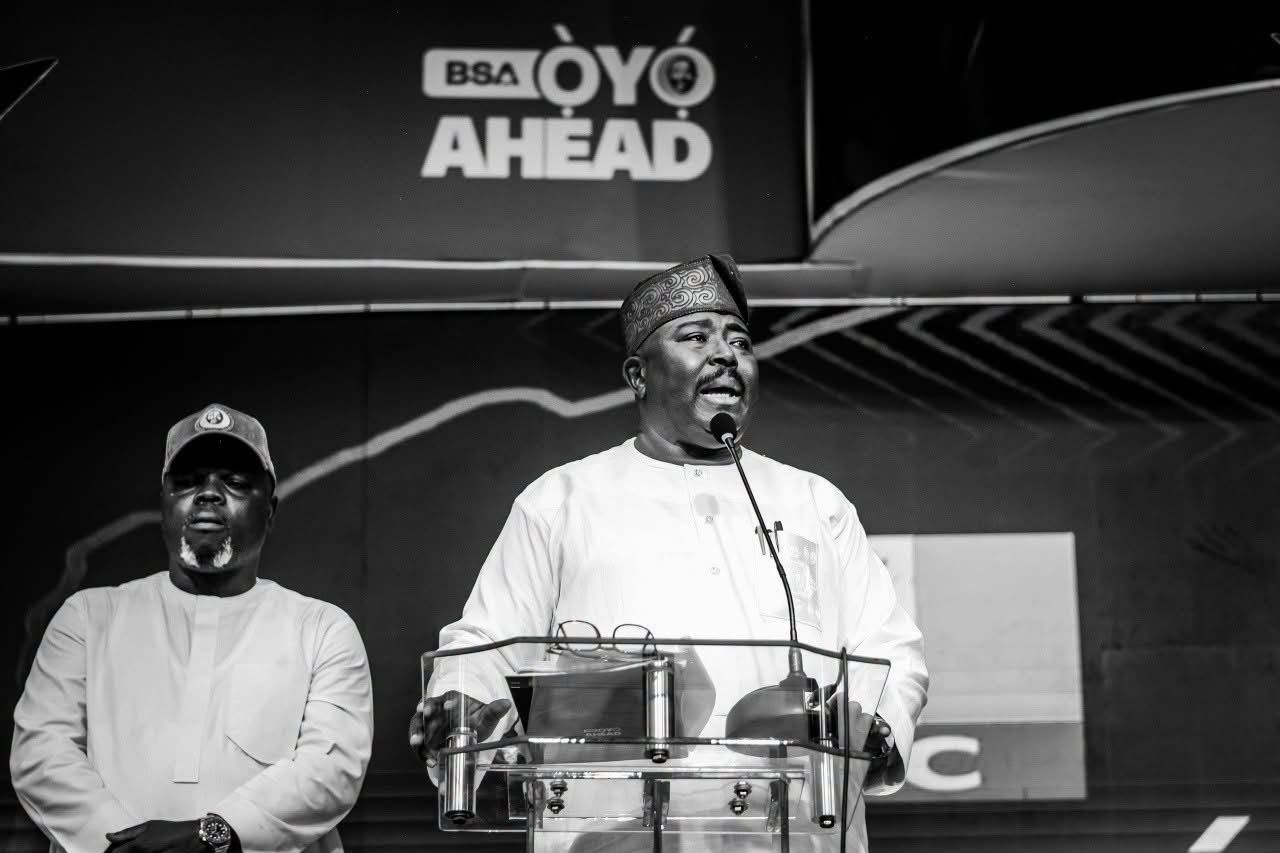
Mega IconThe unveiling of Senator Sharafadeen Abiodun Alli’s OYO AHEAD manifesto has introduced a new dimension to the 2027 Oyo State governorship conversation. Beyond the usual campaign promises, the document presents an attempt to define not just what a government intends to do, but how it proposes to govern. Its central message is that Oyo State needs a development model built around grassroots empowerment, economic productivity, institutional accountability and measurable performance.
What makes the manifesto politically significant is its attempt to connect the candidate’s personal political journey with a proposed programme of government. From his experience as Chairman of Ibadan North Local Government to his service as Secretary to the State Government, Chief of Staff, Senator and Chairman of Odu’a Investment Company, Alli presents himself as a politician whose experience cuts across grassroots administration, constitutional politics, legislative representation and business management. These experiences provide a solid foundation for effective governance and reinforce the expectation that his proposed agenda can be translated into tangible results for the people of Oyo State.
The first pillar, local government autonomy, may well become the most politically consequential. By promising transparent access to council allocations, monthly funding arrangements and greater freedom for local governments to address community needs, BSA is placing grassroots governance at the centre of his development philosophy. The message is unmistakable: democracy must be felt beyond the Government House, and the dividends of government must reach the communities where ordinary people live and work.
His infrastructure proposals also deserve attention. Rather than concentrating exclusively on new construction, the manifesto promises an audit of unfinished roads, published completion schedules, farm access roads, improved electricity, potable water and affordable housing. This suggests an understanding that infrastructure should be judged by its economic and social usefulness, not simply by the political visibility of projects.
In healthcare, the proposed Oyo Care Guarantee for infants, pregnant women and residents above 70 is a significant social intervention. The commitment to strengthen primary healthcare, address shortages of medical personnel and expand health insurance coverage recognises that healthcare is not a privilege reserved for those who can afford it. With the right funding arrangements, adequate staffing and firm institutional commitment, these promises can be translated into a sustainable healthcare system that delivers tangible benefits to the people of Oyo State.
Education is another area where the manifesto attempts to reconnect Oyo with its historic reputation as a pioneer of educational development. Reducing classroom congestion, repairing schools, expanding scholarships, establishing skills centres and linking graduates to employment are proposals that speak directly to the future of the state’s young population. These interventions are designed to translate educational investment into measurable improvements in learning outcomes, practical skills and employment opportunities for the next generation.
Perhaps the most compelling economic proposition is the commitment to move Oyob beyond an economy of consumption towards one of production, investment and job creation. The proposed industrial parks, revival of the Oluyole Free Trade Zone, ₦10 billion Youth Fund, digital skills programme and support for small businesses suggest an administration seeking to make employment creation a central responsibility of government. The ₦150 billion annual internally generated revenue target reflects an ambitious vision of economic growth, driven by expanded business activity, increased investment, efficient revenue administration and the elimination of financial leakages, while preserving a favourable environment for citizens and businesses to prosper.
Agriculture gives the manifesto another important regional dimension. Oyo possesses considerable agricultural potential, particularly across Oke-Ogun, Ogbomoso and Ibarapa. The proposals for processing facilities, revived farm settlements, mechanisation, storage, agricultural insurance and export promotion recognise that farmers cannot prosper merely by producing crops; they must also have access to markets, processing facilities and value chains. If properly executed, this could transform agriculture from subsistence activity into a major engine of industrial growth.
Security, appropriately, is treated as the foundation upon which every other pillar depends. The proposed strengthening of community security networks, protection and insurance for hunters and vigilantes, improved surveillance and farmer-herder mediation reflect the reality that development cannot flourish where fear controls access to farms, schools and businesses. The accompanying commitment to public disclosure of projects, contractors and costs also reinforces the argument that security and accountability are inseparable responsibilities of government.
One particularly striking feature is the candidate’s personal commitment to publish quarterly performance reports and to decline a second-term request if Oyo State is not measurably better by the end of his first tenure. This is a bold political undertaking. It shifts the conversation from the traditional entitlement of incumbency to the obligation of performance. This commitment further underscores the importance of measurable performance targets, transparent reporting and regular public assessments as the foundation for accountable and results-driven governance.
The strength of OYO AHEAD lies not only in the breadth of its promises but also in the opportunity to translate them into a practical development programme. The proposed revenue expansion, healthcare guarantee, youth and women empowerment funds, educational reforms and infrastructure projects provide an ambitious agenda for the state. With proper financial planning, sound legal frameworks, effective coordination and measurable implementation targets, these proposals can form the foundation of a purposeful and results-oriented administration.
This places an important responsibility on the OYO AHEAD Steering Committee. Beyond campaign mobilisation and public presentation, the Committee must sustain the technical work required to support the manifesto with reliable data, realistic costing, legal guidance, implementation timelines and measurable outcomes. The depth of this preparation will be central to demonstrating that OYO AHEAD is not merely a collection of campaign promises, but a carefully considered programme for governing Oyo State.
As the 2027 governorship election approaches, the debate should increasingly focus on the future of Oyo State: the governance philosophy, experience, policy direction and preparedness of those seeking the people’s mandate. Political alliances and personalities will naturally shape the contest, but the enduring question is which proposals offer a clear and practical pathway to development, prosperity and accountable leadership.
OYO AHEAD has placed such a pathway before the people of Oyo State. Its seven pillars provide a framework for addressing the state’s development priorities, while its emphasis on grassroots governance, economic productivity, human capital development and accountability speaks to the need for a new direction. With his political experience, administrative background and familiarity with the challenges of Oyo State, Senator Sharafadeen Abiodun Alli is well positioned to lead the effort to translate this blueprint into meaningful progress. The promise of OYO AHEAD is renewal; its ultimate measure will be the transformation it delivers to the lives of the people.
Prince Armstrong-Bello, JP. Akogun Aliiwo Ibadanland, Author of “Yoruba Leadership in Diaspora: Equity Justice and Tradition” is a Political Communication Strategist and Public Affairs Analyst
Opinion
OYO 2027: MAKINDE EATS SOUR GRAPES, ADEKANMBI’S TEETH MUST BE SET ON EDGE
Published
2 weeks agoon
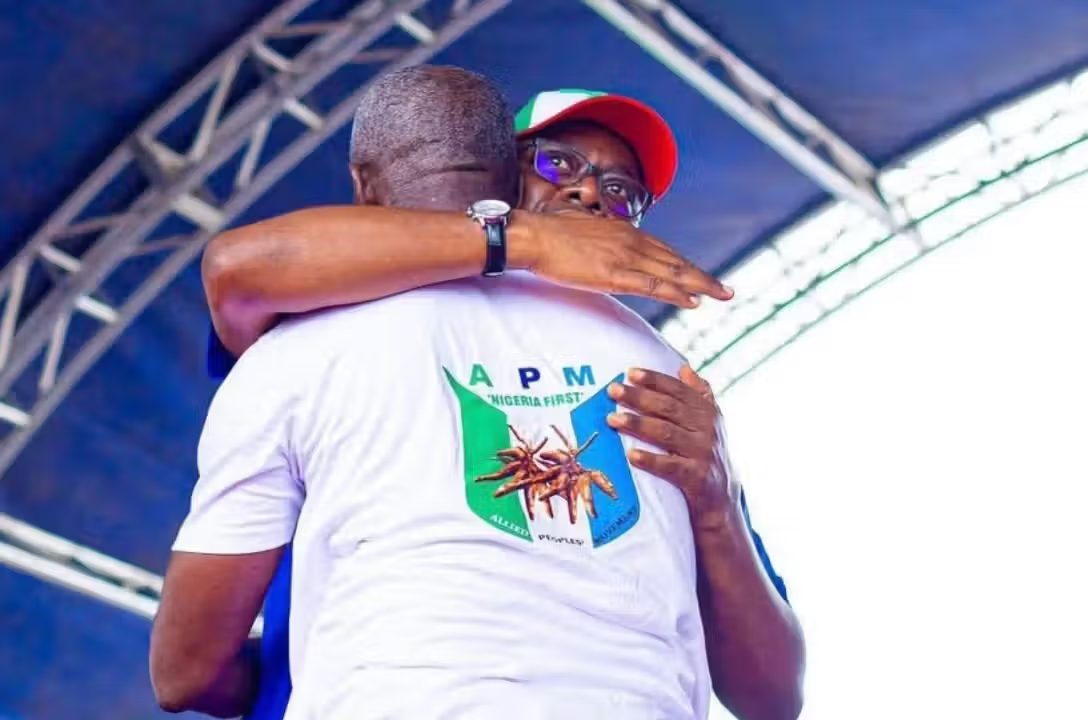
November 4, 2026The confusion within the ranks of the Allied Peoples Movement (APM) is becoming increasingly difficult to describe.
The political empire built by Governor Seyi Makinde on what critics describe as lies, betrayals, broken promises and greed appears to be crumbling by the day.
Indeed, Makinde and his APM loyalists are providing an endless source of amusement these days.
Virtually everyone who leaves the Makinde administration is suddenly dismissed as a “paperweight” by the party’s social media attack dogs.
I have often wondered whether these fellows are unaware of the wisdom behind the Yoruba belief that even cotton wool, when gathered in sufficient quantities, can become a load too heavy for one person to carry.
As the Yoruba proverb puts it: Eni ní òwú ò t’ẹrù; ìwọ̀nba tó fẹ́ fi tan iná ló mú.
You keep losing prominent politicians and influential party stakeholders, yet you dismiss them as political nonentities. But which heavyweight has the power to cast more than one vote for a preferred candidate?
I am certain that even Bimbo Adekanmbi must be wondering how things deteriorated so badly for the APM.
Before his emergence as Governor Makinde’s anointed governorship candidate was made public, I granted an interview on a television station during which I openly predicted that Adekanmbi would get the governor’s endorsement and that his choice as successor would spell trouble for both men.
To one another, both men have become potential political albatrosses. Unfortunately, Governor Makinde’s ego appears to have blinded him to realities beyond his immediate political calculations.
I am particularly surprised that Adekanmbi failed to recognise that he was walking into a political trap by accepting Makinde’s endorsement.
Greed, indeed, can be a dangerous disease. In Adekanmbi’s position, no discerning politician would have ignored the number of political enemies Governor Makinde had accumulated during his seven years in office.
It follows, therefore, that Adekanmbi would inevitably inherit many of those political liabilities. Sadly, he either failed to appreciate the implications or simply chose to overlook the consequences.
By the time Governor Makinde, or perhaps Seye Famojuro, settled for Adekanmbi, the governor was already embroiled in disagreements with prominent political figures, including former Deputy National Chairman of the PDP, Ambassador Taofeek Oladejo Arapaja, Alhaji Bisi Olopoeyan and several first-class traditional rulers in Oyo State.
He had also fallen out with several influential political figures, including Senator Hosea Agboola, Alhaji Razak Gbadegesin, former Deputy Governor Barrister Gbolarunmi Hazeem, Chief Mrs Jumoke Akinjide, Hon. Mulikat Adeola Akande, former Deputy Governor Engr. Rauf Aderemi Olaniyan, Prince Diran Odeyemi, former Ekiti State Governor Ayodele Fayose, former Rivers State Governor Nyesom Wike and even President Bola Ahmed Tinubu.
Beyond these strained relationships, several stakeholders within the Makinde political camp were already uncomfortable with the process that produced Adekanmbi as the APM governorship candidate.
There were also contentious discussions about whether Governor Makinde should be succeeded by a Christian. Equally troubling to some stakeholders was the question of whether it made political sense for Makinde to present Adekanmbi as his preferred successor when both men hail from Ona-Ara Local Government Area.
At the time, agitations were mounting over Governor Makinde’s alleged failure to comply with the Supreme Court judgment granting financial autonomy to local governments.
Other contentious issues included the controversial Circular Road project, the sale of government assets and the proposed transfer of Oyo State farm settlements to estate developers.
The state’s debt profile, which has remained a subject of public concern and debate, was another issue that had yet to be satisfactorily addressed.
All these issues were already in the public domain before Adekanmbi accepted the offer to become Makinde’s anointed candidate.
One is therefore compelled to ask: what could have persuaded Adekanmbi to accept such a politically dangerous offer?
I can only think of one reason: greed.
When Governor Makinde claimed that he had advised Adekanmbi not to inherit his enemies, he was being economical with the truth.
The reality is that those political liabilities became Adekanmbi’s the moment he accepted Makinde’s endorsement.
The governor knows that he is carrying a political baggage that could weigh heavily on his preferred successor. Yet, he appears unwilling to be held accountable for the political consequences of his own administration.
Unfortunately for both men, even Adekanmbi’s campaign slogan tells a story of its own: “Omi Tuntun 3.0”.
How, then, does he intend to separate himself from the “Omi Tuntun” administration and the controversies surrounding it?
Governor Makinde has never hidden his discomfort with genuine local government autonomy. Adekanmbi, by his posture, appears prepared to sustain the same political template, which critics blame for weakening the 33 local government councils in the state.
On virtually every issue over which the people of Oyo State have expressed concern, Adekanmbi appears to be offering continuity rather than a departure from the policies of the present administration.
He has failed to condemn the controversy surrounding the proposed transfer of the Ogbomoso Farm Settlement to estate developers, despite protests by residents of the ancient town.
He has equally remained silent over the controversy surrounding the administration’s reported moves involving the Saki Farm Settlement.
He also appears untroubled by the reported transfer of the 4,000-hectare Eruwa Farm Settlement to investors, whose whereabouts and activities have, according to critics, remained unclear two years after the arrangement.
Indeed, Adekanmbi appears not to appreciate the extent of the challenges facing the state. For instance, Oyo State is said to be short of six general hospitals if the benchmark of one general hospital per local government area is adopted.
Yet, when Senator Sharafadeen Abiodun Alli promised in his manifesto to address this deficit, APM spokespersons reportedly went on the offensive, describing the manifesto as “lacking in originality”.
Governor Makinde has been in office for more than seven years. During this period, his administration has received ecological funds on several occasions.
The question, therefore, is simple: what has happened to those funds?
There are concerns over the utilisation and accountability of the ecological funds received by the state. The governor owes the people a clear explanation of how these resources have been deployed.
There are also questions surrounding the proposed upgrade of the Alakia Airport, a project for which Adekanmbi himself was appointed by Governor Makinde to head a committee.
I have been reliably informed that the contract sum for the airport upgrade was reportedly reviewed upwards from its original figure of over N50 billion to well above N150 billion.
I have raised this question before, but I am yet to hear Adekanmbi offer a convincing explanation or response to the allegation.
Similarly, Governor Makinde reportedly approved more than N60 billion for the renovation of the Government House, an expenditure that attracted public criticism.
As of today, the visible works include the construction of a hall, the painting of the Government House mosque and church, and the replacement of tiles in both places of worship.
I challenge Governor Makinde to tell the people of Oyo State how much of the more than N60 billion reportedly approved for the renovation has actually been released and expended.
Beyond that, the governor should invite members of the press to conduct an independent assessment of the work carried out so far. The people deserve transparency and accountability, not unanswered questions.
The state government’s performance in education is another area that demands urgent attention.
Oyo State’s performance in WAEC and NECO examinations has continued to attract concern, particularly when compared with the performance of other states, including neighbouring Osun, which has been celebrated for its fifth-place position in a recent examination ranking.
Senator Sharafadeen Abiodun Alli has argued that the state must return to an educational system that makes teaching and learning more conducive. One of his proposals is a 30-pupils-per-classroom policy.
But rather than engage constructively with the proposal, APM voices have dismissed its feasibility.
Adekanmbi, as the party’s governorship candidate, has also failed to offer a clear departure from the present arrangement, under which many public primary and secondary school classrooms remain severely overcrowded and unconducive to effective learning.
Oyo State cannot afford another administration that merely promises continuity without addressing the shortcomings of the present one.
The people deserve better, and they now have an alternative in Senator Sharafadeen Abiodun Alli.
Governor Makinde has eaten sour grapes. Unfortunately, Bimbo Adekanmbi appears destined to bear the consequences.
His teeth, indeed, must be set on edge.

MEGAICON TV
Oyo South: Oseni Distributes 40 Transformers to Ibadan Communities in Six Weeks
Makinde’s Ex-Aide, Others Dump APM for APC in Ibadan North-East
APM campaign: SSACO mocks Makinde, Adekanmbi over poor turnout
Trending
-
News4 weeks ago2027: Alli, Oseni Tour Ibarapa, Seek Support for APC Candidacies
-
Opinion4 weeks agoDoctors’ Strike and the Price of Human Life | By Olusegun Hassan
-
Metro4 weeks agoAlli Visits Slain APC Member’s Family, Pledges Support for Pregnant Widow
-
Education3 weeks agoOseni Charges Nigerian Graduates to Prioritise Character, Excellence