Opinion
The North is angry!
Published
3 years agoon
Northern Nigeria used to have a cult of power called the Kaduna Mafia. The Kaduna Mafia decided who would become the Nigerian president, which road to build, which to abandon, which industries to be cited and where. When it couldn’t help but hand the reins of power to the south, it determined which weakest link to exploit. The 1976 assassination of Murtala Muhammed and the handing over of power to Olusegun Obasanjo explains this. If the Kaduna Mafia was bothered about the north-centric disposition of Obasanjo, it could have defiantly handed over the reins of the military government to Shehu Musa Yar’Adua, at that time a lieutenant colonel in the army. Nothing would have happened. When it handed power to Obasanjo, it had to ensure a triple promotion for Yar’Adua, the Fulani scion whose stock needed placation. He was named Chief of Staff Supreme Military Headquarters, with the brief to curtail Obasanjo’s probable excesses against the north.
Though the Kaduna Mafia seemed to have hit its expiry at the time Muhammadu Buhari came into office, the northern oligarchy was resolute about the Daura General’s emergence. And Buhari didn’t disappoint. His administration inflicted one of the most atrocious ethnic and cronyistic governments on Nigeria.
But today, the North is angry. This time, the subject of its annoyance is the planned relocation of some key departments of the Central Bank of Nigeria (CBN) and the Federal Airports Authority of Nigeria (FAAN) from Abuja to Lagos State. In time past, when the north got annoyed, it was akin to the shrill cry of the pied crow. The crow is a bird the Yoruba call the Kannakanna. So many myths surround this strange bird. The most outstanding of its mysterious features is its queer and unusual cries. These, the Yoruba, in their deep into mystical beliefs, associate with calamities. Yet, the Kannakanna has other features, one of which is that, it does not lay own eggs but rather chooses to harry other birds off their own egg nests. This bit about harrying other birds seems to be true. It, however, has no known explicable biological reasons. The other myth woven round the bird is that the Kannakanna does not lay its own eggs. This has been disproved by ornithologists.
When you compare the ancientness of northern elders’ cries in Nigeria whenever they feel things are not going their way with this strange bird, you will find out that the Kannakanna has a lot in common with the elders of the north. This mysterious bird is known among the Yoruba to be the bird of the elders; elders in this wise, witches and wizards. In some other instances, obeisance is paid to witches through chanting of their cognomen. One of these chants is that the witch is the owl with copper-like eyes – owiwi oloju ide. Witches are also simultaneously reputed to have their legs bespattered with camwood – osun. Beliefs in witches say that the crow is a messenger of these unique beings of African women. It is the animal they send on their mysterious, most times destructive assignments. Always decked in black apparel – its quills – a few other species of crows have white apron-like quills on their chests. Though it feeds mostly on ants, the Kannakanna’s most cherished meal is the hatchling of a sparrow (eye ega). The sparrow itself is a social, homely, very small, seed-eating bird with conical bills. It will fight its assailant to a standstill if annoyed. That is why when a spat is in the offing between two groups or individuals, the Yoruba will say that they smell a fight in the proportion of what happens when the crow attempts to beat the hatchling of a sparrow – “Kannakanna na omo ega…”
So, the north is annoyed. This time, the north that is annoyed is represented by the Northern Elders Forum (NEF). A few other voices have spat into the void and lapped the sky-spiraling spittle with their faces. One of them was Ali Ndume, the senator representing Borno South in the National Assembly. While the NEF, through its Director of Publicity and Advocacy, Abdul-Azeez Suleiman, said that the relocation of the CBN departments would lead to brain drain, Ndume delivered his in form of a subtle threat. He said, if the Yoruba-born president of Nigeria goes ahead with the relocation of those departments, this “move would have consequences.”
For Ndume, who is today the self-appointed one-man squad spearheading the north’s dissonance with government’s policies, the president is being ill-advised by the people he derogatorily labeled “Lagos boys” in the corridors of power. Hear him: “All these Lagos boys who are thinking that Lagos is Nigeria are just misinforming and advising the President wrongly. Those political cartels that are in the corridors of power are trying to misinform the President and we will tell the President. The President will take action. They are not doing any favour to Mr President because this will have political consequences”.
If you are imbued with the steady eyes to see the unseen, ears to hear the unsaid and ability to penetrate the thin veneer of today to arrive at Nigeria’s atrocious past, Ndume will remind you of the ubiquitous Kaduna Mafia. The only difference is that the Kaduna Mafia was not as loquacious, nor visible as the Borno senator. In Bala Takaya and Sonni Gwanle Tyoden (eds) book, The Kaduna Mafia: A Study of the Rise, Development and Consolidation of a Nigerian Power Elite, (1987) this mythical, sect-like northern Nigeria powerful force’s role in Nigeria’s political economy was rightly dissected. Operating under similar historical evolution and characteristics as the Mafia in Italy, Spain and the United States of America, the book used the septic-tank darkness nature of the Italian Mafia to explain the Kaduna Mafia. It said it “is such that for (the Kaduna Mafia) to continue its existence and pursue its objectives with the required effectiveness, it cannot but subject its identity, nature and activities to obscurity. (Secrecy) is one of the hallmarks of a successful mafia set-up”.
The Kaduna Mafia, a faction of the Nigerian bourgeois class and northern oligarchy, escalated the ethnic politics between the north and the south in the 1970s to the 1990s. The Mafia was a set of amorphous but lethal power-baiting individuals. Within this period in the life of Nigeria, this narrow group interest held the rest of Nigeria to ransom. It dictated the political and economic barometer of the country and blithely decreed the future of Nigeria. It perfected underdevelopment, focusing solely on development of the north and like godfathers in today’s politics, was narrow-minded and self-centered. Like the roach, the Kaduna Mafia had very sensitive political antennae with which it sniffed the pendulum of power and ethnic gains. Realizing that the best place to manipulate power was outside the locus of power, the Mafia fiddled with policies in such a way as to ensure that the north made maximum benefits through strategic positioning of policies and structures. Using the façade of Islamic puritanic posture, the Kaduna Mafia was be able to conceal its selfish political and economic interests before the overall intent got exposed to a larger Nigeria.
The overall effects of the Kaduna Mafia’s ethnic politics were negatively consequential for Nigeria. In the military, for instance, the first and only Premier of the Northern Region, Sir Ahmadu Bello, was clairvoyant about the future hegemonic hold of uniformed men on the running and ruining of Nigeria. Thus, he ensured that a number of qualifications for entrance into the military were waived for northern boys enlisting in the military in 1959 to the 1960s. In height, education and mental acuity criteria, many northern boys who didn’t measure up became soldiers, rising to become military governors and even Heads of State. This ultimately inflicted colossal damage on the future of the country. One of such boys was Muhammadu Buhari. In terms of academic qualifications, he obviously didn’t have the school certificate requirement. He also ranked very low in terms of depth. How was anyone, even Bello, who had much charisma and depth, to imagine that someday, Nigeria would be in the hands of a Buhari? The rest, as they say, is history.
So, when Ndume and the NEF began the resurgence of their crow cry about a north under siege, what came to the minds of other parts of Nigeria is similar to the cry of a butcher who is being stalked by a threat of death. So when the butcher screams that death was about to take hold of him, the question people ask is, didn’t the animals he had mercilessly butchered too have blood flowing in their veins? Yoruba render this as, “Iku fe pa alapata, o nkigbe; omo eranko t’o ti da l’oro nko?” What this pithy saying advocates is the need for fairness at all times as whatever one is unwilling to stomach, they should refrain from imposing it on others.
The current federal government is trying to relocate CBN departments like the Banking Supervision, Other Financial Institutions Supervision, Consumer Protection Department, Payment System Management Department, and Financial Policy Regulations Department from Abuja to Lagos? Ex-CBN Deputy Governor, Kingsley Moghalu, was the first to thaw its ice by labeling it an unnecessary wolf cry. In a tweet on X, he claimed the Lagos office, which he said had been completed and inaugurated approximately 12 years back, was underutilized while the staff of the CBN at the Abuja headquarters “exceed the health and safety limits of the building, hence the need to relocate.” He said the relocation was “rational, given that the market entities supervised by these departments are predominantly located in Lagos.”
While corroborating Moghalu, CBN former governor and ex-emir of Kano, Sanusi Lamido Sanusi, said “Northern politicians will shout that this is moving from Abuja to Lagos. Abuja is a federal capital not a northern issue. So long as this is a principled decision, the noise should be ignored.” According to him, “All this noise is absolutely unnecessary. The CBN has staff manning its branches and cash offices across the Federation. Moving staff to the Lagos office to streamline operations and make them more effective and reduce cost is a normal prerogative of management.”
Now, why does the NEF relish this idea of northernizing Abuja? Does this Kaduna Mafia-incarnate think that localization means ownership? Countless times, the South-South people have cautioned those who see the FCT as their patrimony, reminding them that the glittering roads of Abuja were paved with oil money from their soil. It was this same northernization of Abuja reasoning that bred the vacuous clamour for a northerner to be FCT Minister at the beginning of this present government and the gas-lighting of the incumbent.
Before the February 4, 1976 promulgation of Decree No 6 by the Federal Military Government of Nigeria which initiated the removal of the national capital from Lagos to Abuja, there had been previous advocacy for its relocation. One of such was made by Chief Obafemi Awolowo at the 1953 constitutional conference held in London. It was Awolowo and his Action Group’s contention that Lagos must be merged with the Western Region while a new federal capital should be built in central Nigeria.
Following this up, the Action Group published a pamphlet in 1953 with the title Lagos Belongs to the West, where it articulated that “(Lagos) is strategically… highly vulnerable. Geographically, it is not by any means properly suited to serve as the headquarters of the Central or Federal Government. Lagos is to Nigeria what Calcutta is to India. What we need now, to pursue this analogy, is a New Delhi.” The party then made this proposal: “A large area of land should be acquired by the Federal Government near Kafanchan, which is almost central geographically, and strategically safe comparatively, for the purpose of building a new and neutral capital. The new capital should be built on a site entirely separate from an existing town, so that its absolute neutrality may be assured. Being the property of the Federal Government, it would automatically be administered by it in the same way as Washington, D.C. in USA or Canberra in Australia. Such a capital would be a neutral place indeed.”
In August I975, the Supreme Military Council formed a Committee on the Location of the Federal Capital, one of whose members was Dr. Tai Solarin, Headmaster of Mayfair College, Ikenne, who had written many articles in the Tribune newspapers advocating relocation of the capital from Lagos to the north. One of such was a 197I article he wrote with the title Lagos ‘should go’. Other members of the committee were Dr Ajato Gando, the only member with a background in geography and urban planning; Reverend Colonel Pedro Martins from Lagos, and Justice T. Akinola Aguda as Chairman. The Aguda committee, made up mostly of westerners, recommended Abuja as the FCT. If the SMC had northernization of Abuja in mind, it probably would have made the committee an all-north affair. While its initial planning and implementation were undertaken by the Military Government of Generals Murtala Muhammed and Obasanjo, Gen Ibrahim Babangida eventually relocated Nigeria’s capital to Abuja.
One of the terms of reference for the establishment of the new capital was to ensure that it was a truly neutral city which would accommodate Northern, Eastern, and Western peoples and where these peoples would co-exist in harmony. The SMC was wary of the new capital not being free from the rancorous historical legacies of state capitals where dominant groups imposed themselves on previous urban centres. Today, with the nauseating ethnicization of Abuja and an opaque reading of sentiments into national policy matters like the FAAN and CBN relocation by northern crows, the fact that there was a predominant Northern influence in the process of construction of Abuja has made the noxious perception rife today that the FCT is a northern bequeathal. What NEF, Ndume and others are doing by locating ulterior motives in the relocations from Abuja to Lagos is northernizing the ownership of the FCT. Otherwise, the president should be left with the prerogative to decide what policies best suits its administration. What Nigeria needs now is healing. What the framers of the FCT establishment and Awolowo’s Action Group envisaged was a neutral capital which it no longer is. NEF, Ndume and the likes are curating an Abuja that is a threat to unity and indeed a potential symbol of the escalation of the North-South discord.
Should Abuja ever be an issue for ethno-religious claim? It was conceived to be a city of love and not hate. It was conceived as a city of equality and not of superiority of one part over another. That was why the Federal Government paid off the original owners of the land and created Suleja for them. As Nigerians, we owe one another that duty of respect and love – and Nigerians can love! I experienced it last Friday during the burial of my mother. Nigerians of all classes and ethnicities, public figures, private figures helped me in seeing my mother off to eternity. Governors who I, at one time or the other, wrote against; senators I once queried their patriotism to Nigeria; captains of industry, North and South; farmers , artisans, white collar, blue collar people – everybody from everywhere gave my mother a state burial. I thank them immensely. The lesson for me there is that I should stay on the track I have chosen for myself while I plead that we work harder to make Nigeria a haven for all Nigerians who are still alive. Enough of bickering over nothing – not over Abuja, especially!
You may like
Opinion
G-WAGON: Dare Adeleke, A Liar’ll Steal; Why’re You Desperate To Conceal The Truth? | Maroof Asudemade
Published
7 days agoon
November 6, 2026By
Mega IconI have read Dare Adeleke’s rather vacuous response to my article on Governor Seyi Makinde’s presentation of a brand-new Mercedes-Benz G-Wagon 500 to the President-General of the Central Council of Ibadan Indigenes (CCII), Barrister Sulaimon Ajeniyi Ajewole. Unfortunately, beneath the insults, name-calling on my person and his apparent eye-service desperation to impress his political benefactor, there is hardly any substance worth engaging.
Adeleke devoted considerable space to calling me a drunken, lowly writer. Yet, in all his verbal gymnastics, he conspicuously failed to address the fundamental questions raised in my article. Has Governor Makinde paid the statutory salaries and entitlements of the Olubadan of Ibadanland, Oba Rashidi Adewolu Ladoja, and the Alaafin of Oyo, Oba Akeem Owoade, since their ascension to the respective thrones? Has his administration provided them with official vehicles, as expected under the applicable government arrangements? These were the issues Adeleke ought to address not my personality.
If he had any credible answers to these questions, he would have provided them. Instead, he chose to exhibit his wrakness as an intellectually exhausted defender. He resorted to abusing the messenger when he couldn’t dismantle the message.
However, there is one particularly interesting aspect of Dare Adeleke’s response that deserves immediate correction. He lied that Governor Makinde spent N1 billion on the completion of the Olubadan Palace. Is he sure he’s not addicted to stealing as a liar? The financial contributions towards the completion of the palace came from multiple sources, including the 11 local governments in Ibadanland, each of which contributed N50 million, amounting to N550 million.
Governor Makinde contributed N250 million. The governor’s contribution was N250 million, not N1 billion! Why would Adeleke inflate the governor’s contribution from N250 million to N1 billion? Is he so desperate to manufacture an impressive record for his political principal that figures have become expendable? Or does he imagine that exaggerating the governor’s generosity will make the unanswered questions of ridiculing our royal fathers disappear?
The 11 local governments of Ibadanland have a responsibility towards the Olubadan institution. Their contributions towards the palace should not be presented as a personal sacrifice by Governor Makinde. They are contributions made by public institutions to an institution that belongs to the people of Ibadanland.
Even more disturbing is Adeleke’s inane argument that because Makinde contributed money towards completing the Olubadan Palace, the governor deserves appreciation rather than criticism. This argument betrays a shocking failure of Adeleke to distinguish between governmental responsibilities and statutory obligations.
Let us even assume, for the sake of argument, that Makinde personally spent N1 billion on the palace. How does constructing or completing a building discharge the government’s obligation to pay the statutory salaries and entitlements of the Olubadan and the Alaafin? How does a palace building become a substitute for official vehicles? Are these royal fathers supposed to live in beautiful palaces while their statutory entitlements remain unpaid?
By Adeleke’s ‘logic’, Governor Makinde could build a magnificent headquarters for the Nigeria Labour Congress and subsequently refuse to pay workers their salaries, expecting the labour movement to applaud him for his generosity. Would that be acceptable? Could the government substitute office buildings for workers’ wages? Dare Adeleke is glaringly a peripheral thinker!
A building is a capital project. Salaries and official entitlements are separate obligations. Since Adeleke knew he could not understand this elementary distinction, he should have smelt his argument before presenting it to the public. His defence is not only logically defective; it is intellectually sour.
More importantly, the completion of the Olubadan Palace was not the subject of my article. I did not dispute the governor’s contribution. I questioned the apparent contradiction between his extravagant generosity towards the CCII President-General and the allegations of neglect concerning the official entitlements of the Olubadan and the Alaafin. Adeleke has not answered that question. He has merely introduced an unrelated expenditure in an attempt to divert attention.
I have no objection to Governor Makinde giving G-Wagons, aeroplanes or even private jets to people he loves, provided he does so with his personal resources. He is entitled to his private generosity. But public accountability should not cease because a governor is generous to his friends, associates or political admirers. The issue is not his freedom to give birthday presents. It is his responsibility to discharge governmental obligations.
As for Adeleke’s unnecessary personal attacks, I refuse to dignify his descriptions of me as a drunken or lowly writer with an elaborate defence. Neither description reflects my personality, and neither alters the substance of my argument. He only needs to be aware that despite his opinion of me as a drunken, lowly writer, I am his better by far as a family man and a responsible father – two essential duties he has failed in. I will also not allow his inability to sustain an intelligent argument to dictate the level of my engagement.
I am upset with Dare Adeleke for not living up to his claim of belonging to Oja’ba. He lacks the intellectual discipline, street wisdom and argumentative dexterity traditionally associated with the historic Ibadan community. His response has demonstrated an unfortunate deficit in all three. “Dare ò m’èsì, ó tún gọ!”
There is also something deeply incongruous about Adeleke’s pretentious defence of Governor Makinde. Those familiar with the undercurrents of Oyo politics may find his public posturing rather amusing. He presents himself as an unquestioning defender of the governor, yet political hypocrisy has a way of concealing its true colours beneath an appearance of loyalty. If the human stomach were transparent like a calabash, perhaps the governor would have a clearer view of Dare Adeleke as the green snake lurking beneath the green grass.
But my concern remains the dignity of the Olubadan and Alaafin institutions, not Adeleke’s political theatrics. He has had an opportunity to answer straightforward questions. He failed. He has had an opportunity to correct the allegations with verifiable facts. He avoided them. Instead, he manufactured a N1 billion contribution, inflated the governor’s generosity and attempted to intimidate a critic with insults.
Let me therefore restate the questions he could not answer: Has Governor Makinde paid the statutory salaries and entitlements of the Olubadan and the Alaafin since their ascension? Has he provided them with their official vehicles in accordance with applicable government policy? If yes, let Adeleke produce the evidence. If no, let him explain why.
A G-Wagon cannot answer questions about unpaid salaries. A palace cannot substitute for statutory entitlements. And N1 billion in political propaganda cannot turn N250 million into N1 billion. Dare Adeleke may choose to defend Makinde with insults, exaggerations and emotional outbursts. I will continue to interrogate the administration with facts, logic and questions that public officeholders owe the people answers to.
The dignity of the Olubadan and the Alaafin is far more important than Adeleke’s desperate attempt to earn political applause. And no amount of name-calling will make me abandon the responsibility of holding those in power accountable.
Opinion
OYO AHEAD: Senator Alli Blueprint for Oyo Renewal | Muji Armstrong-Bello
Published
7 days agoon
November 6, 2026By
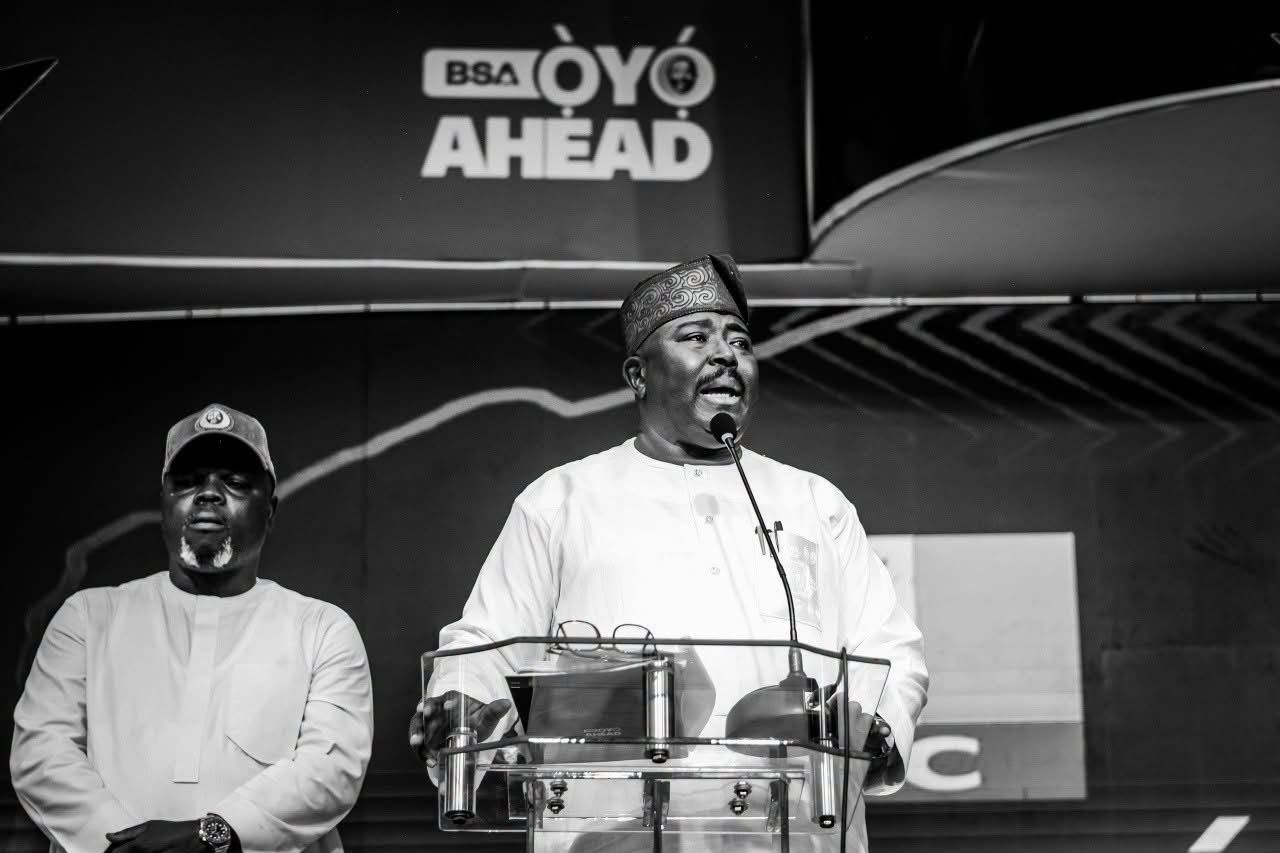
Mega IconThe unveiling of Senator Sharafadeen Abiodun Alli’s OYO AHEAD manifesto has introduced a new dimension to the 2027 Oyo State governorship conversation. Beyond the usual campaign promises, the document presents an attempt to define not just what a government intends to do, but how it proposes to govern. Its central message is that Oyo State needs a development model built around grassroots empowerment, economic productivity, institutional accountability and measurable performance.
What makes the manifesto politically significant is its attempt to connect the candidate’s personal political journey with a proposed programme of government. From his experience as Chairman of Ibadan North Local Government to his service as Secretary to the State Government, Chief of Staff, Senator and Chairman of Odu’a Investment Company, Alli presents himself as a politician whose experience cuts across grassroots administration, constitutional politics, legislative representation and business management. These experiences provide a solid foundation for effective governance and reinforce the expectation that his proposed agenda can be translated into tangible results for the people of Oyo State.
The first pillar, local government autonomy, may well become the most politically consequential. By promising transparent access to council allocations, monthly funding arrangements and greater freedom for local governments to address community needs, BSA is placing grassroots governance at the centre of his development philosophy. The message is unmistakable: democracy must be felt beyond the Government House, and the dividends of government must reach the communities where ordinary people live and work.
His infrastructure proposals also deserve attention. Rather than concentrating exclusively on new construction, the manifesto promises an audit of unfinished roads, published completion schedules, farm access roads, improved electricity, potable water and affordable housing. This suggests an understanding that infrastructure should be judged by its economic and social usefulness, not simply by the political visibility of projects.
In healthcare, the proposed Oyo Care Guarantee for infants, pregnant women and residents above 70 is a significant social intervention. The commitment to strengthen primary healthcare, address shortages of medical personnel and expand health insurance coverage recognises that healthcare is not a privilege reserved for those who can afford it. With the right funding arrangements, adequate staffing and firm institutional commitment, these promises can be translated into a sustainable healthcare system that delivers tangible benefits to the people of Oyo State.
Education is another area where the manifesto attempts to reconnect Oyo with its historic reputation as a pioneer of educational development. Reducing classroom congestion, repairing schools, expanding scholarships, establishing skills centres and linking graduates to employment are proposals that speak directly to the future of the state’s young population. These interventions are designed to translate educational investment into measurable improvements in learning outcomes, practical skills and employment opportunities for the next generation.
Perhaps the most compelling economic proposition is the commitment to move Oyob beyond an economy of consumption towards one of production, investment and job creation. The proposed industrial parks, revival of the Oluyole Free Trade Zone, ₦10 billion Youth Fund, digital skills programme and support for small businesses suggest an administration seeking to make employment creation a central responsibility of government. The ₦150 billion annual internally generated revenue target reflects an ambitious vision of economic growth, driven by expanded business activity, increased investment, efficient revenue administration and the elimination of financial leakages, while preserving a favourable environment for citizens and businesses to prosper.
Agriculture gives the manifesto another important regional dimension. Oyo possesses considerable agricultural potential, particularly across Oke-Ogun, Ogbomoso and Ibarapa. The proposals for processing facilities, revived farm settlements, mechanisation, storage, agricultural insurance and export promotion recognise that farmers cannot prosper merely by producing crops; they must also have access to markets, processing facilities and value chains. If properly executed, this could transform agriculture from subsistence activity into a major engine of industrial growth.
Security, appropriately, is treated as the foundation upon which every other pillar depends. The proposed strengthening of community security networks, protection and insurance for hunters and vigilantes, improved surveillance and farmer-herder mediation reflect the reality that development cannot flourish where fear controls access to farms, schools and businesses. The accompanying commitment to public disclosure of projects, contractors and costs also reinforces the argument that security and accountability are inseparable responsibilities of government.
One particularly striking feature is the candidate’s personal commitment to publish quarterly performance reports and to decline a second-term request if Oyo State is not measurably better by the end of his first tenure. This is a bold political undertaking. It shifts the conversation from the traditional entitlement of incumbency to the obligation of performance. This commitment further underscores the importance of measurable performance targets, transparent reporting and regular public assessments as the foundation for accountable and results-driven governance.
The strength of OYO AHEAD lies not only in the breadth of its promises but also in the opportunity to translate them into a practical development programme. The proposed revenue expansion, healthcare guarantee, youth and women empowerment funds, educational reforms and infrastructure projects provide an ambitious agenda for the state. With proper financial planning, sound legal frameworks, effective coordination and measurable implementation targets, these proposals can form the foundation of a purposeful and results-oriented administration.
This places an important responsibility on the OYO AHEAD Steering Committee. Beyond campaign mobilisation and public presentation, the Committee must sustain the technical work required to support the manifesto with reliable data, realistic costing, legal guidance, implementation timelines and measurable outcomes. The depth of this preparation will be central to demonstrating that OYO AHEAD is not merely a collection of campaign promises, but a carefully considered programme for governing Oyo State.
As the 2027 governorship election approaches, the debate should increasingly focus on the future of Oyo State: the governance philosophy, experience, policy direction and preparedness of those seeking the people’s mandate. Political alliances and personalities will naturally shape the contest, but the enduring question is which proposals offer a clear and practical pathway to development, prosperity and accountable leadership.
OYO AHEAD has placed such a pathway before the people of Oyo State. Its seven pillars provide a framework for addressing the state’s development priorities, while its emphasis on grassroots governance, economic productivity, human capital development and accountability speaks to the need for a new direction. With his political experience, administrative background and familiarity with the challenges of Oyo State, Senator Sharafadeen Abiodun Alli is well positioned to lead the effort to translate this blueprint into meaningful progress. The promise of OYO AHEAD is renewal; its ultimate measure will be the transformation it delivers to the lives of the people.
Prince Armstrong-Bello, JP. Akogun Aliiwo Ibadanland, Author of “Yoruba Leadership in Diaspora: Equity Justice and Tradition” is a Political Communication Strategist and Public Affairs Analyst
Opinion
OYO 2027: MAKINDE EATS SOUR GRAPES, ADEKANMBI’S TEETH MUST BE SET ON EDGE
Published
1 week agoon
November 4, 2026The confusion within the ranks of the Allied Peoples Movement (APM) is becoming increasingly difficult to describe.
The political empire built by Governor Seyi Makinde on what critics describe as lies, betrayals, broken promises and greed appears to be crumbling by the day.
Indeed, Makinde and his APM loyalists are providing an endless source of amusement these days.
Virtually everyone who leaves the Makinde administration is suddenly dismissed as a “paperweight” by the party’s social media attack dogs.
I have often wondered whether these fellows are unaware of the wisdom behind the Yoruba belief that even cotton wool, when gathered in sufficient quantities, can become a load too heavy for one person to carry.
As the Yoruba proverb puts it: Eni ní òwú ò t’ẹrù; ìwọ̀nba tó fẹ́ fi tan iná ló mú.
You keep losing prominent politicians and influential party stakeholders, yet you dismiss them as political nonentities. But which heavyweight has the power to cast more than one vote for a preferred candidate?
I am certain that even Bimbo Adekanmbi must be wondering how things deteriorated so badly for the APM.
Before his emergence as Governor Makinde’s anointed governorship candidate was made public, I granted an interview on a television station during which I openly predicted that Adekanmbi would get the governor’s endorsement and that his choice as successor would spell trouble for both men.
To one another, both men have become potential political albatrosses. Unfortunately, Governor Makinde’s ego appears to have blinded him to realities beyond his immediate political calculations.
I am particularly surprised that Adekanmbi failed to recognise that he was walking into a political trap by accepting Makinde’s endorsement.
Greed, indeed, can be a dangerous disease. In Adekanmbi’s position, no discerning politician would have ignored the number of political enemies Governor Makinde had accumulated during his seven years in office.
It follows, therefore, that Adekanmbi would inevitably inherit many of those political liabilities. Sadly, he either failed to appreciate the implications or simply chose to overlook the consequences.
By the time Governor Makinde, or perhaps Seye Famojuro, settled for Adekanmbi, the governor was already embroiled in disagreements with prominent political figures, including former Deputy National Chairman of the PDP, Ambassador Taofeek Oladejo Arapaja, Alhaji Bisi Olopoeyan and several first-class traditional rulers in Oyo State.
He had also fallen out with several influential political figures, including Senator Hosea Agboola, Alhaji Razak Gbadegesin, former Deputy Governor Barrister Gbolarunmi Hazeem, Chief Mrs Jumoke Akinjide, Hon. Mulikat Adeola Akande, former Deputy Governor Engr. Rauf Aderemi Olaniyan, Prince Diran Odeyemi, former Ekiti State Governor Ayodele Fayose, former Rivers State Governor Nyesom Wike and even President Bola Ahmed Tinubu.
Beyond these strained relationships, several stakeholders within the Makinde political camp were already uncomfortable with the process that produced Adekanmbi as the APM governorship candidate.
There were also contentious discussions about whether Governor Makinde should be succeeded by a Christian. Equally troubling to some stakeholders was the question of whether it made political sense for Makinde to present Adekanmbi as his preferred successor when both men hail from Ona-Ara Local Government Area.
At the time, agitations were mounting over Governor Makinde’s alleged failure to comply with the Supreme Court judgment granting financial autonomy to local governments.
Other contentious issues included the controversial Circular Road project, the sale of government assets and the proposed transfer of Oyo State farm settlements to estate developers.
The state’s debt profile, which has remained a subject of public concern and debate, was another issue that had yet to be satisfactorily addressed.
All these issues were already in the public domain before Adekanmbi accepted the offer to become Makinde’s anointed candidate.
One is therefore compelled to ask: what could have persuaded Adekanmbi to accept such a politically dangerous offer?
I can only think of one reason: greed.
When Governor Makinde claimed that he had advised Adekanmbi not to inherit his enemies, he was being economical with the truth.
The reality is that those political liabilities became Adekanmbi’s the moment he accepted Makinde’s endorsement.
The governor knows that he is carrying a political baggage that could weigh heavily on his preferred successor. Yet, he appears unwilling to be held accountable for the political consequences of his own administration.
Unfortunately for both men, even Adekanmbi’s campaign slogan tells a story of its own: “Omi Tuntun 3.0”.
How, then, does he intend to separate himself from the “Omi Tuntun” administration and the controversies surrounding it?
Governor Makinde has never hidden his discomfort with genuine local government autonomy. Adekanmbi, by his posture, appears prepared to sustain the same political template, which critics blame for weakening the 33 local government councils in the state.
On virtually every issue over which the people of Oyo State have expressed concern, Adekanmbi appears to be offering continuity rather than a departure from the policies of the present administration.
He has failed to condemn the controversy surrounding the proposed transfer of the Ogbomoso Farm Settlement to estate developers, despite protests by residents of the ancient town.
He has equally remained silent over the controversy surrounding the administration’s reported moves involving the Saki Farm Settlement.
He also appears untroubled by the reported transfer of the 4,000-hectare Eruwa Farm Settlement to investors, whose whereabouts and activities have, according to critics, remained unclear two years after the arrangement.
Indeed, Adekanmbi appears not to appreciate the extent of the challenges facing the state. For instance, Oyo State is said to be short of six general hospitals if the benchmark of one general hospital per local government area is adopted.
Yet, when Senator Sharafadeen Abiodun Alli promised in his manifesto to address this deficit, APM spokespersons reportedly went on the offensive, describing the manifesto as “lacking in originality”.
Governor Makinde has been in office for more than seven years. During this period, his administration has received ecological funds on several occasions.
The question, therefore, is simple: what has happened to those funds?
There are concerns over the utilisation and accountability of the ecological funds received by the state. The governor owes the people a clear explanation of how these resources have been deployed.
There are also questions surrounding the proposed upgrade of the Alakia Airport, a project for which Adekanmbi himself was appointed by Governor Makinde to head a committee.
I have been reliably informed that the contract sum for the airport upgrade was reportedly reviewed upwards from its original figure of over N50 billion to well above N150 billion.
I have raised this question before, but I am yet to hear Adekanmbi offer a convincing explanation or response to the allegation.
Similarly, Governor Makinde reportedly approved more than N60 billion for the renovation of the Government House, an expenditure that attracted public criticism.
As of today, the visible works include the construction of a hall, the painting of the Government House mosque and church, and the replacement of tiles in both places of worship.
I challenge Governor Makinde to tell the people of Oyo State how much of the more than N60 billion reportedly approved for the renovation has actually been released and expended.
Beyond that, the governor should invite members of the press to conduct an independent assessment of the work carried out so far. The people deserve transparency and accountability, not unanswered questions.
The state government’s performance in education is another area that demands urgent attention.
Oyo State’s performance in WAEC and NECO examinations has continued to attract concern, particularly when compared with the performance of other states, including neighbouring Osun, which has been celebrated for its fifth-place position in a recent examination ranking.
Senator Sharafadeen Abiodun Alli has argued that the state must return to an educational system that makes teaching and learning more conducive. One of his proposals is a 30-pupils-per-classroom policy.
But rather than engage constructively with the proposal, APM voices have dismissed its feasibility.
Adekanmbi, as the party’s governorship candidate, has also failed to offer a clear departure from the present arrangement, under which many public primary and secondary school classrooms remain severely overcrowded and unconducive to effective learning.
Oyo State cannot afford another administration that merely promises continuity without addressing the shortcomings of the present one.
The people deserve better, and they now have an alternative in Senator Sharafadeen Abiodun Alli.
Governor Makinde has eaten sour grapes. Unfortunately, Bimbo Adekanmbi appears destined to bear the consequences.
His teeth, indeed, must be set on edge.

MEGAICON TV
Late Lam Adesina’s Legacy Remains Enduring – Oseni
Ogbomoso Political Earthquake: Makinde Loses Ex-CoS, 32 APM Chieftains to APC
Oyo APC Raises Alarm Over Alleged Plan to Sell Govt Fish Farm
Trending
-
News3 weeks ago2027: Alli, Oseni Tour Ibarapa, Seek Support for APC Candidacies
-
News4 weeks agoOyo South: Sheikh Olafimihan Hails Oseni for N10m Inyass House Donation
-
Politics4 weeks ago2027: Oseni Support Islamic Group’s Building Project With N10m, Urges Voters to Prioritise Competence Over Religion
-
Opinion3 weeks agoDoctors’ Strike and the Price of Human Life | By Olusegun Hassan