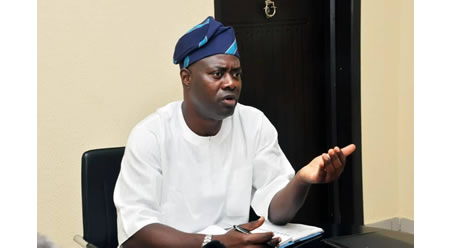
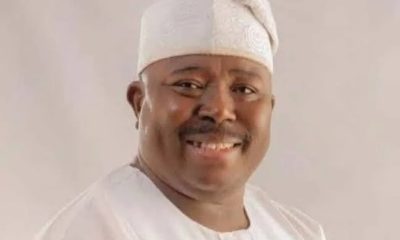
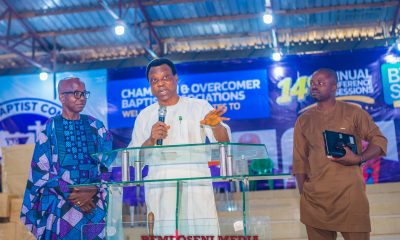
The gubernatorial candidate of the Peoples Democratic Party (PDP), in Oyo State, Engineer Seyi Makinde, has reacted to his victory at the just-concluded gubernatorial primary election of the party in the state.
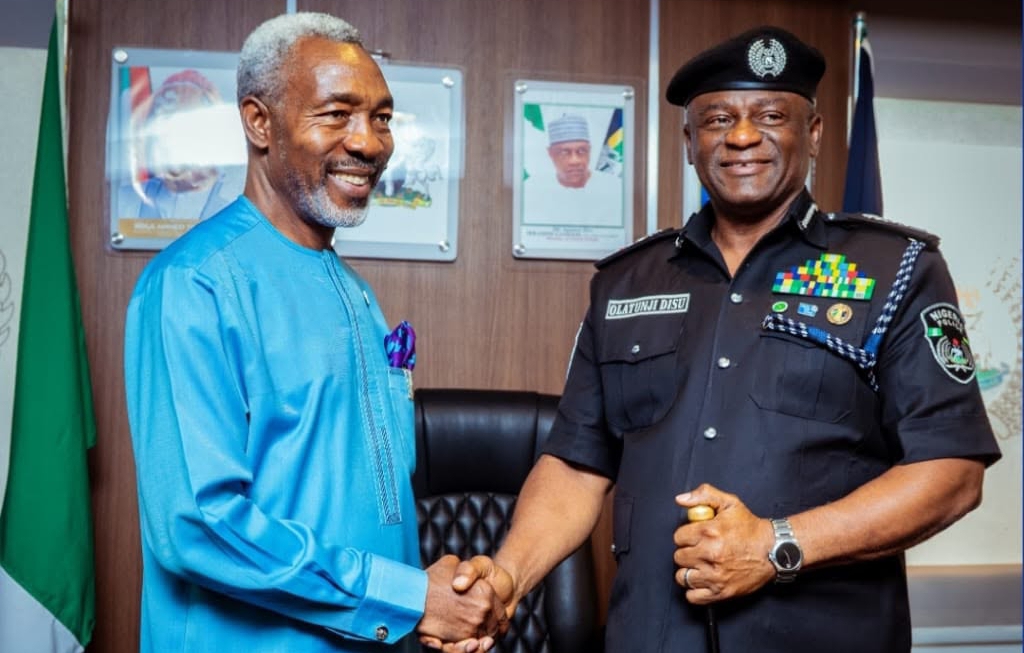
DAILY POST recalls that Makinde, an alumnus of University of Lagos and a native of Ibadan, the state capital scored 2,772 votes to defeat his rival, Senator Hamzat Ayoade Adeseun, an indigene of Ogbomoso who got 21 votes in the primary election held at Obafemi Awolowo Stadium (formerly Liberty Stadium), Oke Ado, Ibadan on Sunday.
But, Makinde while reacting; described his emergence as candidate of the party as “bitter-sweet”.
Makinde in his acceptance speech promised to address the issue of poverty, unemployment and dwindling state of education in the state when elected in the 2019 general elections.
He also used the opportunity to challenge the state governor, Senator Abiola Ajimobi over his failure to address some of the challenges facing the people of the state in the last seven years.
Makinde said, “Ordinarily, when you are victorious at any juncture of your earthly enterprise, the natural reaction it elicits is joy and happiness. For me, victory at our party’s gubernatorial primary today is bitter-sweet as it provokes in me a deep sense of soldiery.
“Bitter because we know the daunting and challenging work ahead of all of us when, by His Grace, we win the Governorship election come 2nd March next year. And sweet because, with all sense of humility, I know that we are capable of walking the talk, we have the ability to solve the myriads of challenges that daily confront our people, particularly the vulnerable citizens whose numbers, as I speak, have continued to increase in frightening proportions especially in the past seven and a half years. The plight of these vulnerable citizens will be addressed by our administration. Good governance is putting people at the centre of development.
“In this state, we have seen well-educated men and women who have done all that the society expects of responsible citizens and who have given back to the society. We have seen them pining away in abject poverty that beggars belief. In this state, there is a legion of educated, hardworking families with mature graduate children and all of them are forced to live under one roof like in war zones. No jobs, all pride gone because they have only one choice left and that is to go cap in-hand begging for food even from strangers. The sad thing is, they are all listening to me now.
“I put myself forward as a serious-minded man who grew up in your midst at a time when the society was more orderly and government money was essentially deployed for the greater good of the masses. Things have since changed, unfortunately for the worse. Government money is now skillfully siphoned out of government coffers and used as an instrument of oppression to taunt, blackmail and seduce the vulnerable masses who actually own the wealth.
“That system that worked while we were growing up produced people like me who hail from Ajia a village in Ona Ara Local Government and made it possible for me, in spite of my humble beginning to compete successfully and brilliantly in the corporate world globally. We will prove to you that it is misplaced priority for a government to embark on fancy capital projects only to compromise and neglect the soul of its citizenry.
“It is common knowledge that good governance is a function of effective public policy.
“However, public policy effectiveness is judged by the extent to which the chosen solution eliminates the problem which triggered the policy intervention in the first place. The primary rationale for my decision to come on board is to provide solutions to public policy problems that have needlessly bedeviled the State. As a result, we have resolved to intervene in five strategic areas of agriculture, education, health, infrastructure, and security in other to make meaningful impact in the lives of Oyo State citizens within the shortest possible period. This is because governance, especially in our own society where there is little or no social security must have a human face.
“Oyo State resources have been badly managed in the past seven years. With an average of N1.8bn from IGR every month and a record debt profile of over N130bn, it is not asking for too much for government to have eliminated the preponderance of the debt owed particularly to the vulnerable citizens. This has necessitated the need to formulate strategies to improve the revenue base of Oyo State using innovative approaches that will not affect the welfare of the citizenry or discourage investors.
“I believe that functional and qualitative education is needed to achieve Oyo State’s strategic visions and development priorities. However, given the dismal performance of Oyo State in National Examinations, there is need for a renewed commitment to education.
“The recently released 2018 WASSCE Results in which Oyo State was ranked a distant 26th among the 36 states of the federation is unacceptable. It is clear for all to see that building a few so called model schools when all the schools should, in fact, be model or asking the international community for meaningless solar systems for secondary schools only magnifies the obvious failure of the present administration. It is a pointer to the systemic failure to stem the uncontrolled free fall in the sector in terms of infrastructural decline, inadequate staffing and learning materials and motivation of both staff and pupils. Our well thought out alternative plans will be in the public domain very soon.
“Government plays an important role in provision of healthcare. It is common knowledge that the role of government is to steer the overall development of the health sector by designing health policies and programmes; securing essential public health functions and regulating the delivery of healthcare services. Any serious administration should not feel comfortable leaving the health sector in a lurch as it is presently. This Government has no clear healthcare policies geared towards the lowly citizenry. The shortcoming is complicated by the dilapidated healthcare facilities and unmotivated staff and requires urgent interventions.
“We will ensure that adequate financing goes to the health sector under a well-coordinated, efficient policy that also prevents neo-natal, post neonatal and child mortality. In addition, government must stop the exodus of health professionals and deploy necessary and effective healthcare interventions to the rural communities. With the poor budgetary allocation to the health sector, this current administration has shown its distaste for factors that can bring about better health conditions to the poor citizens while more attention is given to contracts based infrastructural projects.
“The current level of decadence of physical infrastructure in Oyo State is quite appalling.
“The present government has largely concentrated in the urban areas with poor connectivity to the rural areas. Our intervention in infrastructure in the State will be based on utilizing development of infrastructure to stimulate economic activities (There’s a great deal of difference between economically delicious and economically nutritious policies).
“Access to good paved asphalt road links, adequate water supply and connectivity to power supply including rural electrification will be vigorously pursued. We will also ensure the sustainability and maintenance of our infrastructural investments.
“Our administration is ready to work closely with communities and all stakeholders to develop very effective and efficient strategies that will ensure the security and safety of communities in the state. We will intervene in the area of security with the creation of effective and efficient crime prevention units, adequate equipment support to the law enforcement agencies as well as the encouragement of active and equal law enforcement-community partnership and a problem-solving approach which is responsive to the needs and expectations of the community Despite the existence of high potentials for market-oriented agricultural production, farming activities in the state have mainly been subsistent under the present administration.
“Consequently, our policy intervention intends to look beyond the normal focus of input and output relationship, and delve into the provision and management of other factors that affect the input and output variables in agricultural production in Oyo State. We will ensure an integrated solution based framework focused on assisting farmers through low interest credit intervention, technical support to enhance the expertise to produce, provision of subsidised warehousing, rural infrastructure, farm access roads in the rural areas, agricultural research, adequate irrigation and regulated marketing outlets.
“To get out of this youth unemployment quagmire in Oyo state, agro-processing must be explored actively with heavy financial backing and expertise in place of the current haphazard and tentative halfhearted policies of this current administration. The way to go to have a competitive and robust agro-processing industry in Oyo State should be the creation of processing clusters across the three senatorial zones with infrastructural support, input supply and productivity enhancement and financing.
“The harsh economic environment in the State has largely prevented investors from coming to Oyo State. Today’s investors are significantly influenced by globalization. At the last count by the World Bank, Oyo State came a distant 35th in the area of registering property, 24th in starting a business and 19th in enforcing contracts among 36 states in Nigeria. Rather than the current cosmetic approach being touted by the current administration, we will ensure that we reduce significantly, all factors militating against the ease of doing business in other to make Oyo State the preferred investment destination in Nigeria.
“While the youths represent the future of Oyo State, the present administration has largely neglected the well-being of our youths. There is a need to encourage our young people to take charge of their lives by improving their access to resources and transforming their consciousness through their beliefs, values, and attitudes. We promise to employ innovative ways to empower the youths and also enhance social inclusion and protection of the vulnerable and marginalized groups which is about providing equal opportunities for men and women, boys and girls and redressing the disadvantages of the groups.
“In order for all these plans to become a reality, we require the support of all party members in the forthcoming gubernatorial elections. Together, we can win the election and give the long suffering people of our dear Oyo State the responsible and responsive governance that they desire.
“I thank you all for choosing me as the flagbearer for our party, PDP and I promise to work diligently to actualize the plans which I outlined above.
“As a democrat, I have always wanted a keenly Contested Primary, because it will extend the frontiers of Democracy. For this reason, I was delighted with the determination of my compatriot, Senator Ayoade Adeseun who fought hard and decently to clinch the coveted candidacy.
“There can be no testimony without a test; neither can there be a winner without a contest, for this reason, my respect for Senator Adeseun has gone up one notch even as I look forward to working hand in hand with him to secure Victory for our party in the 2019 genera l elections.
“To the Great People of Oyo State, I have heard questions about who is my God Father; I do not have one, but I have you, the masses and God the Father!
“I therefore say to you in our native Language: Ti ekun ba pe dale, ayo nbo lo wuro.
“God bless the Federal Republic of Nigeria. God bless Oyo State”.