
News
America in trouble as hurricane wreaks havoc

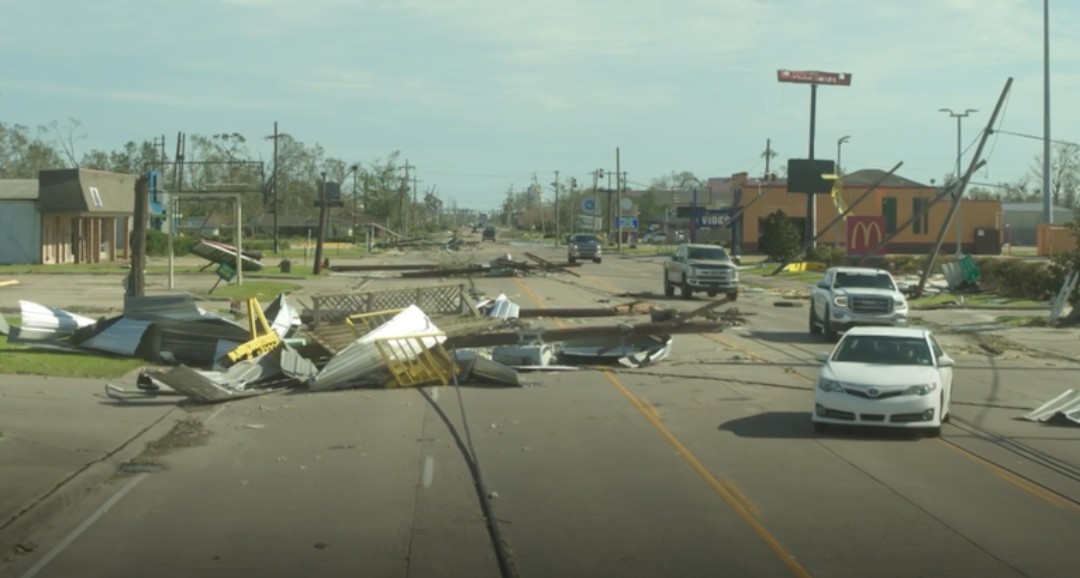
Hurricane Laura, which began the day rolling ashore as one of the strongest storms ever to hit Louisiana, plowed trough the state from south to north, gradually weakening to become a tropical storm but wreaking destruction all along its path and killing at least six people before the afternoon was through.
After slamming coastal communities in the early hours of Thursday, the storm roared into the city of Lake Charles, La., ripping apart buildings and causing a fire at a chemical plant, which sent acrid smoke billowing into the sky and prompted the state to order people living nearby to stay inside with their windows shut.
Laura then steamrolled northward, maintaining hurricane force well into the afternoon, knocking out power to at least 880,000 utility customers in the region and leaving tens of thousands of people without drinkable water.
Four of the deaths tied to the storm in Louisiana were caused by trees falling on homes, according to Gov. John Bel Edwards. One was a 14-year-old girl in Leesville, La., a small city about 100 miles inland; the others were a 68-year-old man near Iota, La., a 64-year-old woman in Allen Parish and a 51-year-old man in Jackson Parish, which is 200 miles from the coast.
In Calcasieu Parish, where Lake Charles is, a 24-year-old man died of carbon monoxide poisoning from a generator inside his house, and another male, whose age was not yet known, drowned when a boat he was in sank during the storm, according to a spokesperson for Louisiana’s health department.
By 4 p.m. Central time, the storm had passed into southern Arkansas, according to the National Hurricane Center. It was trudging north-northeast at 15 miles an hour with maximum sustained winds of 50 miles an hour that extended out 90 miles from the center in all directions. The storm was expected to diminish to a tropical depression overnight.

Laura continued to pose the threat of heavy rains and flash flooding, The center said that up to 7 inches of rain could still fall in much of central and eastern Arkansas, and up to 5 inches in neighboring isolated areas of Mississippi, Tennessee and Missouri. A few tornadoes could also form, the center said.
While many along the Gulf were relieved to find the storm less destructive than they had feared, Laura did cause substantial damage. Roofs were peeled off houses, and the facades of brick buildings were ripped away. Billboards were punched out and knocked down, and trees and power lines littered the roads. In Lake Charles, a regional hub known for its petrochemical plants and crowded casinos, gusts had blown out dozens of windows in high-rise office buildings, including the 22-story Capital One tower, and had ripped the top off a sky bridge.
People on the ground in southwestern Louisiana described severe damage to buildings and vehicles, apparently more from the storm’s punishing winds than from its much-feared storm surge. In Lake Charles, a regional hub known for its petrochemical plants and crowded casinos, commercial buildings were peeled apart, exposing insulation and wood frames. Billboards were punched out and trees snapped in half.
“We did not have the worst case scenario develop — we should all be thankful for that,” Governor Edwards said at a news conference on Thursday. “But there are still thousands and thousands of families whose lives are not right side up today.”
Officials in both Louisiana and Texas had issued the gravest of warnings about the storm, which was among the strongest ever to hit the United States and tied for the strongest ever to hit Louisiana, according to data compiled by Philip Klotzbach, a research scientist at Colorado State University who studies hurricanes. At the peak, more than 1.5 million people in the coastal regions of Texas and Louisiana were under some form of evacuation orders.
But the direst estimates of storm surge did not come to pass; the storm’s damage was chiefly done by its extremely powerful winds.
Search and rescue teams were working on Thursday to get evacuees into shelters such as motel and hotel rooms as quickly as possible, Governor Edwards said, adding, “Today is about saving lives, moving people out of their homes.”
Fallen trees caused much of the damage to homes, sparing others nearby.

Michael Treadway had tree limbs jabbed into his roof. Trees crushing what used to be his carport. Trees on his neighbors’ homes, cars and living rooms.
“Trees everywhere,” he said, sweat-drenched, after he climbed down from his damaged roof early Thursday evening.
Moss Bluff, La., was the land of close calls, near-misses and direct hits.
Fierce winds from Hurricane Laura ripped away roofs and shattered windows, but the trees did some of the worst damage in this town, about eight miles northeast of hard-hit Lake Charles. Trees toppled onto homes, or just nicked them. They came down in front of red-brick banks and outside of Sam Houston High School.
Unlike floodwaters during Hurricane Harvey and Hurricane Katrina that subsumed entire neighborhoods, Hurricane Laura’s tornado-like winds hopscotched the damage in parts of southwestern Louisiana. Houses with minor damage sat across the street from houses pummeled by trees. Unscathed churches and stores were down the street from churches and stores with broken windows and collapsed walls.
Mr. Treadway, a game warden and senior agent with the Louisiana Department of Wildlife and Fisheries, said he had worried that his decades-old house would not survive Laura. “I wasn’t expecting it to be here when I got back,” he said.
But it was. And as he worked up on the roof nailing down blue tarps, he had help — from two fellow game wardens.
Senior Agent Joel Cromp and Sgt. Austin Arteaga were called in from another wildlife region to do search-and-rescue work. There were ultimately few rescues needed, so after their shift was over, they drove to Mr. Treadway’s house to pitch in. They climbed up on the roof using a ladder on the bed of a pickup truck.
“He’d do it for us — we’d do it for him,” Sergeant Arteaga said.
Not too far away on Ryan Road, the giant tree next to Susan Rice’s home came down, roots and all. It barely missed.
Ms. Rice, 64, lived on the lot on Ryan Road in 2005, when Hurricane Rita tore through Moss Bluff. It destroyed her home. So she bought a manufactured home after she was assured it would survive a Category 3 hurricane. Laura made landfall as a Category 4, and only peeled away some roof shingles and tore part of the home’s outer skirt.
“So now I believe them,” Ms. Rice said of those who sold her the manufactured home.
Ms. Rice had evacuated on Tuesday before Laura hit and went to stay with her daughter in Baton Rouge. “On Facebook, I had seen some of the footage of Moss Bluff and I just knew I had lost my home,” she recalled. “I prayed all night.”
She nervously called her neighbors on Thursday morning to ask about her house. They told her it was fine, and still standing.
“I put it to God,” she said.
Thick smoke spread from a fire at a chemical plant in the storm’s wake.

Fire broke out Thursday morning at a chemical plant in Westlake, La., local authorities said, sending thick smoke over a wide area and prompting shelter-in-place directives for residents in the communities of Westlake, Moss Bluff and Sulphur.
Mayor Robert Hardey of Westlake said the fire was burning at a plant operated by BioLab, a subsidiary of Kik Custom Products, which makes cleaners, antifreeze and other chemical products.
Daniel Hoadley, a spokesman for the parent company, confirmed in a statement that the fire was the result of storm damage. He said the company was sending a team of experts to the site to help the local authorities “contain and mitigate the impact of this incident as quickly as possible.” The plant was shut down and evacuated before the storm, he said, and all its employees were safe.
A chlorine leak from the BioLab facility appeared to have started the fire. Colonel Kevin W. Reeves, the superintendent of the Louisiana State Police, said that an “undetermined” amount of the leaked chlorine had begun generating heat and burning, releasing gas into the atmosphere.
The crew at the BioLab made several “unsuccessful” attempts to extinguish the flames, Mr. Reeves said, which began at some point during the course of the storm. The fire has now reached a “stable point,” he said, and officials don’t believe the incident to be endangering anyone off site.
Data from the Environmental Protection Agency shows that the BioLab site, which specializes in making pool and spa cleaning products, stores large amounts of chlorine, which can pose a fire and explosion risk.
Environmental hazards and vulnerable communities were in the storm’s path.

Hurricane Laura’s punishing storm surge and winds swept through some of the most industrialized parts of the southern United States: a broad stretch of coast studded with plants that produce fuels, petrochemicals and other products, and that can release toxic chemicals into the air, water and soil when damaged by storms.
The people living closest to these concentrations of industries are typically the poorest, and tend to be communities of color: places like the Westside neighborhood of Port Arthur, Texas, and Mossville, La., near Lake Charles.
“The fence-line community is the one that’s bearing the burden of pollution and industrial encroachment,” said Robert D. Bullard, a professor of urban planning and environmental policy at Texas Southern University and co-chair of the Black Environmental Justice Network, an advocacy group devoted to addressing harm caused by systemic racism.
Hurricane Laura’s path bisected a region packed with large refineries and chemical plants. Port Arthur has the Motiva oil refinery, North America’s largest. Beaumont has a major Exxon Mobil refinery, and refineries along its ship channel manufacture a majority of the nation’s military jet fuel. Farther east, the city of Orange has dozens of chemical plants. The Lake Charles area is home to a number of major chemical plants, including the Sasol Chemicals complex, owned by a South African company, and the BioLab plant that caught fire Thursday.
While some of the facilities were designed to withstand storms, the amplification that climate change appears to be giving to many of today’s storms could render the old defenses inadequate. The Port Arthur refinery has a 14-foot levee, but the storm surge forecast for Laura ranged as high as 20 feet for parts of the nearby Louisiana coast.
Many of those plants sit right next to vulnerable communities, like Mossville, a historic Black community founded by an ex-slave.
“Hurricane Laura’s path is through environmental justice communities,” said Monique Harden, assistant director of law and policy at the Deep South Center for Environmental Justice in New Orleans.
Two weeks after a vote to keep a Confederate monument, Laura tears it down.

As protests against police violence and white supremacy swept away dozens of longstanding memorials to the Confederacy this summer, a 105-year-old monument on the courthouse lawn in Lake Charles, La., remained standing.
On Thursday, Hurricane Laura tore the statue atop it down.
“It is a blessing, a small blessing, in a very devastating situation,” said Davante Lewis, who grew up in Lake Charles and supported the monument’s removal.
The debate over what to do about the South’s Defenders Memorial Monument, which depicted a Confederate soldier on a marble pedestal, had been the “hottest thing in the city” in recent months, Mr. Lewis said on Thursday, until residents turned their attention to preparing for one of the strongest hurricanes ever to hit the region.
The monument was the object of anger and protests after the killing of George Floyd, a Black man, by the police in Minneapolis. But two weeks ago, the Calcasieu Parish Police Jury, an elected body that acts like a county board of commissioners and has jurisdiction over the courthouse property, voted 10 to 5 at a special meeting to keep it.
“If the city would have done what many of us asked it to do, that statue could be in a museum, it could be well kept together and not be damaged,” Mr. Lewis said. “But unfortunately, they took other opportunities to keep it in the bright light of day, and Mother Nature had another plan.”
Hurricane Laura’s powerful winds — tied for the strongest ever to strike Louisiana — appeared to have ripped the bronze statue of the soldier from its pedestal and left it lying next to the base of the monument on Thursday morning among a pile of broken tree limbs.
Officials said they did not know what will happen to it now.
The statue has come down several times before — including in a 1918 storm, just three years after it was erected — but has always been restored. In 1995 it was blown off and repaired, despite protests from some local residents, including a district judge, who turned their backs as the soldier was returned to the pedestal.
Cary Chavis, who helped lead the recent protests seeking the monument’s removal, said he hoped that would not be the case this time around.
“That’s what I’m hoping for — that as we put Lake Charles back together,” he said, “we put it back together not with images of systemic racism or white supremacy on public grounds.”
Did the storm live up to the fearsome forecasts?

Adam Sobel is an atmospheric scientist and the director of the Initiative on Extreme Weather and Climate at Columbia University.
Was Hurricane Laura actually as powerful and destructive a storm at landfall as predicted? It is surprisingly difficult to answer this question with precision.
The full extent of the damage won’t be known for quite some time, but there are a few things we can say now about the observations of the storm itself.
Let’s start with the wind. Storms are rated by their maximum sustained winds, which the National Hurricane Center defines as the average wind speed over a one-minute period. (Maximum gusts will be higher, but they last just a few seconds.)
The center reports that Laura made landfall with maximum sustained winds of 150 miles an hour, at the high end of the Category 4 range. Yet nothing like that was measured on land. The strongest readings were at Lake Charles, La., where gusts got to 150 m.p.h., but the sustained winds only reached 99 m.p.h.
That doesn’t mean the center was wrong, though. It goes by the maximum sustained winds anywhere in the storm — but very few locations are actually measured, and measurements taken on land tend to be lower because the solid, bumpy land surface slows the air down, compared with the flat, fluid ocean. At landfall, about half the storm is still over water, so it’s likely that the storm’s strongest winds are there, too.
The most frightening prediction about Laura was a 15- to 20-foot storm surge. That did not materialize. The highest surge recorded on a NOAA tide gauge by Thursday morning was around 9 feet — meaning how high the water was above where it would otherwise be with the tide alone. That reading came at Calcasieu Pass, near Lake Charles.
(A 9-foot storm surge is nothing to shrug at: Hurricane Sandy’s maximum surge was about 9 feet, and that caused an enormous disaster.)
Sparse data may be obscuring what happened.
Calcasieu Pass is pretty close to where the center of the storm passed on its way north. We’d expect the storm’s largest surge to occur, not there, but to the east, where the counterclockwise winds were blowing directly onshore. The next gauge to the east that reported any data, though, was at Freshwater Canal Locks, about 64 miles away, and it stopped recording around 6 p.m. Wednesday, well before the peak surge.
Until we get more data, we won’t have a complete picture of how high that peak was.
‘By the grace of God!’: Seeking shelter in a sanctuary in the heart of the storm.
The screaming winds from Hurricane Laura peeled away the blue metal roof of the Lord’s Outreach Worship Center as the storm tore through Lake Charles early Thursday, leaving the parking lot coated in clumps of insulation, and wooden beams exposed to the morning sun. Congregants who rode out the storm inside the church were grateful to be alive.
“We stayed in the sanctuary, and it did not come to the sanctuary,” Devery James, 58, said of the storm. “We lost the roof, but no lives were lost.”
“By the grace of God!” added Meldon Thibodeaux, 55.
Across Lake Charles, a city of 80,000, the storm shaved roofs from homes and businesses, toppled trees and showered yards and roads with tree limbs and ribbons of loose utility lines. In some places on Thursday, major thoroughfares were blocked by impassable floodwaters, and toppled pine trees or collapsed metal signs lay in traffic lanes.
At Lord’s Outreach, on the east end of Lake Charles, congregants spent the night afraid for their lives as the wind and rain shredded their neighborhood.
“This is the house of God, so we prayed about it,” said Kolise Houston, 41.
A parade of utility crews and rescue workers filed into the city on Thursday from Interstate 10, their trucks bullied by the winds still pounding parts of Louisiana. Along the highway, whole thickets of trees bowed to the north, bent by the wind. Barns and sheds had collapsed, and large swaths of open land were littered with debris.
Mr. James chuckled at the reason he had moved to Lake Charles six years ago: “The weather.” He had been living in Pennsylvania, and his girlfriend at the time had an aneurysm; they needed to move somewhere without icy winters, and his girlfriend’s sister lived in the area. “I wasn’t expecting anything like this,” he said.
Joy McCarty’s two children were playing outside the church on Thursday after the wind and rain stopped.
“They didn’t know what to think,” Ms. McCarty said. “They were upset, and didn’t know how to react.”
“But we’re all safe and in one piece,” said Ms. Houston, sitting shoulder to shoulder with Ms. McCarty. “That’s all we can really ask for.”
“There’s probably some who didn’t make it,” Ms. McCarty said.
Ms. Houston, who lives in an apartment complex nearby, wanted to know what had happened to her home. “I don’t know if it’s still standing,” she said. “I hope it’s still standing.”
A dispute among evacuees leads to the fatal shooting of a homeless woman.
A feud among dozens of evacuees in downtown Austin resulted in a shooting that killed a woman whom the police described on Thursday as an innocent bystander. The shooting took place around midnight Wednesday, at roughly the same time that Hurricane Laura was making landfall as a Category 4 storm about 300 miles away in southwestern Louisiana.
Austin, designated as one of Texas’ major evacuation centers, took in more than a thousand Gulf Coast residents in advance of the storm.
The shooting remained under investigation Thursday, but the Austin Police Department said the still-unidentified woman appeared to have been homeless, and was caught in gunfire that erupted from a dispute among dozens of people fighting along Sixth Street, a bar-and-entertainment district about five blocks south of the State Capitol.
Lt. Jeff Greenwalt of the Austin Police said the woman “had nothing to do’” with the feuding groups, whom witnesses told investigators were from Beaumont and Port Arthur, neighboring cities in the oil-rich “Golden Triangle’’ region of the Gulf Coast.
The woman was pronounced dead at an Austin hospital and had no identifying information, Liuetenant Greenwalt said.
“Austin opened up this community for those evacuating from this large storm,” said Monte Osburn, executive director of the city’s Foundation for the Homeless. “To have them come into the community and create this situation where we lose one our own, it’s just a sad situation.”
An estimated 2,500 homeless people live in Austin, according to a survey by the Ending Community Homelessness Coalition, an 11 percent increase over last year.
The evacuation for Hurricane Laura required more than a million people on the Gulf Coast to leave their homes. More than 3,000 of those evacuees were being housed in 21 Austin hotels, as well as the city’s convention center, under a government program as of Thursday morning, said Bryce Bencivengo, a spokesman for Austin’s emergency management agency.
Hundreds or thousands of other evacuees made their own lodging arrangements in the city, or stayed with friends or family, officials said.
Holly Beach, raised high to survive floodwaters, takes a beating from the wind.

Search and rescue helicopters flew low Thursday over Holly Beach, a small coastal community close to where Laura barreled ashore in southwestern Louisiana. But they kept on flying. There was no one to rescue.
Dozens of houses and trailers were destroyed or damaged, but residents had evacuated well before the storm, and there appeared on Thursday to be no one who had stayed behind. Holly Beach was a ghost town.
There were bent trees and bent stop signs. Chunks of roofing and siding littered the street. Air-conditioners dangled by a few wires. Many roads and homes in Holly Beach and on Highway 82 along the Gulf Coast appeared to have escaped flooding damage, but windblown debris was everywhere. The scene looked less like the aftermath of a hurricane than of a tornado.
Houses on stilts were dry at the bottom but roofless at the top. Downed power lines laced the pavement or hung low enough to scrape the hoods of cars. Tin roof sections were wrapped around utility poles like swirls of cotton candy on a stick. R.V. parks were wrecks of wind-tossed furniture and toppled walls.
With no cellphone or internet service available for miles, communities like Holly Beach were eerily lifeless in the wake of such an intense storm. Most of the people milling around on Thursday afternoon were reporters and TV news crews, and most of the sounds came from the whirring of helicopters, the flapping of dying fish in the muddy streets, the creaking of unmoored aluminum siding twisting in the wind. Confused crabs dashed across the sand-caked streets.
Holly Beach, 11 miles west of Cameron in an area known locally as the Cajun Riviera, is mostly a narrow strip of houses on stilts facing the Gulf. The community was all but wiped out by Hurricane Rita in 2005; after that, houses had to be raised higher off the ground, a strategy that seemed to spare them from flooding this time — but not from Laura’s ferocious winds.
Texas officials say the state has suffered less destruction than they had dreaded.

With Hurricane Laura marching north through Louisiana on Thursday after landing just east of the Texas line overnight, local officials in East Texas said that damage on their side of the border appeared to be far less severe than feared.
In Jefferson County — home to two cities, Beaumont and Port Arthur, that were devastated by Hurricane Harvey — the top elected official said he was thrilled.
“We dodged the bullet,” said the official, County Judge Jeff Branick, in a text message. “Widespread power outages, but not the property damage, carnage and flooding we’ve seen in past storms.”
Mr. Branick said that other than the electricity problems, the reports were good so far in Port Arthur, where officials had worried about a hard hit from wind damage and storm surge. The county is lifting its mandatory evacuation order, clearing the way for residents to return home.
Gov. Greg Abbott said on CNN Thursday morning that the state had not yet had any reports of fatalities from the storm, which he attributed to residents heeding warnings to evacuate early.
“The storm surge and the powerful winds could have led to catastrophic deaths,” Mr. Abbott said. “We no doubt saved lives because of those evacuations.”
He said search and rescue teams were in the Beaumont, Port Arthur and Orange County areas looking for people who needed help, and that the storm still posed a threat as it moved inland. “People in northeast Texas still need to remain very vigilant right now,” he said.
About an hour’s drive down the Texas coast from Port Arthur, on the Bolivar Peninsula, Wilford Raney, 56, was beginning to take stock of his property on Thursday morning. He was unable to secure a trailer in time to evacuate his livestock, so he decided to stay put and make sure his 25 cows were protected.
“You could hear everything going crazy,” he said, noting that a tree on his property was ripped apart by the wind. “I can’t tell you how many times we just prayed.”
Mr. Raney said he believed nearly everyone else in Gilchrist, his town, had evacuated, in part because Gilchrist has no sea wall and little protection from storm surges. “That’s something that scares everybody the most,” he said.
But he knew he couldn’t leave his livestock alone, he said, and when the winds died down in the morning, he was relieved to find that his animals were secure.
“I do everything I can to have my animals safe,” Mr. Raney said.
Louisiana, the state in the storm’s way, has also been ravaged by the coronavirus.

Hurricane Laura has descended on a state that has been among the hardest hit by the coronavirus pandemic. With more than 145,000 confirmed cases, Louisiana has a higher rate of infections per capita than any other state in the nation.
Early on, the virus was particularly brutal in New Orleans, where Mardi Gras celebrations helped fuel an eruption in cases. But it has also more recently been spreading rapidly in other parts of the state, including Baton Rouge and the Shreveport area, which are in the storm’s path.
Though daily case counts have fallen a bit in the state since reaching a peak in July, the virus was still lurking when the storm arrived. In the area around Lake Charles, which was being pounded by the storm on Thursday morning, about 9 percent of tests have been coming back positive lately, well above the 3 to 5 percent rate that experts say would indicate the virus was being brought under control.
The convergence of two crises threatened to deepen. them both. Virus testing sites were closed in parts of Louisiana this week in anticipation of the storm. Fleeing families piled onto evacuation buses — this time wearing masks. And Gov. John Bel Edwards turned to a message that has now become familiar: Stay home.
“It’s 2020, right?” said Rebecca C. Christofferson, who studies emerging viruses and transmission at Louisiana State University and spent part of Wednesday hunkered down in the bathroom as strong thunderstorms raged outside her home in Baton Rouge. By Thursday morning, she was watching the hurricane’s torrential rains pour down in her neighborhood.
“People have family everywhere,” she said, “and what do you do when you evacuate? You go to family’s house.” But during a pandemic, she said, that precaution can also become a risk. “You are inheriting the network of the people coming to you, they are inheriting your network,” she said. “At some point, something is going to converge.”
Source :New York Times











Alli Visits Slain APC Member’s Family, Pledges Support for Pregnant Widow

Fresh N100bn Loan: Oyo APC Tells Makinde to Refund Every Kobo After Office

Watchdog Alleges Pressure on Oyo LG Chairmen, Warns Against Releasing N2.57bn for election



-
 Politics4 weeks ago
APM Rally: APC Tackles Makinde Over Use of ‘CAF-Rejected’ ₦5.5bn Stadium
-
Politics4 weeks ago
Oyo: No APC Defection To APM, Makinde Lied — APM Scribe
-
Opinion4 weeks ago
Makinde Deserves No Sympathy: He Brought His Present Predicament Upon Himself
-
Politics2 weeks ago
2027: Oseni condemns attack on campaign train, demands probe