Connect with us

News

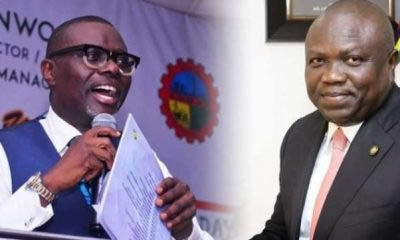
Ambode vs Sanwo-Olu: Why we cancelled Lagos primary – APC panel

Published

on

The All Progressives Congress, APC, National Working Committee (NWC) has explained why it cancelled the Lagos governorship primary election that took place earlier in the day.

It said the preparatory process for the election had just been concluded.

The Chairman of the panel, Chief Clement Ebri spoke at a news conference in Alausa, Ikeja.

The battle is between Governor Akinwunmi Ambode and Babajide Sanwo-Olu, a former commisioner.

“The preparatory process had just been concluded for the primaries. The primary is to begin anytime soon.

“There was no election. Election materials are being sorted.

“The stage is set and election begins anytime from now. We have guidelines and we will stick to the guidelines.

“Because of the political tension in the state, we decided to be very careful, very methodical. As party men, peace is more important to us than victory.

“We want a kind of victory that will be celebrated by both parties.

“We want an election that will be credible and in line with the guidelines, the extant rules and the laws of the country.

“And that is what we have done. We are ready to go to the field and execute this. So that at the end of the day, we will not be accused of partisanship. Lagos is very important to us and it is a flagship of the APC,” Ebri said.

He said that the panel was ready to give the most credible primary to the state and would contact the national headquarters for information on the preparatory process.

“It takes a lot of work for the main show to take place.

“We are ready to give the state the most credible election.

“We will contact the national headquarters on the timing for the release of materials. It is not our fault that this exercise took this long,” he said.

Ebri said the panel was waiting for the party chairman, Alhaji Tunde Balogun, to provide certain information that would enable them post people to the wards.

“We have two aspirants and we need to be fair to both parties. The information we demanded for came in about an hour ago. And we had to struggle this period to balance the equation.

“Now that we are ready, we will contact the national headquarters on the situation and the right time will be announced,” Ebri said.

He said that five persons from the local organising committee and four for each ward would be posted.

“They will all go out to ensure the primary is conducted. We all understand the terrain in the state especially as it concerns the traffic situation. So, the materials are available now and ready for deployment.

“The national secretariat advised us to use ballot papers and we came into Lagos with thousands of them. But during the stakeholders meeting, it became obvious that the state chapter of the party was not ready for such primary.

“They claimed that there was time to educate the members and others. And based on the submission made at the stakeholders meeting on Monday, some changes were made,” he said.

Ebri said the panel was advised to conduct the open ballot in a manner that would be objective to all parties.

“And that is one of the adjustment we made to accommodate views of the stakeholders. For us, the stage is set and the primary should commence any moment from now,” he said.

Earlier, the chairman Lagos APC, Balogun said the election held and that it was free fair and credible.

When asked if the panel supervised the election, he said he would not be able to answer that.

According to Balogun, he only saw observers and could not tell.

“We are awaiting the panel to declare the result,” he said.

Comments

News

Senate passes state police bill, governors to appoint CPs

Published

on

The Senate on Wednesday passed a bill seeking to amend the 1999 Constitution to establish state police services across the country, a major milestone in ongoing efforts to decentralise policing and tackle Nigeria’s worsening security challenges.

The proposed legislation introduces a dual policing framework comprising a Federal Police Service and State Police Services, effectively replacing the existing structure under which policing is exclusively controlled by the Federal Government through the Nigeria Police Force.

The bill was passed after Senate Leader, Opeyemi Bamidele, presented its general principles on the floor of the Red Chamber.

It subsequently scaled second reading, underwent a rigorous clause-by-clause consideration and was passed for third reading after securing the support of more than two-thirds of the senators.

A key provision of the constitutional amendment empowers governors to appoint Commissioners of Police for their respective states, subject to confirmation by the state Houses of Assembly.

Clause 17 of the bill provides that a State Police Service shall be headed by a Commissioner of Police appointed by the governor on the recommendation of the National Police Council and confirmed by the House of Assembly of the state.

The proposed law further defines the operational relationship between governors and state police commands, allowing governors to issue lawful written directives of a general policy nature to Commissioners of Police on matters relating to the maintenance of public safety and order within their states.

To address widespread concerns over possible abuse of the proposed policing structure, lawmakers incorporated safeguards aimed at protecting political freedoms and civil liberties.

The bill expressly states that a state Commissioner of Police shall not arrest, detain, investigate or deploy force against any individual, political party or group merely for criticising the government, except in accordance with the law.

The provision is intended to prevent state police formations from being used to intimidate political opponents, activists, journalists and other dissenting voices while ensuring that all actions taken conform with due process.

The amendment also empowers the Federal Police Service to temporarily intervene in the internal security affairs of a state where there is an actual or imminent breakdown of public order or public safety which the state police are unable or unwilling to contain.

Such intervention must be authorised in writing by the President, who is required to state the grounds, territorial scope, functions and duration of the operation.

The President must also notify the governor, the Speaker of the state House of Assembly, the National Police Council and the National Assembly within 48 hours of the commencement of the intervention.

The bill further provides that no federal intervention shall continue beyond a period to be prescribed by an Act of the National Assembly unless approved by a resolution of the Senate.

The Senate’s approval came barely a day after President Bola Tinubu transmitted the bill to the National Assembly as part of his administration’s efforts to reform Nigeria’s security architecture.

According to the President, the proposed amendment is designed to provide a legal framework for a dual policing structure that would allow states to establish and operate their own police services alongside the federal police.

Tinubu said the proposal is a critical component of ongoing efforts to reorganise the country’s policing system, enhance security and better protect citizens, adding that communities, municipalities and local government areas would play more active roles in policing responsibilities under the new arrangement.

The renewed push for state police comes amid growing concerns over insecurity, banditry and mass kidnappings across parts of the country.

Supporters of the proposal argue that decentralised policing would strengthen grassroots intelligence gathering, deepen community-based security initiatives and ensure quicker responses to crimes and emergencies.

Critics, however, have cautioned against possible political interference by governors, funding challenges and the risk of exacerbating ethnic or communal tensions.

Tinubu had earlier described state police as inevitable in addressing the nation’s security challenges and urged lawmakers to fast-track constitutional amendments aimed at bringing the proposal to fruition.

Continue Reading

News

Tinubu sends state police bill to Senate

Published

on

President Bola Tinubu has transmitted a Constitution Alteration Bill to the Senate seeking the establishment of state police as part of efforts to reform Nigeria’s security architecture.

The proposed legislation, contained in a communication dated June 15, 2026, was read during plenary on Tuesday by Senate President Godswill Akpabio.

Tinubu said the bill was aimed at providing a legal framework for a dual policing structure that would allow states to establish and operate their own police services alongside the Nigeria Police Force.

According to the President, the proposed amendment forms a key component of ongoing efforts to restructure the country’s policing system to improve security and enhance the protection of lives and property.

He explained that under the arrangement, communities, municipalities and local government areas would play more active roles in policing, enabling local authorities to detect suspicious activities and promptly relay intelligence to security agencies.

Following the presentation, Akpabio referred the bill to the Senate Committee on Constitution Review and directed it to report back on Wednesday.

Speaking on the importance of community-based policing, the Senate President said local authorities were better placed to identify security threats and support proactive responses by law enforcement agencies.

“You will know when foreigners infiltrate Nigeria and alert security agencies so they can react proactively rather than reactively,” he said.

Akpabio expressed optimism that sustained collaboration between the executive and legislative arms would ensure the successful passage and implementation of the initiative.

He disclosed that the process would be undertaken in phases through constitutional amendments and subsequent Acts of Parliament.

“We will do it in two phases through alteration and an Act of Parliament. There will be a lot of safeguards; let us come and do this important task. It is extremely important that we come tomorrow,” he said.

The Senate President also informed lawmakers that plenary would not entertain other major business following the death of a member of the House of Representatives, Yahaya Tongo of Gombe State.

Similarly, the Senate Leader urged senators to attend the next sitting, stressing the significance of the proposed state police framework.

“We need a minimum of two-thirds of members to vote on constitutional alterations. The issue of state police is non-partisan and cuts across geopolitical zones and interests,” he said.

The latest development came barely two weeks after the Senate passed an executive bill on state police for second reading.

Akpabio said the fresh Constitution Alteration Bill transmitted by the President builds on the earlier proposal and seeks to provide the constitutional foundation necessary for the establishment and operation of state police services across the country.

Continue Reading

News

Kola Oyewo’s family to Adeleke, Ooni, Atiku: Your condolences are our pillar of strength

Published

on

The family of the late veteran actor and scholar, Chief (Prof.) Adekola “Kola” Oyewo, has expressed deep appreciation to Governor Ademola Adeleke of Osun State, the Ooni of Ife, Oba Adeyeye Enitan Ogunwusi, Ojaja II, and former Vice President Atiku Abubakar, among other Nigerians, for their messages of condolence and support following the death of their patriarch.

In a statement issued on Saturday by Dr. Adewale Oyewo on behalf of the family, the bereaved household said the overwhelming show of sympathy, prayers, visits and acts of kindness from across Nigeria and beyond had served as a strong pillar of comfort in their period of grief.

The family described the late Oyewo as a respected community leader, accomplished academic, devoted family man, and traditional title holder whose life was defined by service, integrity, and unwavering commitment to societal development.

According to the statement, the tributes received in his honour reflect the far-reaching impact he made on students, colleagues, cultural practitioners and the wider society.

The family particularly appreciated Governor Ademola Adeleke for his condolence message and prayers, noting that his support had been deeply comforting.

It also expressed gratitude to the Ooni of Ife, whose words of encouragement were described as uplifting and consoling during the mourning period.

The statement further acknowledged the Oloba of Oba-Ile, Oba (Prof.) Adekunle Ashamu Oyeyemi (Tewogbade I), the Oloba-in-Council, and other traditional institutions for their fatherly support and solidarity.

Former Vice President Atiku Abubakar was also commended for his message of sympathy, which the family said brought reassurance in their moment of loss.

The family extended appreciation to professional bodies including the National Association of Nigerian Theatre Arts Practitioners (NANTAP) and the Theatre Arts and Motion Pictures Practitioners Association of Nigeria (TAMPAN), as well as academic communities of Obafemi Awolowo University, Redeemer’s University, Ekiti State University, and Elizade University, where the deceased served.

They also thanked friends, associates and well-wishers who stood by them with prayers and support.

“As we continue preparations to honour the life and legacy of our beloved patriarch, we humbly seek continued prayers and support,” the statement added, praying for the peaceful repose of his soul.

Continue Reading

Advertisement

Entertainment

Advertisement

MegaIcon Magazine Facebook Page

Advertisement

MEGAICON TV

Advertisement

Trending