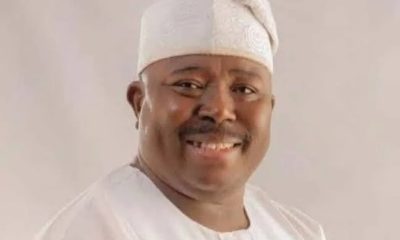
The campaign organisation of the All Progressives Congress (APC) governorship candidate in Oyo State, Senator Sharafadeen Alli, has criticised Governor Seyi Makinde over the state government’s reliance on diesel-powered generators for streetlights, questioning the fate of its N8.5 billion independent power project (IPP).
The campaign organisation, in a statement by its Director of Media and Publicity, Bisi Oladele, said the governor could not continue to blame inadequate electricity supply for the use of fuel-powered generators when the state had acquired regulatory powers to develop its electricity market.
It argued that the Electricity Act 2023 had opened the way for states to develop intrastate electricity markets and attract private investment into power generation and distribution.
Oyo State subsequently established the Oyo State Electricity Regulatory Commission (OYSERC), while regulatory oversight of the state’s intrastate electricity market was transferred from the Nigerian Electricity Regulatory Commission (NERC) to the state regulator in August 2024. NERC said the transfer was carried out pursuant to the Electricity Act 2023.
The campaign organisation said: “Governor Makinde, therefore, has no excuse for his own incompetence and glaring failure.”
It specifically questioned the outcome of the 11-megawatt Oyo State Independent Power Project awarded to Elektron Energy.
According to the campaign, the project, which it put at N8.5 billion, failed to deliver the expected value to residents despite the money committed to it.
However, records from the governor’s office show that the project was conceived as an 11MW hybrid power solution comprising 10MW of gas-fired generation and 1MW of solar power, to supply government facilities within the Oyo State Secretariat, Agodi, Ibadan and adjoining areas. The project was structured on a Build-Operate-Transfer model.
The first phase of the project was commissioned in December 2024. Elektron Energy said the commissioned facility combined 10MW of gas generation, 1MW of solar power and a 1MWh battery energy storage system.
The Alli campaign, however, said the project had not produced the benefits promised by the administration.
It also questioned the continued operation of diesel-powered streetlights on major roads across the state, alleging that the generators were expensive to maintain and had become a recurring drain on public resources.
“Even the diesel-guzzling streetlights are no longer working, leaving many major roads dark at night,” the statement said.
The campaign organisation further challenged the state government to explain why the power project had not provided a sustainable electricity source for public infrastructure, including streetlights, the state Secretariat in Agodi and health facilities which, it said, had been listed among the intended beneficiaries.
It compared Oyo’s experience with developments in other states, citing Abia’s 188MW Geometric Power project and Akwa Ibom’s 191MW Ibom Power plant.
Abia State’s government confirms that the 188MW Geometric Power Plant was commissioned in February 2024 to supply electricity within the Aba ring-fenced area, while Ibom Power’s own records put its installed Phase One capacity at 191MW.
The campaign also faulted Makinde for citing poor electricity supply as a reason for continued dependence on diesel generators.
It said the explanation was particularly troubling given the governor’s professional background as an electrical engineer.
“The purpose of leadership is to solve problems, not to repeatedly describe them or use them as excuses for failure,” the statement said.
It added that after more than seven years in office, the governor should be held responsible for problems within the state’s authority and capacity to address.
The campaign organisation proposed a power strategy built around solar-powered streetlights, embedded generation, renewable energy, independent distribution networks and increased private-sector investment.
It said these would form part of Senator Alli’s agenda if elected governor of Oyo State.