Connect with us

Opinion

The Mohbad in Nigeria at 63 |By  Festus Adedayo

Published

on


Humour and laughter often serve as a powerful tool in driving home words that may otherwise be difficult to communicate. An example is Nigeria celebrating her 63rd anniversary and yet enmeshed in several dysfunctions that cannot be explained. One of the many popular jokes about the Nigerian crisis available on the streets has attempted to humourize the ailment and drive home the complexity of the Nigerian problem.

It goes thus: “There is absolute (turmoil) – economic collapse, political commotion, wars, social dislocation, tsunamis etc – in the world, and all nations decide to meet God in Heaven to ask for when their great tribulations would come to an end. Every single country that comes before God does so in sublime supplication and with torrents of tears, pleading for knowledge of when its problems would come to an end. The Almighty obliged each country, telling it when all would be well. Some got 10 years, others were promised 25 years, others about 50 years. When Nigeria staggers before the Almighty to ask God for when her problems would be over, God bursts into tears…”

Although an engaging comic, the humour speaks to Odolaye Aremu, late Ilorin, Kwara State Dadakuada musician’s song. Odolaye sang that when a calamity grieves the heart beyond measurable limit, even tears become incapable of articulating the tragedy, precipitating the need to employ laughter as well. “Oro t’o ba j’ekun lo, erin laa fi rin”, Odolaye sang. Perhaps, God later laughed? He had endowed Nigeria with too much potentials to warrant her getting this stuck in the mud.

Today marks Nigeria’s 63rd Independence Day celebration. In the midst of all diseases that ail Nigeria, apart from the need for gratitude to God by her citizens over their individual existence, there is hardly any cause for cheer. When a situation appears hopeless, the babalawo’s words become poignant in his bid to articulate the sorrowful climate. He says birds have refused to chirp as they are wont to, and rats have lost their squeaks. This equation appears to be Nigeria’s. Nigerians are agreed that today, there is no reason for celebrations.

If anyone ever doubts that there is a synchrony between living and non-living things, dead and the living and that life can be better lived if we take lessons and messages from situations around us, Late Alagba Adebayo Faleti reinforced this binary. In Saworoide, Mainframe International’s satiric movie, a critique of bad leadership that has become a pestilence in Africa, Faleti played the role of an elderly palace staff called Baba Opalanba. Opalanba is a Yoruba name for broken bottle. Anyone who ever once mistakenly stepped on smithereens would remember the discomfiture and pain shards inflict. A knowledgeable and respected thespian and broadcaster steeped in, and a repository of Yoruba culture and tradition, Faleti’s role in this movie was that of a sage. His lacerating words, delivered through music, chastised evil and evil doers. Opalanba demonstrated that music can be used to straighten the curves of bad leadership. Pretending to be asleep while chiefs gathered to hatch details of their evil plots, Opalanba deployed his sagely musical lines to chaperone them off their path of destruction. He warned that birds that perch on rooftops don’t do so merely to rest their aching legs but to gather information. He expressed this as, “Oro l’eye ngbo, eye o dede ba l’orule o, oro l’eye ngbo o”.

Nigeria must be one of the most researched countries in the world. Scholars have dissected her stunted growth from all prisms. At inception, the country held huge promises for the Blackman all over the globe. Three months into Nigeria’s independence in 1960, in its December 5, 1960 edition, the Time magazine, super-excited about her prospects, had written, “In the long run, the most important and enduring face of Africa might well prove to be that presented by Nigeria,” while adding that Nigeria was a “sober voice urging the steady, cautious way to prosperity and national greatness.” On the front page of that Time edition, the picture of Queens English-speaking Tafawa Balewa, Nigeria’s Prime Minister, adorning his native babariga announced to the rest of the world that the Blackman had arrived the global scene. Gradually, like the destructive cells of cancer, Nigeria began to destroy every of those potentials.

Since the destruction started to manifest, from military rule to civilian dictatorship, different theses have been propounded on what led to the quashing of such massive investments of hopes. Not only has Nigeria proved to be a total letdown to the rest of the black world, she has been a major letdown to her citizens themselves.

So many descriptions have been coined to express the colossal letdown that Nigeria is. My teacher at the University of Ibadan, Eghosa Osaghae, labeled the Nigerian fall as that of a crippled giant. Karl Maier, American-born ex-African correspondent for the London-based newspaper, Independent, in a locus classicus biography of Nigeria’s rot, said it was a house (that had) fallen, even remarking that, “(w)ith the benefit of hindsight, it is clear that such optimism (the like of Time magazine’s) was naïve” and that, in retrospect, Nigeria was “the bastard child of imperialism.” To the duo of Nigerian scholars, Wale Adebanwi and Ebenezer Obadare, “Nigeria is the predicted ‘giant’ that has become a disappointing, even aggravating Lilliput.”

In the case of Nigerian rapper, Ilerioluwa Oladimeji Aloba, professionally known as MohBad, and his fatherland, there may be a synchrony, a link of his life with the Faleti bird that perches on the rooftop. A few weeks to today’s Nigerian independence anniversary, specifically on September 12, 2023, hitherto sparsely-known Mohbad suddenly died, aged 27. At death, MohBad seized the klieg like a pestilence, calling global attention to the life he lived, the state of Nigerian music and the ordinariness of death in Nigeria. Apart from being a rapper, he was a singer, songwriter and formerly signed to Naira Marley’s Marlian Records. His hits that have since shot him to top ranking dancehall charts are Ponmo, Peace, Beast and Peace, Sorry, Feel Good and KPK (Ko Po Ke).

Mohbad’s convoluted death has evoked all manner of theories on what exactly could have led to his untimely departure. From suspicion of his having been poisoned, gas-lighted to his grave or probably remote-controlled to his death through native talisman, the likelihood of resolution of the cause of Mohbad’s death, even after the release of an autopsy report carried out on his exhumed body, may be slim. However, at death, Mohbad’s hidden glory became manifest. By September 15, three days after his sudden death, his Beast & Peace, which was the opening track of his Blessed album, oscillated at Number Four and his Feel Good track flicked at Number Five of global music ranking. In the same vein, between September 12 and 14, a space of two days post-death, his streams peaked at 702%, from 990,000 to 8.02 million. During the week of September 2023, Peace, one of his tracks, debuted on Billboard’s Hot Trending Songs chart, occupying its prestigious Number Two. Equally, on September 18, 2023, Blessed peaked at Number Four, and Light hit its first on the chart entry, becoming Number 20 on the Nigerian Official Top 50 Albums chart. On September 21, streams of Blessed catapulted to the top by over 530%, while on September 23, Mohbad rose to become the 46th best-selling digital artist, sidestepping recognized international artists like Nicki Minaj, Eminem, 21 Savage, Lady Gaga and Chris Brown.

Though not as beloved alive as in death, the rash attempt to beatify Mohbad, both as a brand and due to the tragic circumstances of his death, has made apportioning him blame for his own death very unpopular. The truth however is that drug addiction among Nigerian youths and specifically, among musicians, played a major role in the circumstances of his early passage. From testimonies about his life, it was obvious that Mohbad got trapped in the puddle of that destructive belief that drug consumption was an enabler of musical inspiration.

Drug consumption has, from time immemorial, been the bane of music and musicians. It is an affliction that didn’t just start today; it has dragged many notable musicians down the sepulcher, in their scores. Even outside the shores of Nigeria, there exists this subsisting but notorious notion that drug consumption contributes highly to artistic inspiration. While scientific studies locate a liaison between these two, no study has been able to strictly confine inspiration strictly to drug consumption. In other words, there have been artists who got to the topmost height of their careers but who did so while maintaining wide social distancing from drugs. What this means is that, yes drugs can be enhancer of inspiration, other less-dangerous pastimes can evoke even higher inspirations as well. You could count artistes, in remarkable number, who never had any consonance with drugs.

In my book, Ayinla Omowura: Life and Times of an Apala Legend (2020), I drew on a canvas the tragic life of Ayinla, an equally highly talented Yoruba musician whose life was cut short in his prime in 1980. While drug consumption, which he was notorious for, couldn’t be strictly isolated as the cause of his death, it was obvious that if Ayinla had escaped the bar-room violence that eventually took his life, another death lurked in the backyard for him in his addiction to drugs. Many of today’s musicians are enmeshed in a binge of drugs consumption. A couple of years ago, the name of hip-hop singer, Davido, was identified in a messy puddle of group drugs allegation, when some of his friends were caught with the substance, a pastime that claimed the lives of some of them. For this gang in the musical and showbiz world, it is almost an anathema not to be involved in the culture of drugs, which I once dubbed “the water bottle culture.” This has proved to be the graveyard of many in this category.

Whenever the issue is about drug addiction, one musical star close to my heart, which dimmed unceremoniously and whose fatal life I always cite, is Brenda Fassie. A highly talented South African singer, who was so talented that the great Nelson Mandela was not only fascinated by her song and danced with her on the dancehall, Madiba and million others, including me, were her fans. Born on November 3, 1964 in Langa, Cape Town, Brenda was a wonder to watch. Her album, Memeza (Shout), which was released in 1997, is rated as the top of her musical success. It went platinum on the first day of its release. After Yvonne Chaka Chaka, arguably, no musician from that country possessed Brenda’s waltz and voice. She also made a huge contribution to Miriam Makeba’s famous hit, Sangoma, as well as Harry Belafonte’s anti-apartheid song, Paradise in Gazankulu. She was once voted 17th in the Top 100 Great South Africans. Unfortunately, Brenda was a suicidal drug addict and addictively wedged to lesbianism.

Brenda was not only talented but possessed the tantrums of divas, so much that the Time magazine dubbed her the Madonna of the Townships. The world, however, began to notice hiccups in her life when her weird passion spilled into the limelight in 1995. Brenda was found in a hotel room with the remains of her lesbian partner, who passed on during an orgy. She had died of an apparent drug overdose. Brenda herself must have gone in and out of a rehab for about 30 times and on one occasion, sure she had overcome drugs, screamed, “I’m going to become the Pope next year. Nothing is impossible!” A few years after, Brenda reportedly collapsed in her brother’s arms, flung her last cocaine straw on the kitchen floor of her home in Buccleuch, fell into coma and died on May 9, 2004, shortly after suffering from a brain damage. Postmortem report even claimed she was HIV-positive.

Today, hundreds of musicians and emerging stars, especially in Nigeria, are trapped in waltz of drugs. Their excuse is that it is a performance-enhancer. They however fail to come to terms with two facts: one, that you could perform resplendently without drugs and second, drugs could cut your life short at the cusp of stardom.

While hopefully, autopsy should tell us what actually killed Mohbad, the fact that this talented artist stomached innate, bountiful glory in him for 27 years of his earthly existence, while glorying in peripheral stardom, is an area of interest to me. At 63, scholars, spiritualists, international agencies, comity of nations, etc. who speak disappointingly of Nigeria’s Mohbad glory, even as she is bedeviled by underdevelopment and bad governance, have not ceased to marvel.

In the same way as what led to Mohbad’s death and his stunted glory while alive has been a subject of intense debate, in the last 63 years, no conclusion has been reached on what actually led to Nigeria’s stunted growth. For instance, scholars who sought to unlock the secret of the Nigerian crisis, like famous writer, Chinua Achebe, in his The Trouble With Nigeria, have submitted that leadership is at the cusp of the crisis. Osaghae, in Crippled Giant, follows this same conversation. So also did Wole Soyinka, who, while conducting a postmortem on General Sani Abacha, reckoned that Nigerian leaders have “no idea of Nigeria (and) no notion of Nigeria.” Some others even said that Nigeria was such a queer contraption that “it is within disorder or adversity that many social actors in Nigeria have derived profit or advantage.”

Some other scholars locate the Nigerian stunted glory in what they called the “resource curse” thesis, in that the oil find in Nigeria ruined her growth. This thesis is padded by a joke which allegedly transpired in the 1950s between the Nigerian economic minister and the Prime Minister. The minister had told the PM, “I have some good and bad news for you” and the PM asked for the good news first. When told that Nigeria had just discovered a large swathe of petroleum buried deep in the bowel of her soil, excited at the immeasurable possibilities for growth of the find, the PM then asked for the bad news. He was told that, “The bad news is that we have just discovered vast reserves of petroleum!”

To some others, Nigeria’s Mohbad-like stunted glory is due to the fact that blood was not shed in the struggle for her independence, as was done in South Africa and some Southern African countries. I disagree with this thesis because our forefathers indeed sacrificed their lives in the cause of the 1960 independence. Yet, some said that the quality of the led is Nigeria’s problem. This appears very profound because the havoc which followers have wrecked since independence is indeed colossal. To some, it is a sustained history of corruption in Nigeria that has made us a Mohbad.

I tend to agree with those who concluded that Nigeria’s major problem is leadership. We thought 2023 would give us what has clearly posed a stumbling block to our growth. The last four months have been very opaque and do not speak to any hope in the horizon. We still need to continue to search for that leadership. French historian, Fernand Braudel, has argued that “any nation can have its being only at the price of forever being in search of itself.” Unfortunately, Nigeria hasn’t begun or is hypocritical about the search. Leadership makes a huge difference in the life of a people. A comparison is often made about a Nigeria that seems to be free of natural disasters like cyclone, earthquakes, hurricanes and tremors which afflict other countries at the drop of a hat. When such disasters happen in those countries, leadership comes to their rescue. Nigeria, on the reverse, seems to be afflicted by a more tumultuous and deadlier disaster – leadership.

Yet, many others have predicted that it is only when Nigeria dies, like Mohbad, that her glory can materialize. It is then that all her trapped glorious stars (nations) will reach for their utmost heights. This is after she may have been granted opportunity to breathe as independent entities.

Good night, Mohbad.

Comments

Opinion

G-WAGON: Dare Adeleke, A Liar’ll Steal; Why’re You Desperate To Conceal The Truth? | Maroof Asudemade

Published

on

I have read Dare Adeleke’s rather vacuous response to my article on Governor Seyi Makinde’s presentation of a brand-new Mercedes-Benz G-Wagon 500 to the President-General of the Central Council of Ibadan Indigenes (CCII), Barrister Sulaimon Ajeniyi Ajewole. Unfortunately, beneath the insults, name-calling on my person and his apparent eye-service desperation to impress his political benefactor, there is hardly any substance worth engaging.

Adeleke devoted considerable space to calling me a drunken, lowly writer. Yet, in all his verbal gymnastics, he conspicuously failed to address the fundamental questions raised in my article. Has Governor Makinde paid the statutory salaries and entitlements of the Olubadan of Ibadanland, Oba Rashidi Adewolu Ladoja, and the Alaafin of Oyo, Oba Akeem Owoade, since their ascension to the respective thrones? Has his administration provided them with official vehicles, as expected under the applicable government arrangements? These were the issues Adeleke ought to address not my personality.

If he had any credible answers to these questions, he would have provided them. Instead, he chose to exhibit his wrakness as an intellectually exhausted defender. He resorted to abusing the messenger when he couldn’t dismantle the message.

However, there is one particularly interesting aspect of Dare Adeleke’s response that deserves immediate correction. He lied that Governor Makinde spent N1 billion on the completion of the Olubadan Palace. Is he sure he’s not addicted to stealing as a liar? The financial contributions towards the completion of the palace came from multiple sources, including the 11 local governments in Ibadanland, each of which contributed N50 million, amounting to N550 million.

Governor Makinde contributed N250 million. The governor’s contribution was N250 million, not N1 billion! Why would Adeleke inflate the governor’s contribution from N250 million to N1 billion? Is he so desperate to manufacture an impressive record for his political principal that figures have become expendable? Or does he imagine that exaggerating the governor’s generosity will make the unanswered questions of ridiculing our royal fathers disappear?

The 11 local governments of Ibadanland have a responsibility towards the Olubadan institution. Their contributions towards the palace should not be presented as a personal sacrifice by Governor Makinde. They are contributions made by public institutions to an institution that belongs to the people of Ibadanland.

Even more disturbing is Adeleke’s inane argument that because Makinde contributed money towards completing the Olubadan Palace, the governor deserves appreciation rather than criticism. This argument betrays a shocking failure of Adeleke to distinguish between governmental responsibilities and statutory obligations.

Let us even assume, for the sake of argument, that Makinde personally spent N1 billion on the palace. How does constructing or completing a building discharge the government’s obligation to pay the statutory salaries and entitlements of the Olubadan and the Alaafin? How does a palace building become a substitute for official vehicles? Are these royal fathers supposed to live in beautiful palaces while their statutory entitlements remain unpaid?

By Adeleke’s ‘logic’, Governor Makinde could build a magnificent headquarters for the Nigeria Labour Congress and subsequently refuse to pay workers their salaries, expecting the labour movement to applaud him for his generosity. Would that be acceptable? Could the government substitute office buildings for workers’ wages? Dare Adeleke is glaringly a peripheral thinker!

A building is a capital project. Salaries and official entitlements are separate obligations. Since Adeleke knew he could not understand this elementary distinction, he should have smelt his argument before presenting it to the public. His defence is not only logically defective; it is intellectually sour.

More importantly, the completion of the Olubadan Palace was not the subject of my article. I did not dispute the governor’s contribution. I questioned the apparent contradiction between his extravagant generosity towards the CCII President-General and the allegations of neglect concerning the official entitlements of the Olubadan and the Alaafin. Adeleke has not answered that question. He has merely introduced an unrelated expenditure in an attempt to divert attention.

I have no objection to Governor Makinde giving G-Wagons, aeroplanes or even private jets to people he loves, provided he does so with his personal resources. He is entitled to his private generosity. But public accountability should not cease because a governor is generous to his friends, associates or political admirers. The issue is not his freedom to give birthday presents. It is his responsibility to discharge governmental obligations.

As for Adeleke’s unnecessary personal attacks, I refuse to dignify his descriptions of me as a drunken or lowly writer with an elaborate defence. Neither description reflects my personality, and neither alters the substance of my argument. He only needs to be aware that despite his opinion of me as a drunken, lowly writer, I am his better by far as a family man and a responsible father – two essential duties he has failed in. I will also not allow his inability to sustain an intelligent argument to dictate the level of my engagement.

I am upset with Dare Adeleke for not living up to his claim of belonging to Oja’ba. He lacks the intellectual discipline, street wisdom and argumentative dexterity traditionally associated with the historic Ibadan community. His response has demonstrated an unfortunate deficit in all three. “Dare ò m’èsì, ó tún gọ!”

There is also something deeply incongruous about Adeleke’s pretentious defence of Governor Makinde. Those familiar with the undercurrents of Oyo politics may find his public posturing rather amusing. He presents himself as an unquestioning defender of the governor, yet political hypocrisy has a way of concealing its true colours beneath an appearance of loyalty. If the human stomach were transparent like a calabash, perhaps the governor would have a clearer view of Dare Adeleke as the green snake lurking beneath the green grass.

But my concern remains the dignity of the Olubadan and Alaafin institutions, not Adeleke’s political theatrics. He has had an opportunity to answer straightforward questions. He failed. He has had an opportunity to correct the allegations with verifiable facts. He avoided them. Instead, he manufactured a N1 billion contribution, inflated the governor’s generosity and attempted to intimidate a critic with insults.

Let me therefore restate the questions he could not answer: Has Governor Makinde paid the statutory salaries and entitlements of the Olubadan and the Alaafin since their ascension? Has he provided them with their official vehicles in accordance with applicable government policy? If yes, let Adeleke produce the evidence. If no, let him explain why.

A G-Wagon cannot answer questions about unpaid salaries. A palace cannot substitute for statutory entitlements. And N1 billion in political propaganda cannot turn N250 million into N1 billion. Dare Adeleke may choose to defend Makinde with insults, exaggerations and emotional outbursts. I will continue to interrogate the administration with facts, logic and questions that public officeholders owe the people answers to.

The dignity of the Olubadan and the Alaafin is far more important than Adeleke’s desperate attempt to earn political applause. And no amount of name-calling will make me abandon the responsibility of holding those in power accountable.

Continue Reading

Opinion

OYO AHEAD: Senator Alli Blueprint for Oyo Renewal | Muji Armstrong-Bello

Published

on

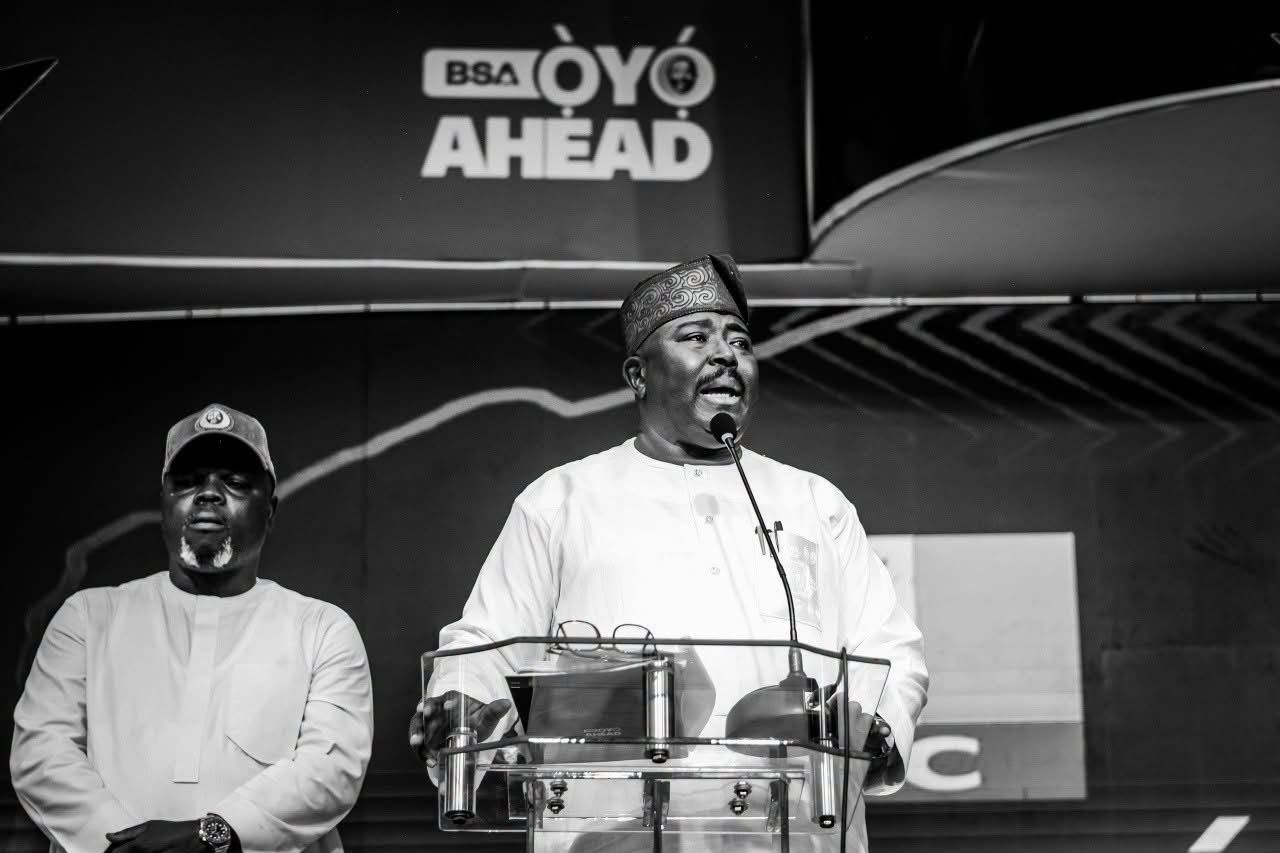
The unveiling of Senator Sharafadeen Abiodun Alli’s OYO AHEAD manifesto has introduced a new dimension to the 2027 Oyo State governorship conversation. Beyond the usual campaign promises, the document presents an attempt to define not just what a government intends to do, but how it proposes to govern. Its central message is that Oyo State needs a development model built around grassroots empowerment, economic productivity, institutional accountability and measurable performance.

What makes the manifesto politically significant is its attempt to connect the candidate’s personal political journey with a proposed programme of government. From his experience as Chairman of Ibadan North Local Government to his service as Secretary to the State Government, Chief of Staff, Senator and Chairman of Odu’a Investment Company, Alli presents himself as a politician whose experience cuts across grassroots administration, constitutional politics, legislative representation and business management. These experiences provide a solid foundation for effective governance and reinforce the expectation that his proposed agenda can be translated into tangible results for the people of Oyo State.

The first pillar, local government autonomy, may well become the most politically consequential. By promising transparent access to council allocations, monthly funding arrangements and greater freedom for local governments to address community needs, BSA is placing grassroots governance at the centre of his development philosophy. The message is unmistakable: democracy must be felt beyond the Government House, and the dividends of government must reach the communities where ordinary people live and work.

His infrastructure proposals also deserve attention. Rather than concentrating exclusively on new construction, the manifesto promises an audit of unfinished roads, published completion schedules, farm access roads, improved electricity, potable water and affordable housing. This suggests an understanding that infrastructure should be judged by its economic and social usefulness, not simply by the political visibility of projects.

In healthcare, the proposed Oyo Care Guarantee for infants, pregnant women and residents above 70 is a significant social intervention. The commitment to strengthen primary healthcare, address shortages of medical personnel and expand health insurance coverage recognises that healthcare is not a privilege reserved for those who can afford it. With the right funding arrangements, adequate staffing and firm institutional commitment, these promises can be translated into a sustainable healthcare system that delivers tangible benefits to the people of Oyo State.

Education is another area where the manifesto attempts to reconnect Oyo with its historic reputation as a pioneer of educational development. Reducing classroom congestion, repairing schools, expanding scholarships, establishing skills centres and linking graduates to employment are proposals that speak directly to the future of the state’s young population. These interventions are designed to translate educational investment into measurable improvements in learning outcomes, practical skills and employment opportunities for the next generation.

Perhaps the most compelling economic proposition is the commitment to move Oyob beyond an economy of consumption towards one of production, investment and job creation. The proposed industrial parks, revival of the Oluyole Free Trade Zone, ₦10 billion Youth Fund, digital skills programme and support for small businesses suggest an administration seeking to make employment creation a central responsibility of government. The ₦150 billion annual internally generated revenue target reflects an ambitious vision of economic growth, driven by expanded business activity, increased investment, efficient revenue administration and the elimination of financial leakages, while preserving a favourable environment for citizens and businesses to prosper.

Agriculture gives the manifesto another important regional dimension. Oyo possesses considerable agricultural potential, particularly across Oke-Ogun, Ogbomoso and Ibarapa. The proposals for processing facilities, revived farm settlements, mechanisation, storage, agricultural insurance and export promotion recognise that farmers cannot prosper merely by producing crops; they must also have access to markets, processing facilities and value chains. If properly executed, this could transform agriculture from subsistence activity into a major engine of industrial growth.

Security, appropriately, is treated as the foundation upon which every other pillar depends. The proposed strengthening of community security networks, protection and insurance for hunters and vigilantes, improved surveillance and farmer-herder mediation reflect the reality that development cannot flourish where fear controls access to farms, schools and businesses. The accompanying commitment to public disclosure of projects, contractors and costs also reinforces the argument that security and accountability are inseparable responsibilities of government.

One particularly striking feature is the candidate’s personal commitment to publish quarterly performance reports and to decline a second-term request if Oyo State is not measurably better by the end of his first tenure. This is a bold political undertaking. It shifts the conversation from the traditional entitlement of incumbency to the obligation of performance. This commitment further underscores the importance of measurable performance targets, transparent reporting and regular public assessments as the foundation for accountable and results-driven governance.

The strength of OYO AHEAD lies not only in the breadth of its promises but also in the opportunity to translate them into a practical development programme. The proposed revenue expansion, healthcare guarantee, youth and women empowerment funds, educational reforms and infrastructure projects provide an ambitious agenda for the state. With proper financial planning, sound legal frameworks, effective coordination and measurable implementation targets, these proposals can form the foundation of a purposeful and results-oriented administration.

This places an important responsibility on the OYO AHEAD Steering Committee. Beyond campaign mobilisation and public presentation, the Committee must sustain the technical work required to support the manifesto with reliable data, realistic costing, legal guidance, implementation timelines and measurable outcomes. The depth of this preparation will be central to demonstrating that OYO AHEAD is not merely a collection of campaign promises, but a carefully considered programme for governing Oyo State.

As the 2027 governorship election approaches, the debate should increasingly focus on the future of Oyo State: the governance philosophy, experience, policy direction and preparedness of those seeking the people’s mandate. Political alliances and personalities will naturally shape the contest, but the enduring question is which proposals offer a clear and practical pathway to development, prosperity and accountable leadership.

OYO AHEAD has placed such a pathway before the people of Oyo State. Its seven pillars provide a framework for addressing the state’s development priorities, while its emphasis on grassroots governance, economic productivity, human capital development and accountability speaks to the need for a new direction. With his political experience, administrative background and familiarity with the challenges of Oyo State, Senator Sharafadeen Abiodun Alli is well positioned to lead the effort to translate this blueprint into meaningful progress. The promise of OYO AHEAD is renewal; its ultimate measure will be the transformation it delivers to the lives of the people.


Prince Armstrong-Bello, JP. Akogun Aliiwo Ibadanland, Author of “Yoruba Leadership in Diaspora: Equity Justice and Tradition” is a Political Communication Strategist and Public Affairs Analyst

Continue Reading

Opinion

OYO 2027: MAKINDE EATS SOUR GRAPES, ADEKANMBI’S TEETH MUST BE SET ON EDGE

Published

on

The confusion within the ranks of the Allied Peoples Movement (APM) is becoming increasingly difficult to describe.

The political empire built by Governor Seyi Makinde on what critics describe as lies, betrayals, broken promises and greed appears to be crumbling by the day.

Indeed, Makinde and his APM loyalists are providing an endless source of amusement these days.

Virtually everyone who leaves the Makinde administration is suddenly dismissed as a “paperweight” by the party’s social media attack dogs.

I have often wondered whether these fellows are unaware of the wisdom behind the Yoruba belief that even cotton wool, when gathered in sufficient quantities, can become a load too heavy for one person to carry.

As the Yoruba proverb puts it: Eni ní òwú ò t’ẹrù; ìwọ̀nba tó fẹ́ fi tan iná ló mú.

You keep losing prominent politicians and influential party stakeholders, yet you dismiss them as political nonentities. But which heavyweight has the power to cast more than one vote for a preferred candidate?

I am certain that even Bimbo Adekanmbi must be wondering how things deteriorated so badly for the APM.

Before his emergence as Governor Makinde’s anointed governorship candidate was made public, I granted an interview on a television station during which I openly predicted that Adekanmbi would get the governor’s endorsement and that his choice as successor would spell trouble for both men.

To one another, both men have become potential political albatrosses. Unfortunately, Governor Makinde’s ego appears to have blinded him to realities beyond his immediate political calculations.

I am particularly surprised that Adekanmbi failed to recognise that he was walking into a political trap by accepting Makinde’s endorsement.

Greed, indeed, can be a dangerous disease. In Adekanmbi’s position, no discerning politician would have ignored the number of political enemies Governor Makinde had accumulated during his seven years in office.

It follows, therefore, that Adekanmbi would inevitably inherit many of those political liabilities. Sadly, he either failed to appreciate the implications or simply chose to overlook the consequences.

By the time Governor Makinde, or perhaps Seye Famojuro, settled for Adekanmbi, the governor was already embroiled in disagreements with prominent political figures, including former Deputy National Chairman of the PDP, Ambassador Taofeek Oladejo Arapaja, Alhaji Bisi Olopoeyan and several first-class traditional rulers in Oyo State.

He had also fallen out with several influential political figures, including Senator Hosea Agboola, Alhaji Razak Gbadegesin, former Deputy Governor Barrister Gbolarunmi Hazeem, Chief Mrs Jumoke Akinjide, Hon. Mulikat Adeola Akande, former Deputy Governor Engr. Rauf Aderemi Olaniyan, Prince Diran Odeyemi, former Ekiti State Governor Ayodele Fayose, former Rivers State Governor Nyesom Wike and even President Bola Ahmed Tinubu.

Beyond these strained relationships, several stakeholders within the Makinde political camp were already uncomfortable with the process that produced Adekanmbi as the APM governorship candidate.

There were also contentious discussions about whether Governor Makinde should be succeeded by a Christian. Equally troubling to some stakeholders was the question of whether it made political sense for Makinde to present Adekanmbi as his preferred successor when both men hail from Ona-Ara Local Government Area.

At the time, agitations were mounting over Governor Makinde’s alleged failure to comply with the Supreme Court judgment granting financial autonomy to local governments.

Other contentious issues included the controversial Circular Road project, the sale of government assets and the proposed transfer of Oyo State farm settlements to estate developers.

The state’s debt profile, which has remained a subject of public concern and debate, was another issue that had yet to be satisfactorily addressed.

All these issues were already in the public domain before Adekanmbi accepted the offer to become Makinde’s anointed candidate.

One is therefore compelled to ask: what could have persuaded Adekanmbi to accept such a politically dangerous offer?

I can only think of one reason: greed.

When Governor Makinde claimed that he had advised Adekanmbi not to inherit his enemies, he was being economical with the truth.

The reality is that those political liabilities became Adekanmbi’s the moment he accepted Makinde’s endorsement.

The governor knows that he is carrying a political baggage that could weigh heavily on his preferred successor. Yet, he appears unwilling to be held accountable for the political consequences of his own administration.

Unfortunately for both men, even Adekanmbi’s campaign slogan tells a story of its own: “Omi Tuntun 3.0”.

How, then, does he intend to separate himself from the “Omi Tuntun” administration and the controversies surrounding it?

Governor Makinde has never hidden his discomfort with genuine local government autonomy. Adekanmbi, by his posture, appears prepared to sustain the same political template, which critics blame for weakening the 33 local government councils in the state.

On virtually every issue over which the people of Oyo State have expressed concern, Adekanmbi appears to be offering continuity rather than a departure from the policies of the present administration.

He has failed to condemn the controversy surrounding the proposed transfer of the Ogbomoso Farm Settlement to estate developers, despite protests by residents of the ancient town.

He has equally remained silent over the controversy surrounding the administration’s reported moves involving the Saki Farm Settlement.

He also appears untroubled by the reported transfer of the 4,000-hectare Eruwa Farm Settlement to investors, whose whereabouts and activities have, according to critics, remained unclear two years after the arrangement.

Indeed, Adekanmbi appears not to appreciate the extent of the challenges facing the state. For instance, Oyo State is said to be short of six general hospitals if the benchmark of one general hospital per local government area is adopted.

Yet, when Senator Sharafadeen Abiodun Alli promised in his manifesto to address this deficit, APM spokespersons reportedly went on the offensive, describing the manifesto as “lacking in originality”.

Governor Makinde has been in office for more than seven years. During this period, his administration has received ecological funds on several occasions.

The question, therefore, is simple: what has happened to those funds?

There are concerns over the utilisation and accountability of the ecological funds received by the state. The governor owes the people a clear explanation of how these resources have been deployed.

There are also questions surrounding the proposed upgrade of the Alakia Airport, a project for which Adekanmbi himself was appointed by Governor Makinde to head a committee.

I have been reliably informed that the contract sum for the airport upgrade was reportedly reviewed upwards from its original figure of over N50 billion to well above N150 billion.

I have raised this question before, but I am yet to hear Adekanmbi offer a convincing explanation or response to the allegation.

Similarly, Governor Makinde reportedly approved more than N60 billion for the renovation of the Government House, an expenditure that attracted public criticism.

As of today, the visible works include the construction of a hall, the painting of the Government House mosque and church, and the replacement of tiles in both places of worship.

I challenge Governor Makinde to tell the people of Oyo State how much of the more than N60 billion reportedly approved for the renovation has actually been released and expended.

Beyond that, the governor should invite members of the press to conduct an independent assessment of the work carried out so far. The people deserve transparency and accountability, not unanswered questions.

The state government’s performance in education is another area that demands urgent attention.

Oyo State’s performance in WAEC and NECO examinations has continued to attract concern, particularly when compared with the performance of other states, including neighbouring Osun, which has been celebrated for its fifth-place position in a recent examination ranking.

Senator Sharafadeen Abiodun Alli has argued that the state must return to an educational system that makes teaching and learning more conducive. One of his proposals is a 30-pupils-per-classroom policy.

But rather than engage constructively with the proposal, APM voices have dismissed its feasibility.

Adekanmbi, as the party’s governorship candidate, has also failed to offer a clear departure from the present arrangement, under which many public primary and secondary school classrooms remain severely overcrowded and unconducive to effective learning.

Oyo State cannot afford another administration that merely promises continuity without addressing the shortcomings of the present one.

The people deserve better, and they now have an alternative in Senator Sharafadeen Abiodun Alli.

Governor Makinde has eaten sour grapes. Unfortunately, Bimbo Adekanmbi appears destined to bear the consequences.

His teeth, indeed, must be set on edge.

Continue Reading

Trending