Connect with us

Opinion

Tax Revenue as Nigeria’s New ‘Crude oil’

Published

on

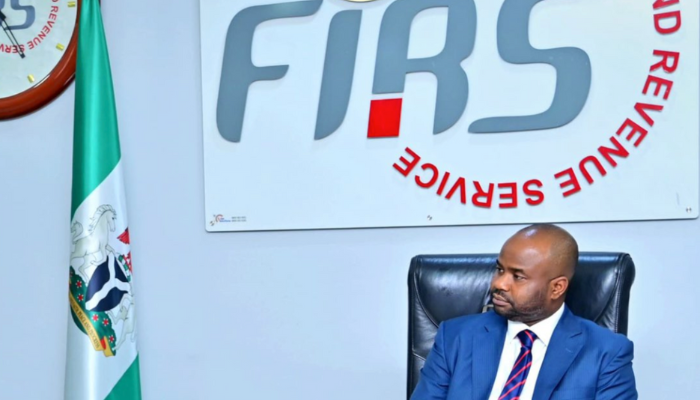
Executive ChaIrman, FIRS, Zacch Adedeji

Prior to Nigeria’s Independence in 1960, agriculture was the mainstay of its economy, even as reflected in the economic activities of the regions there were in the country at that time. Famous stories of the First Republic chronicled how the defunct regions were reliant on revenues from the groundnut pyramids in the north, the cocoa export receipts from the defunct west and the rubber as well as palm oil proceeds from the east.

With the discovery of crude oil in commercial quantities, beginning from Oloibiri in the present-day Bayelsa State in 1956, agriculture, over time, became supplanted by black gold in terms of contributions to the national revenue pool. Not only did crude oil receipts ride the wave as far as the total collectable revenue was concerned, but the Nigerian National Petroleum Corporation (NNPC) became the cornerstone entity for the three tiers of government to look up to for salvation in terms of their fiscal projections.

However, those days when the federal, state and local government councils wait zealously for revenue figures from NNPC have not only receded into the past but appear to have gone for good. At the monthly meeting of the Federation Account Allocation Committee (FAAC), focus has shifted to the Federal Inland Revenue Service (FIRS), the goose that is laying the golden egg for the fiscal stability and wellbeing of the federation.

For those who may not know, the ‘cake’ shared monthly by the Federation is baked by four major entities: NNPC, FIRS, the Nigerian Upstream Petroleum Regulatory Commission (NUPRC), formerly known as Department of Petroleum Resources (DPR) and the Nigeria Custom Service (NCS).

Of the body of ‘bakers,’ FIRS under Zacch Adedeji has emerged as the cream of the crop, singlehandedly and aggregately accounting for close to 70 percent of the total revenues collected and shared by the three tiers of government at FAAC meetings in 2024.

Out of N2.068 trillion that accrued to the Federation Accounts in January 2024, tax collected by FIRS accounted for more than 50 percent, with the agency’s contribution totalling N1.275 trillion. The other three revenue-remitting bodies jointly raked in the balance. While oil receipts from NNPC brought N115billion, NUPRC grossed N469.8billion, just as the Nigeria Custom Service remitted N207 billion.

The contribution of FIRS to the pool grew in February by N300 billion from what it brought to the account in January. From the N2.3 trillion that accumulated into the account, takings by FIRS amounted to N1.491 trillion, a collection figure that was more than 50 percent of the total revenue for the month. In fact, NNPC’s contribution to the pool was just N92 billion. NUPRC and NCS contributed N487 billion and N254 billion, respectively.

In March, FIRS contributed N1.061 trillion out of N1.867 trillion in the pool and in April, the Federation Account got N1.187 trillion from FIRS out of the N2.192 trillion revenue accrual. For May, out of the N2.324 trillion shared by the three tiers of government, FIRS alone contributed N1.571 trillion.

The last month in the first half of 2024 finished on a strong note for the Federation in terms of the size of the ‘cake’ available for sharing among the three tiers of government. Of the N3.5 trillion accrual in the Federation Account for the month, FIRS accounted for N2.841 trillion. Contributions from NNPC for the month was N8.3billion with NUPRC and NCS remitting N402.5billion N264 billion, respectively.

The upward trajectory of FIRS contribution to the Federation Account continued at the beginning of the second half of the year. It accounted for N2.295 trillion out of N3.508 trillion remitted into the Federation Account for July, representing 65.4 percent of the total haul. For August, the FIRS figure for FAAC was N1.87 trillion out of the N2.7 trillion in the pool. In September, October, November, and December, the agency’s contributions were N1.45trillion (out of N2.4trilion), N1.74trillion (out of N2.9), N1.56trillion (out of N2.8trillion) and N1.41trillion (out of NN2.2trillion), respectively.

The significance of FIRS contributions displacing oil receipts and turning tax revenue into the country’s new ‘crude oil’ has been well situated by the Accountant General of the Federation, Dr (Mrs) Oluwatoyin Madein. At an event in Abuja, she declared: “Tax revenue, as of today, is the highest source of revenue accruing to the Federation. Therefore, at FAAC meetings, we eagerly await the numbers coming from FIRS because the performance of the agency keeps on increasing and this brings succour to all tiers of government.”

Putting FIRS contribution to FAAC revenue pool in 2024 in context, we will see how it has helped the three tiers of government to plan, project and experience fiscal stability. There is nothing like fiscal discipline except you have accurate revenue prediction. If you say you want to spend N10, that means you must assurance that the N10 will come from somewhere. This commendable collection performance is in tandem with Adedeji’s vision of making taxation the pivot of national development.

What did FIRS do differently?

The impressive revenue collection posted by FIRS is not a product of happenstance. It is the outcome of a well-thought-out strategy and process re-engineering that formed the bedrock of a cocktail of administrative and process reforms embarked upon by the agency under Adedeji. One of his key refrains is that if FIRS is going to succeed in its critical national mandate of domestic revenue mobilisation, taxpayers must be at the centre of all policies and initiatives of the agency.

The FIRS chairman summarised the restructuring and re-orientation that powered the huge revenue collection and turned it to a customer-centric agency thus: “We restructured our operations at FIRS in such a way that we are now effectively carrying out our duty of assessing, collecting and accounting for taxes. We used to have functional types of taxes, but we have since identified that the only customers we have are the taxpayers. We have, therefore, improved the way we relate with our customers by rearranging our operations based on our customers, using their turnover as the basis to categorise them into large, medium, and emerging tax groups.
“We did this to develop expertise in what we do. Secondly, to provide them with a one-stop shop for their activities. If you are in a large tax group, you only need to go to one office to pay all forms of taxes, including conducting audit and other activities. You do not need to move from one office to another again.

“We are here to serve the taxpayers. The taxpayers are not armed robbers or criminals that we will be chasing about. FIRS is also not a law enforcement organisation. We are partners in progress. The taxpayers are the trees in our vineyard. The only thing we can do is to ensure they are well watered and well pruned so they can bear good fruits for us to have a big harvest.

Because of the streamlining of tax processes, the removal of hurdles in the way of tax payment as well placing a high premium on transparency and accountability, a total number of 182, 724 new taxpayers, representing a 25.3% increase, voluntarily enrolled on the agency’s tax administration platform called Tax Pro-Max in 2024. It is the single biggest leap in the number of firms in the tax net in the recent history of the tax agency. This not only underscores the level of trust reposed in the new processes emplaced at the agency. It also lends credence to Adedeji’s sharp vision of making the agency one of the world’s most efficient and trusted revenue authorities.

The president, Lagos Chamber of Commerce and Industry (LCCI), Mr Gabriel Idahosa, testified to the unusual transformation witnessed at FIRS. Idahosa commended the agency for conducting reforms that align with the needs of businesses, particularly singling out the increasing use of technology in tax administration as well as the shift in the mental geography of tax officers from being mere tax collectors to “actively providing services that enhance business operations.”

One key import of the unprecedented growth in tax revenue for the Federation is that the non-oil sector accounts for about 75% of the total haul. This clearly signposts the commitment of the President Bola Tinubu-led administration to truly diversify the economy from its mono-product, crude oil. According to Adedeji, all accolades for the impressive tax collection by FIRS should go to President Tinubu. Of a truth, two key policies by the president, namely the removal of fuel subsidy and unification of the exchange rate, gave fillip to the record tax revenue collection by FIRS. The negative consequences of not setting these economic fundamentals at the time President Tinubu did would have been unbearable for an economy that was already in the ICU before President Tinubu assumed office.

Despite the laudable achievements of the agency since its assumption of office in September 2023, Adedeji is not resting on his oars. He believes the success recorded so far is just a beginning, with his key fiscal focus being on growing Nigeria’s tax-to-GDP ratio to 18% in the next three years. This, he believes, is achievable without putting additional burden on the taxpayers but by making the pie bigger to collect more revenue for government at all levels to be able to meet their obligations to the citizenry.

For him, there is irreducible minimum if the upward tax revenue trajectory must continue. “We can play with everything, but what we cannot afford to play with, if we are going to succeed, are data and merit,” he once said.

It needs to be said that prior to Adedeji’s leadership, the agency’s contribution to FAAC had been growing. However, the coming of Adedeji has moved the quantum significantly higher through a potpourri of internal administrative and process reforms he introduced, leading to simplifying of tax payment.

For 2025, FIRS is targeting to collect N25.2 trillion in tax revenue, and this means more money for the three tiers of government to meet their needs. This is another reason why there should be no opposition to the tax reform bills currently before the National Assembly. If FIRS could post these huge records in a short time, breaking its own records and setting higher targets and goals, a tax system that is modernised and fit for purpose can only add impetus to the task of domestic revenue mobilisation given to FIRS.

For those asking the question: where does tax revenue by FIRS go? The answer is this: every month that the federal, state and local government councils gather in Abuja for FAAC meeting and money is shared accordingly, about 70% of that money comes from the tax revenue FIRS collects from taxpayers.

For perceptive observers, President Tinubu deserves to be hailed for the huge jump in shareable FAAC allocations, which continue the upward swing since his assumption of office. All the states now collect almost three times of what they used to get as FAAC allocation prior to the coming of the Tinubu administration. Every month, managers of the three tiers smile to the banks, thanks to the President’s courageous leadership.

Adekanmbi is the Special Adviser on Media to the Executive Chairman, Federal Inland Revenue Service (FIRS).

Comments

Opinion

Why Ibadan North youths are rooting for Repete

Published

on

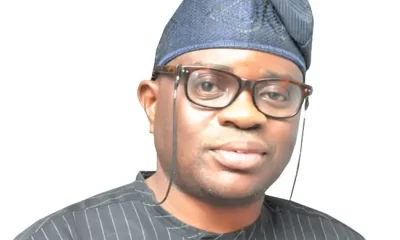
Growing support has continued to trail a youthful politician and technology advocate, Hon. Khalil Mustapha Adegboyega, popularly known as Repete, as many youths in Ibadan North Federal Constituency expressed confidence in his leadership style and vision for development.

Across several communities within the constituency, residents, particularly students, artisans and young professionals, described Repete as one of the emerging political figures with strong grassroots appeal and a passion for youth empowerment.

Supporters said his growing popularity stems from his consistent advocacy for innovation, entrepreneurship and skills development aimed at addressing unemployment and creating opportunities for young people.

As an engineer and technology enthusiast, Repete is also said to possess a deep understanding of the evolving digital economy and the need to position youths for global competitiveness.

Many of his supporters noted that his approach to leadership focuses on practical solutions, mentorship and capacity-building initiatives capable of helping young people become self-reliant and economically productive.

Some community stakeholders who spoke on his rising profile said his humility, accessibility and relationship with the grassroots have continued to endear him to many residents within the constituency.

They added that Repete’s engagement with youths and community groups reflects his commitment to inclusive governance and people-oriented representation.

Observers within the constituency also maintained that the increasing support for the politician reflects a growing desire among residents for a new generation of leaders driven by innovation, competence and accountability.

According to them, many young people see Repete as a symbol of hope and progressive leadership capable of contributing meaningfully to the development of Ibadan North Federal Constituency.

Continue Reading

Opinion

Repete or Regret: APC’s Moment of Truth in Ibadan North

Published

on

File photo of Hon. Khalil Mustapha Adegboyega (Repete)

The All Progressives Congress (APC) in Oyo State stands on the edge of a consequential decision—one that may define not only its fortunes in Ibadan North Federal Constituency but also its broader political relevance in the state.

As the countdown to the party primaries intensifies, the question before APC leaders is no longer routine. It is strategic. It is urgent. And it is decisive: will the party align with the clear preference of the people or risk repeating costly political miscalculations?

At the centre of this debate is Hon. Khalil Mustapha Adegboyega, widely known as Repete—a name that has, over time, evolved from a political identity into a grassroots phenomenon.

A Candidate Rooted in the People

In contemporary Nigerian politics, where voter awareness is rising and expectations are shifting, candidates are increasingly judged not by promises but by presence. On this scale, Adegboyega stands tall.

His political journey is marked by consistent engagement with constituents—far beyond the optics of election seasons. From youth empowerment initiatives that provide practical skills and startup support, to sustained interventions in healthcare access for the elderly and indigent, his footprint across Ibadan North reflects a model of leadership anchored on service.

Unlike the transactional approach that often defines political relationships, Adegboyega’s connection with the people appears organic—built on trust, accessibility, and continuity. These are not mere campaign attributes; they are political assets.

The Danger of Political Disconnect

History offers the APC a clear lesson: parties that ignore grassroots sentiment often pay a heavy electoral price. The imposition of candidates perceived as distant or untested has, in several instances, resulted in voter apathy, internal dissent, and eventual defeat at the polls.

Ibadan North presents no exception.

With opposition parties closely monitoring the APC’s internal dynamics, any misstep in candidate selection could provide a ready opening. A divided house, coupled with a candidate lacking widespread acceptance, is a formula the opposition is well-positioned to exploit.
The implication is straightforward: this is not merely about party loyalty; it is about electoral viability.

Echoes from the Grassroots

Across the length and breadth of Ibadan North—markets, motor parks, religious centres, and community gatherings—a consistent pattern emerges in political conversations. The name “Repete” resonates with familiarity and acceptance.

Such organic support is not easily manufactured. It is cultivated over time through visible impact and sustained presence. For a party seeking electoral certainty in a competitive environment, this level of grassroots validation is not just desirable—it is critical.

A Test of Leadership and Judgment

For the APC leadership in Oyo State, the moment calls for clarity of purpose. Decisions driven by narrow interests, personal alignments, or short-term calculations may carry long-term consequences.

The task, therefore, is to balance internal considerations with external realities. Elections are ultimately decided by voters, not by party caucuses. A candidate who commands public confidence offers the strongest pathway to victory.

The Stakes Are Clear

Ibadan North is too strategic a constituency for experimentation. The cost of error is not limited to a single seat; it extends to party cohesion, credibility, and future positioning within the state’s political landscape.

In this context, the argument for Adegboyega is less about sentiment and more about strategy. His visibility, acceptability, and record of engagement place him in a strong position to consolidate support and mobilise voters effectively.

Conclusion: A Choice with Consequences

As the APC moves closer to its primaries, the decision before it is both simple and significant: align with a candidate who reflects the mood of the electorate or risk conceding advantage to a watchful opposition.

In politics, moments such as this often separate foresight from hindsight.
For APC in Ibadan North, this may well be one of those defining moments.


Aderibigbe Akanbi, a political analyst, writes from Ibadan.

Continue Reading

Opinion

Ibarapa East: Yusuf Ramon’s Quest for Responsive Representation

Published

on

Hon. Yusuf Abiodun Ramon

As the road to 2027 gradually unfolds across Oyo State, political conversations are shifting from routine permutations to deeper questions about competence, generational leadership, and measurable impact. In Ibarapa East, that conversation has found a new voice in Yusuf Abiodun Ramon — a Lanlate-born technocrat whose entry into the race for the State House of Assembly is redefining what representation could mean for the constituency.

In a political environment often dominated by familiar faces and conventional calculations, Ramon presents a profile shaped by technical discipline, structured thinking, and solution-driven engagement. His professional background, anchored in analytical precision and systems management, forms the foundation of his public service aspiration.

For him, representation must move beyond ceremonial presence to practical responsiveness — laws that reflect local realities, oversight that protects public resources, and advocacy that translates into visible development.

Ramon argues that the future of Ibarapa East lies in leadership that listens deliberately, plans strategically, and delivers measurably. He speaks of strengthening rural infrastructure, expanding youth-driven economic opportunities, and institutionalising transparency as core pillars of his agenda. In his view, governance must not merely be symbolic; it must be structured, accountable, and people-centred.

Rooted in Ile Odede, Isale Alubata Compound, Ward Seven of Ibarapa East Local Government, and maternally linked to Ile Sobaloju, Isale Ajidun Compound, Eruwa, Ramon’s story is not one of distant ambition but of lived experience. He is, in every sense, a son of the soil — shaped by the same roads, schools, and economic realities that define daily life in Ibarapa East.

“I was born here. I grew up here. I understand our struggles, our strengths, and our untapped potential,” he says. “Representation must go beyond occupying a seat; it must translate into preparation, competence, and genuine commitment to development.”

His academic journey mirrors that philosophy of steady growth. He began at Islamic Primary School, Lanlate (1995–2001), proceeded to Baptist Grammar School, Orita Eruwa (2001–2007), and later earned a National Diploma in Mechanical Engineering Technology from Federal Polytechnic, Ilaro, between 2009 and 2011. Refusing to plateau, he advanced his intellectual horizon and is now completing a Bachelor of Science in Business Administration at the University of Lagos. “Education,” he reflects, “is continuous capacity building. Leadership today requires both technical knowledge and administrative insight.”

That blend of engineering precision and managerial training has defined a professional career spanning more than a decade. Shortly after his diploma, Yusuf joined Mikano International Limited as a generator installer, gaining hands-on experience in industrial power systems — a sector central to Nigeria’s infrastructural backbone. He later transitioned into telecommunications at Safari Telecoms Nigeria Limited, where he received specialized training in Industrial, Scientific, and Medical radio bands, strengthening his expertise in network operations.

In 2013, he became a Field Support Engineer at Netrux Global Concepts Ltd., then a leading ISM service provider in Nigeria. Over four formative years, he immersed himself in telecom infrastructure deployment and maintenance, mastering field coordination, logistics management, and real-time technical problem-solving.

Since July 2017, he has served as a Field Support Engineer with Specific Tools and Techniques Ltd., a power solutions firm providing services to major operators including MTN Nigeria and Airtel Nigeria. In that capacity, he operates at the frontline of ensuring energy reliability and network uptime — responsibilities that demand discipline, accountability, and systems thinking.

For political observers in Ibarapa East, this trajectory matters. It reflects more than résumé credentials; it speaks to a mindset anchored in efficiency, coordination, and measurable outcomes — qualities increasingly demanded in legislative representation.

Beyond the private sector, Ramon’s political exposure is neither sudden nor superficial. A loyal member of the progressive political family in Lagos, he once served as a personal assistant to a former lawmaker, gaining practical insight into legislative procedure and constituency engagement. Within his community, he has quietly extended financial support to small-scale entrepreneurs and students — modest but consistent interventions rooted in personal responsibility.

“My interest is my people,” he states firmly. “Ibarapa East deserves strategic, responsive, and capable leadership at the State Assembly. We must move from rhetoric to results.”

Across the constituency — from Lanlate to Eruwa — development priorities remain clear: youth employment, vocational empowerment, rural road rehabilitation, stable power supply, agricultural value-chain expansion, improved educational standards, and stronger lawmaking that directly reflects community needs.

Political analysts argue that Ramon’s technocratic background positions him uniquely at the intersection of policy formulation and practical implementation. At a time when national discourse increasingly favours competence over grandstanding, his profile resonates with a broader generational shift toward performance-driven governance. His engineering discipline reinforces problem-solving; his business training strengthens administrative understanding; his grassroots roots anchor his empathy.

For Ibarapa East, the 2027 election cycle may represent more than a routine democratic exercise. It may mark a recalibration of expectations — a demand for representation that understands both the soil beneath its feet and the systems that drive modern development. As political alignments gradually crystallize in Oyo State, Yusuf Abiodun Ramon’s declaration signals the arrival of a candidate seeking to translate private-sector structure into public-sector impact.

One thing is clear: the conversation about the future of Ibarapa East has begun — and it is now framed around competence, credibility, and capacity.


Oluwasegun Idowu sent in this piece from Eruwa, Ibarapa East LG, Oyo State

Continue Reading

Advertisement

Entertainment

Advertisement

MegaIcon Magazine Facebook Page

Advertisement

MEGAICON TV

Advertisement

Trending