Connect with us

Opinion

Obasa, Aláàfin Ṣàngó and the capture of Lagos | By Festus Adedayo 

Published

on

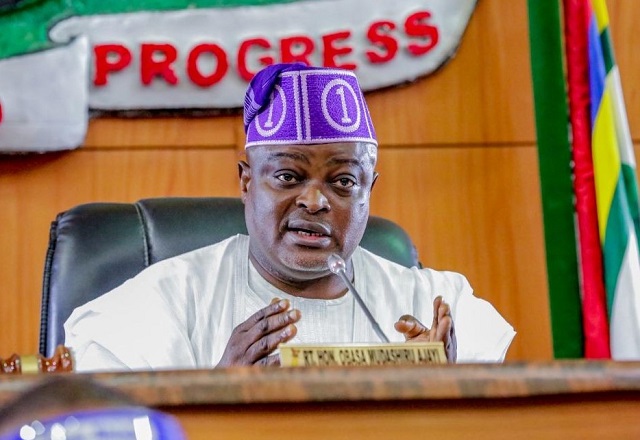
On Wednesday, February 25, 2025, a very toxic but innocuous advertorial was published in the Punch newspaper. It was authored by a group which called itself De Renaissance Patriots Foundation. Entitled Systematic Marginalization of Lagos State Indigenes, and signed by Major General Tajudeen Olanrewaju (rtd.) and Yomi Tokosi, the advertorial explains the legislative gangsterism currently going on in Lagos State, ex-Speaker Mudashiru Obasa’s impudent audacity and President Bola Tinubu’s nauseating silence on the civilian coup ongoing in the State of Aquatic Splendour.

The only fitting narrative that can explain the Obasa phenomenon and the Lagos godfather’s paternalism for Obasa and his ilk is the Osu caste system in Igboland. Among other obnoxious systems like the killing of twin babies, killing of children who grew first upper incisors, human sacrifices, among others, Osu caste is evergreen in its evil, and rooted in Igbo tradition and religion. Rev. George Thomas Basden’s book Among the Ibos of Southern Nigeria, (1921), a detailed account of the clergy’s experiences while living in Igbo land as a Christian missionary in the early 20th century, examines the people’s customs, beliefs, social structure and religious practices.

On page 109 of the book, Basden defined Osu as “a slave, but one distinct from an ordinary slave (ohu/oru) who in fact is the property of the god and when devoted to a god, he has no prospect of regaining freedom and he restricts his movements to the procuts of the shrine to which he was attached”. Centuries after the end of slavery and in spite of modernity, Osu caste’s poignant smell is rank in Igboland as Osu are still discriminated against, cannot marry a freeborn, their aspirations curtailed. They are thus forced to form an inter-group bond and alliance to press for their rights. A former minister under Olusegun Obasanjo, who is an Osu, is the rallying point of this caste against discrimination by “freeborn” Igbo. As I will argue presently, the Lagos parliament crisis, among other indicators, is fueled by the ancient indigene/settler dichotomy in Lagos. In this case, the Lagos godfather symbolizes the Obasanjo minister, hell-bent on protecting his fellow Lagos migrant-settlers.

General Olanrenwaju’s group which published the advertorial made several allegations against the godfather. They are encapsulated in the phrase, “persistent discrimination against the indigenous people of Lagos State.” Perhaps, the most insulting to the group was the temerity of the godfather’s choice of two non-indigenes of the state, Bisi Akande and Segun Osoba, ex-governors of Osun and Ogun States, to mediate in the crisis of the Lagos House of Assembly. Apart from the group’s total denunciation of this alien intervention, it specifically took Akande to the cleaners. Akande, it said, who “is struggling for political breath” in his home state, being unable to resolve the ongoing conflagration therein, feels entitled to poke-nose into Lagos matter “because his children, Akande Funmilayo (Chairman Apapa/Iganmu LCDA) and Yinka Akande are seriously benefiting from (sic) as Local Council Chairman and Director of Lekki Free Trade Zone respectively.”

As groups or individuals, Lagos indigenes have always stood up against the ruling establishment. A 1908 proposed water rate for Lagosians is an example. On July 20 of that year, Governor Walter Egerton proposed to charge Lagosians for them to access portable water. This was after his government constructed a #130,000 pipe borne water scheme, the precursor of the Iju waterworks built in 1916. Two indigenes of Lagos, John Randle and Orisadipe Obasa, medical doctors, under the banner of the People’s Union, arranged a rally of Lagosians at Enu Owa on November 26, 1908 where they took Egerton on. Randle and Obasa were themselves not autochthonous Lagosians. Randle, born in 1855 in Regent, Sierra Leone, originally from Oyo town, was son of Thomas, who settled in Aroloya part of Lagos, while Obasa, whose father descended from the Elekole of Ikole-Ekiti, was brought to Lagos in 1878. It must be borne in mind that Orisadipe Obasa has no ancestral connect with Mudashiru who is currently recreating an MC Oluomo motor-park hijack prototype in the Lagos parliament.

Indigene/settlers conflict in Lagos dates back to the 15th century. The Awori headsmen earliest settlers on Lagos Island, descendants of legendary Ogunfunminire, who hailed from Ile-Ife, had faced a Bini attempt to uproot them which was successful. A fierce battle that took place at Iddo had Olofin, who administered the area, being routed. Since then, the development of Lagos has attracted the influx of migrant-settlers Yoruba and other ethnicities laying claim to Lagos. The influence of migrant-settlers was so overwhelming that when in 1950, Dr I. Olorun-Nimbe emerged Mayor of the Lagos Council, only him and four others were Lagos indigenes while the rest 19 were migrant-settlers. The 1951 Constitution which placed Lagos under Ibadan, in a Western Region administration, further worsened Lagos’ fate, until the 1954 Constitution restored its place. In 1967, Lagos got a state of its own and federal capital status. So, when in the 1950s, the heartland of Lagos indigenes’ residence, the Isale Eko, was demolished, groups were formed to continually fight the interest of indigenous Lagosians. They included the Isale Eko Association (1955) and Egbe Eko Parapo (Lagos Citizens’ Rights Protection Council – LCRPC) 1962. The latter emerged from a merger of the Lagos Aborigines Society and the Egbe Omo Ibile Eko (Association of the Sons of Lagos State) which was led by Chief T. A. Doherty. Today, the most prominent of those associations is the Association of Lagos State Indigenes (ALSI) hitherto led by Justice Ishola Oluwa, a retired High Court Judge.

The role of identity in Nigeria’s migrant-settlers crisis shows its importance in Nigerian social life. It also shows that identity has negative potentials that can be deployed as a tool for mobilizing violence. In the year 2000, Lagos deployed identity for violence when Hausa and Yoruba indigene-settlers engaged one other in a fratricidal war in Ketu. That fight, which claimed lives, indicates the adversarial use that autocththony can be put to. Scholars have said that several of Nigeria’s worst conflicts occurred because original inhabitants, or indigenes, are pitted against migrant-settlers. The Obasa Lagos budding conflict, though appears political, may unravel the powers behind it.

In Yorubaland, the migrant-settlers dynamics is rich in literature. It is indeed an ancient phenomenon. Signified by the native markers of àjèjì or àjòjì (migrants) and onílé, (autocththony) the common phrase that defines that transaction is, no migrant-settler should duel with an indigene over ownership of land (àjòjì kìí b’ónílé du’lé). This is the meat of General Olanrewaju and his De Renaissance Patriots Foundation’s beef with Tinubu and why many autochthonous Lagosians, regardless of Tinubu’s behemoth political power in Nigeria, his talismanic influence and boundless wealth, are against his continued domination of Lagos. It also explains why a Tinubu, who today is carrying a monstrous elephant of Nigerian power and wealth on his head could be this needlessly bothered by the tiny cricket of being sidelined in the sack of Obasa as Lagos House of Assembly Speaker. The moment Tinubu loses this makeshift, badly-constructed Lagos identity in the battle with autochthonous Lagosians, he has lost all.

The above was recalled with the aim of stating that, though the àjèjì and onílée stranger politics in Lagos has always been on the front burner, it has been more pronounced in recent time. This specifically drew more Lagosians’ ire with the godfather, an àjèjì, becoming the Lord of Lagos and defender of the rights of fellow migrant settlers. In the above referenced advertorial, the De Renaissance Patriots Foundation claimed that since 1999, only one Lagos Omo-Onílé (son of the land) has been governor, ostensibly Raji Fashola. What this means is that Tinubu, Akinwumi Ambode and Babajide Sanwo-Olu, in the words of the advertorial, are àjòjì. The group also listed names of many àjòjì who it said have, unfairly, hoisted the banner of Lagos at the detriment of Lagosians.

Some extreme ones among the Lagos indigenes’ rights advocates have literally equalized their battle to an ancient Yoruba wise saying that no stranger can back a child like its mother (kò s’éni t’ó le mòó pòn bí olómo). Some others, in pursuit of this narrative, have claimed that the àjòjì at the helm of political affairs in and of Lagos, don’t appreciate Lagos enough,just like the domestic goat undervalues the prowess of a hunter and his gun; or one who inherits a huge agbada gown does not appreciate its value (ewúrẹ́ ilé kó mọ iyì odẹ, aj’ogún ẹwù kó mọ iyì agbádá nlá). It is on these twin premises that they derive their two conclusions. One is that, Lagos could have developed more than it does if the migrant-settlers had been autochtonous Lagosians. Second, that Lagos could have been greater but for the fact that the wealth accruable to the Ajoji from their leadership of Lagos are being funneled to the migrants’ original place of migration.


Prior to 1999, there did not seem to be anyone who held the jugular of Lagos like Tinubu. Before the ascendancy of his volcanic phenomenon, the last power outpost of Lagos was a group pejoratively called the ‘Ijebu Mafia’, disciples of Chief Obafemi Awolowo, operating as Afenifere leaders, living in Lagos. They determined the political geography of the aquatic state. Indeed, this group conducted the primary for the 1999 governorship which allegedly had Late Funsho Williams coming tops but which an internal abracadabra among the group tilted in favour of Tinubu. Immediately he grabbed political power, Tinubu, applying Law 33 of Robert Greene’s 48 Laws of Power which encourages the power holder to discover each man’s thumbscrew – their weaknesses – found out the Ijebu Mafia leaders’ thumbscrew and used it to prepare their political graveyards. He then succeeded in tearing them apart, deploying the Niccolo Machiavelli divide and rule tactics in the service of his ambition.


By 2007 when the godfather left office as Lagos governor, he had totally decimated their ranks, cloning a counter-group called Afenifere Renewal Group and leaving the Awo disciples licking their fatally bruised wounds. Abetted by Lagosians themselves, only a few, like the late Chief Ganiyu Dawodu, fought Tinubu to the hilt before his transition. By the time Lagos aborigines woke up to do a reconnaissance, it was too late. The godfather had captured Lagos and kept the lagoon and the sea inside his limitless-space pocket. Twenty five years after, not only does the godfather determine the political and economic barometer of Lagos, he determines when it will rain in the state or its time of drought.


The godfather’s migrant-settler place in Lagos is discussed only in hushed tones. Those privy to his migration and the story of his settling in Lagos maintain sealed lips. While he was governor of Lagos State, some dissident groups made efforts to document his migrancy by writing a book to document the family tree of Lagos Tinubus. Some other analysts have said that if the Lagos autochthony is to be broken into brass-tacks, virtually all Lagosians will fail the litmus test. For instance, the ancestor of the Tinubus is himself a Kanuri. While some settlers chose the Lagos Island side of Lagos called Isale Eko, Sierra Leone returnees were known as Akus or Saros, and Brazilians and Cuban returnees known as Agudas. Many of them originally hailed from towns scattered round the southwest. Only the Aworis can be said to own the Lagos autochthony. Immediately Mudashiru Obasa began to recreate the MC Oluomo-style tactic in Lagos House of Assembly, some forces came out to assert the deposed Speaker’s àt’òhúnrìnwá (migrant) status in Lagos and that he was not linked in any way with Orisadipe Obasa.


The 2023 election witnessed a groundswell of push-backs by, especially non-Yoruba indigene-settlers in Lagos, against the godfather’s fiefdom hold on Lagos. The outcome of that election showed a gradual whittling of the corrosive hold of the godfather on Lagos politics. Apparently a rebellion, Lagos migrant-settlers encircled the Peter Obi Labour Party and succeeded in giving it 582,454 votes as against 572,606 for the godfather’s APC. The godfather must have been furious. Until then and since 1999 when he held court, no one dared peer naked fire to look at the fiery face of the leopard. In the process of scapegoating for this colossal rout, a source told me the godfather held his Ajélè (an appointed official who oversees an empire’s economic and political interests) responsible and has since not forgiven him. More importantly, he is cross with him for being his own man and having the guts to win re-election due to his personal effort. For any godfather, a la the precepts of the Forty-eight Laws of Power, the Ajélè had committed an unpardonable sin against the Leviathan. So, even though Obasa rode roughshod on the Ajélè as Speaker, especially during the 2025 budget speech presentation, keeping him waiting for hours, the godfather wasn’t fazed and probably wrote the script. The world has since seen that, as Obasa’s water bug (Ìròmi) dances on the stream surface with impunity and audacity, executed with sheer brigandage, as well as abetted by institutions of the Nigerian state, the danceable tune egging the poor little creature on comes from a godfather drummer living in Aso Rock whose ego was fatally bruised.


To buttress General Olanrewaju’s submission, today, Lagos political power echelon, from governor, deputy governor, commissioners to special advisers, ministers representing Lagos, to federal and state parliamentarians, is tilted in favour of àt’òhúnrìnwá (immigrants) as against autochthonous Lagosians. The most laughable was Senator Solomon Olamilekan Adeola who represented Lagos West from 2015 to 2023 and before then, from 2011 to 2015, was Lagos House of Representatives member. Today, the man, known as Yayi, has perfunctorily exchanged state of origin like a prostitute changes her liaisons. He now represents Ogun West.


The story of Lagos, its godfather and potential explosion is beginning to resemble the cataclysmic end of the Yoruba deity of thunder and lightning, Ṣàngó. Aláàfin Ṣàngó, the third monarch of the Oyo Empire, was about the most celebrated and one of the most controversial rulers of the Empire. He was fiery, ambitious, charismatic and was extremely powerful. Like the cap insignia with which the Lagos godfather is known by today and which his worshippers scramble to don, Ṣàngó’s motif was a staff called Ose Ṣàngó, an ornately carved symbol depicted by fire, lighting and thunder.

Ṣàngó, the third Aláàfin of Oyo, who reigned between the 15th and early 16th centuries, was a man of great ambition, fiery charisma, and immense power. His name is invoked today to reify awesome might and the mystery of power. He mirrors a complex interplay of leadership acumen, divinity, and eventually, a reference point of potential human vulnerability. Like the Lagos godfather, Aláàfin Ṣàngó had a talismanic and commanding presence and inspired widespread loyalty. He also had the magical and mystical ability to command fire from the sky in his fit of anger. Ultimately, though his strength , the endowment ultimately led to his downfall. One day, Ṣàngó, enraged, invoked fire which resulted in a conflagration that went out of control. It eventually led to the destruction of his palace as well as lives of its inhabitants. It was the beginning of his end. Stripped of all he had, Ṣàngó departed Oyo Kingdom and never returned. He eventually committed suicide at a place called Koso.

Apart from the power of Yoruba anecdotal retelling latent in that Sango narrative, the downfall of Oba Ṣàngó is a detailed illustration that even in a modern world, no ruler or godfather is immune from the vulnerabilities of power. It also illustrates the destruction immanent in human nature. The Obasa episode, though seemingly miniature, has the potential to implode and flush the Lagos godfather down the drain, replicating the Ṣàngó downfall in recent history.


Maybe we all should just watch while an end comes to this tyrannical hold, after all, in the words of Nawal El Saadawi in her A daughter of Isis, “Things that never end are only boring, and were it not for death, life would be an impossible burden.”

Comments

Opinion

Why Ibadan North youths are rooting for Repete

Published

on

Growing support has continued to trail a youthful politician and technology advocate, Hon. Khalil Mustapha Adegboyega, popularly known as Repete, as many youths in Ibadan North Federal Constituency expressed confidence in his leadership style and vision for development.

Across several communities within the constituency, residents, particularly students, artisans and young professionals, described Repete as one of the emerging political figures with strong grassroots appeal and a passion for youth empowerment.

Supporters said his growing popularity stems from his consistent advocacy for innovation, entrepreneurship and skills development aimed at addressing unemployment and creating opportunities for young people.

As an engineer and technology enthusiast, Repete is also said to possess a deep understanding of the evolving digital economy and the need to position youths for global competitiveness.

Many of his supporters noted that his approach to leadership focuses on practical solutions, mentorship and capacity-building initiatives capable of helping young people become self-reliant and economically productive.

Some community stakeholders who spoke on his rising profile said his humility, accessibility and relationship with the grassroots have continued to endear him to many residents within the constituency.

They added that Repete’s engagement with youths and community groups reflects his commitment to inclusive governance and people-oriented representation.

Observers within the constituency also maintained that the increasing support for the politician reflects a growing desire among residents for a new generation of leaders driven by innovation, competence and accountability.

According to them, many young people see Repete as a symbol of hope and progressive leadership capable of contributing meaningfully to the development of Ibadan North Federal Constituency.

Continue Reading

Opinion

Repete or Regret: APC’s Moment of Truth in Ibadan North

Published

on

File photo of Hon. Khalil Mustapha Adegboyega (Repete)

The All Progressives Congress (APC) in Oyo State stands on the edge of a consequential decision—one that may define not only its fortunes in Ibadan North Federal Constituency but also its broader political relevance in the state.

As the countdown to the party primaries intensifies, the question before APC leaders is no longer routine. It is strategic. It is urgent. And it is decisive: will the party align with the clear preference of the people or risk repeating costly political miscalculations?

At the centre of this debate is Hon. Khalil Mustapha Adegboyega, widely known as Repete—a name that has, over time, evolved from a political identity into a grassroots phenomenon.

A Candidate Rooted in the People

In contemporary Nigerian politics, where voter awareness is rising and expectations are shifting, candidates are increasingly judged not by promises but by presence. On this scale, Adegboyega stands tall.

His political journey is marked by consistent engagement with constituents—far beyond the optics of election seasons. From youth empowerment initiatives that provide practical skills and startup support, to sustained interventions in healthcare access for the elderly and indigent, his footprint across Ibadan North reflects a model of leadership anchored on service.

Unlike the transactional approach that often defines political relationships, Adegboyega’s connection with the people appears organic—built on trust, accessibility, and continuity. These are not mere campaign attributes; they are political assets.

The Danger of Political Disconnect

History offers the APC a clear lesson: parties that ignore grassroots sentiment often pay a heavy electoral price. The imposition of candidates perceived as distant or untested has, in several instances, resulted in voter apathy, internal dissent, and eventual defeat at the polls.

Ibadan North presents no exception.

With opposition parties closely monitoring the APC’s internal dynamics, any misstep in candidate selection could provide a ready opening. A divided house, coupled with a candidate lacking widespread acceptance, is a formula the opposition is well-positioned to exploit.
The implication is straightforward: this is not merely about party loyalty; it is about electoral viability.

Echoes from the Grassroots

Across the length and breadth of Ibadan North—markets, motor parks, religious centres, and community gatherings—a consistent pattern emerges in political conversations. The name “Repete” resonates with familiarity and acceptance.

Such organic support is not easily manufactured. It is cultivated over time through visible impact and sustained presence. For a party seeking electoral certainty in a competitive environment, this level of grassroots validation is not just desirable—it is critical.

A Test of Leadership and Judgment

For the APC leadership in Oyo State, the moment calls for clarity of purpose. Decisions driven by narrow interests, personal alignments, or short-term calculations may carry long-term consequences.

The task, therefore, is to balance internal considerations with external realities. Elections are ultimately decided by voters, not by party caucuses. A candidate who commands public confidence offers the strongest pathway to victory.

The Stakes Are Clear

Ibadan North is too strategic a constituency for experimentation. The cost of error is not limited to a single seat; it extends to party cohesion, credibility, and future positioning within the state’s political landscape.

In this context, the argument for Adegboyega is less about sentiment and more about strategy. His visibility, acceptability, and record of engagement place him in a strong position to consolidate support and mobilise voters effectively.

Conclusion: A Choice with Consequences

As the APC moves closer to its primaries, the decision before it is both simple and significant: align with a candidate who reflects the mood of the electorate or risk conceding advantage to a watchful opposition.

In politics, moments such as this often separate foresight from hindsight.
For APC in Ibadan North, this may well be one of those defining moments.


Aderibigbe Akanbi, a political analyst, writes from Ibadan.

Continue Reading

Opinion

Ibarapa East: Yusuf Ramon’s Quest for Responsive Representation

Published

on

Hon. Yusuf Abiodun Ramon

As the road to 2027 gradually unfolds across Oyo State, political conversations are shifting from routine permutations to deeper questions about competence, generational leadership, and measurable impact. In Ibarapa East, that conversation has found a new voice in Yusuf Abiodun Ramon — a Lanlate-born technocrat whose entry into the race for the State House of Assembly is redefining what representation could mean for the constituency.

In a political environment often dominated by familiar faces and conventional calculations, Ramon presents a profile shaped by technical discipline, structured thinking, and solution-driven engagement. His professional background, anchored in analytical precision and systems management, forms the foundation of his public service aspiration.

For him, representation must move beyond ceremonial presence to practical responsiveness — laws that reflect local realities, oversight that protects public resources, and advocacy that translates into visible development.

Ramon argues that the future of Ibarapa East lies in leadership that listens deliberately, plans strategically, and delivers measurably. He speaks of strengthening rural infrastructure, expanding youth-driven economic opportunities, and institutionalising transparency as core pillars of his agenda. In his view, governance must not merely be symbolic; it must be structured, accountable, and people-centred.

Rooted in Ile Odede, Isale Alubata Compound, Ward Seven of Ibarapa East Local Government, and maternally linked to Ile Sobaloju, Isale Ajidun Compound, Eruwa, Ramon’s story is not one of distant ambition but of lived experience. He is, in every sense, a son of the soil — shaped by the same roads, schools, and economic realities that define daily life in Ibarapa East.

“I was born here. I grew up here. I understand our struggles, our strengths, and our untapped potential,” he says. “Representation must go beyond occupying a seat; it must translate into preparation, competence, and genuine commitment to development.”

His academic journey mirrors that philosophy of steady growth. He began at Islamic Primary School, Lanlate (1995–2001), proceeded to Baptist Grammar School, Orita Eruwa (2001–2007), and later earned a National Diploma in Mechanical Engineering Technology from Federal Polytechnic, Ilaro, between 2009 and 2011. Refusing to plateau, he advanced his intellectual horizon and is now completing a Bachelor of Science in Business Administration at the University of Lagos. “Education,” he reflects, “is continuous capacity building. Leadership today requires both technical knowledge and administrative insight.”

That blend of engineering precision and managerial training has defined a professional career spanning more than a decade. Shortly after his diploma, Yusuf joined Mikano International Limited as a generator installer, gaining hands-on experience in industrial power systems — a sector central to Nigeria’s infrastructural backbone. He later transitioned into telecommunications at Safari Telecoms Nigeria Limited, where he received specialized training in Industrial, Scientific, and Medical radio bands, strengthening his expertise in network operations.

In 2013, he became a Field Support Engineer at Netrux Global Concepts Ltd., then a leading ISM service provider in Nigeria. Over four formative years, he immersed himself in telecom infrastructure deployment and maintenance, mastering field coordination, logistics management, and real-time technical problem-solving.

Since July 2017, he has served as a Field Support Engineer with Specific Tools and Techniques Ltd., a power solutions firm providing services to major operators including MTN Nigeria and Airtel Nigeria. In that capacity, he operates at the frontline of ensuring energy reliability and network uptime — responsibilities that demand discipline, accountability, and systems thinking.

For political observers in Ibarapa East, this trajectory matters. It reflects more than résumé credentials; it speaks to a mindset anchored in efficiency, coordination, and measurable outcomes — qualities increasingly demanded in legislative representation.

Beyond the private sector, Ramon’s political exposure is neither sudden nor superficial. A loyal member of the progressive political family in Lagos, he once served as a personal assistant to a former lawmaker, gaining practical insight into legislative procedure and constituency engagement. Within his community, he has quietly extended financial support to small-scale entrepreneurs and students — modest but consistent interventions rooted in personal responsibility.

“My interest is my people,” he states firmly. “Ibarapa East deserves strategic, responsive, and capable leadership at the State Assembly. We must move from rhetoric to results.”

Across the constituency — from Lanlate to Eruwa — development priorities remain clear: youth employment, vocational empowerment, rural road rehabilitation, stable power supply, agricultural value-chain expansion, improved educational standards, and stronger lawmaking that directly reflects community needs.

Political analysts argue that Ramon’s technocratic background positions him uniquely at the intersection of policy formulation and practical implementation. At a time when national discourse increasingly favours competence over grandstanding, his profile resonates with a broader generational shift toward performance-driven governance. His engineering discipline reinforces problem-solving; his business training strengthens administrative understanding; his grassroots roots anchor his empathy.

For Ibarapa East, the 2027 election cycle may represent more than a routine democratic exercise. It may mark a recalibration of expectations — a demand for representation that understands both the soil beneath its feet and the systems that drive modern development. As political alignments gradually crystallize in Oyo State, Yusuf Abiodun Ramon’s declaration signals the arrival of a candidate seeking to translate private-sector structure into public-sector impact.

One thing is clear: the conversation about the future of Ibarapa East has begun — and it is now framed around competence, credibility, and capacity.


Oluwasegun Idowu sent in this piece from Eruwa, Ibarapa East LG, Oyo State

Continue Reading

Advertisement

Entertainment

Advertisement

MegaIcon Magazine Facebook Page

Advertisement

MEGAICON TV

Advertisement

Trending