Connect with us

Opinion

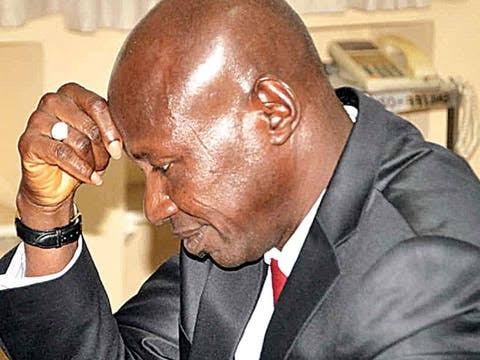
Magu, maggots and Maga dogs | By Festus Adedayo

Published

on

Again, the system felled Ibrahim Magu, Acting Chairman of the Economic and Financial Crimes Commission (EFCC) last week. It had always done that. Olusegun Obasanjo, the maiden president at inception of Nigeria’s fourth republic, first erected the crucifixion upon which a crime-fighting czar was hung. While employing the old Yoruba verbal denunciation of thieves by way of pouting lips, clapping both hands repeatedly, literally poking hands into the face of the accused and shouting Ole! Ole! E ki’gbe ole, ole!, Obasanjo did all that against former Inspector General of Police, Tafa Balogun in January, 2005.

He did more: Obasanjo asked Balogun to immediately tender his letter of resignation, on account of huge theft of public money traced to him. The dossier lay threateningly on the table before Obasanjo that morning inside the Aso Rock Villa. As narrated by Nuhu Ribadu, first EFCC’s Chairman’s biographer, Prof Wale Adebanwi in his A Paradise for Maggots, Balogun went on all fours as a tribal symbolic solicitation to Obasanjo to, in my words, kill me at home and not kill me abroad, whose Yoruba translation was, pa mi si’le, ma pa mi si’ta. A total sum of N2.7 billion in five different banks and jaw-dropping number of choice properties had been traced to the police chief whose mantra for combating crime was Operation Fire for Fire.

Three people were at that meeting: Obasanjo, his Chief of Staff, Abdullahi Mohammed and Balogun himself. Mohammed had earlier summoned Balogun, on behalf of the President. The three of them, being and having affinity with the Yoruba nation (Mohammed hailed from Ilorin, Kwara State), could connect with Balogun’s symbol-baiting prostration. Here was the bodily hefty, giant-in-position Nigeria’s Inspector General of Police in total surrender to his accuser. Tafa Balogun was not only prostrate, in that prostrating position, he was pliant, literally castrated of his manhood and was in subdued acceptance of his guilt.

Balogun was to be dragged by the EFCC to court a few weeks later. He had been handcuffed and even dragged on the floor by young police officers who probably had not stopped sucking their mothers’ teats when he joined the police force. Then Chief Superintendent of Police, Ibrahim Magu, one of the EFCC operatives under Ribadu, led that operation that saw a huge crime czar like Balogun falling with a deafening thud like a common felon.

Thoroughly defoliated of his manhood in the public by Magu and his boys, Balogun had reportedly pleaded with them that, “I can change your lives, please. Let me settle you and let’s settle this. I can make you rich for life.”
Within the period he held the brunt of power, Ribadu oscillated in the air like a pestilence to a commune of Nigerian fraudsters and corrupt Politically-Exposed Persons (PEPs) who were mutating in the air like a ravaging virus.

Aside allegations against him that he was Obasanjo’s poo-poo bowl carrier, Ribadu succeeded in instilling fears into the hearts of Nigerian malefactors clothed in the euphemism of political office holders. His rout of criminals was so celebrated that late literary giant, Chinua Achebe, in lauding the clinical way he fought crime and criminals, compared him to Eliot Ness.

Ness was an American crime-bursting legend of the 1930s renowned for bringing down the Al Capone gang in Chicago, Illinois. His law enforcement team, a 1,000-strong group called Bureau of Prohibition, was nicknamed The Untouchables. When the system was to chop Ribadu off, it made mincemeat of him and flushed the Adamawa-born crime-buster down the cistern like a common felon.

In quick successions, Farida Waziri and Ibrahim Lamorde came, appointed into office by Presidents Umaru Musa Yar’Adua and Goodluck Ebele Jonathan. They also made noise and got some criminals to scamper off their felonies. However, not long after, they became the proverbial Maga dogs, biting the systemic hands that recruited and fed them, thereby getting drenched in the sewage waters that seemed to have been reserved for Nigerian crime-busting chiefs. So, why did the four EFCC czars come into office with so much hope, so much adulations, expectations, vapory glories, but ended up being drenched in a haze of ignominy?

Is there a latent systemic error that will always ensure that the after-office graveyards of these crime lords must be garlanded with stench and shame?
As against what its minders are making us to believe, it is a huge minus to the Muhammadu Buhari government that Magu is being tried now. It is either the government has no mind of its own and was amenable to being swept right, left and center by the currents of some individuals’ whims and caprices, or that it is seriously implicated in the politics of crime-fighting, the ocean of which is alleged to have drowned Magu. This is because, in the cache of allegations said to have been leveled against the ex-EFCC boss, there is a rehash of same allegations which the DSS, about five years ago, saw as reasons why Magu’s nomination should not be upheld by the Nigerian senate.

Throughout the years spent by Magu as EFCC chair, those who understood the workings of the mind of the Buhari government claimed that he was an insider-outsider therein. This meant that though Magu was of the government, he was not for them. If he was for them, his confirmation as EFCC chair shouldn’t have lingered as embarrassingly as it did, like the cry of a wife who clandestinely murdered her hubby. There is the claim that he was of the Bola Tinubu/Yemi Osinbajo rump of the current power calculus. This then must explain why it was easy for those who cooked the slur on the Vice President’s name, using alleged proceedings of Magu’s interrogation, to reinforce the believability of their claim.

The truth is, there are far weightier allegations against Buhari government functionaries hanging in the public domain than those leveled against Magu. For instance, owning property in Dubai, UAE is alleged to be one of Magu’s errs. However, it is common knowledge that the UAE remains a haven where corruptly acquired wealth is laundered for the Nigerian political elite and owning eye-popping property in this Arab country is the rule, rather than the exception. No wonder cyber-heist kingpins like Hushpuppi and Woodberry found a comforting nest there. A minister in Buhari’s government was recently accused of owning humongous mansions in Abuja. His riposte was that he acquired them as a teacher.

The Attorney General of the Federation, the one who must be popping champagne for having seen the back of Magu, also has a mountain load of his own allegations trailing him like recalcitrant flies envelope oozing stench. There is no doubt that illicit financial outflows from Nigeria daily trickle out of PEPs’ conduits and pipes.

The Chief of Army Staff, Lt. Gen. Tukur Buratai was, not long ago, enmeshed in an asset declaration scandal pronged on allegation of ownership of property in Dubai. In his reply, he claimed that the property belonged to his unstated family and that the family made these investments in this Middle East city in 2013, long before his appointment. No further questions were asked. No further investigations needed to be carried out. As far as Nigeria and government were concerned, Buratai’s answers were QED.

Matthew Page, in a Carnegie Endowment for International Peace page, had made a damning condemnation of this capricious craving of Nigeria’s political elite. “For Nigeria’s corrupt political elites, Dubai is the perfect place to stash their ill-gotten gains and enjoy luxury real estate worth millions. But unless authorities stop turning a blind eye, the long-term costs to Nigeria’s economy and Dubai’s reputation could be high,” he had written.
If the truth be told, Magu was an accident waiting to happen on the Nigerian crime-fighting system. So also were his predecessors.

This is because, an office which is that consequential is subjected to inconsequential indices of operations which cannot but render its occupants dead on arrival. What procedure, process or rules guide the appointment of EFCC czars? In other words, how do they emerge? Are they chosen on account of moral gallantry, their ethnicity, man-knows-man procedure or mere seniority? How many times did past occupiers of that office, before and after coming on board, demonstrate ability to look at enticing lures in the face and tell them to go jump inside the River Niger? Elliot Ness, who Achebe compared Ribadu to, in 1931, had a member of the Al Capone gang bait with two $1,000 notes (about $17,000) if he turned a blind eye to the group’s illegal merchandizing. He refused and even though he died penurious at age 54, Ness’ heroic reputation is legendary in America.

Is there a crime-fighting institution or architecture in Nigeria? The answer is no. Our measurement of their suitability is the candidate’s ethnic affiliation, the person who introduces them and their loyalty to the occupier of authority seat. To expect a thorough-bred czar to come out of such a nebulous system is hypocrisy of the highest order.

The story is told of how Obasanjo picked Dora Akunyili without any bother about her ethnicity but a buzz that she had demonstrated an unusual moral courage alien to this clime while working with the Petroleum Trust Fund (PTF) as pharmacist. When she eventually came on board at NAFDAC, she merely rehashed what was her internal constitution. In serious climes, anyone who is to be appointed into an office as critical as the EFCC, who would naturally confront billions of Naira in kickbacks and illicit perks of office must have been psychologically grilled before society can arrive at their suitability. In Nigeria, politicians, who know the criminal functionality of having their Man Fridays occupy such positions, fight tooth and nail to have them in office.

Again, are we being fair to appoint a policeman with no pedigree of snubbing ill-gotten wealth, whose salary is a paltry few thousands of Naira, to superintend over a potential illicit wealth empire like the EFCC? The Carnegie Endowment said PEPs – “individuals who are or have been entrusted with a prominent public function” like Magu and the likes, “are at higher risk of involvement in unlawful activity due to their positions of influence and access to assets.” In fact, it states that, as at 2016, the Center for Advanced Defense Studies (now known as C4ADS) “acquired the data of a private database of Dubai real estate information (dubbed the  ‘Sandcastles’ data) and that, at a conservative estimate, “at least 800 properties were found to have links to Nigerian PEPs or their family members, associates, and suspected proxies.”

So why are we crying wolf now when we exposed a police officer whose take-home is less than a million naira to assets in multiple of billion naira worth?

In a Nigeria that is brimming with street mindsets of fraudulently acquired wealth, of filthy wealthy men and women who crawl in a cesspit like maggots, are we sincere to think we would always have men/women who will kick against what has become normal among us? Are we seriously looking for a clean EFCC chairman in this dirty clime? Those are the honest questions we must ask ourselves. If we now seek a person who is unlike the filth associated with us, should we just pick them peremptorily like they pick a fallen mango off the tree?

This is why, if we think that, with Muhammed Umar as replacement for Magu, or even any substantive name brought up eventually, the maladies in the EFCC would stop, we are fooling ourselves and are on a Pyrrhic victory binge. This is because, no institution of consequence is so forged in saner clime.

By the way, I read that Magu is bitterly complaining that his tormentors-in-chief had treated him with rank ignominy, like a common criminal, inside the Force Criminal Investigation and Intelligence (FCIID) dungeon where he is said to be currently held. Oh, right? How did he, as CSP who led the assault operation against Tafa Balogun, treat the then Inspector General of Police? Wickedness is like the story in the Myth of Sisyphus, a 1942 essay by the Algerian-French philosopher, Albert Camus. While Sisyphus pushes the boulder down the mountain, he goes back again and does the same thing, till the end of time. Good is the only thing that can break the jinx.

Comments

Opinion

Why Ibadan North youths are rooting for Repete

Published

on

Growing support has continued to trail a youthful politician and technology advocate, Hon. Khalil Mustapha Adegboyega, popularly known as Repete, as many youths in Ibadan North Federal Constituency expressed confidence in his leadership style and vision for development.

Across several communities within the constituency, residents, particularly students, artisans and young professionals, described Repete as one of the emerging political figures with strong grassroots appeal and a passion for youth empowerment.

Supporters said his growing popularity stems from his consistent advocacy for innovation, entrepreneurship and skills development aimed at addressing unemployment and creating opportunities for young people.

As an engineer and technology enthusiast, Repete is also said to possess a deep understanding of the evolving digital economy and the need to position youths for global competitiveness.

Many of his supporters noted that his approach to leadership focuses on practical solutions, mentorship and capacity-building initiatives capable of helping young people become self-reliant and economically productive.

Some community stakeholders who spoke on his rising profile said his humility, accessibility and relationship with the grassroots have continued to endear him to many residents within the constituency.

They added that Repete’s engagement with youths and community groups reflects his commitment to inclusive governance and people-oriented representation.

Observers within the constituency also maintained that the increasing support for the politician reflects a growing desire among residents for a new generation of leaders driven by innovation, competence and accountability.

According to them, many young people see Repete as a symbol of hope and progressive leadership capable of contributing meaningfully to the development of Ibadan North Federal Constituency.

Continue Reading

Opinion

Repete or Regret: APC’s Moment of Truth in Ibadan North

Published

on

File photo of Hon. Khalil Mustapha Adegboyega (Repete)

The All Progressives Congress (APC) in Oyo State stands on the edge of a consequential decision—one that may define not only its fortunes in Ibadan North Federal Constituency but also its broader political relevance in the state.

As the countdown to the party primaries intensifies, the question before APC leaders is no longer routine. It is strategic. It is urgent. And it is decisive: will the party align with the clear preference of the people or risk repeating costly political miscalculations?

At the centre of this debate is Hon. Khalil Mustapha Adegboyega, widely known as Repete—a name that has, over time, evolved from a political identity into a grassroots phenomenon.

A Candidate Rooted in the People

In contemporary Nigerian politics, where voter awareness is rising and expectations are shifting, candidates are increasingly judged not by promises but by presence. On this scale, Adegboyega stands tall.

His political journey is marked by consistent engagement with constituents—far beyond the optics of election seasons. From youth empowerment initiatives that provide practical skills and startup support, to sustained interventions in healthcare access for the elderly and indigent, his footprint across Ibadan North reflects a model of leadership anchored on service.

Unlike the transactional approach that often defines political relationships, Adegboyega’s connection with the people appears organic—built on trust, accessibility, and continuity. These are not mere campaign attributes; they are political assets.

The Danger of Political Disconnect

History offers the APC a clear lesson: parties that ignore grassroots sentiment often pay a heavy electoral price. The imposition of candidates perceived as distant or untested has, in several instances, resulted in voter apathy, internal dissent, and eventual defeat at the polls.

Ibadan North presents no exception.

With opposition parties closely monitoring the APC’s internal dynamics, any misstep in candidate selection could provide a ready opening. A divided house, coupled with a candidate lacking widespread acceptance, is a formula the opposition is well-positioned to exploit.
The implication is straightforward: this is not merely about party loyalty; it is about electoral viability.

Echoes from the Grassroots

Across the length and breadth of Ibadan North—markets, motor parks, religious centres, and community gatherings—a consistent pattern emerges in political conversations. The name “Repete” resonates with familiarity and acceptance.

Such organic support is not easily manufactured. It is cultivated over time through visible impact and sustained presence. For a party seeking electoral certainty in a competitive environment, this level of grassroots validation is not just desirable—it is critical.

A Test of Leadership and Judgment

For the APC leadership in Oyo State, the moment calls for clarity of purpose. Decisions driven by narrow interests, personal alignments, or short-term calculations may carry long-term consequences.

The task, therefore, is to balance internal considerations with external realities. Elections are ultimately decided by voters, not by party caucuses. A candidate who commands public confidence offers the strongest pathway to victory.

The Stakes Are Clear

Ibadan North is too strategic a constituency for experimentation. The cost of error is not limited to a single seat; it extends to party cohesion, credibility, and future positioning within the state’s political landscape.

In this context, the argument for Adegboyega is less about sentiment and more about strategy. His visibility, acceptability, and record of engagement place him in a strong position to consolidate support and mobilise voters effectively.

Conclusion: A Choice with Consequences

As the APC moves closer to its primaries, the decision before it is both simple and significant: align with a candidate who reflects the mood of the electorate or risk conceding advantage to a watchful opposition.

In politics, moments such as this often separate foresight from hindsight.
For APC in Ibadan North, this may well be one of those defining moments.


Aderibigbe Akanbi, a political analyst, writes from Ibadan.

Continue Reading

Opinion

Ibarapa East: Yusuf Ramon’s Quest for Responsive Representation

Published

on

Hon. Yusuf Abiodun Ramon

As the road to 2027 gradually unfolds across Oyo State, political conversations are shifting from routine permutations to deeper questions about competence, generational leadership, and measurable impact. In Ibarapa East, that conversation has found a new voice in Yusuf Abiodun Ramon — a Lanlate-born technocrat whose entry into the race for the State House of Assembly is redefining what representation could mean for the constituency.

In a political environment often dominated by familiar faces and conventional calculations, Ramon presents a profile shaped by technical discipline, structured thinking, and solution-driven engagement. His professional background, anchored in analytical precision and systems management, forms the foundation of his public service aspiration.

For him, representation must move beyond ceremonial presence to practical responsiveness — laws that reflect local realities, oversight that protects public resources, and advocacy that translates into visible development.

Ramon argues that the future of Ibarapa East lies in leadership that listens deliberately, plans strategically, and delivers measurably. He speaks of strengthening rural infrastructure, expanding youth-driven economic opportunities, and institutionalising transparency as core pillars of his agenda. In his view, governance must not merely be symbolic; it must be structured, accountable, and people-centred.

Rooted in Ile Odede, Isale Alubata Compound, Ward Seven of Ibarapa East Local Government, and maternally linked to Ile Sobaloju, Isale Ajidun Compound, Eruwa, Ramon’s story is not one of distant ambition but of lived experience. He is, in every sense, a son of the soil — shaped by the same roads, schools, and economic realities that define daily life in Ibarapa East.

“I was born here. I grew up here. I understand our struggles, our strengths, and our untapped potential,” he says. “Representation must go beyond occupying a seat; it must translate into preparation, competence, and genuine commitment to development.”

His academic journey mirrors that philosophy of steady growth. He began at Islamic Primary School, Lanlate (1995–2001), proceeded to Baptist Grammar School, Orita Eruwa (2001–2007), and later earned a National Diploma in Mechanical Engineering Technology from Federal Polytechnic, Ilaro, between 2009 and 2011. Refusing to plateau, he advanced his intellectual horizon and is now completing a Bachelor of Science in Business Administration at the University of Lagos. “Education,” he reflects, “is continuous capacity building. Leadership today requires both technical knowledge and administrative insight.”

That blend of engineering precision and managerial training has defined a professional career spanning more than a decade. Shortly after his diploma, Yusuf joined Mikano International Limited as a generator installer, gaining hands-on experience in industrial power systems — a sector central to Nigeria’s infrastructural backbone. He later transitioned into telecommunications at Safari Telecoms Nigeria Limited, where he received specialized training in Industrial, Scientific, and Medical radio bands, strengthening his expertise in network operations.

In 2013, he became a Field Support Engineer at Netrux Global Concepts Ltd., then a leading ISM service provider in Nigeria. Over four formative years, he immersed himself in telecom infrastructure deployment and maintenance, mastering field coordination, logistics management, and real-time technical problem-solving.

Since July 2017, he has served as a Field Support Engineer with Specific Tools and Techniques Ltd., a power solutions firm providing services to major operators including MTN Nigeria and Airtel Nigeria. In that capacity, he operates at the frontline of ensuring energy reliability and network uptime — responsibilities that demand discipline, accountability, and systems thinking.

For political observers in Ibarapa East, this trajectory matters. It reflects more than résumé credentials; it speaks to a mindset anchored in efficiency, coordination, and measurable outcomes — qualities increasingly demanded in legislative representation.

Beyond the private sector, Ramon’s political exposure is neither sudden nor superficial. A loyal member of the progressive political family in Lagos, he once served as a personal assistant to a former lawmaker, gaining practical insight into legislative procedure and constituency engagement. Within his community, he has quietly extended financial support to small-scale entrepreneurs and students — modest but consistent interventions rooted in personal responsibility.

“My interest is my people,” he states firmly. “Ibarapa East deserves strategic, responsive, and capable leadership at the State Assembly. We must move from rhetoric to results.”

Across the constituency — from Lanlate to Eruwa — development priorities remain clear: youth employment, vocational empowerment, rural road rehabilitation, stable power supply, agricultural value-chain expansion, improved educational standards, and stronger lawmaking that directly reflects community needs.

Political analysts argue that Ramon’s technocratic background positions him uniquely at the intersection of policy formulation and practical implementation. At a time when national discourse increasingly favours competence over grandstanding, his profile resonates with a broader generational shift toward performance-driven governance. His engineering discipline reinforces problem-solving; his business training strengthens administrative understanding; his grassroots roots anchor his empathy.

For Ibarapa East, the 2027 election cycle may represent more than a routine democratic exercise. It may mark a recalibration of expectations — a demand for representation that understands both the soil beneath its feet and the systems that drive modern development. As political alignments gradually crystallize in Oyo State, Yusuf Abiodun Ramon’s declaration signals the arrival of a candidate seeking to translate private-sector structure into public-sector impact.

One thing is clear: the conversation about the future of Ibarapa East has begun — and it is now framed around competence, credibility, and capacity.


Oluwasegun Idowu sent in this piece from Eruwa, Ibarapa East LG, Oyo State

Continue Reading

Advertisement

Entertainment

Advertisement

MegaIcon Magazine Facebook Page

Advertisement

MEGAICON TV

Advertisement

Trending