Connect with us

Top Stories

IITA to present digital tools in cassava, maize farming systems to policymakers

Published

on

The International Institute of Tropical Agriculture (IITA) in the framework of the African Cassava Agronomy Initiative (ACAI) will on Monday present a series of digital innovation tools in cassava and maize cultivation to policymakers in Nigeria to empower extension workers and farmers in the country.

Commissioners of Agriculture and Rural Development, Permanent Secretaries as well as heads of Agricultural Development Programs (ADP) from more than 24 states are among the key stakeholders expected at the official presentation billed to take place at a one-day meeting on the IITA campus in Ibadan on 2 December 2019.

The theme of the event is tagged: “Digital Tools: Disruptive innovations in cassava/maize farming systems.’’

Dr. Nteranya Sanginga, IITA Director General, explains that the institute is sharing the digital tools with state government officials to help solve the problem of poor extension services which is one of the major reasons why Nigeria’s agricultural sector has underperformed in the last three decades.

“Currently, extension- farmer ratio in some states is estimated at one extension agent to 4000 farmers,” he said. “These large numbers of farmers per extension agent undermine the effectiveness of the traditional extension system.

According to Dr. Alfred Dixon, IITA Director for Development & Delivery, “The objective of this one-day meeting is to share these digital tools with commissioners of agriculture, permanent secretaries, and other state actors for dissemination in their various states to empower the extension system and farmers.

“Through this approach, we hope that states across Nigeria will be able to increase their agricultural productivity and ultimately the incomes of farmers,” Dr. Dixon who successfully led the IITA Cassava Weed Management Project added.

In the last 5 years, the IITA Cassava Weed Management Project has developed integrated weed control methods that are helping farmers to double the productivity of cassava and maize. These recommendations are being scaled out to farmers through a variety of digital platforms in the framework of the African Cassava Agronomy Initiative (ACAI).

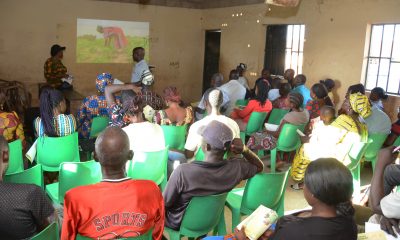
The ACAI project has already distributed mobile phones and mini-projectors loaded with videos on the Decision Support Tools to extension agents. The agents, in the first phase of dissemination, are working in Oyo and Benue States using videos to educate farmers in rural areas on the Six Steps to Cassava Weed Management and Best Planting Practices.

“Engaging policymakers at this point will help in amplifying the use of these digital tools for the benefit of resource-poor farmers,” Dr. Dixon added.

The tools to be presented include videos, radio programs, cassava seed tracker, Akilimo, IITA Herbicide Calculator, e-commerce site and IITA News App.

Comments

Metro

Woman allegedly sets co-wife, two children ablaze in Kano

Published

on

Residents of the Hotoro area of Kano were thrown into panic after a woman allegedly set her co-wife and two children ablaze in a late-night domestic attack.

The incident occurred on Monday night in the Mai Allo area of Hotoro, leaving four persons with varying degrees of burns.

The victims — a 28-year-old woman and her two children aged seven and three — are currently receiving treatment at the National Orthopaedic Hospital, Dala and Murtala Muhammad Specialist Hospital.

Their father, who reportedly sustained injuries while attempting to rescue the victims from the inferno, is also undergoing treatment.

A relative of the family informed that they received a distress call around 3am informing them that the woman, her husband and the children had been set ablaze.

According to the source, the victim had spent less than two weeks in her matrimonial home before the attack occurred.

“She is about 28 years old. The children are from her previous marriage. They are stepchildren to the husband, who works as a tricycle rider,” the relative added.

Residents of the area described the incident as horrifying and called on security agencies to ensure justice was served.

“We are shocked by what happened. This kind of violence has no place in our community,” a resident said.

The suspect has since been taken into custody at the Mariri Police Division.
As of the time of filing this report, the Kano State Police Command had yet to issue an official statement on the incident.

Continue Reading

Crime & Court

UNIBEN killing: Edo security squad arrests 12 suspected cultists, seals initiation centres

Published

on

Security operatives in Edo State have arrested 12 suspected cultists and sealed two apartments allegedly used as initiation centres during coordinated raids across parts of Benin City following the killing of a young man near the gate of the University of Benin.

The operation, code-named “Operation Flush Out Cultists and Kidnappers,” was carried out by the state’s Special Security Squad after the killing recorded on Sunday, May 10, 2026.

The development was disclosed in a statement issued on Tuesday by the Chief Press Secretary to Governor Monday Okpebholo, Patrick Ebojele.

According to the statement, the Chief Security Officer and Principal Security Officer to the governor led the raids conducted in Ekosodin, Isihor, Old Road off S&T Barracks, Airport Road, 19th Street Ugbowo, Ogba-Evbuodia and Evbuomore Quarters, all in Benin City.

Spokesman for the security squad, Noah Idemudia, alleged that some youth leaders within communities in the state were aiding violent crimes and harbouring criminal elements.

He said intelligence reports indicated that sophisticated weapons used in deadly attacks were often traced to communities across the state.

“Reports reaching us indicate that some persons are allegedly harbouring criminals. Intelligence reports also suggest that sophisticated weapons used in deadly attacks on citizens are allegedly sourced from communities.

“The governor is warning community leaders to maintain peace in their various communities and ensure that no unlicensed weapons are found in their possession, as they will be held liable and treated as criminals,” Idemudia said.

He, however, clarified that the 12 suspects arrested were not directly linked to the killing near the university gate.

According to him, the suspects were allegedly identified as members of different cult groups after security operatives reportedly discovered symbols, signs and other incriminating materials on them during the raids.

Idemudia added that the suspects had been handed over to the Anti-Cultism Unit of the Nigeria Police Force for profiling and further investigation.

Speaking on the properties sealed during the operation, he said one of the apartments was allegedly being used as a cult initiation centre.

He explained that operatives came under attack while attempting to arrest suspects at the location, forcing authorities to seal the premises and invite the property owner for questioning.

He added that another apartment raided allegedly contained shrines and fetish items scattered across several rooms, which investigators suspect were being used for initiation into different confraternities.

According to him, the owner of the property had also been invited for questioning by security agencies.

“The governor has warned those sponsoring cultism and violent killings in the state to desist immediately.

“Anyone found aiding criminality in Edo State will face the full weight of the law, as the state will no longer be conducive for criminal elements,” Idemudia added.

He also warned against unlawful gatherings, alleging that some cult groups were planning anniversary celebrations across the state.

Continue Reading

Crime & Court

Ex-Power Minister Mamman Jailed 75 Years Over ₦33.8bn Fraud

Published

on

A Federal High Court in Abuja on Wednesday convicted and sentenced former Minister of Power, Saleh Mamman, to a cumulative 75 years imprisonment in absentia over a ₦33.8bn money laundering scandal linked to the Zungeru and Mambilla hydroelectric power projects.

The trial judge, Justice James Omotosho, found Mamman guilty on all 12 counts bordering on conspiracy and money laundering filed against him by the Economic and Financial Crimes Commission.

The judge ruled that the prison terms would run consecutively, bringing the total sentence to 75 years.

Justice Omotosho held that Mamman deliberately absented himself from court on the day of judgment and during the previous adjourned sitting in a bid to frustrate the administration of justice.

He agreed with counsel for the EFCC, Rotimi Oyedepo (SAN), that the Administration of Criminal Justice Act, 2015 empowered the court to proceed with sentencing despite the defendant’s absence.

The court consequently sentenced the former minister to seven years imprisonment each on Counts 1, 2, 3, 6, 7, 8, 9, 10, 11 and 12 without an option of fine.

Mamman was also sentenced to three years imprisonment on Count 4 with an option of a ₦10m fine, and two years imprisonment on Count 5 without an option of fine.

Justice Omotosho further ordered that the sentence would commence from the date of Mamman’s arrest since he was convicted in absentia.

The judge directed security agencies within and outside Nigeria, including Interpol, to arrest the convict wherever he is found and hand him over to the Nigerian Correctional Service to serve his jail term.

The court also ordered the final forfeiture of two Abuja properties linked to the former minister, alongside various sums recovered in different currencies by anti-graft agencies.

In addition, the court ordered Mamman to refund the outstanding balance from the ₦22bn already traced to the Zungeru and Mambilla hydroelectric power projects out of the ₦33.8bn allegedly diverted.

The conviction followed a lengthy trial instituted by the EFCC, which accused Mamman of conspiring with ministry officials and private companies to divert funds earmarked for the two power projects.

Mamman was arraigned on July 11, 2024 on a 12-count charge and pleaded not guilty.

During the trial, the EFCC called 17 witnesses and tendered 43 exhibits to support its case.

Following the close of the prosecution’s case, the former minister filed a no-case submission on November 19, 2025, contending that the EFCC had failed to establish sufficient evidence against him.

However, Justice Omotosho, in a ruling delivered on December 11, 2025, dismissed the application and held that the prosecution had established a prima facie case requiring the defendant to open his defence.

The matter was subsequently adjourned for continuation of defence before Wednesday’s judgment brought the proceedings to a close.

The case, regarded as one of the most significant corruption convictions in recent years, stemmed from Mamman’s arrest and detention by the EFCC on May 10, 2021.

Continue Reading

Advertisement

Entertainment

Advertisement

MegaIcon Magazine Facebook Page

Advertisement

MEGAICON TV

Advertisement

Trending