Opinion
Dotun Sanusi In My Eyes: An X-ray of A Prophet That Is Honoured In His Hometown
Published
8 years agoon
By
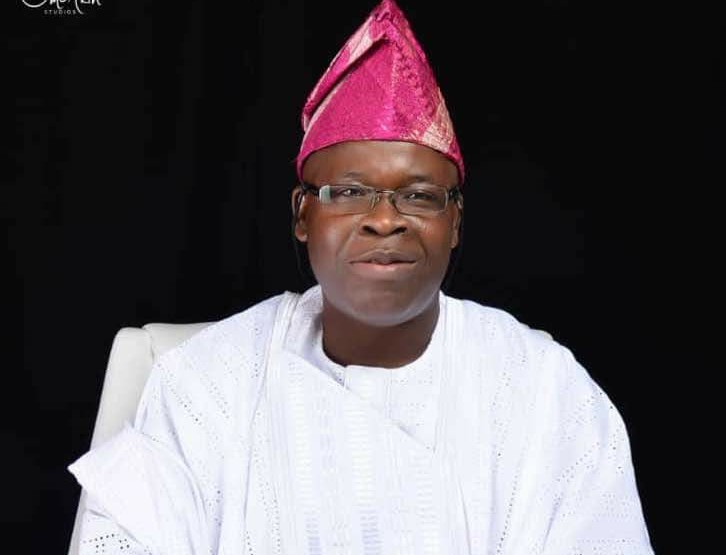
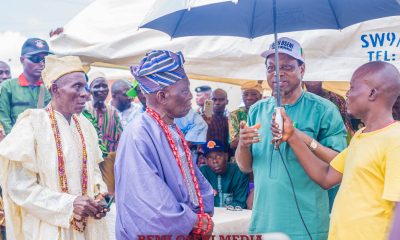
Mega IconTHERE is popularly maxim that ‘a God’s prophet is not usually accepted by their people’. While the statement can not be cast aside in its entirety as we have read in the scripture how some prophets were first castigated and rejected by their own very people but in the case of Engr. Dotun Sanusi, the Chief Executive Officer of Ilaji Stadium and Resort Center and the Proprietor of Institute of Collage of Arts and Science (ICAST) Group of Schools, his people have reciprocated in quantum the love he has showered on them. Infact the paramount ruler of his hometown, Ibadan, His Imperial Majesty, the Olubadan of Ibadanland, Oba Saliu Adetunji Ogunguniso I, has, in recognition of his contributions to the socio-economic of Ibadaland, conferred on him and his wife, the Otun-ApesinOla and the Yeye Otun-Apesinola of Ibadanland last Saturday, October 20, at his palace, Popoyemoja, Ibadan.
I have known Engr. Sanusi for two years now and he is someone who sees progress when every other person sees challenges especially when it comes to projects execution. He is someone who believes in planning and he has a methodology that has worked so well for him. In 2016, in the course of the interview I had with him, he told me then that he wanted to build a ‘Games’ Village’ in Akanran town which will have all the infrastructural facility of any given city. This Game Village according to him will generate it’s own electricity which will be extended to Akanran and its environs.
His reason; it will prevent the rural-urban migration, relieve the city off the pressure on its infrastructural facility and change the mindset of the youths in the rural areas that it is only when you get to the city before you can reach your pot of gold. That Games Village is what has been transformed as Ilaji Stadium and Resorts Center. It generates it’s own electricity via solar energy. It has become a Mecca of sort to the youths not only the ones in the village but to the ones in the rural areas as well.
You don’t need hours around Engr. Dotun Sanusi to know that he is a cosmopolitan person. There is hardly any classes of people that he doesn’t interact with. You need to see him with the labourers who work in any of his establishments to understand this; he would laugh, joke and dance with them. There was time a friend of his warned him to associate less with the people of the lower class so as not to make himself vulnerable for unnecessary attacks. Though, he thanked the fellow but insisted it is the right thing to do. It took a year before I found out the wisdom behind his action. I was in his car that evening and he said in a low voice “I see shocks in the eyes of the owners of the stalls around our stadium here anytime I go there to buy something or to play with them. I have heard some people say I should be careful. Sometimes I wonder, to be careful of what? Why would you alienate yourself from the very people who are your first line of defence? I am someone who is not always around. And here is a multi-billion naira facility. These people here are the first set of our security. If they see a strange face, they are the first that will challenge him even though they know that we have security personnel”, he concluded.
It is an open secret that Engr. Sanusi is a lover of the physically challenged. I am not saying this because he distributed 70 wheel chairs to the physically challenged persons last Wednesday as a way of marking his Golden Jubilee birthday; not at all. But because I had witnessed first hand the genuine love he has for these people. One of the God’s talents Engr. Sanusi has is his ability to move people into actions through his speeches. To say he is an orator is not an exaggeration, but because some events demand that he delivers his speech via printed material, he went to this particular occasion with copies of his speech. I had a premonition that something emotional was going to happen when we got to the event and he refused to wear his well starched and well ironed Agbada. Why would the Chairman of an event refused to wear his Agbada when he had it at the back his car? As if he had read our mind, “I have entered places where the Highs and the Mighties hobnobbed. I have never been asked, for once, to turn back due to the quality of my wears”, this was his response to our queries. This answer kept us mute until we enter the venue of the event. The event which was organised by Revd. Tunde Tioluwani was meant to raise funds for the Man of God’s school for the physically challenged. Engr. Sanusi was ushered into his seat as the Chairman of the occasion. We (a friend of his and yours sincerely ) were also treated nicely too. There were presentations by these special creatures from God. During this period, any able-bodied person who understands the workings of God would have been thanking God Almighty for making all his organs perfectly functioning. When it got to the turn of Engr. Sanusi to deliver his speech, I was waiting for him to start before distributing his speech but the very first statement he uttered in a sober tone that complimented his sober look made me jettison any idea of that, “today is not a day for many words, it is a day for action” this was his first sentence after grabbing the microphone amidst sobs and tensed atmosphere, he continued but not without using his white handkerchief to remove, intermittently, the cloud of tears which has gathered in his eyes, “to know that these special people live all their lives in these kinds of state witnessed here this afternoon is too much for me to bear. What have we (able -bodied) done for God for granting us this huge favour by allowing our organs to function perfectly?”.
He thereafter announced his decision to buy certain number of wheel chairs which ran into millions of naira for some special people there. He added by declaring that he would be assisting the school with 150,000 every month “as long as I live as my own little contributions to the wage bills paid by the school’s leadership to the teachers of this school”, he concluded and thereafter dropped the microphone. To say everyone was surprised was to say the least. The presiding pastor of the church was shocked to the brim because it was the first time he was meeting Engr. Sanusi. The pastor was told to make Engr. Sanusi the Chairman of the occassion through a staunch member of the church who knows that Engr. Sanusi and philanthropic activities are Siamese twins. It wasn’t long after his speech that press men demanded to interview him but he rejected their overtures instead directing to interview the presiding pastor of the church or other notable personalities in attendance.
That Amuloko-Akanran axis and other 50 communities have not had light for over 15 years is no more news, infact the news of the flag off of the resuscitation of the electrification project in these communities has since gone viral. What some people may not know is the compassion for humanity that led to the sponsorship of the project by Engr. Sanusi. “When the people came to plead with me begging me to save them from the shackles of darkness that has enveloped them for over fourteen years. I didn’t have any choice than to give in to their request. I had to look at other sources of my income to finance the project. This electrification project was not in my plan”. What then could have been the reason that spurred him into sponsoring a project that has gulped well over 35 million naira. Was it a spontaneous action? can someone of his status do things solely because of rush of emotions? All these were going through my mind when he continued “I can’t turn my back on these people. The covenant I had with God is that in as much as He continues to give me the means I will never turn my back on any projects that bothers on my people social well being”. he concluded.
If I want to highlight all the humanitarians activities of Engr. Sanusi that I have witnessed since over a year ago that I have been working relatively closely with him, then this is not the right medium as I will have to publish a book on that alone. Engr. Sanusi is a professional to the core. He is a Identifier and someone who nurtures and reward talents if he sees it in someone. He is a good administrator not only of companies but of people too. He is an industrious individual who transmits such to anyone working around him. You can’t afford to be lazy or laxity in the work given to you by Engr. Sanusi. He is a boss who speaks little but shows much through actions.
He translates to his employees his vision and leaves you to create path to get to that destination. His time consciousness is unrivalled. He has made look stupid several times when he gets to an event before I do.. Despite the fact that he has given his employees roles to play in any event he organised yet he still moves around ensuring that everything goes according to plan.
How he compartmentalises his brain to cope with his thousand of employees is still a mystery to me. Engr. Sanusi knows every of his employee inside out.
He knows our strengths and weaknesses. He plays to our strength but gives us everything we need to improve on our weaknesses. Engr. Sanusi at 50 is someone who works as if he is half his age. His energy level is amazing. He is also a family man to the core. His love for his extended family is as strong as the one he had for his nuclear family. He is blessed by God in all fronts and you need to see his wife to appreciate this as she is beautiful, dutiful but most importantly God conscious. She keeps things very tight at home while his husband is away on business trips.
Like the Biblical Moses, Engr. Dotun Sanusi, was sent forth by our Creator to ‘liberate’ his people; his thoughts and actions are pointers to this claim. Or how can one explain an entrepreneur who has spent billions to establish a company but whose main objective is to use the company for the uplift of the underpriviledged. I once told him an idea someone shared with me about how the elites in our society can constantly visit Ilaji Stadium. His answer was “our vision for the establishment of Ilaji Stadium and Resort Center was not solely for the attraction of the elite class to the resort. We want the children of the less priviledged, the commoners in our society to make use of the facilities here too”.
I will round off this article by narrating his explanation for refusing to allow his partner companies to sponsor individual advert today. “I told them that rather than spending huge money on published advert just to congratulate me on my birthday when Olubadan of Ibadanland conferred on me a chieftaincy title, they should spend that money on the development of this community. Just look around this community, even the deaf will hear that this community is crying for help”.
By Hazeez Ayansola
Opinion
Beyond Deportations: What South Africa’s Immigration Crisis Reveals About Nationhood and Economic Frustration
Published
5 days agoon
July 9, 2026By
Mega IconThe popular saying that “one good turn deserves another” appears increasingly absent from present-day South Africa’s national consciousness. It is difficult not to ask whether many South Africans have forgotten the history of their country’s liberation and the immense sacrifices made by Nigeria and other African nations in the long struggle against apartheid.
For days, I have been deeply troubled by reports of South Africa’s worsening immigration crisis and the forceful, vigilante-style eviction of African migrants, particularly Nigerians. Beyond the headlines are broken families, shattered dreams and livelihoods painstakingly built over many years. It is a painful development that should concern every African who once believed in the ideals of continental solidarity.
Anti-immigrant sentiments in South Africa are not new. For more than two decades, campaigns against foreign nationals have been fuelled by high unemployment, widespread poverty, rising crime and frustration over inadequate public services. Many South Africans believe undocumented immigrants compete with them for jobs, housing, healthcare and social services, thereby denying citizens access to these basic necessities.
Yet, available evidence tells a more complex story. Research has consistently shown that immigrants alone cannot be blamed for South Africa’s economic and social challenges. Reducing such deep-rooted problems to the presence of foreign nationals oversimplifies a crisis that has been decades in the making.
What is often overlooked is the country’s structural economic reality. A significant skills mismatch, coupled with weaknesses in the quality of education, has left many job seekers ill-equipped for the demands of an economy increasingly driven by technology, innovation and specialised skills. This challenge is not peculiar to South Africa. Across much of sub-Saharan Africa, thousands of graduates enter the labour market every year without the technical, vocational and digital competencies employers now demand.
Beyond this, crime, insecurity, systemic corruption and poor governance continue to weigh heavily on South Africa’s economy. The country has one of the highest youth unemployment rates in the world. Persistent violent crime discourages investment, while corruption and the mismanagement of public resources have weakened service delivery, slowed infrastructure development and eroded investor confidence.
Equally significant is the enduring legacy of apartheid. More than three decades after democracy, inequalities in education, housing, infrastructure and economic opportunities remain deeply entrenched. Many Black communities still live with the consequences of decades of institutional discrimination and economic exclusion.
Against this backdrop, blaming undocumented immigrants for South Africa’s economic difficulties amounts to little more than scapegoating. It is a convenient narrative that diverts attention from the country’s more fundamental governance and developmental challenges.
The recurring xenophobic attacks against Nigerians and other African nationals make the situation even more painful. The recent killing of Emeka Iroegbu and Musa Yunana Joe on June 28, 2026, amid rising anti-migrant tensions, is a tragic reminder of how dangerous such sentiments can become.
One cannot help but ask: Is this the same South Africa for which Nigeria and many other African countries stood firmly during the anti-apartheid struggle?
I vividly remember growing up in the 1980s, listening to songs such as Free Mandela and Stop Apartheid in South Africa by iconic Nigerian musicians, including Majek Fashek, Onyeka Onwenu and Sonny Okosun. Those songs dominated the airwaves on NTA and became powerful symbols of African solidarity.
As a child, I even believed Nelson Mandela was Nigerian because Nigerians embraced his cause with such passion.
Mandela was released from prison in 1990 and became South Africa’s first Black President in 1994, bringing an end to decades of institutionalised racial segregation and apartheid. Today, just over three decades later, many Africans who once stood shoulder to shoulder with South Africans in their darkest hour are treated as unwelcome strangers.
History can be painfully ironic.
Perhaps, then, the saying that one good turn deserves another does not always reflect reality. Human beings are capable of repaying kindness with hostility. It is an uncomfortable truth, but one that life repeatedly teaches.
At a personal level, this reminds us to live with fewer expectations and strive for greater self-reliance. A heart that expects little, even after giving much, is less likely to be broken.
At the national level, however, the lesson is far more profound. Nigeria must build a country where its citizens can thrive without feeling compelled to seek survival elsewhere. Studies have shown that the overwhelming motivation behind the Japa phenomenon is the search for better opportunities and improved living conditions. If those opportunities existed at home, many Nigerians would gladly remain and contribute to national development.
The experience in South Africa—and, indeed, recent developments in the United States—demonstrates that immigration policies are shaped by changing political realities. No foreign country offers permanent guarantees.
Although the U.S. Supreme Court recently ruled against President Donald Trump’s executive order seeking to abolish birthright citizenship on constitutional grounds, the episode illustrates that even long-established policies can become subjects of political contestation. A constitutional principle that has existed since 1868 could still become a matter of national debate. That alone should remind us that every nation ultimately prioritises its own interests.
The enduring lesson is simple: no country can offer Nigerians greater long-term security than a well-governed Nigeria.
Nigeria’s greatest asset remains its people. Sustainable national prosperity can only be built through visionary leadership, accountable institutions, respect for the rule of law and responsible citizenship. When government creates an enabling environment and citizens embrace innovation, productivity and accountability, Nigeria can become a destination for investment rather than a source of economic migration.
As dozens of Nigerians return home following their repatriation from South Africa, government must move beyond sympathy and symbolic gestures. Some have returned with nothing more than the clothes they wore and a single travelling bag, leaving behind businesses, investments and years of hard work. Their return is not merely a journey home; for many, it is the painful collapse of dreams painstakingly built over decades. They deserve meaningful support to rebuild their lives and contribute productively to the nation’s economy once again.
History teaches that nations are strengthened not by chasing away strangers but by creating opportunities for their own citizens. Nigeria must therefore draw the right lessons from South Africa’s painful experience. Rather than exporting its brightest minds in search of survival, it should become a country where talent is rewarded, enterprise is encouraged and hope no longer requires a passport. Only then will Nigeria become not merely the giant of Africa by population, but by the quality of life it offers its people.
Olusegun Hassan, Ph.D
Public Policy Analyst and Social Commentator
Opinion
An Open Letter to Northern Leaders: Arewa Is Bleeding. Who Will Answer the Call?
Published
1 week agoon
July 7, 2026By
Mega IconI write this letter with a heavy heart to the sons and daughters of Arewa, particularly those entrusted with leadership and influence, concerning the painful reality confronting our region today. Once united in purpose and driven by a shared vision, Arewa now appears to be living in the shadow of its glorious past.
Our forefathers built this great region with one voice, setting aside differences of ethnicity and religion. They understood that unity was our greatest strength and that our diversity was not a weakness but a blessing. Their legacy was one of peace, mutual respect, visionary leadership, and collective progress.
Today, it is heartbreaking to witness how far we have drifted from those ideals. This letter is a sincere call for reflection, reconciliation, and a renewed commitment to rebuilding the unity, security, and prosperity that once defined our beloved Arewa.
Arewa Under Siege
Northern Nigeria has become widely known as a hotspot for multiple forms of insecurity. From the Boko Haram insurgency to widespread kidnapping, armed banditry, and violent attacks, fear has become part of everyday life. People no longer feel safe in their homes, workplaces, on their farms, or while travelling on the highways. Every journey is undertaken with uncertainty, with no guarantee of arriving safely.
Even more troubling is the perception that these security challenges have become normalised. Reports of abductions, killings, and attacks have become so frequent that they often receive far less attention than they deserve. This perceived indifference from those in positions of authority has contributed to a growing public belief that criminal groups now operate with confidence and relative impunity.
Consequently, many residents feel abandoned, while public trust in the government’s ability to protect lives and property continues to erode.
Addressing this crisis requires a coordinated and sustained response through stronger security operations, improved intelligence gathering, greater support for affected communities, and genuine accountability. Without decisive action, the cycle of violence and fear will continue to undermine the region’s stability, economic development, and the well-being of its people.
Beyond Insecurity: A Crisis of Leadership
The North’s challenges are not accidental. Poverty, insecurity, and underdevelopment are the cumulative consequences of long-standing structural failures, weak governance, and policy choices that have compounded over decades.
Responsibility is shared across different segments of society—including the political elite, the educated class, and the business community—many of whom have possessed both the influence and the opportunity to intervene more decisively than they have.
Rather than being the result of a single coordinated agenda, what is evident is a persistent pattern of neglect, weak accountability, and recurring governance failures that have allowed social and economic conditions to deteriorate. These failures have contributed to rising unemployment, declining educational outcomes, inadequate healthcare, and the expansion of insecurity across much of the region.
Breaking this cycle requires more than assigning blame. It demands institutional reform, accountable leadership, strategic investment in human capital, and a renewed sense of public responsibility.
Where Are the Northern Elite?
This brings us to the most difficult question: Where are the Northern elite? Where are the governors, ministers, lawmakers, business leaders, scholars, and other influential voices? Many command enormous influence, considerable private wealth, and extensive international networks, yet too often appear unable—or unwilling—to meaningfully confront the conditions that continue to leave large parts of the region insecure, impoverished, and politically weakened.
Why does this gap persist?
Part of the answer lies in proximity to power. In political environments shaped by patronage, speaking boldly may threaten access, while silence preserves influence. Over time, self-preservation begins to resemble strategy.
Unfortunately, the cost is borne not by those in positions of privilege but by ordinary communities far removed from the rooms where decisions are made.
Reviving the North’s Industrial Legacy
Northern Nigeria was once the industrial powerhouse of the country. Cities such as Kano and Kaduna were thriving centres of manufacturing, commerce, and employment. Today, much of that industrial strength has faded.
This is, therefore, a respectful appeal to two of Nigeria’s most accomplished industrialists—Aliko Dangote and Abdul Samad Rabiu. Many people continue to ask why there is limited visible large-scale industrial reinvestment in Kano, your home state, and across Northern Nigeria.
As a Kano indigene, and to the best of my knowledge, neither Aliko Dangote nor Abdul Samad Rabiu currently operates major manufacturing facilities actively producing in Kano. Several facilities associated with their businesses are widely reported to have become inactive or to function primarily as warehouses rather than active industrial plants. For example, along Tafawa Balewa Road, two BUA facilities that previously operated flour and vegetable oil mills are reported to have ceased production. Likewise, several Dangote industrial sites stretching from Mai Malari Road to the Sharada Industrial Area are also widely reported to be inactive or operating far below capacity.
Kano and Kaduna, once renowned for their vibrant manufacturing sectors, have experienced decades of industrial decline, resulting in widespread unemployment and underutilised infrastructure. At the same time, a significant share of new private-sector industrial investment appears to have been concentrated in other parts of the country, particularly the South-West. This naturally raises important questions about balanced national development.
Philanthropy remains valuable and deeply appreciated. Scholarships, donations, and humanitarian support undoubtedly improve lives. However, charity cannot replace sustainable industrial development.
What the North urgently needs is long-term investment that revives manufacturing, creates employment, strengthens local supply chains, develops skills, and rebuilds industrial ecosystems across Kano, Kaduna, and neighbouring states. Strong factories build strong communities, while sustainable industries create lasting prosperity. The expectation, therefore, is not charity but a renewed commitment to the economic transformation of the region where many of Nigeria’s greatest industrial success stories first began.
The Responsibility of Business Leaders
The Northern business elite have watched insecurity, poverty, and displacement deepen while economic activity has increasingly concentrated elsewhere.
Insurgency, banditry, and weakened rural governance have disrupted agriculture, trade routes, and local markets. Investment naturally gravitates towards safer and more predictable environments. Yet public advocacy from many influential business leaders has often remained muted, constrained by commercial interests, political relationships, and regulatory considerations.
The region risks becoming divided into two realities: one integrated into national wealth and opportunity, and the other left to bear the consequences of persistent insecurity, economic stagnation, and neglect.
Business leadership extends beyond generating profits. It also entails helping to create an environment where enterprise can flourish, jobs can be created, and communities can prosper. Sustainable economic growth depends not only on private investment but also on the willingness of influential stakeholders to advocate policies and initiatives that promote stability, security, and inclusive development.
The North’s business community has historically played a significant role in shaping the region’s economic fortunes. That tradition of leadership remains essential today. While governments bear primary responsibility for governance and security, the private sector also possesses the capacity to influence development through strategic investments, partnerships, innovation, and constructive engagement with public institutions.
Rebuilding confidence in Northern Nigeria requires collaboration among government, businesses, civil society, and local communities. A more secure and prosperous region ultimately benefits everyone, creating new opportunities for investment, employment, and long-term economic growth.
A Message to Political Leaders
To the political leadership of Northern Nigeria: the contradiction has become increasingly difficult to ignore. The region remains one of the country’s most significant in terms of population and political influence, yet it continues to lag behind on key development indicators such as education, healthcare, infrastructure, employment, and security.
When communities are attacked, farmers are displaced, and schools are forced to close, silence from those entrusted with leadership is seldom interpreted as restraint. More often, it is perceived as detachment. Leadership is measured not only by electoral success or political influence but also by the willingness to confront difficult realities with courage, empathy, and decisive action.
The expectations of citizens go beyond promises. They seek visible commitment, practical solutions, and sustained engagement with the challenges affecting their daily lives. Rebuilding public confidence requires leadership that is accountable, responsive, and focused on the long-term development of the region.
A Message to the Educated and Professional Class
To our academics, professionals, and intellectuals: the evidence is neither hidden nor difficult to find. Reports, research, and lived experiences consistently reveal widening gaps in human development, education, healthcare, and security.
Yet, too often, expertise remains confined within institutions and professional circles that discourage open engagement with entrenched power. Knowledge should not merely describe problems; it should help solve them. Research should inform policy, enrich public debate, and contribute meaningfully to sustainable solutions.
Every society depends on courageous thinkers who are willing to engage constructively, challenge complacency, and place the public interest above personal convenience. The North possesses no shortage of intellectual talent. What is needed is a stronger connection between knowledge and action.
A Message to Cultural Influencers
To our musicians, artists, writers, actors, and other public figures: throughout history, art has served as a powerful instrument of truth, reflection, and social transformation. Cultural voices have inspired movements, preserved history, and given hope to communities during difficult times.
Yet, when economic survival becomes closely tied to political or commercial interests, critical voices often become subdued. Society benefits when its cultural figures speak with honesty, empathy, and a sense of responsibility. Their influence extends beyond entertainment; it helps shape public values, inspire civic engagement, and amplify the concerns of ordinary people.
A Shared Responsibility
Ultimately, this is not solely a Northern Nigerian problem. It reflects a broader question confronting societies everywhere: what happens when elite interests become disconnected from the well-being of ordinary people?
When access becomes more valuable than accountability, and proximity to power outweighs responsibility to the public, silence is rarely accidental—it becomes institutionalised.
The result is a widening emotional and political distance between leadership and the people. Unless that distance is narrowed through meaningful investment, principled advocacy, and courageous leadership, the same questions will continue to resonate:
Who speaks? Who benefits? Who bears the cost?
History will judge every generation by how it responds to the challenges of its time. Northern Nigeria possesses enormous human potential, entrepreneurial talent, agricultural resources, and a rich cultural heritage.
What it requires now is leadership marked by vision, courage, integrity, and an unwavering commitment to the common good.
This letter is not intended to condemn but to encourage honest reflection and meaningful action. The future of Arewa depends not only on government but also on every leader, businessperson, scholar, professional, artist, and citizen willing to place the region’s long-term prosperity above personal or political interests.
May we find the wisdom to rebuild what has been weakened, the courage to confront uncomfortable truths, and the determination to restore Northern Nigeria to its rightful place as a region of peace, opportunity, and shared prosperity.
Abba Dukawa writes from Kano and can be reached at abbahydukawa@gmail.com.
Opinion
2027: Why Oyo APC Should Close Ranks Behind Sarafadeen Alli | By Adeniyi Olowofela
Published
2 weeks agoon
July 4, 2026By
Mega IconSince the emergence of Senator Sarafadeen Alli as the governorship candidate of the All Progressives Congress (APC) for the 2027 election in Oyo State, I have listened to and read numerous reactions from party members and stakeholders. While some of his co-contestants have expressed disappointment, such feelings are understandable in every keenly contested democratic process.
Interestingly, many people have attempted to draw Senator Teslim Folarin into the controversy surrounding the party’s choice. However, he has remained silent. In my view, that silence is deliberate. I believe Senator Folarin understands the direction taken by the party’s national leadership regarding the choice of candidate.
Anyone who believes Senator Folarin was unaware of Senator Sarafadeen Alli’s governorship ambition does not fully appreciate his political experience. Senator Folarin is a strategic politician. In the 2023 governorship election, he pursued victory with determination and commitment. Personally, I had hoped he would emerge victorious, and I remain convinced that he gave his all in that contest.
Former Minister of Power, Chief Bayo Adelabu, also contested the 2023 governorship election on the platform of the Accord Party. Although I disagreed with that political decision, democracy guarantees every citizen the freedom of association and political choice.
Following the election, he was appointed into the Federal Executive Council, a development many interpreted differently based on their political perspectives.
Today, Chief Adelabu commands a substantial political following built over several election cycles. His support base remains significant, and if APC is to present a formidable front in 2027, Senator Sarafadeen Alli will undoubtedly benefit from the goodwill and backing of Adelabu and his loyalists.
Similarly, former Minister of Communications, Barrister Adebayo Shittu, has consistently demonstrated interest in Oyo State’s governorship over the years, even though he did not purchase the APC nomination form this time. His political experience and network remain valuable assets that should not be ignored.
My sympathy also goes to those aspirants who invested as much as ₦50 million each to purchase the APC governorship nomination form. That is no small sacrifice. Nonetheless, politics demands sacrifice in the collective interest. The pendulum could easily have swung in favour of any of them. Had that happened, the rest of us would equally have appealed to others to rally behind the eventual flag bearer.
I recall an incident during the 2022/2023 party activities when an official from Abuja, sent to supervise APC affairs in Oyo State, passionately appealed to stakeholders to embrace consensus. His message remains instructive. He warned that continued division within the party would only prolong its stay outside power and ultimately hurt everyone.
That warning remains relevant today.
For seven years, the APC has remained outside government in Oyo State. Can the party afford another four years in opposition? I do not think so.
This is why the task before us goes beyond the personal ambition of Senator Sarafadeen Alli. It is a collective struggle for every APC member, especially the foot soldiers who have remained loyal through difficult times. The Federal Government alone cannot provide opportunities for everyone. Regaining power in Oyo State is essential if the party hopes to broaden opportunities for its members at both the state and federal levels.
The challenge before us, therefore, is to build a larger political platform that accommodates everyone.
Senator Sarafadeen Alli is no political novice. Over the years, he has built relationships across virtually every ward in Oyo State. His political structure and grassroots appeal are undeniable. If party members unite behind him, APC stands a strong chance of returning to Government House.
Realistically, the 2027 governorship contest in Oyo State is shaping up to feature three major political forces. First is Senator Sarafadeen Alli of the APC, representing arguably the state’s most established political platform. Second is Hon. Bimbo Adekanbi, who many believe enjoys the backing of Governor Seyi Makinde and is expected to fly the flag of the APM. Third is Alhaji Hazmat Oriyomi of the Accord Party, whose growing popularity among many grassroots supporters cannot be dismissed.
The eventual winner is likely to emerge from one of these three political blocs. That reality alone should remind APC members that victory is far from guaranteed.
The surest path to success is unity.
This election should not be seen as Senator Sarafadeen Alli’s personal battle. It is the collective responsibility of every APC member who desires the party’s return to power in Oyo State.
The time has come to bury personal grievances, close ranks and work together. Only through unity can APC reclaim Oyo State in 2027.
Prof. Adeniyi Olowofela, former Chairman of the defunct Alliance for Democracy (AD) in Oyo State, former Chairman of Ido Local Government, former Commissioner for Education, Science and Technology in Oyo State, and former Federal Commissioner representing Oyo State at the Federal Character Commission (FCC), writes from Abuja.
Advertisement
Entertainment
MegaIcon Magazine Facebook Page
MEGAICON TV
Advertisement
Trending
-
News1 week agoBode Market Inferno: ‘You Are Not Alone,’ Oseni Tells Victims, Donates ₦20m, Seeks FG Intervention
-
News4 days agoAbducted Oyo pupils, teachers regain freedom
-
Opinion1 week agoAn Open Letter to Northern Leaders: Arewa Is Bleeding. Who Will Answer the Call?
-
News5 days agoSenate approves ₦403bn Police Trust Fund budget, Tinubu pushes criminal justice reform