
Top Stories
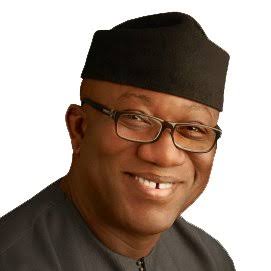
Creating Separate Arts, Culture and Tourism Ministry: Fayemi Set The Pace In Ekiti | By Olaoluwa Mimiola


The role of tourism in enhancing inclusive economic growth and development of both advanced and emerging economies cannot be overemphasized. Tourism stimulates economic growth by generating income, employment, investments, exports and it serves as a catalyst for socio-economic development.
In fact, tourism has been included as a target in goals 8, 12 and 14 of the Sustainable Development Goal (SDGs). Despite the increasing and unpredictable shocks from terrorist attacks and political instability, health pandemics and natural disasters, Travel and tourism continued to show it’s resilience in 2016 and accounted for about 30% of total global service exports.
Investment in tourism is particularly important for Nigeria due to dwindling government revenue and economic contraction as a result of the drastic fall in crude oil prices, and with the vision to be rated among the top 20 economies of the world today by 2020. Hence, tourism industry press t’s an alternative source of revenue for the government and job opportunities for the youthful population.
The landscape of Nigerian is, no doubt, dotted with innumerable enviable tourism potentials, both natural and man-made. But, the country could be said to be lagging behind in tourism promotion and development, in spite of the many tourism potentialities, both in material and human resources. This has continued to give stakeholders in the industry serious concerns.
Stakeholders in the industry including the press, have suggested a legal framework and creation of a separate Culture and Tourism Ministry, to improve accelerate development in the Nigerian Tourism industry. As at the time of publishing this piece, Tourism is buried in the Information and Culture Ministry, which Alhaji Lai Mohammed heads.
In the bid to ensure a favourable legal framework for the Nigerian Tourism industry, was the Bill for an Act on the Nigerian Tourism Development Authority (NTDA) Act Cap N137 LFN, 2004 (Repeal and Enactment) Bill, 2017 (AN.429) on Thursday, August 17, 2017, on Conference Hall 022, Senate Building (New Wing), National Assembly complex. The bill successfully passed through three hearings by the Senate, hence the approval of the 8th Legislative arm of government, headed by Senator Bukola Saraki, to sequester the Tourism Ministry.
However, President Muhammadu Buhari conveyed to the Senate his decision to withhold assent to the Nigeria Tourism Development Authority (NTDA), among other 30 bills he rejected in his first term.
In a letter read by the then Senate President, Bukola Saraki, at plenary the President gave reasons for withholding assent to the bill.
Buhari said section 14(d), section 30(2d) of the Nigeria Tourism Development Authority (Repeal and re-enactment) bill contradicts section 4 (1-3) and paragraph 60 (d) of the second schedule of Nigeria’s Constitution.
Section 30 of the bill proposing to levy a tourism fee on all inbound international travellers, a tourism levy on all outbound travellers and a tourism departure contribution fee of 1 per cent per hotel room rate.
“Such a flat fee has been fixed by the authority and a corporate tourism development levy of 1 per cent to be charged on the revenue of banks, telecommunications and other corporate entities. This will be inimical to the growth of the tourism and hospitality industry in Nigeria and constitute an additional burden on the tourism business,” the letter reads.
Director-General, Ekiti State Council for Arts and Culture, Ambassador Wale Ojo-Lanre, prior his appointment, in the one-man campaign to some Media Houses in Ibadan, the Oyo State capital charged President Buhari to create a separate ministry for Culture and Tourism.
The efforts yielded no positive result at the federal level. In fact, no Governor in Nigeria has seen the need for a separate Ministry for Culture and Tourism.
But, Ekiti State Governor, Dr John Kayode Fayemi, on Wednesday, December 11, 2019, took the giant and unprecedented step of creating a separate ministry for Arts, Culture and Tourism.
He made the pronunciation at the opening ceremony of the 2019 edition of the Ekiti State Festival of Arts and Culture (EKIFEST), by upgrading the state’s Council for Arts and Culture to the Ministry of Arts, Culture andTourism.
Fayemi also disclosed the determination of his administration to increase its investment and exploits in the arts and culture sector for the economic prosperity of the state and its citizens.
This singular, bold and laudable act of Governor Fayemi would no doubt speed up the development of Tourism in Ekiti State, boosting the state’s economy, creating wealth for her people and jobs for the youths, and exposing the state to the world for better patronage.
The Nigerian Tourism industry would, no doubt, develope at a faster pace if President Muhammadu Buhari could reason with the rightly-thinking stakeholders in the Tourism industry and borrow a leaf from other countries that are doing well in the industry, and sequester the Tourism Ministry.
Let Governors of another state in the country emulate Governor Fayemi and sequester the Culture and Tourism Ministry for faster and better development of the industry, which will no doubt better than lots of the states and the people therein.


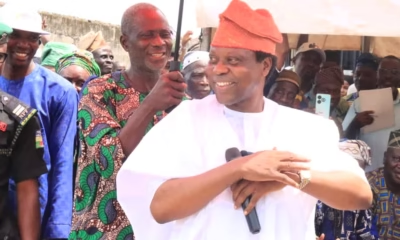


The lawmaker representing Akinyele/Lagelu Federal Constituency of Oyo State, Olafisoye Akinmoyede, has denied allegations of violence at the All Progressives Congress (APC) state secretariat, describing claims that he assaulted a party member as false and politically motivated.
An online platform, IMPARTNEWSNETWORK, had alleged that Akinmoyede assaulted one Gafar Oyebade during a meeting convened by the state chairman of the party, Alake Adeyemo, to resolve issues surrounding the executive list of the APC in Lagelu Local Government Area.
However, Akinmoyede, in a statement on Tuesday, said the meeting was peaceful and attended by key members of the state executive, including the chairman, deputy chairman, and secretary, who witnessed the proceedings.
He clarified that contrary to Oyebade’s claim of being the party secretary, the official list presented by the state leadership recognised him as the Public Relations Officer.
According to the lawmaker, following the clarification, the state executive directed the Lagelu Local Government chairman, Fatai Awoyoola, to proceed with the swearing-in of other party officials.
Akinmoyede also faulted attempts to link the incident with the 2019 killing of a former federal lawmaker, noting that a court of competent jurisdiction had already ruled on the matter.
He said, “In Suit No. I/70c/2019, delivered by Justice Mufutau Adegbola on January 23, 2020, all those accused were discharged and acquitted.”
The lawmaker expressed concern over what he described as a deliberate attempt to mislead the public, alleging that Oyebade, a public school teacher under the Oyo State Government, should not be involved in partisan politics.
He described the allegation as a “recycled script” aimed at tarnishing his image ahead of political activities, urging constituents to remain calm.
Akinmoyede also called on journalists to verify information before publication and urged security agencies to take action against individuals who file false reports.
“These tactics surface every election cycle. Those behind them should learn to accept the outcomes of political processes. They failed before and will fail again. Power comes from God,” he added.
The lawmaker representing Akinyele/Lagelu Federal Constituency in the House of Representatives, Hon. Olafisoye Akinmoyede, has denied allegations of assault levelled against him by a member of the All Progressives Congress (APC) in Lagelu Local Government Area, Mr. Gafar Oyebade.
Akinmoyede described the allegation as “false” and “a lie taken too far,” insisting that no physical altercation occurred.
The denial was contained in a statement issued on Monday by his Legislative Aide, Dr. Isiaq Akintunde.
Oyebade had alleged that he was hospitalised following a confrontation during a meeting held at the office of the state party chairman in Oke-Ado, Ibadan, convened to resolve a leadership dispute in the local government.
But the federal lawmaker maintained that the meeting was peaceful and attended by top party officials.
“The meeting was convened to clarify Mr. Oyebade’s position within the local executive, and it was attended by the State Party Chairman, his deputy, the secretary, the publicity secretary, and other key state executives, all of whom witnessed the peaceful proceedings,” the statement read.
He added that contrary to Oyebade’s claim of being the party secretary, the official list presented by the Lagelu Local Government Party Chairman, Hon. Fatai Awoyoola, identified him as the Public Relations Officer.
According to Akinmoyede, the state executive thereafter directed Awoyoola to proceed with the swearing-in of the remaining members of the local government executive.
The lawmaker accused Oyebade of fabricating the allegation to advance political interests.
“I wonder why Mr. Gafar Oyebade, a secondary school teacher, would claim he was assaulted in the presence of the State Executive. This is an attempt to justify money allegedly collected from an aspirant to tarnish my image,” he said.
Akinmoyede further claimed that Oyebade was seen walking freely after the meeting and was not hospitalised as alleged.
He also raised concerns over Oyebade’s involvement in partisan politics, noting that civil servants are restricted from active participation in political activities.
The lawmaker called on security agencies and the media to investigate the incident at the party’s Oke-Ado office to ascertain the veracity of the claims.
Efforts to reach Oyebade for comments were unsuccessful as of the time of filing this report.
The lawmaker representing Ibarapa East/Ido Federal Constituency and Chairman, House Committee on Federal Roads Maintenance Agency, Aderemi Oseni, has declared his intention to contest the Oyo South Senatorial seat in the 2027 general elections.
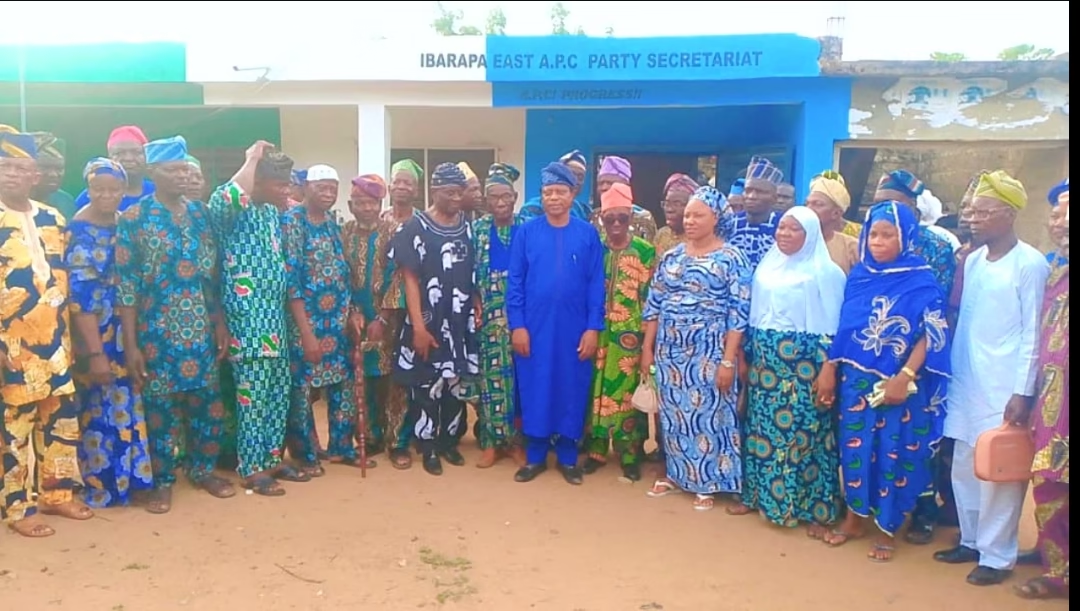
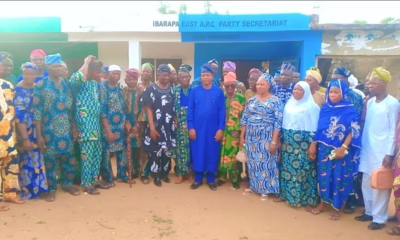
Oseni made his aspiration known during a high-level meeting with the Ibarapa APC Elders’ and Leaders’ Forum, comprising the G9 and the expanded G64 caucus, held at the party secretariat in Eruwa, Ibarapa East Local Government Area, over the weekend.
The G9 and G64 groups consist of influential stakeholders drawn from Ibarapa East, Ibarapa Central, and Ibarapa North local government areas.
In a statement issued on Monday by his media aide, Idowu Ayodele, and made available to journalists in Ibadan, the lawmaker expressed appreciation to the forum for their support and confidence in his leadership and vision.
He said his ambition to represent Oyo South Senatorial District was anchored on a determination to consolidate and expand his record of performance.
Oseni said, “This aspiration is not built on mere rhetoric, but on the continuity and expansion of a proven track record of quality representation and grassroots-oriented governance.”
While soliciting the support of party leaders, he described his ambition as a divine call to serve the people with renewed dedication.
According to him, “This is not a time for self-glory but a sacred responsibility to intensify efforts towards real development, bring more relief to our people and ensure inclusive governance.”
He pledged not to betray the trust reposed in him by party elders and faithful, stressing that his aspiration is rooted in progressive ideals and a genuine commitment to the development of the district.
Oseni also urged leaders in the zone to mobilise support towards delivering one million votes for President Bola Tinubu in the forthcoming election.
Speaking at the meeting, a leader from Ibarapa East, Chief Michael Morawo, lauded the lawmaker for delivering democratic dividends and strengthening the party structure. He added that Oseni has demonstrated commendable leadership through his performance, noting that his impact in stabilising the party within the constituency is evident.
Similarly, a former council chairman in Ibarapa Central, Chief Theophilus Adenrele, commended the lawmaker for not betraying the trust reposed in him. Also, a chieftain from Ibarapa North, Chief Francis Babalola, described Oseni as a humble leader committed to progressive ideals, dismissing speculations about his possible defection if he does not secure the governorship ticket.
In his remarks, the Chairman of the forum, Chief Timothy Jolaoso, said the lawmaker enjoys widespread grassroots acceptance that cuts across political divides.
Jolaoso said, “All indicators consistently point to Oseni as a candidate with acceptance that transcends party lines. He is not only capable but a man of deep faith with proven empathy for the downtrodden.”
He added, “He possesses the goodwill, financial strength, and public trust required for leadership.”
The elder statesman further noted that Oseni’s performance in the House of Representatives, alongside his role as Chairman of the FERMA Committee, underscores his competence and commitment to development.





-
 News7 days ago
Oseni Secures Prestigious City People Political Award Nomination
-
 Politics3 days ago
2027: Oseni kicks off Oyo South Senate bid, rallies support for one million Tinubu votes
-
 Health7 days ago
Oyo confirms Lassa fever death in Ibadan, activates emergency response, traces contacts
-
 Crime & Court7 days ago
Joshua crash: Driver faces fresh charges as court adjourns trial