Opinion
Bamise’s murder and this Cryptocurrency generation
Published
5 years agoon
On Saturday, March 12, 2022, I delivered the paper below at the Kegites Club’s celebration of ex-President Olusegun Obasanjo’s 85th birthday which was held at the OOPL (Olusegun Obasanjo Presidential Library) in Abeokuta, Ogun State, with him in attendance:
At the installation of the new Olubadan of Ibadanland, I took my time to listen to his cognomen, with studied interest. I came out of the encounter first, with laughter, then shock and trepidation. His royal majesty’s praise chants describe him as “omo o toro obe, toro abe; boo bun mi l’obe, bun mi l’abe nitori abe dun j’obe lo”. Roughly translated, this means, the child of he who begs for soup and begs for sex; he says if you don’t have soup, hesitate not to give me the taste of sex because sex is sweeter than soup.
Such cognomens and songs give indications of traditional African society. They reveal, not strictly the promiscuity of pre-colonial Africa but even other sins they committed like killing one another for killing’s sake. Take for instance the cognomen, oriki of the Iloko lineage of Oyo Yoruba. Iloko proudly dances to chants of lines like omo abe’nilori fiyoku bun ni, translated to mean, one who cuts off somebody’s head and then forgives the victim after the act. My friend, Lasisi Olagunju, an Iloko, proudly flaunts this.
Elders of our land, today, your traditional Africa is under serial attacks. That same traditional Africa which, in nostalgia, you label the purest of all societies, is today mocked by a generation I call the cryptocurrency generation. As the Olubadan’s cognomen was being chanted, I listened to a very naughty little boy of that generation beside me say, so their generation too was that decadent; so why do they disdain ours?
Early this week, as the lifeless body of 22-year-old Oluwabamise Ayanwole, the young lady who commuted on the Lagos Bus Rapid Transit, was found, you were mocked, elders of our land. Oluwabamise’s remains had been dumped on Lagos’ Carter Bridge, with some of her body parts alleged to be missing. Whether the young hapless lady’s death was as a result of a rape gone awry or ritual killing, we are yet to be fully told. However, Nigerians have recently witnessed a resurgence of killings for money rituals.
Respected British scholar, John Peel, in one of his works, said his research found out that in pre-colonial Nigeria, mortuary killings were predominant in southwest Nigeria and strangers were often killed to preserve the life of a community.
Whenever and wherever mutilated bodies of victims of ritual killings are found, your traditional Africa suffers a terrible blow. As tears roll down their cheeks, children of this generation are quick to warn you, canvassers of the purity of traditional Africa, to save your crocodile tears for another day. They claim that the graveyards are filled with bones of hundreds of people your forefathers murdered for what they called the sustenance of traditional Africa; that money ritual is one of your bequeathals to their generation.
As if that was not enough, the cryptocurrency generation calls you hypocrites. What impudence! Asked to elaborate, the vociferous ones among them said that while your forefathers, in one breath, fascinatingly rendered the ancient poetic lines of J. F. Odunjo Alawiye’s poem which asked us to spare the crawling insect and not stamp our feet on it because it is also God’s creation in the chant, “Yi ese re si apa kan, ma se pa kokoro ni, kokoro ti iwo ko le da, Olorun lo le da”…in another breath, your cultic forebears gorged out eyes, breasts, hearts and private parts of their victims. They said those body parts symbolized creationism and multiplicity. With body parts for rituals, wealth and communal wellbeing were assured.
I know you are stupefied at this generation’s daring guts. But listen yet again. This generation says it is amused that you are bothered at the common occurrence now of teenagers, barely off diapers, driving around shining, metallic wonders-on-wheels. Why are they aghast that we earn millions of dollars from Yahoo Yahoo scam of white men and women? they chorus.
Again, they ask you to cover your face in shame. Rather than the villains you say they are, the cryptocurrency generation says it is a generation of heroes and warriors. Their defence is that this is a generation that has chosen not to stand by and lament the over-a-century slave trading and despoliation of the fecund lands of Africa. According to them, they chose instead to fight your battles, battles that you were too effeminate to fight and could not have won against your taskmasters. By defrauding offspring of your colonial taskmasters who took you into slavery centuries ago, the cryptocurrency generation claims it is helping you repatriate the unpaid wages and sweats of your forefathers who, centuries ago, were hewers of woods and drawers of water for Europe and the Americas.
In your very eyes, those lullabies of purity of traditional Africa are exploding into smithereens, elders of our land, you who are the last surviving offspring of traditional Africa. You are at a crossroads. You are right now at that place where three footpaths meet, the very place you called the crossroads that turns the stranger into a novice, the ikorita meta ti n damu alejo.
In the name of fashion, your children are today the archetype of what you resented with the whole of your being. Your children happily flaunt sartorial madness, regalia of that same species of beings you loathsomely labelled as one whose insane dances at the market square are scintillating to watch but whom no one prays to have as a child; the were dun wo loja, ko se bi l’omo.
This cryptocurrency generation wears that same locked, dishevelled, filthy, lengthy, bushy, dreadlocked hairs that the local madman in your area wears, the equivalent of the hairs on the head of Jesus the Christ’s generation’s madman of Gadarene. Your abetiaja cap they mock to ridicule as Stone Age sartorial cruelty and your agbada receives their scorn as a needless parachute. In its place, they wear torn jean trousers like this same madman of Gadarene and place their trousers below the heap of the two clefts of their bottoms – the bebere idi. But of course, they are ever quick to refer you, our elders, to the aforementioned Olubadan’s cognomen as proof that the generations of yesteryears were not as innocent and pure as they have been made to believe!
Ah ah! The myth of purity is exploding in your very eyes like vapours of nothingness! Today’s fashion, the fashion sense of the cryptocurrency world that we live in, blatantly mocks all that excessive coverage of the essential body parts. Your daughters scarcely wear anything at all today. They make public spoils of their nakedness, advertising their cleavages, the bodily variant of what legendary Yoruba Kennery Music exponent, Orlando Owoh, called the sweet pineapple within which there is multiple sweetness – the ope oyinbo to fi dundun s’ewa.
Didn’t your forefathers teach that there is wisdom in masking glory before its maturation, which you concisely couched in that pithy aphorism, bi isu eni ba ta, a f’owo bo je ni? Your male children today and their new wives pose for photographs on Facebook and Instagram with protruded pregnant alaboyun tummies, more naked than the prehistoric Adam and Eve, in a wild celebration they call Baby Shower. When your forefathers sighted a naked man or woman on the street, aghast, they shouted: “Ikunle abiamo o!” a lamentation of the labour pain of a woman that has come to ruins. If in lamentation of nakedness, your forefathers, when they saw a naked madman on the streets, murmured, aso o b’Omoye mo, Omoye ti rin’hoho w’oja, why do you, elders of our land, tolerate your children wearing nakedness as clothing to the marketplace and you laugh and dance with them?
The best place to begin the interrogation of what has gone wrong with us is to find out whether this generation and generations before them share a meeting of the minds on what values are. We need to dispense with this before we accuse one of cultural and value impunity and beatify the other as torchbearers of standards, values and purity. Why has social media become the new German philosopher, Fredrich Nietzche’s Superman, dishing out absolute moral codes to our children and turning them into alien spectacles we can scarcely recognize? Why have we chosen to look away in odious resignation while our fruits, the leaders of our tomorrow, decimate the values that gave us our sterling identity and pride of old?
In Africa, such values as respect for elders, hard work, respect for seniority, the extended family system, valour, premium on children, etc reigned. Pre-colonial Africa is often held as the Golden Years of the continent.
Let us pick the above African values one by one and see where they are in a 21st-century world. Respect for elders. Celebrated columnist, Reuben Abati, faced one of the most acidic attacks ever recently when he demanded that his age be properly attributed on a television programme. Abati was facing what the late poet, Gabriel Okara, mirrored in his ‘Piano and Drums’, piano symbolizing modernity and drums, traditional Africa. Unfortunately for Abati, he forgot that television and modern broadcasting are 21st-century objects, with their own set codes and ethos, to which he wanted to sacrifice pre-colonial ritual objects! Greetings and respect for elders in Africa, Nigeria, and among the Yoruba, like Rome, were not built in a day and did not die in one day. They die gradually. In Yorubaland, the gradual death of respect for elders began from youngsters offering what is called idobale igbingbado – the corn-planting prostration position. It then moved to the merely-bowing-of-head position and today, respect for elders is facing total annihilation. Youngsters offer handshakes as greetings to elders.
Hard work. Today, only a tiny population of our youths believes in hard work. They want to ride Bugatti and Bentley the day they are born. Music as popular culture in pre-colonial Africa and even immediate post-colonial Africa helped to underscore the value of hard work. Musicians of that period sang that sorcery and magic cannot make one wealthy. Today, musicians sing praises of felons and exalt virtues that they say are in scamming and 419.
In the same manner, the values of the extended family system, valour, premium on children and others have become extinct. Those days, Europeans and Americans celebrated our virtue of communal living, our Ubuntu. Ubuntu is a South African social philosophy of culture which explains Africa’s capacity to express compassion, dignity, harmony and humanity while building and maintaining a sense of communality, justice and mutual caring. Ubuntu is a fellow human feeling which is diametrically opposed to the individualistic theory of society propounded by the French philosopher, René Descartes, expressed in the Latin word, “cogito, ergo sum” – I think, therefore I am. For us in Africa, our underlying social philosophy of culture was, I am because we are. Today, Africa has returned to Descartes. It is everyone for himself and God for us all.
Social media is today held as the culprit of the implosion of immorality in Nigeria. I do not subscribe to this fully. I think what we have now is an explosion of reportage of evil, not an explosion of the act. The truth is, there is little difference in the decadence prevalent in pre-colonial African society and now. The little difference is that the ratio of righteous countrymen then, compared to now, has dwindled considerably. Promiscuity was like pestilence then and immorality ruled our world. Until the Nigerian law forbade it, bastard children, products of liaisons with married women, littered the space. Murder was like sport and injustice was everywhere. In the politics of the First Republic, dead bodies were brought to the front of the houses of political opponents so as to rope them into murder. What the social media can be accused of doing now is coordinating all these indecencies that seem to be latent in us – ones in Zamfara, Ebonyi, to Osun – and making them available across time and space, in a baffling spontaneity that looks like a spike.
The way to begin is for each of us to return to our homes. As the saying goes that whoever the gods want to destroy, they first make mad; the family in Africa has become a mad place. William Yeats, Irish poet, dramatist, writer and one of the foremost figures of 20th-century literature, wrote in his poem, ‘The Second Coming’, talked about things that have gone awry, purity that has been polluted. It is the same in our families today. The falcon cannot hear the falconer as things (have) fallen apart; the centre cannot hold. Right inside the family, mere anarchy is loosed upon the world. Parents gladly receive car gifts from their Yahoo Yahoo children who they know are kingpins of scamming. They are the ones who help to philosophise the fraud rot that has destroyed many victims’ lives forever by saying that Yahoo Yahoo is an attempt to repatriate stolen African valuables by the West. I learnt there is even an association of Yahoo Yahoo mothers.
We have to begin from our homes to teach our children the values and purity of hard work and the unenduring worth of indolence and fraud. We must begin to teach them morals by asking our children to remember the child of whom they are. Though we are in a 21st-century world, J. F. Odunjo’s books, his poems, the stories of tortoise and his wife who we called Ijapa and Yannibo, stories that moulded us to responsible adulthood, are evergreen, imperishable, relevant for this age and are calling for our attention today. Each family must teach their children, from the diapers, about Odunjo’s classic poem, ‘Ise l’ogun ise‘ (Work serves as an antidote to poverty). In fact, it must be hung on the wall as we did almanac those days. That poem teaches that we should intensify efforts at work because, not only is there dignity in labour, work is the only thing that can lift one up.
If we religiously do this, we will be rescuing this generation and the ones to come from the madness of swindling, indolence and warped sense of achievement. More importantly, we will be saving our children from the hands of this fast-moving, all-that-is-wrong-is-right cryptocurrency generation, the scions of the ZaZuZeh culture that kills the Oluwabamises of this world for rituals, believing that in their severed body parts, lie antidotes to poverty.
Dr. Festus Adedayo, a Journalist, Lawyer and Columnist writes

You may like
Opinion
Seven Factors That Keep Sharafadeen Alli Ahead in 2027 Oyo Governorship Race
Published
5 days agoon
September 14, 2026By
Bisi Oladele
Fact 1: Homegrown Leader with Unmatched Grassroots Experience
Senator Alli’s political journey began at the grassroots level in Ibadan, where he made history in 1991 as the first democratically elected Executive Chairman of Ibadan North Local Government. This early leadership role demonstrates a deep, foundational understanding of local governance and the needs of the people, a critical asset for a state governor.
![]()
Fact 2: Rare Combination of Top-Tier Academic and Professional Credentials
Senator Alli is not just a politician but also a distinguished legal practitioner with a Ph.D. in Legislative and Strategic Studies. His extensive education, including degrees from the University of Ibadan, combined with his fellowships from prestigious professional institutes, provides him with the analytical, legal and strategic acumen required to manage the complex affairs of Oyo State.
![]()
Fact 3: Proven Executive Administrative Competence at the Highest State Level
His tenures as Secretary to the Oyo State Government (SSG) and later as Chief of Staff (CoS) to the Governor showcase his direct experience in the engine room of state administration.
![]()
He has been intimately involved in policy formulation, committee leadership and the day-to-day running of the state, making him uniquely prepared to assume the governorship and hit the ground running from day one.
Fact 4: Demonstrated Executive Business Leadership with Regional Impact
As Chairman, Board of Directors of Odu’a Investment Company Limited, Senator Alli was not just an administrator but a visionary economic leader. He spearheaded landmark investments such as the Cocoa Mall and Heritage Mall in Ibadan, which transformed the economic landscape of Oyo State. This proven ability to attract and drive large-scale economic development is directly transferable to governing Oyo State.
![]()
Fact 5: Battle-Tested and Consistent Political Figure
Senator Alli’s political career spans more than three decades, weathering the annulment of his 1996 Senate election and consistently remaining a relevant and influential force. He has contested for Deputy Governor and Governor in the past, giving him a comprehensive understanding of statewide campaigns and the diverse political landscape of Oyo State. His journey demonstrates resilience, deep political networks and unwavering commitment.
Fact 6: Current, Performing Senator and Influential Figure
As the sitting Senator for Oyo South, he is actively delivering quality representation, impactful constituency projects and people-oriented legislation. He has sponsored five Bills and raised six Motions to promote development. Senator Alli has also facilitated employment for 100 constituents across Federal Government agencies.
![]()
His role as Chairman of the Senate Committee on Agricultural Colleges and Research Institutions, as well as his membership in the ECOWAS Parliament, demonstrate that he is not only focused on local issues but is also equipped with a broader perspective on governance, trade and regional integration.
Fact 7: Unifying and Respected Traditional Title Holder
Senator Alli’s position as the Ekaarun Balogun of Ibadanland, one of the highest-ranking chieftaincy titles in the ancient city, signifies his deep-rooted connection to tradition and his standing as a respected community leader.
His reputation as a calm, wise, simple, relatable and inclusive bridge-builder who unites people across political, religious and ethnic divides positions him as a leader capable of fostering peace, stability and consensus across the entire state.
Oladele is the Director of Media & Publicity, Senator Sharafadeen Alli Campaign Organization.
Opinion
Oloye Lekan Alabi: Memories Ere Death Beckoned Both Caller and Called |By Wole Adejumo
Published
1 month agoon
August 7, 2026By
Mega IconThe young lady who usually delivers packaged moinmoin for members of staff who want it for lunch came in as she usually did, and after the exchange of pleasantries, I asked if she knew the difference between Ọọlẹ and Moinmoin. My colleagues looked at me strangely when I disagreed with her response that both were the same. I promised to tell her the difference later. I, however, told my colleagues the difference as explained to me by Oloye Lekan Alabi. Though a suave, urbane and sophisticated Ibadan chief, he took time to explain the similarities and differences as we prepared for the annual Oke ‘Badan Festival some years back.
He had retired from the service of Odua Investment Company Limited, where he demonstrated competence and character then, but that did not in any way diminish his encyclopaedic knowledge of history. He sat beside the Aboke, Chief Ifamapowa and some other stakeholders at the press conference heralding the ceremony that year.
My first real contact with him happened after I had written a short piece, ‘The Man Who Would Be King’, about him. Oloye, who bore the titles of Jagun Olubadan and Akogun of Lalupon agreed to have an interview. My Bureau Chief, Bola Davies (now of blessed memory) directed me to go and when I got to his office in Cocoa House, he thanked me for wishing him well. He thereafter took time to explain the Olubadan ascension system. The interview was published in one of the earliest editions of City People Quarterly back then. That interview and some other things I wrote about him eventually earned me a mention in one of his books.
Oloye Alabi was no doubt an aficionado when history, music and culture are up for discussion. Of course, with his rich cultural heritage, he stood out anywhere and everywhere. Little wonder His Imperial Majesty, the Ooni of Ife hosted his investiture when he was appointed as the first Cultural Ambassador of the National Museum, Ile Ife. His immense breadth of knowledge will give him a place in history just as it did to the likes of Chiefs John Adeyemi Ayorinde, Theophilus Akinyele and Alaafin Lamidi Adeyemi III. His love for good music too was more than obvious. Like a true connoisseur, he did everything with class and style. He wrote countless articles about Chief Commander Ebenezer Obey, King Sunny Ade, Chief Eddy Okonta and many more. His love for Yusuf Olatunji’s Sakara music defied competent description. It was so great that he named his youngest son after the Sakara legend.
In one of his many philosophical volumes, ‘Baba L’Egba’ as Olatunji was fondly called, sang that “o ye ka ni ‘fura taa ba nsin ale eni lo” (one should be watchful when seeing off a concubine) and the only person I felt I could ask what was on Baba L’Egba’s mind then was Oloye ‘Lekan Alabi. Sadly, the auspicious time to ask never came.
A reception was once hosted in his honour by Ambassador Ibironke Adefope at Bodija and it was regal! Everyone who mattered came to honour Oloye ‘Lekan Alabi. Reporting the event for City People then, one of the most unusual sights was Otunba Adebayo Alao-Akala, the then Deputy Governor of Oyo State. His simplicity was indescribable. Aside driving his convertible BMW, he came in a yellow sweatshirt and jeans.
And when he turned 60, it was like everyone else joined the Ibadan establishment to celebrate Oloye ‘Lekan Alabi. Aare Arisekola Also spoke about the celebrant in glowing terms as he emphasized that Oloye Alabi was indeed a man destined for greatness. The party afforded me the opportunity of seeing Alhaja Batile Alake live on stage. Her sonorous voice actually brought great childhood memories of when songs of Batile Alake, Olubowale Ajasco, Alalaye Ilorin and others were regular on the television.
Apart from his respectable dress sense and indepth knowledge of issues, other admirable traits of the late Abese Olubadan were his timeliness and punctuality. He once told me the story of how he had suggested that card be presented to the then military President, General Ibrahim Babangida on the birth of his baby girl back then. It turned out that the picture of where he handed the card over was published in dailies the following day. Apart from personal discipline, working with four Governors of Oyo State obviously rubbed off on him, he never attended an event late. There was a day we had to apologize as we started an event behind schedule at the Premier Hotel, Ibadan. He was about the first guest and after accepting our apologies, he didn’t become vexatious, rather, with a smile he told us that he would be in his room upstairs. He said all we needed to do was put call through to him when we were ready to start the programme.
I stood close by him at certain event and heard Chief Lateef Oyelade praying for Oloye Alabi who had just greeted him in Yoruba, he said “Olubadan o kan o” (may it be your turn to become the Olubadan). Like many of his mentees, I looked forward to seeing him on the exalted Olubadan throne, it was however not to be.
Reflecting on those golden days of celebrity journalism; the Bodija reception, the grand 60th birthday, the laughter of legends now silent; one is reminded that time eventually beckons both the caller and the called. Bola Davies, His Excellency, Otunba Alao-Akala, Aare Arisekola Alao, Chief Lateef Oyelade, Ambassador Adefope and now Oloye himself have all answered that ultimate call. Though the exalted Olubadan throne eluded him, Oloye ’Lekan Alabi leaves behind a legacy as towering as Cocoa House itself. Like his noble forebears – Oyetunde Olundegun, ‘Erin o P’ojo Logun’, and Ekerin Suberu Ajengbe, he came, he saw, he lived with unmatched panache, and he left an indelible mark on the sands of time.
Adejumo sent this piece from Ogbomoso
Opinion
Beyond Deportations: What South Africa’s Immigration Crisis Reveals About Nationhood and Economic Frustration
Published
2 months agoon
July 9, 2026By
Mega IconThe popular saying that “one good turn deserves another” appears increasingly absent from present-day South Africa’s national consciousness. It is difficult not to ask whether many South Africans have forgotten the history of their country’s liberation and the immense sacrifices made by Nigeria and other African nations in the long struggle against apartheid.
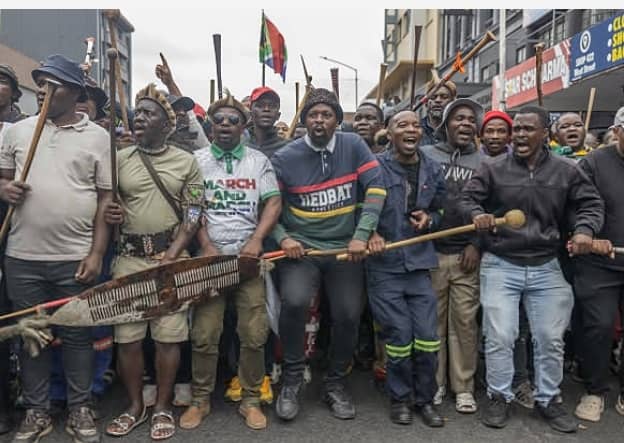
For days, I have been deeply troubled by reports of South Africa’s worsening immigration crisis and the forceful, vigilante-style eviction of African migrants, particularly Nigerians. Beyond the headlines are broken families, shattered dreams and livelihoods painstakingly built over many years. It is a painful development that should concern every African who once believed in the ideals of continental solidarity.
Anti-immigrant sentiments in South Africa are not new. For more than two decades, campaigns against foreign nationals have been fuelled by high unemployment, widespread poverty, rising crime and frustration over inadequate public services. Many South Africans believe undocumented immigrants compete with them for jobs, housing, healthcare and social services, thereby denying citizens access to these basic necessities.
Yet, available evidence tells a more complex story. Research has consistently shown that immigrants alone cannot be blamed for South Africa’s economic and social challenges. Reducing such deep-rooted problems to the presence of foreign nationals oversimplifies a crisis that has been decades in the making.
What is often overlooked is the country’s structural economic reality. A significant skills mismatch, coupled with weaknesses in the quality of education, has left many job seekers ill-equipped for the demands of an economy increasingly driven by technology, innovation and specialised skills. This challenge is not peculiar to South Africa. Across much of sub-Saharan Africa, thousands of graduates enter the labour market every year without the technical, vocational and digital competencies employers now demand.
Beyond this, crime, insecurity, systemic corruption and poor governance continue to weigh heavily on South Africa’s economy. The country has one of the highest youth unemployment rates in the world. Persistent violent crime discourages investment, while corruption and the mismanagement of public resources have weakened service delivery, slowed infrastructure development and eroded investor confidence.
Equally significant is the enduring legacy of apartheid. More than three decades after democracy, inequalities in education, housing, infrastructure and economic opportunities remain deeply entrenched. Many Black communities still live with the consequences of decades of institutional discrimination and economic exclusion.
Against this backdrop, blaming undocumented immigrants for South Africa’s economic difficulties amounts to little more than scapegoating. It is a convenient narrative that diverts attention from the country’s more fundamental governance and developmental challenges.
The recurring xenophobic attacks against Nigerians and other African nationals make the situation even more painful. The recent killing of Emeka Iroegbu and Musa Yunana Joe on June 28, 2026, amid rising anti-migrant tensions, is a tragic reminder of how dangerous such sentiments can become.
One cannot help but ask: Is this the same South Africa for which Nigeria and many other African countries stood firmly during the anti-apartheid struggle?
I vividly remember growing up in the 1980s, listening to songs such as Free Mandela and Stop Apartheid in South Africa by iconic Nigerian musicians, including Majek Fashek, Onyeka Onwenu and Sonny Okosun. Those songs dominated the airwaves on NTA and became powerful symbols of African solidarity.
As a child, I even believed Nelson Mandela was Nigerian because Nigerians embraced his cause with such passion.
Mandela was released from prison in 1990 and became South Africa’s first Black President in 1994, bringing an end to decades of institutionalised racial segregation and apartheid. Today, just over three decades later, many Africans who once stood shoulder to shoulder with South Africans in their darkest hour are treated as unwelcome strangers.
History can be painfully ironic.
Perhaps, then, the saying that one good turn deserves another does not always reflect reality. Human beings are capable of repaying kindness with hostility. It is an uncomfortable truth, but one that life repeatedly teaches.
At a personal level, this reminds us to live with fewer expectations and strive for greater self-reliance. A heart that expects little, even after giving much, is less likely to be broken.
At the national level, however, the lesson is far more profound. Nigeria must build a country where its citizens can thrive without feeling compelled to seek survival elsewhere. Studies have shown that the overwhelming motivation behind the Japa phenomenon is the search for better opportunities and improved living conditions. If those opportunities existed at home, many Nigerians would gladly remain and contribute to national development.
The experience in South Africa—and, indeed, recent developments in the United States—demonstrates that immigration policies are shaped by changing political realities. No foreign country offers permanent guarantees.
Although the U.S. Supreme Court recently ruled against President Donald Trump’s executive order seeking to abolish birthright citizenship on constitutional grounds, the episode illustrates that even long-established policies can become subjects of political contestation. A constitutional principle that has existed since 1868 could still become a matter of national debate. That alone should remind us that every nation ultimately prioritises its own interests.
The enduring lesson is simple: no country can offer Nigerians greater long-term security than a well-governed Nigeria.
Nigeria’s greatest asset remains its people. Sustainable national prosperity can only be built through visionary leadership, accountable institutions, respect for the rule of law and responsible citizenship. When government creates an enabling environment and citizens embrace innovation, productivity and accountability, Nigeria can become a destination for investment rather than a source of economic migration.
As dozens of Nigerians return home following their repatriation from South Africa, government must move beyond sympathy and symbolic gestures. Some have returned with nothing more than the clothes they wore and a single travelling bag, leaving behind businesses, investments and years of hard work. Their return is not merely a journey home; for many, it is the painful collapse of dreams painstakingly built over decades. They deserve meaningful support to rebuild their lives and contribute productively to the nation’s economy once again.
History teaches that nations are strengthened not by chasing away strangers but by creating opportunities for their own citizens. Nigeria must therefore draw the right lessons from South Africa’s painful experience. Rather than exporting its brightest minds in search of survival, it should become a country where talent is rewarded, enterprise is encouraged and hope no longer requires a passport. Only then will Nigeria become not merely the giant of Africa by population, but by the quality of life it offers its people.
Olusegun Hassan, Ph.D
Public Policy Analyst and Social Commentator
MEGAICON TV
Diesel – powered streetlights, CAF- rejected stadium expose Makinde’s failure as engineer – Alli
Oyo South: Oseni Supports Apete Widows With N10m, Promises More Interventions
Oyo: ‘APM, PMS Plot to Destroy Alli’s Billboards, Posters’ – Campaign Organisation Raises Alarm
Trending
-
Metro4 weeks agoOyo: Oseni Sympathises With Oranyan Traders Over Market Fire
-
Politics2 weeks agoOyo won’t become real estate company, says Alli
-
News3 weeks agoOyo: Oseni Donates 500KVA Transformer, N10m to Baptist Conference
-
News6 days agoOyo South: Oseni Approves N100m for Ibadan Community Road Rehabilitation