Education
10 Communication Secrets Of Great Leaders || By Mike Myatt
Published
7 years agoon
IT is simply impossible to become a great leader without being a great communicator. I hope you noticed the previous sentence didn’t refer to being a great talker – big difference. The key to becoming a skillful communicator is rarely found in what has been taught in the world of academia.
From our earliest days in the classroom we are trained to focus on enunciation, vocabulary, presence, delivery, grammar, syntax and the like. In other words, we are taught to focus on ourselves. While I don’t mean to belittle these things as they’re important to learn, it’s the more subtle elements of communication rarely taught in the classroom (the elements that focus on others), which leaders desperately need to learn. In today’s column I’ll share a few of the communication traits, which if used consistently, will help you achieve better communication results.
It is the ability to develop a keen external awareness that separates the truly great communicators from those who muddle through their interactions with others. Examine the world’s greatest leaders and you’ll find them all to be exceptional communicators. They might talk about their ideas, but they do so in a way which also speaks to your emotions and your aspirations. They realize if their message doesn’t take deep root with the audience then it likely won’t be understood, much less championed.
I don’t believe it comes as any great surprise that most leaders spend the overwhelming majority of their time each day in some type of an interpersonal situation. I also don’t believe it comes as a great shock that a large number of organizational problems occur as a result of poor communications. It is precisely this paradox that underscores the need for leaders to focus on becoming great communicators. Effective communication is an essential component of professional success whether it is at the interpersonal, inter-group, intra-group, organizational, or external level. While developing an understanding of great communication skills is easier than one might think, being able to appropriately draw upon said skills when the chips are down is not always as easy as one might hope for.
Skills acquired and/or knowledge gained are only valuable to the extent they can be practically applied when called for. The number one thing great communicators have in common is they possess a heightened sense of situational and contextual awareness. The best communicators are great listeners and astute in their observations. Great communicators are skilled at reading a person/group by sensing the moods, dynamics, attitudes, values and concerns of those being communicated with. Not only do they read their environment well, but they possess the uncanny ability to adapt their messaging to said environment without missing a beat. The message is not about the messenger; it has nothing to do with messenger; it is however 100% about meeting the needs and the expectations of those you’re communicating with.
So, how do you know when your skills have matured to the point that you’ve become an excellent communicator? The answer is you’ll have reached the point where your interactions with others consistently use the following ten principles:
1. Speak not with a forked tongue: In most cases, people just won’t open up to those they don’t trust. When people have a sense a leader is worthy of their trust they will invest time and take risks in ways they never would if their leader had a reputation built upon poor character or lack of integrity. While you can attempt to demand trust, it rarely works. Trust is best created by earning it with right acting, thinking, and decisioning. Keep in mind people will forgive many things where trust exists, but will rarely forgive anything where trust is absent.
2. Get personal: Stop issuing corporate communications and begin having organizational conversations – think dialog not monologue. Here’s the thing – the more personal and engaging the conversation is the more effective it will be. There is great truth in the following axiom: “people don’t care how much you know until they know how much you care.” Classic business theory tells leaders to stay at arms length. I say stay at arms length if you want to remain in the dark receiving only highly sanitized versions of the truth. If you don’t develop meaningful relationships with people you’ll never know what’s really on their mind until it’s too late to do anything about it.
3. Get specific: Specificity is better than Ambiguity 11 times out of 10: Learn to communicate with clarity. Simple and concise is always better than complicated and confusing. Time has never been a more precious commodity than it is today. It is critical leaders learn how to cut to the chase and hit the high points – it’s also important to expect the same from others. Without understanding the value of brevity and clarity it is unlikely you’ll ever be afforded the opportunity to get to the granular level as people will tune you out long before you ever get there. Your goal is to weed out the superfluous and to make your words count.
4. Focus on the leave-behinds not the take-aways: The best communicators are not only skilled at learning and gathering information while communicating, they are also adept at transferring ideas, aligning expectations, inspiring action, and spreading their vision. The key is to approach each interaction with a servant’s heart. When you truly focus on contributing more than receiving you will have accomplished the goal. Even though this may seem counter-intuitive, by intensely focusing on the other party’s wants, needs & desires, you’ll learn far more than you ever would by focusing on your agenda.
5. Have an open mind: I’ve often said that the rigidity of a closed mind is the single greatest limiting factor of new opportunities. A leader takes their game to a whole new level the minute they willingly seek out those who hold dissenting opinions and opposing positions with the goal not of convincing them to change their minds, but with the goal of understanding what’s on their mind. I’m always amazed at how many people are truly fearful of opposing views, when what they should be is genuinely curious and interested. Open dialogs with those who confront you, challenge you, stretch you, and develop you. Remember that it’s not the opinion that matters, but rather the willingness to discuss it with an open mind and learn.
6. Shut-up and listen: Great leaders know when to dial it up, dial it down, and dial it off (mostly down and off). Simply broadcasting your message ad nauseum will not have the same result as engaging in meaningful conversation, but this assumes that you understand that the greatest form of discourse takes place within a conversation, and not a lecture or a monologue. When you reach that point in your life where the light bulb goes off, and you begin to understand that knowledge is not gained by flapping your lips, but by removing your ear wax, you have taken the first step to becoming a skilled communicator.
7. Replace ego with empathy: I have long advised leaders not to let their ego write checks that their talent can’t cash. When candor is communicated with empathy & caring and not the prideful arrogance of an over inflated ego good things begin to happen. Empathetic communicators display a level of authenticity and transparency that is not present with those who choose to communicate behind the carefully crafted facade propped-up by a very fragile ego. Understanding the this communication principle is what helps turn anger into respect and doubt into trust.
8. Read between the lines: Take a moment and reflect back on any great leader that comes to mind… you’ll find they are very adept at reading between the lines. They have the uncanny ability to understand what is not said, witnessed, or heard. Being a leader should not be viewed as a license to increase the volume of rhetoric. Rather astute leaders know that there is far more to be gained by surrendering the floor than by filibustering. In this age of instant communication, everyone seems to be in such a rush to communicate what’s on their mind that they fail to realize everything to be gained from the minds of others. Keep your eyes & ears open and your mouth shut and you’ll be amazed at how your level or organizational awareness is raised.
9. When you speak, know what you’re talking about: Develop a technical command over your subject matter. If you don’t possess subject matter expertise, few people will give you the time of day. Most successful people have little interest in listening to those individuals who cannot add value to a situation or topic, but force themselves into a conversation just to hear themselves speak. The fake it until you make it days have long since passed, and for most people I know fast and slick equals not credible. You’ve all heard the saying “it’s not what you say, but how you say it that matters,” and while there is surely an element of truth in that statement, I’m here to tell you that it matters very much what you say. Good communicators address both the “what” and “how” aspects of messaging so they don’t fall prey to becoming the smooth talker who leaves people with the impression of form over substance.
10. Speak to groups as individuals: Leaders don’t always have the luxury of speaking to individuals in an intimate setting. Great communicators can tailor a message such that they can speak to 10 people in a conference room or 10,000 people in an auditorium and have them feel as if they were speaking directly to each one of them as an individual. Knowing how to work a room and establish credibility, trust, and rapport are keys to successful interactions.
11. Bonus – Be prepared to change the message if needed: Another component of communications strategy that is rarely discussed is how to prevent a message from going bad, and what to do when does. It’s called being prepared and developing a contingency plan. Again, you must keep in mind that for successful interactions to occur, your objective must be in alignment with those you are communicating with. If your expertise, empathy, clarity, etc. don’t have the desired effect, which by the way is very rare, you need to be able to make an impact by changing things up on the fly. Use great questions, humor, stories, analogies, relevant data, and where needed, bold statements to help connect and engender the confidence and trust that it takes for people to want to engage. While it is sometimes necessary to “Shock and Awe” this tactic should be reserved as a last resort.
Don’t assume someone is ready to have a particular conversation with you just because you’re ready to have the conversation with them. Spending time paving the way for a productive conversation is far better than coming off as the proverbial bull in a china shop. Furthermore, you cannot assume anyone knows where you’re coming from if you don’t tell them. I never ceased to be amazed at how many people assume everyone knows what they want to occur without ever finding it necessary to communicate their objective. If you fail to justify your message with knowledge, business logic, reason, empathy etc., you will find that said message will likely fall on deaf ears needing reinforcement or clarification afterward.
Bottom line – The leadership lesson here is whenever you have a message to communicate (either directly, or indirectly through a third party) make sure said message is true & correct, well reasoned, and substantiated by solid business logic that is specific, consistent, clear and accurate. Spending a little extra time on the front-end of the messaging curve will likely save you from considerable aggravation and brain damage on the back-end. Most importantly of all, keep in mind that communication is not about you, your opinions, your positions or your circumstances. It’s about helping others by meeting their needs, understanding their concerns, and adding value to their world. Do these things and you’ll drastically reduce the number of communications problems you’ll experience moving forward.
Mike Myatt, is a leadership advisor to Fortune 500 CEOs and Boards, Author of Hacking Leadership (Wiley), and Chairman at N2Growth.
Source: Forbes

You may like
-
Forbes names Rihanna a billionaire, ‘richest female musician’
-
Renewable Energy Is Now The Cheapest Option – Even Without Subsidies | By James Ellsmoor
-
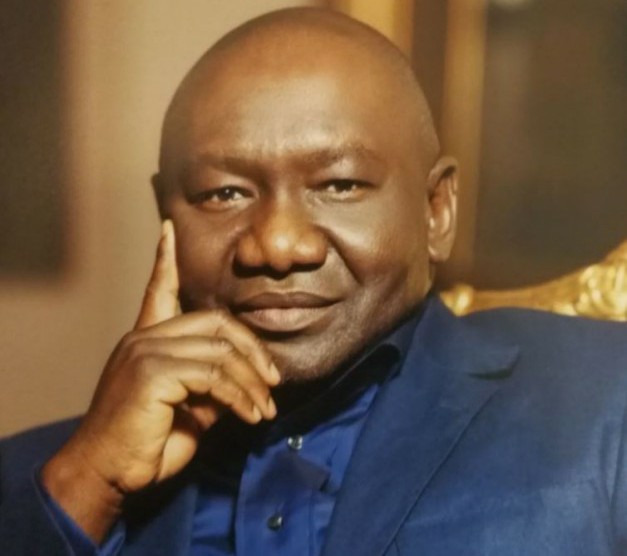
Aiteo Founder, Benedict Peters Wins Forbes Oil & Gas Leader of the Year Award, 2018
-
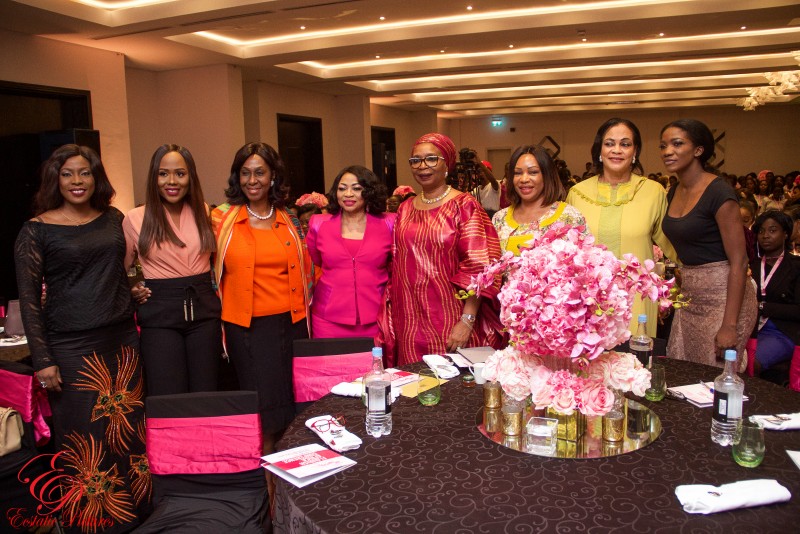
Folorunso Alakija Inspires 300 Women at Prestigious 2017 Flourish Africa Conference
Education
MAKPOLY holds maiden Music Technology performance exam
Published
1 week agoon
July 29, 2026By
Mega Icon
Michael Adeniyi Koleosho Polytechnic, Saki, Oyo State, on Wednesday recorded a major milestone with the conduct of the maiden final-year performance examination for the pioneer student of its Department of Music Technology, marking a new chapter in the institution’s commitment to practical and creative education.
The examination, held at the TETFund Building of the School of Business and Communication Studies, featured Master Okegbola Moses Bright, the department’s first National Diploma student. Lecturers, students, family members and other guests gathered at the venue to witness what many described as a historic moment for the institution.
The practical assessment was coordinated by the Acting Head of the Department, Dr. Abegunrin Adebayo Olugbenga, while two external examiners from The Polytechnic, Ibadan, Dr. Rotimi Ologududu and Dr. Abiodun Akere, evaluated the student’s performance. The Dean of the School of Business and Communication Studies, Mr. Waheed Popoola, and other senior officials of the polytechnic also attended the exercise.
Welcoming guests, Abegunrin described the occasion as a landmark in the department’s history, saying it signalled that the vision behind establishing the programme was becoming a reality.
He said, “Today marks a milestone not just for our department, but for Michael Adeniyi Koleosho Polytechnic. We are witnessing the stage performance of our very first Music Technology student. This is the first of many, and it shows that the seed we planted has begun to bear fruit.”
He explained that the performance examination is a compulsory practical requirement for the award of the National Diploma in Music Technology, adding that it is designed to assess students’ creativity, technical competence and stage performance.
“Music Technology is not just about theory; it is about performance, production and impact. Our pioneer student is setting the standard for those who will come after him,” he added.
Congratulating the student for blazing the trail, Abegunrin urged him to perform with confidence, passion and professionalism. He also encouraged other students in the department to remain focused and committed, assuring them that they, too, would have the opportunity to showcase their talents in due course.
Speaking on the department’s future, the acting head said plans were underway to expand its studio facilities, strengthen collaboration with industry players and build a programme capable of producing graduates with the skills to thrive in the music and creative industries.
“Our goal is to make this department a hub for sound production, live performance, music business and digital creativity in Oyo State and beyond,” he said.
Abegunrin thanked the management of the polytechnic for its continued support and expressed appreciation to the Dean of the School of Business and Communication Studies, members of staff and other stakeholders for their contributions to the growth of the Department of Music Technology, saying their commitment had been instrumental to the programme’s success.
Education
Oseni unveils AI learning hubs for Oyo South students
Published
2 weeks agoon
July 23, 2026By
Mega IconThe All Progressives Congress (APC) senatorial candidate for Oyo South in the 2027 election, Hon. Aderemi Oseni, on Thursday unveiled the Remi Oseni Smart Learning Intervention (ROSMA) Legacy Programme, introducing a network of Artificial Intelligence-powered learning hubs designed to prepare secondary school students for the demands of a fast-changing digital world.
The initiative, which also witnessed the commissioning of the first batch of ROSMA Smart Learning Hubs in Ibadan, is aimed at exposing students to Artificial Intelligence (AI), robotics, coding, digital literacy and mentorship, while supporting their preparation for public examinations, including WAEC, NECO and the Unified Tertiary Matriculation Examination (UTME).
Addressing an audience of students, teachers, parents and community leaders, Oseni who represents Ibarapa East/Ido federal constituency said the future would belong to nations that invest in knowledge and technology, stressing that education must move beyond conventional classroom learning to embrace innovation.
He described the project as a deliberate investment in the next generation, saying every child, regardless of background, deserves the opportunity to compete with peers anywhere in the world.
“This programme is not just about giving support; it is about opening doors. We want our students to understand Artificial Intelligence, embrace technology and develop the confidence to compete with their peers anywhere in the world. Every investment we make in a child today is an investment in a stronger society tomorrow,” Oseni said.
The federal lawmaker recalled that his intervention in education did not begin with politics, noting that over the years he had funded scholarships, bursaries, free WAEC and JAMB registrations, digital skills training and entrepreneurship programmes for thousands of young people, many of whom are now pursuing higher education across the country.
He also announced the proposed ROCOF Royal Ambassadors Initiative, which, according to him, will recognise exceptional students, innovators, entrepreneurs and youth leaders who distinguish themselves through academic excellence, creativity and integrity. Such recognition, he said, would inspire more young people to strive for excellence.
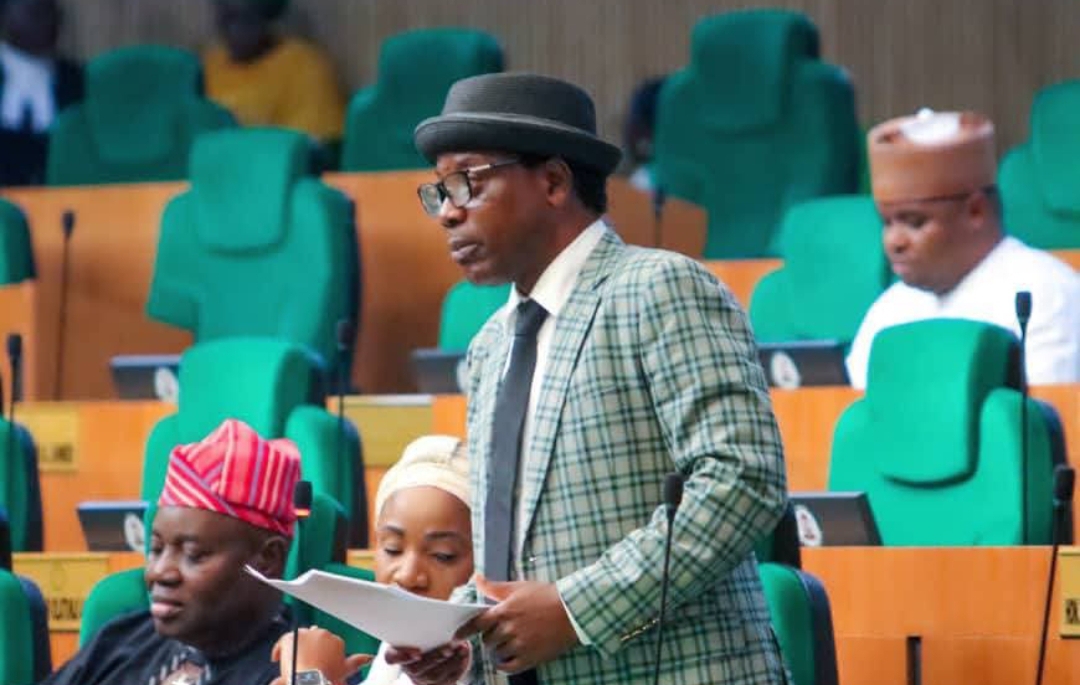
The Chairman , House Committee on Federal Roads Maintenance Agency (FERMA) added that his ambition to represent Oyo South in the Senate was driven by a desire to expand educational opportunities across the district, promising that if elected in 2027, programmes such as free WAEC and NECO registrations, JAMB sponsorships, scholarships, bursaries, AI education and digital empowerment would be extended to all nine local government areas.
Project Director of the ROSMA Legacy Programme, Dr. Demilade AkinAlabi, described the initiative as a bold response to the growing digital divide, saying children in Oyo South must not be left behind at a time when technology increasingly determines educational and economic success.
AkinAlabi disclosed that five of the proposed nine Smart Learning Hubs had been completed in Eruwa, Agbadagbudu, Ido, Oke-Ado and Oja’ba, while construction was ongoing at the remaining centres. He explained that the hubs would go beyond providing computers and internet access by offering practical training in coding, artificial intelligence, digital marketing, data analysis and other employable skills for students, artisans, farmers and small business owners.
”Our dream is simple. A child’s future should never be determined by where he or she was born. These hubs are more than classrooms with computers; they are places where ideas will grow, talents will be discovered and futures will be built. We want every child who walks through these doors to believe that anything is possible,” AkinAlabi said.
Oseni, however urged the students to remain disciplined, dream beyond their circumstances and embrace technology as a tool for solving real-life problems. He said the ROSMA Legacy Programme was conceived not merely to improve academic performance but to nurture a generation of innovative, confident and globally competitive young people capable of shaping the future of Oyo South and Nigeria.
Education
Ayede Poly trains staff on FG skills scheme, targets employable graduates
Published
4 weeks agoon
July 14, 2026By
Mega IconThe Federal Polytechnic, Ayede, Oyo State, has intensified efforts to align with the Federal Government’s skills-based education policy by training its academic and non-academic staff on the implementation of the National Skills Qualification (NSQ), Nigerian Skills Qualifications Framework (NSQF) and Mandatory Skills Qualification (MSQ).
The capacity-building workshop, organised in collaboration with the National Board for Technical Education (NBTE) and JACL Consulting, was held at the institution’s Centre for Vocational, Skills Acquisition and Entrepreneurship Development, NDE Model Skills Centre, Onipaanu, Ogbomoso.
The training is part of the Polytechnic’s broader strategy to deepen competency-based education and ensure that its graduates leave school with practical and industry-relevant skills capable of improving their employability and entrepreneurial prospects.
The institution had earlier organised a similar exercise for students, a move that reinforces its commitment to preparing both staff and learners for the seamless implementation of the Federal Government’s national skills certification policy.
Declaring the workshop open, the Acting Rector, Dr. Morufat Adepoju, described the National Skills Qualifications Framework as a game-changing initiative that would bridge the long-standing gap between classroom learning and industry expectations.
According to her, the framework will produce graduates equipped with practical competencies required to meet the demands of a fast-changing economy while strengthening Nigeria’s technical and vocational education system.
Adepoju expressed appreciation to President Bola Ahmed Tinubu, the Chairman of the Governing Council, Hon. Yakubu Dati, and the Federal Government for their continued support for the institution. She also commended the Executive Secretary of the NBTE, Prof. Idris Bugaje, for driving reforms aimed at repositioning technical education in the country.
She equally acknowledged the contributions of the pioneer Rector, Dr. Taofeek Abdul-Hameed, and other pioneer principal officers, noting that the institution was building on the solid foundation they laid.
Explaining the significance of the initiative, the Don said the National Skills Qualifications Framework provides a nationally recognised system for assessing and certifying occupational knowledge, technical competence and practical skills across various sectors of the economy.
She added that the framework would not only improve the quality of technical education but also reduce unemployment by equipping graduates with hands-on skills capable of stimulating entrepreneurship, wealth creation and national development.
”The NSQ provides the compass we desperately need as a nation seeking to equip its workforce with relevant competencies for national growth and global competitiveness,” Adepoju said.
Earlier, in his welcome address, the Acting Director of the Centre for Vocational, Skills Acquisition and Entrepreneurship Development, Mr. Oluwaseun Owojori, said the workshop was organised to prepare members of staff for the effective implementation of the NSQ, NSQF and MSQ in line with NBTE guidelines.
He stressed that the success of the Federal Government’s skills development agenda would depend largely on the preparedness of institutions and their personnel to deliver quality competency-based education. Owojori thanked the Acting Rector, management, principal officers and participants for their support, while appreciating the resource persons for facilitating the training.
One of the facilitators, the Acting Director, South-West Zone of the NBTE, Dr. John Onyebuchi, urged participants to embrace skills acquisition, describing practical competence as a vital asset in today’s economy. “I encourage everyone to acquire a skill because skills are the driving force in today’s economy, not money,” he said.
Also speaking, Dr. Julius Ayodele of JACL Consulting encouraged both academic and non-academic staff to participate actively in entrepreneurship and vocational development programmes.
He said continuous skills acquisition would improve professional competence, enhance productivity and open up wider career opportunities, expressing optimism that the workshop would promote innovation and practical learning across the Polytechnic.
The workshop attracted principal officers of the institution, including the Registrar, Mr. Akinlolu Akinpade, represented by the Director of SERVICOM and Deputy Registrar (Council Affairs and Establishment), Mr. Kolapo Olatinwo; the Bursar, Mr. Mufutau Alao, represented by Deputy Bursar, Mr. Lukman Buhari; and the Acting Polytechnic Librarian, Mr. Dare Samuel Adeleke, represented by Dr. Halimat Amuda, Coordinator of Women in Technical Education and Development.
Advertisement
Entertainment
MegaIcon Magazine Facebook Page
MEGAICON TV
Advertisement
Trending
-
Politics1 week agoOyo : Oseni seeks reconciliation, urges aggrieved APC members to close ranks
-
News1 week agoOyo lawmaker, Oseni empowers Agbeni traders with ₦50m grant, rallies support for Tinubu
-
Politics1 week agoArapaja endorses Oseni’s Oyo South Senate bid, seeks APC victory in 2027
-
News1 week agoReps panel declares alleged Presidential council DG’s appointment letter fake