Opinion
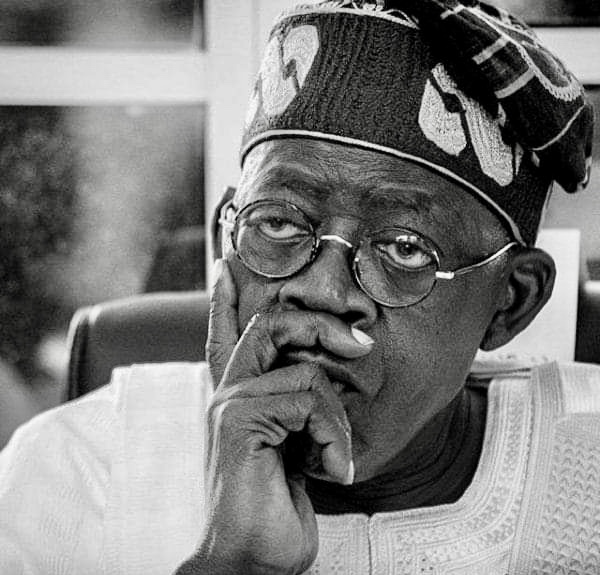
Tinubu; the man they couldn’t ‘cancel’
Published
4 years agoon
“Never hate your enemy it destroys your judgment “ – Mario Puzo
Our desire to flog, destroy, and write other off often cast a log of wood in our eyes to see issues for what it’s rather than resolving them in character assassination, twisting and tailoring a given fact to fit our primordial sentiment that does not fit reality, and consequently prediction and theory that will eventually go wrong.
Sometimes, when David Hundyen describes Nigeria’s elite as a toilet elite without class, I thought such overgeneralization was too harsh but now I understand better. Rather than pay attention to real issues and ask pertinent questions that can help make an informed opinion on the road to 2023, again, we have made the subject of our debate about the men and not issues base discussions that are of utmost relevance to the nation’s building.
And, our parody of double standards, hypocrisy, and arm-twisting of obvious facts beat my imagination. I have seen those I held in highest esteem fall into this muckraker, especially the latter-day apostle of new Nigeria. I think the problem with many of those who dress in intellectual garb is their juvenile obsession to see the Nigeria of their dreams work which is a valid aspiration but we seem to forget so soon that this is a democracy, and we must all participate in equal measure.
It’s too late to cry a river, the faith of over 200 million Nigerians has been bestridden in the hands of party delegates across the political party divides who decide the faith of millions of Nigeria through party primaries, and not wishful thinking through social media that doesn’t go beyond our circle of Influence, who likely may not be a part of delegate in any of the two dominating political party.
Maybe, if this nation will work, the intellectuals need to come down from their high heaven comfort zone to the wards level where the faith of over 200 million Nigerians is being decided by common men and women rather than gaslighting others on social media or forming an elite club of spectators and rubbing shoulders.
Of course, like the main character in The Godfather by Mario Puzo, Michael Corleon, Asiwaju Bola Ahmed Tinubu is a paradigmatic strategy and he will dwarf men of his contemporaries when placed side by side especially considering his foresight, network, and intelligence.
In many ways, like many of his contemporaries, Tinubu has many sins, so also there are many things to appreciate and celebrate about the man, for a man who surrounded himself with thousands of thinkers can’t be said to suffer from inadequacies or be daft of the intellectual philosophical premise.
Perhaps, the most exceptional thing about Tinubu is how to fish for the best of hands, a strategic maneuver that enables him to win many political battles and lose a few through his ability to predict others’ intentions, which has been the paradox of his character as Capo Dei Capi as he rose through many challenges posed by time, age, and power to become Nigeria’s most powerful and sought-after Godfather in the political equation of this country and beyond but interestingly, adding the garb of a president to the garb of Godfather role seems to be more life-ambition to Asiwaju than being a Godfather alone.
And, so it seems this particular move has further opened him up for biting and attacks from all angles at this unprotected moment in his political chess. Interestingly, Osinbajo and many of his godsons want the same thing: they all think it’s wiser to contest for the exalted office now rather than give Tinubu the benefit of the godfather.
Italians have a little joke, that the world is so hard a man must have two fathers to look after him, Tinubu is not just a godfather, to his credit he has redefined Nigeria politics by the judicious way in which he wields power in raising men of enviable academic pedigree in the altar of power through the institution of governance. Tinubu no doubt has raised a leader and this singular trait has continued to endear him to people at the grassroots.
Poignantly, Tinubu has proven to be a prolific and magnetic wartime strategist, revered and feared by so many. One may not agree with everything about the man. For example, many see him as a big-time extortionist who dresses in a garb of a democrat but there is no question that Bola Ahmed Tinubu is a unifier, a strategist out of box thinker, and perhaps his ability to think clearly under fire, and to be decisive makes him the most significant factors in the history of democracy in Nigeria influencing who gets what, where, when and how to say the least. To say otherwise amounts to dishonesty.
In many ways, Asiwaju has shown to be both a ruthless fighter and a sacrificial hero when need be, slaving away for the rest of his political family, sacrificing his ambition over the years for political well-being and elevation of those around him. Such a man cannot be ruffle feathers, without putting the party under the bus. In many ways, he has proven to be a hard nut to crack. Trying to crack him, or to make him a sacrificial lamb, may spell doom for not just the party but all candidates on the platform of the ruling All Progressives Congress (APC) may become the sacrificial lamb as well. To what ends?
Perhaps, I don’t know anyone else in recent times that has gotten his hands dirty in preparation to become the president of the federal republic of Nigeria other than Asiwaju. For a man who has invested in his dream for so long even when it was not wise to do so tells the quality of his mind. In the APC trilogy merger, where men separate themselves from boys, Asiwaju occupies a pride ground.
No doubt Asiwaju is a man of strong will, appetite, and passion when others are scared, he’s already in the field consulting the length and breadth of Nigeria. If Asiwaju is too ambitious to be a president, perhaps, others would fail for the opposite reason. Make no mistake, this is not to say it’s only Asiwaju that’s most qualified for the party’s nomination. Nonetheless, prosperity has put him in a position it’s impossible to scheme him unfairly out of this race without destroying the party. Certainly, he may not be among the best orator but he remains the most prepared to take over from President Muhammadu Buhari and maybe Yemi Osinbajo owing to the benefit of being the nation’s number two and Peter Obi of the Labour party (LP).
As the All Progressives Congress (APC) prepares to elect its party candidate for next year’s presidential election, the web of anti-Tinubu conspiracy, an ambush orchestrated within the presidency, and the recrimination of June 12, led to the abrupt collapse of the third republic must be avoided at all cost. If this orchestration does not whistle down by President Buhari, the vision to undo one man wouldn’t only blind everyone, it will make every man so stupid not to see the pit of downfall ahead.
Merely a supremely egotistical power wielded by those in the corridor of power is making them mistake it to be more potent than it was. Should a free and fair primary election be held today, the chances that Tinubu would win are more likely than not. So the fact that achieving conquest against Tinubu is impossible without putting the party at a great disadvantage or destroying the party by the following consensus should be enough warning to those toying with this idea if APC wishes to remain relevant in the next election
The party must not create the false illusion that we can win without Tinubu. Any attempt to toy with the ideas will spell doom for the APC and a win for the main opposition party, which has positioned itself to benefit from the ruling party’s fallout. Therefore, such a perilous and egotistical move has to be smashed. It must never be allowed for the greater good of men and women who had labored for the APC to stand but “those whom the gods wish to destroy they first make mad”.
Adediji Wasiu writes from Oyo State, Southwest Nigeria
Related
You may like
The All Progressives Congress (APC) in Oyo State stands on the edge of a consequential decision—one that may define not only its fortunes in Ibadan North Federal Constituency but also its broader political relevance in the state.
As the countdown to the party primaries intensifies, the question before APC leaders is no longer routine. It is strategic. It is urgent. And it is decisive: will the party align with the clear preference of the people or risk repeating costly political miscalculations?
At the centre of this debate is Hon. Khalil Mustapha Adegboyega, widely known as Repete—a name that has, over time, evolved from a political identity into a grassroots phenomenon.
A Candidate Rooted in the People
In contemporary Nigerian politics, where voter awareness is rising and expectations are shifting, candidates are increasingly judged not by promises but by presence. On this scale, Adegboyega stands tall.
His political journey is marked by consistent engagement with constituents—far beyond the optics of election seasons. From youth empowerment initiatives that provide practical skills and startup support, to sustained interventions in healthcare access for the elderly and indigent, his footprint across Ibadan North reflects a model of leadership anchored on service.
Unlike the transactional approach that often defines political relationships, Adegboyega’s connection with the people appears organic—built on trust, accessibility, and continuity. These are not mere campaign attributes; they are political assets.
The Danger of Political Disconnect
History offers the APC a clear lesson: parties that ignore grassroots sentiment often pay a heavy electoral price. The imposition of candidates perceived as distant or untested has, in several instances, resulted in voter apathy, internal dissent, and eventual defeat at the polls.
Ibadan North presents no exception.
With opposition parties closely monitoring the APC’s internal dynamics, any misstep in candidate selection could provide a ready opening. A divided house, coupled with a candidate lacking widespread acceptance, is a formula the opposition is well-positioned to exploit.
The implication is straightforward: this is not merely about party loyalty; it is about electoral viability.
Echoes from the Grassroots
Across the length and breadth of Ibadan North—markets, motor parks, religious centres, and community gatherings—a consistent pattern emerges in political conversations. The name “Repete” resonates with familiarity and acceptance.
Such organic support is not easily manufactured. It is cultivated over time through visible impact and sustained presence. For a party seeking electoral certainty in a competitive environment, this level of grassroots validation is not just desirable—it is critical.
A Test of Leadership and Judgment
For the APC leadership in Oyo State, the moment calls for clarity of purpose. Decisions driven by narrow interests, personal alignments, or short-term calculations may carry long-term consequences.
The task, therefore, is to balance internal considerations with external realities. Elections are ultimately decided by voters, not by party caucuses. A candidate who commands public confidence offers the strongest pathway to victory.
The Stakes Are Clear
Ibadan North is too strategic a constituency for experimentation. The cost of error is not limited to a single seat; it extends to party cohesion, credibility, and future positioning within the state’s political landscape.
In this context, the argument for Adegboyega is less about sentiment and more about strategy. His visibility, acceptability, and record of engagement place him in a strong position to consolidate support and mobilise voters effectively.
Conclusion: A Choice with Consequences
As the APC moves closer to its primaries, the decision before it is both simple and significant: align with a candidate who reflects the mood of the electorate or risk conceding advantage to a watchful opposition.
In politics, moments such as this often separate foresight from hindsight.
For APC in Ibadan North, this may well be one of those defining moments.
Aderibigbe Akanbi, a political analyst, writes from Ibadan.
Related
Opinion
Ibarapa East: Yusuf Ramon’s Quest for Responsive Representation
Published
3 months agoon
February 14, 2026As the road to 2027 gradually unfolds across Oyo State, political conversations are shifting from routine permutations to deeper questions about competence, generational leadership, and measurable impact. In Ibarapa East, that conversation has found a new voice in Yusuf Abiodun Ramon — a Lanlate-born technocrat whose entry into the race for the State House of Assembly is redefining what representation could mean for the constituency.
In a political environment often dominated by familiar faces and conventional calculations, Ramon presents a profile shaped by technical discipline, structured thinking, and solution-driven engagement. His professional background, anchored in analytical precision and systems management, forms the foundation of his public service aspiration.
For him, representation must move beyond ceremonial presence to practical responsiveness — laws that reflect local realities, oversight that protects public resources, and advocacy that translates into visible development.
Ramon argues that the future of Ibarapa East lies in leadership that listens deliberately, plans strategically, and delivers measurably. He speaks of strengthening rural infrastructure, expanding youth-driven economic opportunities, and institutionalising transparency as core pillars of his agenda. In his view, governance must not merely be symbolic; it must be structured, accountable, and people-centred.
Rooted in Ile Odede, Isale Alubata Compound, Ward Seven of Ibarapa East Local Government, and maternally linked to Ile Sobaloju, Isale Ajidun Compound, Eruwa, Ramon’s story is not one of distant ambition but of lived experience. He is, in every sense, a son of the soil — shaped by the same roads, schools, and economic realities that define daily life in Ibarapa East.
“I was born here. I grew up here. I understand our struggles, our strengths, and our untapped potential,” he says. “Representation must go beyond occupying a seat; it must translate into preparation, competence, and genuine commitment to development.”
His academic journey mirrors that philosophy of steady growth. He began at Islamic Primary School, Lanlate (1995–2001), proceeded to Baptist Grammar School, Orita Eruwa (2001–2007), and later earned a National Diploma in Mechanical Engineering Technology from Federal Polytechnic, Ilaro, between 2009 and 2011. Refusing to plateau, he advanced his intellectual horizon and is now completing a Bachelor of Science in Business Administration at the University of Lagos. “Education,” he reflects, “is continuous capacity building. Leadership today requires both technical knowledge and administrative insight.”
That blend of engineering precision and managerial training has defined a professional career spanning more than a decade. Shortly after his diploma, Yusuf joined Mikano International Limited as a generator installer, gaining hands-on experience in industrial power systems — a sector central to Nigeria’s infrastructural backbone. He later transitioned into telecommunications at Safari Telecoms Nigeria Limited, where he received specialized training in Industrial, Scientific, and Medical radio bands, strengthening his expertise in network operations.
In 2013, he became a Field Support Engineer at Netrux Global Concepts Ltd., then a leading ISM service provider in Nigeria. Over four formative years, he immersed himself in telecom infrastructure deployment and maintenance, mastering field coordination, logistics management, and real-time technical problem-solving.
Since July 2017, he has served as a Field Support Engineer with Specific Tools and Techniques Ltd., a power solutions firm providing services to major operators including MTN Nigeria and Airtel Nigeria. In that capacity, he operates at the frontline of ensuring energy reliability and network uptime — responsibilities that demand discipline, accountability, and systems thinking.
For political observers in Ibarapa East, this trajectory matters. It reflects more than résumé credentials; it speaks to a mindset anchored in efficiency, coordination, and measurable outcomes — qualities increasingly demanded in legislative representation.
Beyond the private sector, Ramon’s political exposure is neither sudden nor superficial. A loyal member of the progressive political family in Lagos, he once served as a personal assistant to a former lawmaker, gaining practical insight into legislative procedure and constituency engagement. Within his community, he has quietly extended financial support to small-scale entrepreneurs and students — modest but consistent interventions rooted in personal responsibility.
“My interest is my people,” he states firmly. “Ibarapa East deserves strategic, responsive, and capable leadership at the State Assembly. We must move from rhetoric to results.”
Across the constituency — from Lanlate to Eruwa — development priorities remain clear: youth employment, vocational empowerment, rural road rehabilitation, stable power supply, agricultural value-chain expansion, improved educational standards, and stronger lawmaking that directly reflects community needs.
Political analysts argue that Ramon’s technocratic background positions him uniquely at the intersection of policy formulation and practical implementation. At a time when national discourse increasingly favours competence over grandstanding, his profile resonates with a broader generational shift toward performance-driven governance. His engineering discipline reinforces problem-solving; his business training strengthens administrative understanding; his grassroots roots anchor his empathy.
For Ibarapa East, the 2027 election cycle may represent more than a routine democratic exercise. It may mark a recalibration of expectations — a demand for representation that understands both the soil beneath its feet and the systems that drive modern development. As political alignments gradually crystallize in Oyo State, Yusuf Abiodun Ramon’s declaration signals the arrival of a candidate seeking to translate private-sector structure into public-sector impact.
One thing is clear: the conversation about the future of Ibarapa East has begun — and it is now framed around competence, credibility, and capacity.
Oluwasegun Idowu sent in this piece from Eruwa, Ibarapa East LG, Oyo State
Related
Opinion
Flying on Trust: How Ibom Air’s Reliability Became Its Winning Strategy
Published
3 months agoon
February 5, 2026“In a sky where delays are normal, one airline flies with precision and trust. Ibom Air shows that reliability can be a strategy”.
In Nigeria’s skies, where flight delays and cancellations are often taken as routine, Ibom Air has quietly rewritten the rules. From the moment it launched in June 2019, the Akwa Ibom State–owned carrier has treated reliability not as a bonus, but as a core strategy—turning punctuality, discipline, and operational excellence into a competitive edge that passengers can count on.
While most airlines chase rapid expansion or flashy promotions, Ibom Air has chosen consistency. Flights depart on schedule, disruptions are minimal, and communication with passengers is clear and timely. This predictability has quickly earned the airline a loyal following among business travellers, professionals, government officials, and families for whom time is invaluable.
The airline’s approach is methodical. Every flight is treated as a commitment, and operational decisions are guided by structured planning, not improvisation. This discipline underpins everything from scheduling to fleet management, ensuring passengers experience flying without surprises.
Central to this model is Ibom Air’s modern fleet. Its Airbus A220-300 and Bombardier CRJ-900 aircraft are fuel-efficient, comfortable, and rigorously maintained to meet both manufacturers’ specifications and the regulatory standards of the Nigerian Civil Aviation Authority and international aviation bodies. Safety here is a culture, not a compliance exercise.
Cabin cleanliness and aircraft health are equally prioritized. Passengers consistently step into neat, hygienic, and professionally maintained cabins, reinforcing confidence and comfort even before take-off. In a sector where small details signal operational quality, Ibom Air’s standards speak volumes.
Technology quietly drives reliability across operations. From booking and check-in to flight coordination and customer service, modern systems enhance efficiency, reduce disruptions, and ensure smooth communication. These tools allow the airline to anticipate challenges rather than merely react.
R–L: Dr. Solomon Oroge, a consultant, and Mr. Idowu Ayodele, journalist and media practitioner, aboard an Ibom Air flight.
Service delivery follows the same disciplined pattern. Pilots, cabin crew, engineers, and ground staff operate under strict professional standards. Courtesy is paired with efficiency, and calm, structured service ensures passengers feel confident throughout their journey.
The Ibom Flyer loyalty programme reflects this structured approach, rewarding consistent passengers and fostering long-term engagement. It turns reliability into a tangible benefit for frequent flyers.
From its hub at Victor Attah International Airport, Uyo, Ibom Air serves major Nigerian cities including Lagos, Abuja, Port Harcourt, Calabar, and Enugu, while extending its reach to West Africa with flights to Accra, Ghana. Expansion is deliberate, prioritizing sustainability over rapid growth that could compromise service quality.
Measured growth allows the airline to maintain operational excellence and service consistency even as demand increases—a strategy that contrasts sharply with competitors whose rapid expansion often strains resources.
Mr. Idowu Ayodele, journalist and media practitioner, pictured inside an Ibom Air aircraft.
Beyond commercial success, Ibom Air has become a national example. It has created employment, stimulated tourism, and strengthened regional connectivity, projecting a positive image of Nigerian aviation at a time when confidence in the sector is often fragile.
The airline has also challenged assumptions about government-owned enterprises. By combining professional management with operational autonomy, it demonstrates that public investment can achieve efficiency, accountability, and competitiveness.
Reliability, in the case of Ibom Air, is than a promise—it is a deliberate business philosophy. It shapes operations, informs decisions, and builds passenger trust consistently.
Technology, discipline, and attention to detail converge to produce an airline that works. Every element, from fleet maintenance to cabin service, supports the promise that Ibom Air delivers what it advertises—without surprises.
In a market where uncertainty has been the norm, Ibom Air has shown that consistency can be a strategic advantage. Passengers no longer fly with anxiety; they fly with confidence, knowing their schedules will hold and service will meet expectations.
Ultimately, Ibom Air is not just an airline—it is a model of operational excellence in Nigerian aviation. By prioritizing reliability over spectacle, discipline over improvisation, and planning over shortcuts, it sets a benchmark for the industry and a standard for passengers: in the skies, predictability is priceless
Idowu Ayodele – Journalist, Ibadan, Oyo State
0805 889 3736 | megaiconpress@gmail.com
Related
Advertisement
Entertainment
Adekunle Gold, Simi welcome twins
Ayefele drops new album, Reflections
Reggae Legend, Jimmy Cliff, Dies At 81
Photos: Davido blows $3.7m on lavish Miami white wedding for Chioma
FAAN probes K1 for spilling alcohol on airport officer during boarding
Odunlade Adekola loses father
MegaIcon Magazine Facebook Page
MEGAICON TV
Advertisement
Trending
-
Politics1 day ago2027: Oyo APC Set for Credible Direct Primaries, Says Alake Adeyemo
-
News1 week agoTCN plans power outage in Ibadan over substation maintenance
-
News5 days agoTegbe clarifies: No 3-month promise on power grid, outlines realistic reform timeline
-
News5 days agoYoruba Heritage Festival Honouring Ogedengbe Begins July 29