Connect with us

Opinion

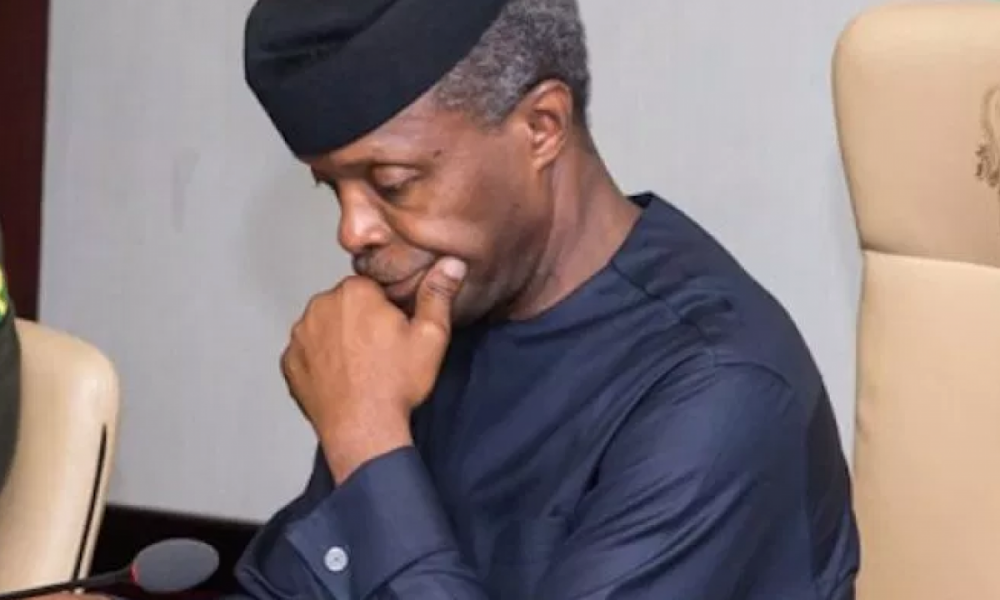
The trials of Brother Osinbajo | By Festus Adedayo

Published

on

Anyone who has access to a political barometer will see clearly that Aso Rock is quaking at the moment. The dusts the quake is provoking is so huge that it can block nasal passages. You only need to make use of the barometer and become Johnny Nash instantly. Nash?


John Lester “Johnny” Nash, Jr. was an American reggae and pop music singer-songwriter who was best known for his 1972 hit song he labeled I can See Clearly Now. In the song, Nash acknowledged his erstwhile inability to visualize critical occurrences but proclaimed thereafter that, “I can see clearly now the rain is gone// I can see all obstacles in my way//Gone are the dark clouds that had me blind//It’s gonna be a bright (bright) Bright (bright) sunshiny day.


In the last few weeks, there have been snippets of very disturbing news sneaking out of the Nigerian seat of power. They are indicative of the fact that Vice President Yemi Osinbajo has been under the buffeting of his boss, Muhammadu Buhari. The snippets, though seemingly hazy, are very glaring to those who understand the tone and tenor of presidential seat of power dissonances in a Third World like Nigeria. Most times, the dissonance does not obey the geography of such, all over the world, especially in mature democracies. It could be triggered by inane, mundane and very illogical indices. It could even be an insignificant, incorrigible and absolutely irresponsible allegation as the occupiers of the seats’ mutual spousal disagreements. In most cases however, the dissonances are founded on projected power calculus and perceived rupture of this calculation. The victim does not have to deliberately hurt the calculus. When the projections of power are shaken, they are stimuli for taking very sweeping jabs at the lower occupier of power seat.


When Buhari went on his earlier UK search for health remedy to an undisclosed ailment, it was a top gossip in the seat of power that Osinbajo, engrossed in a prayer session with his Redeemed Christian Church of God (RCCG) accomplices in his home state of Ogun, and frantically being prayed for, for God to make him president by one of the pastors who starred at the prayer session, didn’t know that a strong ally of Buhari – unbeknown to the ally that such “prayer coup” was ongoing – had entered their midst, innocently there to pay obeysance to the VP. Still with their eyes closed, the prayer warriors nearly prayed that the ground should swallow them when, upon opening their eyes, they saw the president’s ally with them. If you were praying the VP into the office of the president, with the VP shouting thunderous “Amen” to your prayer, weren’t you praying for the boss’ death? That was the first infraction against the laws of power the VP was said to have committed. And one of the reasons Osinbajo hounded and still harangues the ally till today.


The second foot Osinbajo reportedly hit against the stone was said to be his role during Buhari’s AWOL shuttle to his infirmary. That Walter Onnoghen, allegedly primed to package Buhari inside a judicial casket during the 2019 elections, emerged acting Chief Justice of the Federation through his acting pen angered Villa power apparatchik, so much that they imputed a political Judas into Osinbajo’s act. The removal of Lawal Daura, erstwhile Director-General of Department of State Services on August 7, 2018 also rankled these owls.


If Osinbajo stepped on their mamba’s tail by this act, he fiddled with their lion’s tail subsequently when, at a conference of Online Publishers Association of Nigeria (OPAN), he unabashedly said that, before Saturday, January 12, Buhari was not aware of Onogohen’s trial. What this did was to populate and give official imprimatur to the belief that Buhari was just a mere scarecrow decorating the patio of Aso Rock. As if wearing Omoyele Sowore’s activists’ bandana, the VP also told whoever was behind the Onnoghen trial that, “It has consequences such as we have today, such that people say how can such an important person be subjected to trial without the Federal Government.”


More stinging to this set of people known as the cabal, was the fact that Osinbajo sidelined all of them in his decision-taking during the period, was already strutting hither thither like an accursed turtle-dove which, to them, added to the coup-prayer session, was an apparent indication that he was sure Buhari wouldn’t come back and the clock was ticking for the cabals at the Villa.


Unforgiving and vengeful as the power vultures surrounding the president can be, they swallowed this rheum, even past the electioneering period. When they were sure that the VP believed it was peace and safety, they unleashed their dragons. The first in tow was the disbandment of the Economic Management Team (EMT) that he previously headed and its replacement with an Economic Advisory Council (EAC) under the chairmanship of Doyin Salami. Buhari was not done in his castration of his VP, he instructed him to thenceforth seek approvals for all the agencies under his suzerainty. Osinbajo was chair of National Emergency Management Agency (NEMA), National Boundary Commission, Border Communities Development Agency and Niger Delta Power Holdings Ltd. Bothered by the impression that this calibration of a man who was aiming that if fate smiled at him, he could be a Buhari in 2023, his aides began a move to robe an Omoye whose madness, the Yoruba say, had reached the market-place in her disgraceful nakedness.


The most recent in the list of artillery fires shot at the VP is the removal of his aides, 35 in all. The ding-dong over the authenticity of this claim has been baffling. While government loyalists initially claimed that opposition was merely crying wolf, the press ferreted out the list. While the VP’s aide denied that there was a sack, Garba Shehu, his counterpart with Buhari, claimed that there was indeed a rout but it was in “our interest” – the people of Nigeria, that is.


On Thursday night, the VP aide had tweeted, “a list circulating in the media on the so-called sacked presidential aides is not genuine and ought to be ignored,” while his colleague, after a long-winding and circuitous merry-go-rounding, in one breath submitted that “the Presidency wishes to strongly deny rumours of a rift between President Muhammadu Buhari and Vice President Yemi Osinbajo,” but in another breath, said that, indeed, “there is, on-going, an unprecedented overhaul of the nation’s seat of government, arising from which a number of political appointments have either been revoked or not renewed in the Second Term,” but that it was in our interest as a people, so as “to streamline decision-making, cut down multiple authorities and reduce the cost of administration,” and that “the office of the Vice President, Yemi Osinbajo has, in compliance with the directive of the President, equally been shed of a number of such appointees.” As a parting shot, strictly for the birds, Shehu had said, “The streamlining was not personal or targeted to undermine the Vice President’s office, as the so-called insider sources quoted by the media appear to make it seem.”


There are some issues of national concern in the shrouded brickbats between the VP and his boss. One is that, the two officers of the presidency are as dissembling and riotous as the lack of locus among their bosses, as well as the messages they communicate. If you take the dislocations in their messages as symptomatic of the presidency, then you would be acquitted by logic if you submit that the Villa is currently a house of commotion.


Common sense is on sabbatical, especially in the release by Shehu. If the presidency had been cutting cost, how many aides were relieved of their jobs in Buhari’s office?


Nigerians will like to know. If they had been relieving people of their jobs, “cut(ting) down multiple authorities and reduce the cost of administration,” how come that a few weeks ago, the wife of the president got, according to her, unsolicited, six more aides in the offing? If you go to the brass-tacks, you will even discover that the said sacked aides of Osinbajo were just offerings to the gods of nepotism and cronyism. You would find on that list the names of children of friends and all that, who, professionally, are just emerging from diapers.


Until this purported sack, Nigerians didn’t know that there was such a Babelian number of aides attached to one man. Since Buhari is the maigaskia, can he come clean with the people who purportedly voted him into office and tell them how many of such aides their national sweats sustain their voyeuristic excitements at the Villa? Since they have a website at the Villa, how come this list is not there? This is how low Nigeria has sunken under her current taskmasters.


This most pitiable sight in the sorry equation at the Villa is the VP. A very sound academic, I still remember one of the students he supervised her PhD thesis, now a professor of law and SAN, who waxes lyrical whenever talks come to Osinbajo’s academic excellence. Upon coming to Aguda House however, Thomas Jefferson’s eternal quip, to wit that, “whenever a man has cast a longing eye on (an) office(s), a rottenness begins in his conduct” becomes very apt to describe his actions. He has given intellectual abetment to Buhari’s draconian governance, carried his can of spittle smilingly and frightened off his own kinsmen in the course of doing all that. Now that he has entered the belly of the dragon, Osinbajo has these people behind him seldom. The situation became so bad that a man with such lustering academic laurels tumbled down to becoming a butt of jokes all over, described unflatteringly as VP in charge of condolence matters and VP academics.


The most cogent lesson in the trial of Brother Osinbajo is the need to build home base. Rolling into the fifth year of his vice presidency, except for an army of recruited Alsatian dogs on Twitter paid to bay for blood and bark at genuine concerns over his groveling before a cow so as to eat beef in 2023, Osinbajo is as bereft of a base as floating ojuoro and osipata – hyacinths – on the river top. Those waiting to clear their 2023 river of such hyacinths are finding it so easy to shovel Osinbajo off their space.


If you ask me, however, I will queue behind Osinbajo. The few sparkles of governance Nigerians have had thus far came from him when Buhari was infirm and vacillating in the UK. Nigerians know that Buhari is just a ceremonial figurehead who “does not know” and has no whiff of what is going on in his surroundings. That hogwash from Shehu, to wit that, “the President is in absolute control of his government,” that “the media should stop attributing non-existent powers to some people” and that “there cannot be anyone too powerful for President Buhari to control” should be the most laughable cant Nigerians have heard this year.


Osinbajo should continue to pray to his God. If he comes out unscathed, he will be our modern day three Hebrew boys. Nebuchadnezzar, king of Babylon, that these people are have sold their souls to Mephistopheles for a farthing. They have ordered him thrown into a fiery furnace.


Source : tribuneonlineng


Comments

Opinion

Why Ibadan North youths are rooting for Repete

Published

on

Growing support has continued to trail a youthful politician and technology advocate, Hon. Khalil Mustapha Adegboyega, popularly known as Repete, as many youths in Ibadan North Federal Constituency expressed confidence in his leadership style and vision for development.

Across several communities within the constituency, residents, particularly students, artisans and young professionals, described Repete as one of the emerging political figures with strong grassroots appeal and a passion for youth empowerment.

Supporters said his growing popularity stems from his consistent advocacy for innovation, entrepreneurship and skills development aimed at addressing unemployment and creating opportunities for young people.

As an engineer and technology enthusiast, Repete is also said to possess a deep understanding of the evolving digital economy and the need to position youths for global competitiveness.

Many of his supporters noted that his approach to leadership focuses on practical solutions, mentorship and capacity-building initiatives capable of helping young people become self-reliant and economically productive.

Some community stakeholders who spoke on his rising profile said his humility, accessibility and relationship with the grassroots have continued to endear him to many residents within the constituency.

They added that Repete’s engagement with youths and community groups reflects his commitment to inclusive governance and people-oriented representation.

Observers within the constituency also maintained that the increasing support for the politician reflects a growing desire among residents for a new generation of leaders driven by innovation, competence and accountability.

According to them, many young people see Repete as a symbol of hope and progressive leadership capable of contributing meaningfully to the development of Ibadan North Federal Constituency.

Continue Reading

Opinion

Repete or Regret: APC’s Moment of Truth in Ibadan North

Published

on

File photo of Hon. Khalil Mustapha Adegboyega (Repete)

The All Progressives Congress (APC) in Oyo State stands on the edge of a consequential decision—one that may define not only its fortunes in Ibadan North Federal Constituency but also its broader political relevance in the state.

As the countdown to the party primaries intensifies, the question before APC leaders is no longer routine. It is strategic. It is urgent. And it is decisive: will the party align with the clear preference of the people or risk repeating costly political miscalculations?

At the centre of this debate is Hon. Khalil Mustapha Adegboyega, widely known as Repete—a name that has, over time, evolved from a political identity into a grassroots phenomenon.

A Candidate Rooted in the People

In contemporary Nigerian politics, where voter awareness is rising and expectations are shifting, candidates are increasingly judged not by promises but by presence. On this scale, Adegboyega stands tall.

His political journey is marked by consistent engagement with constituents—far beyond the optics of election seasons. From youth empowerment initiatives that provide practical skills and startup support, to sustained interventions in healthcare access for the elderly and indigent, his footprint across Ibadan North reflects a model of leadership anchored on service.

Unlike the transactional approach that often defines political relationships, Adegboyega’s connection with the people appears organic—built on trust, accessibility, and continuity. These are not mere campaign attributes; they are political assets.

The Danger of Political Disconnect

History offers the APC a clear lesson: parties that ignore grassroots sentiment often pay a heavy electoral price. The imposition of candidates perceived as distant or untested has, in several instances, resulted in voter apathy, internal dissent, and eventual defeat at the polls.

Ibadan North presents no exception.

With opposition parties closely monitoring the APC’s internal dynamics, any misstep in candidate selection could provide a ready opening. A divided house, coupled with a candidate lacking widespread acceptance, is a formula the opposition is well-positioned to exploit.
The implication is straightforward: this is not merely about party loyalty; it is about electoral viability.

Echoes from the Grassroots

Across the length and breadth of Ibadan North—markets, motor parks, religious centres, and community gatherings—a consistent pattern emerges in political conversations. The name “Repete” resonates with familiarity and acceptance.

Such organic support is not easily manufactured. It is cultivated over time through visible impact and sustained presence. For a party seeking electoral certainty in a competitive environment, this level of grassroots validation is not just desirable—it is critical.

A Test of Leadership and Judgment

For the APC leadership in Oyo State, the moment calls for clarity of purpose. Decisions driven by narrow interests, personal alignments, or short-term calculations may carry long-term consequences.

The task, therefore, is to balance internal considerations with external realities. Elections are ultimately decided by voters, not by party caucuses. A candidate who commands public confidence offers the strongest pathway to victory.

The Stakes Are Clear

Ibadan North is too strategic a constituency for experimentation. The cost of error is not limited to a single seat; it extends to party cohesion, credibility, and future positioning within the state’s political landscape.

In this context, the argument for Adegboyega is less about sentiment and more about strategy. His visibility, acceptability, and record of engagement place him in a strong position to consolidate support and mobilise voters effectively.

Conclusion: A Choice with Consequences

As the APC moves closer to its primaries, the decision before it is both simple and significant: align with a candidate who reflects the mood of the electorate or risk conceding advantage to a watchful opposition.

In politics, moments such as this often separate foresight from hindsight.
For APC in Ibadan North, this may well be one of those defining moments.


Aderibigbe Akanbi, a political analyst, writes from Ibadan.

Continue Reading

Opinion

Ibarapa East: Yusuf Ramon’s Quest for Responsive Representation

Published

on

Hon. Yusuf Abiodun Ramon

As the road to 2027 gradually unfolds across Oyo State, political conversations are shifting from routine permutations to deeper questions about competence, generational leadership, and measurable impact. In Ibarapa East, that conversation has found a new voice in Yusuf Abiodun Ramon — a Lanlate-born technocrat whose entry into the race for the State House of Assembly is redefining what representation could mean for the constituency.

In a political environment often dominated by familiar faces and conventional calculations, Ramon presents a profile shaped by technical discipline, structured thinking, and solution-driven engagement. His professional background, anchored in analytical precision and systems management, forms the foundation of his public service aspiration.

For him, representation must move beyond ceremonial presence to practical responsiveness — laws that reflect local realities, oversight that protects public resources, and advocacy that translates into visible development.

Ramon argues that the future of Ibarapa East lies in leadership that listens deliberately, plans strategically, and delivers measurably. He speaks of strengthening rural infrastructure, expanding youth-driven economic opportunities, and institutionalising transparency as core pillars of his agenda. In his view, governance must not merely be symbolic; it must be structured, accountable, and people-centred.

Rooted in Ile Odede, Isale Alubata Compound, Ward Seven of Ibarapa East Local Government, and maternally linked to Ile Sobaloju, Isale Ajidun Compound, Eruwa, Ramon’s story is not one of distant ambition but of lived experience. He is, in every sense, a son of the soil — shaped by the same roads, schools, and economic realities that define daily life in Ibarapa East.

“I was born here. I grew up here. I understand our struggles, our strengths, and our untapped potential,” he says. “Representation must go beyond occupying a seat; it must translate into preparation, competence, and genuine commitment to development.”

His academic journey mirrors that philosophy of steady growth. He began at Islamic Primary School, Lanlate (1995–2001), proceeded to Baptist Grammar School, Orita Eruwa (2001–2007), and later earned a National Diploma in Mechanical Engineering Technology from Federal Polytechnic, Ilaro, between 2009 and 2011. Refusing to plateau, he advanced his intellectual horizon and is now completing a Bachelor of Science in Business Administration at the University of Lagos. “Education,” he reflects, “is continuous capacity building. Leadership today requires both technical knowledge and administrative insight.”

That blend of engineering precision and managerial training has defined a professional career spanning more than a decade. Shortly after his diploma, Yusuf joined Mikano International Limited as a generator installer, gaining hands-on experience in industrial power systems — a sector central to Nigeria’s infrastructural backbone. He later transitioned into telecommunications at Safari Telecoms Nigeria Limited, where he received specialized training in Industrial, Scientific, and Medical radio bands, strengthening his expertise in network operations.

In 2013, he became a Field Support Engineer at Netrux Global Concepts Ltd., then a leading ISM service provider in Nigeria. Over four formative years, he immersed himself in telecom infrastructure deployment and maintenance, mastering field coordination, logistics management, and real-time technical problem-solving.

Since July 2017, he has served as a Field Support Engineer with Specific Tools and Techniques Ltd., a power solutions firm providing services to major operators including MTN Nigeria and Airtel Nigeria. In that capacity, he operates at the frontline of ensuring energy reliability and network uptime — responsibilities that demand discipline, accountability, and systems thinking.

For political observers in Ibarapa East, this trajectory matters. It reflects more than résumé credentials; it speaks to a mindset anchored in efficiency, coordination, and measurable outcomes — qualities increasingly demanded in legislative representation.

Beyond the private sector, Ramon’s political exposure is neither sudden nor superficial. A loyal member of the progressive political family in Lagos, he once served as a personal assistant to a former lawmaker, gaining practical insight into legislative procedure and constituency engagement. Within his community, he has quietly extended financial support to small-scale entrepreneurs and students — modest but consistent interventions rooted in personal responsibility.

“My interest is my people,” he states firmly. “Ibarapa East deserves strategic, responsive, and capable leadership at the State Assembly. We must move from rhetoric to results.”

Across the constituency — from Lanlate to Eruwa — development priorities remain clear: youth employment, vocational empowerment, rural road rehabilitation, stable power supply, agricultural value-chain expansion, improved educational standards, and stronger lawmaking that directly reflects community needs.

Political analysts argue that Ramon’s technocratic background positions him uniquely at the intersection of policy formulation and practical implementation. At a time when national discourse increasingly favours competence over grandstanding, his profile resonates with a broader generational shift toward performance-driven governance. His engineering discipline reinforces problem-solving; his business training strengthens administrative understanding; his grassroots roots anchor his empathy.

For Ibarapa East, the 2027 election cycle may represent more than a routine democratic exercise. It may mark a recalibration of expectations — a demand for representation that understands both the soil beneath its feet and the systems that drive modern development. As political alignments gradually crystallize in Oyo State, Yusuf Abiodun Ramon’s declaration signals the arrival of a candidate seeking to translate private-sector structure into public-sector impact.

One thing is clear: the conversation about the future of Ibarapa East has begun — and it is now framed around competence, credibility, and capacity.


Oluwasegun Idowu sent in this piece from Eruwa, Ibarapa East LG, Oyo State

Continue Reading

Advertisement

Entertainment

Advertisement

MegaIcon Magazine Facebook Page

Advertisement

MEGAICON TV

Advertisement

Trending