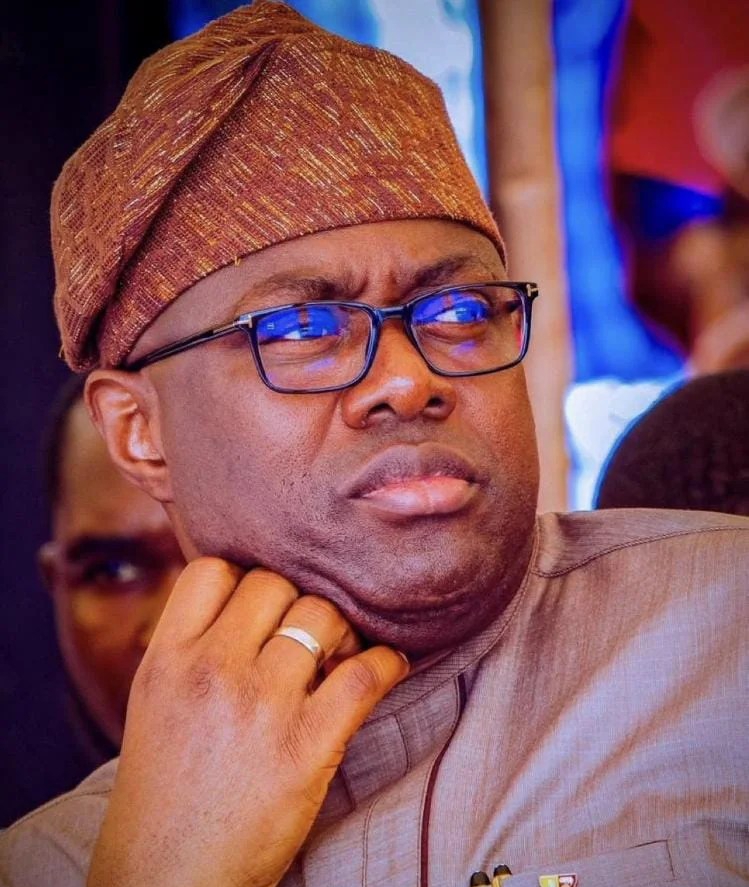
In response to my brother, Shuaib Idris, who wrote the piece titled “Seyi Makinde Deserves Our Sympathy,” I submit that Seyi Makinde does not deserve our sympathy. How do you sympathise with somebody who brought political calamity upon himself?
There is a point in every political journey when a leader must pause, look around and ask himself a difficult question: How did I get here? For Governor Seyi Makinde, that moment has long arrived.
Much has been written and said about the governor’s increasingly combative public interventions, his exchanges with political opponents and his determination to market the candidacy of his preferred successor. Some have interpreted these developments as signs of pressure surrounding him. But sympathy, in this circumstance, may be misplaced.
If Governor Makinde is under pressure today, much of that pressure is self-inflicted. If his administration is now being subjected to increasingly intense scrutiny, he cannot reasonably blame those asking the questions. And if political opponents have become emboldened enough to challenge his record openly, he should perhaps examine the decisions and conduct that have created the circumstances in which those challenges are now flourishing.
The governor’s recent political conduct provides ample illustration.
At the 70th birthday celebration of Bishop Francis Wale Oke, the governor reportedly used his appearance to introduce Bimbo Adekanmbi, the APM governorship candidate whom he supports. Adekanmbi’s emergence as the APM candidate is not in dispute; the party adopted him as its consensus candidate in May.
Two things continue to haunt him: his subpar performance in office and what critics describe as his imposition of Adekanmbi and Open Salawu, new entrants into his team, on his “first eleven.”
The question, therefore, is not whether Governor Makinde has the right to support a candidate. He does. The question is why a governor who repeatedly speaks of his administration’s achievements appears increasingly eager to make the 2027 succession contest a personal project.
A governor nearing the end of his tenure should ordinarily be concerned about preserving the dignity of the office, defending his record with facts and allowing his preferred candidate to present his own credentials. Indeed, Adekanmbi himself has publicly said he would not be a political stooge and that he would take responsibility for his own decisions if elected. That is political rhetoric. However, everything about Adekanmbi, according to his critics, points to the possibility of his being a stooge waiting to be planted to do Makinde’s bidding after the latter leaves office in 2027.
Yet Governor Makinde has increasingly inserted himself into the political conversation surrounding his successor. That creates an unavoidable question: if Adekanmbi is sufficiently qualified and politically prepared to succeed him, why does the governor so frequently feel compelled to fight the successor’s battles himself?
This is where the argument about pressure becomes particularly relevant. Political pressure does not simply descend from heaven. It can be generated by the choices of the politician himself.
Consider the recent exchange with Senator Sharafadeen Alli over the legal profession. Governor Makinde reportedly questioned Alli’s experience as a lawyer, arguing that he had never entered a courtroom. Alli’s campaign organisation subsequently responded by detailing his legal background and professional experience.
There is nothing wrong with political candidates examining one another’s records. That is part of democratic competition. But reducing a lawyer’s professional identity to courtroom appearances is a curious line of attack, particularly when the political argument ought ultimately to be about competence, experience, policy and public record.
A lawyer can practise in several areas of the profession without making litigation the centre of his career. Administrative work, corporate practice, legal consultancy, governance and institutional management are among the possible avenues available to members of the profession.
The larger point, however, is this: when an incumbent administration turns the professional credentials of an opponent into a central campaign issue, it invites its own record to be placed under the microscope. So, why does he need to be sympathised with over what he brought upon himself?
The response from Alli’s camp has shifted attention towards questions about Makinde’s own record as an engineer and governor, particularly the controversy surrounding diesel-powered streetlights and the renovation of the Lekan Salami Stadium. Those are now matters of public political debate, with competing claims about expenditure and performance. How do you sympathise with someone who threw a stone and received a Scud missile?
This is the unavoidable consequence of political combat: once you open the door to scrutiny of another man’s credentials, you should expect yours to be examined with equal intensity. Governor Makinde cannot reasonably demand immunity from the same standard he applies to others.
The same principle applies to his much-advertised “first eleven.” If the governor describes his administration as being driven by a carefully assembled team of exceptional people, the public is entitled to ask what became of that team when the question of succession arose. Why was the search for a successor extended beyond this celebrated first eleven?
A football coach who constantly boasts about his first eleven naturally invites the question of who among that eleven can step forward when the captain leaves the field. If none is selected, his team’s fans will ask why. That is not persecution. It is accountability.
There is another issue the governor should confront: political loyalty. Governor Makinde did not arrive at the Government House in 2019 in isolation. His political journey involved alliances with people and groups who contributed to the coalition that eventually produced his victory. The political history of that period is well known and should not be rewritten simply because former allies and associates are now on different sides of the political divide.
The problem with “use and discard” politics is that yesterday’s ally eventually becomes tomorrow’s witness. People who helped build a political structure do not disappear simply because their usefulness has expired. And when they begin speaking, the politician who once relied on them may find himself answering questions he never anticipated.
That appears to be part of the political atmosphere surrounding Governor Makinde today. His confrontation with traditional institutions is another matter that requires careful reflection. Whatever one’s political affiliation, Yoruba traditional institutions occupy a distinctive place in the cultural architecture of Oyo State. Political disagreement with individual traditional rulers is legitimate; treating the institution itself with disdain is entirely wrong, and it raises questions about Makinde’s Omoluabi values.
A governor may disagree with a monarch’s political preference. He may even believe traditional rulers should remain politically neutral. But the language employed in expressing that disagreement matters.
The office of governor carries enormous constitutional authority, but it also carries a moral obligation to exercise restraint. A governor should not need to be reminded that words spoken from Government House do not remain personal words. They acquire the weight of the office. That is why some of Governor Makinde’s recent public exchanges have generated such controversy.
The irony is that political power is temporary, while institutions and relationships often outlive individual office holders. The governor should know this better than most.
He is approaching the end of his constitutionally permitted tenure in Oyo State. The political question before him is therefore not how to remain governor indefinitely, but what legacy he will leave behind. Will he be remembered primarily for the projects executed under his administration? For the policies introduced? For the institutions strengthened? Or increasingly for the political battles fought during the final phase of his tenure? The last question is what will occupy people’s minds most after Makinde has left office.
The most consequential political mistake an incumbent can make is to interpret every criticism as persecution and every opponent as an enemy. Criticism is not necessarily hatred. Opposition is not necessarily sabotage. Questions about public expenditure are not necessarily attacks on a person. And scrutiny of an administration is not evidence of an organised conspiracy.
A mature government answers questions. A confident administration publishes records. A secure political movement allows its candidate to speak. And a governor who believes his record speaks for itself should have little reason to spend every available political moment speaking for his preferred successor.
That is why sympathy for Governor Makinde is evidently misplaced. The political pressure surrounding him today is not simply something that happened to him. It is also the product of political decisions, alliances, rhetoric and strategies that he and his political associates have consciously pursued.
He chose his successor. He chose his political platform. He chose to engage his opponents. He chose to make their records a subject of public debate. He chose to defend his administration through increasingly political exchanges. Those choices have consequences.
The electorate is now watching. And when the people begin to ask questions, the appropriate response from a governor is not to complain about pressure. It is to provide answers. Oyo people do not owe any politician sympathy for the consequences of his political choices. They owe themselves something far more important: a careful examination of every candidate, every record, every promise and every claim before making their decision in 2027.