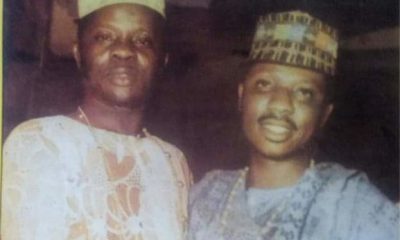
In the course of my research into the work, Ayinla Omowura: Life and Times of an Apala Legend, I concluded that stardom and eccentricity are intertwined. One of my sources told me that one day in the late 1970s, Omowura, the late Yoruba musician, as a litigant in a matter that took place in an Abeokuta, Ogun State High Court, walked into the courtroom clutching a half-smoked wrap of burning marijuana. The judge was so scandalized that he shouted, “Get out of here! Where do you think you are!” apparently in deference to his stardom; otherwise, he should have been arrested forthwith.
Virtually all musicians parade one eccentric feature or the other. Iconic maestro, poet, philosopher and staunch defender of African rights, Winston Hubert MclnTosh, popularly known as Peter Tosh, was in this mould. Aside from his staunch belief, like many other Rastafarians, that smoking marijuana was a spiritual purification exercise, Tosh was extremely controversial and did not care whose ox was gored.
Tosh’s first major hit after separating from his friend, Bob Marley, was an atavistic album he called ‘Legalize It’ released in 1976. It uncompromisingly sang the praises of the banned narcotic called Indian hemp, lauding its alleged health benefits. Its album sleeve had him smoking marijuana chalice pipe in a countryside hemp plantation.
Tosh once told a 40-000-strong audience that he was not a man of peace as “peace” was “the diploma you get in the cemetery” because, on the tombstone, it is written, “Rest in Peace!” In his bassy voice, encrusted by heavy ganja he smoked anywhere, unabashedly, he shouted: “Hungry people are angry people.” His memorable words landed with a thud because earlier at the concert, he had ordered camera journalists whom he labelled “lickle pirates from America… wid dem camera and dem TV business” to cease filming him.
Barely five months after, Tosh was arrested by the police. He was mercilessly beaten and in the process, his skull was cracked. He only stayed alive by feigning that he had been murdered. This probably explains the recurrence of the brutality of Babylon (the police) in his songs. In his ‘Na go a’ jail track, he banalized the criminalisation of hemp smoking and made a mockery of the system which relentlessly hounded the weed smoker. “This here smoke that you see me with, sir, I just got it from an officer; And this here little bit of green Sensimilla, I just got it from an Inspector, He’s my friend… I hear one leader say, If it wasn’t for the little Sensi, Him no know what happens to the economy; I see another leader, Go in a Half Way Tree, And he set them ganja prisoners free…” he sang, stating that even the priest smoked marijuana.
In one of his vinyl, Sakara music great, Yusuf Olatunji, once threw away the prudery associated with African elders. He sang that he once went to Ibadan on a musical engagement and his host dashed him a “baby” to please his soul. You would think that women were commodities to be given out as gratification of souls. On getting home, said Olatunji, he couldn’t narrate what transpired to his wife. “O se mi l’alejo o, mi o je rohin fun’yawo mi file o, o fi baby kan ke mi, en o gba’rohin nij’o ti mo dealer,” he sang.
The eccentricity of Fela Anikulapo Kuti was also largely known. From marrying 27 wives in one day, to publicly smoking weed and appearing almost naked in public. When musician, Habeeb Okikiola, popularly known as Portable, got embroiled with the law for refusing to honour police invitation, he merely fed into the troll of the eccentricity of musicians. Last Tuesday, videos of how he pelted policemen with curses after their attempt at getting him arrested for rough-handling some men of the Nigeria police hit the internet. At the expiration of the 72-hour ultimatum given him by the police, as I write this, he is said to have been locked up in a police cell at Eleweran, Abeokuta, preparatory to his arraignment in court. Police alleged that it acted based on a petition written to it by a Nigerian studio owner whose office the musician allegedly destroyed while ordering “his boys” to beat him up.
Half-literate, Portable, like most of the musicians of his ilk, is alleged to romance the banned substance Rastafarians call African herb. Sometimes, he lapses into incoherence that probably speaks to some mental disconnect but the depth of his musical rendition is most times confounding.
It is gladsome that the Ogun state police spoke of how the law is no respecter of persons and thus, the need to arraign Portable in court. It must also follow it to the letter. Its public relations officer, Abimbola Oyeyemi, had said that the police believed “that you are an artiste or a star does not make you above the law… and the law is no respecter of anybody”. Those interested in fine-tuning celebrities and stars should take a deeper interest in Portable. I have written of how Brenda Fassie, a South African diva, died of drug addiction, denying her fans her great talents. The question is, can’t eccentric behaviour be divorced from artistry? I fear that Portable stands the risk of being swallowed by the tide of his eccentricity. Like his predecessors.
Dr Adedayo, a journalist, lawyer and columnist writes from Ibadan, Oyo state