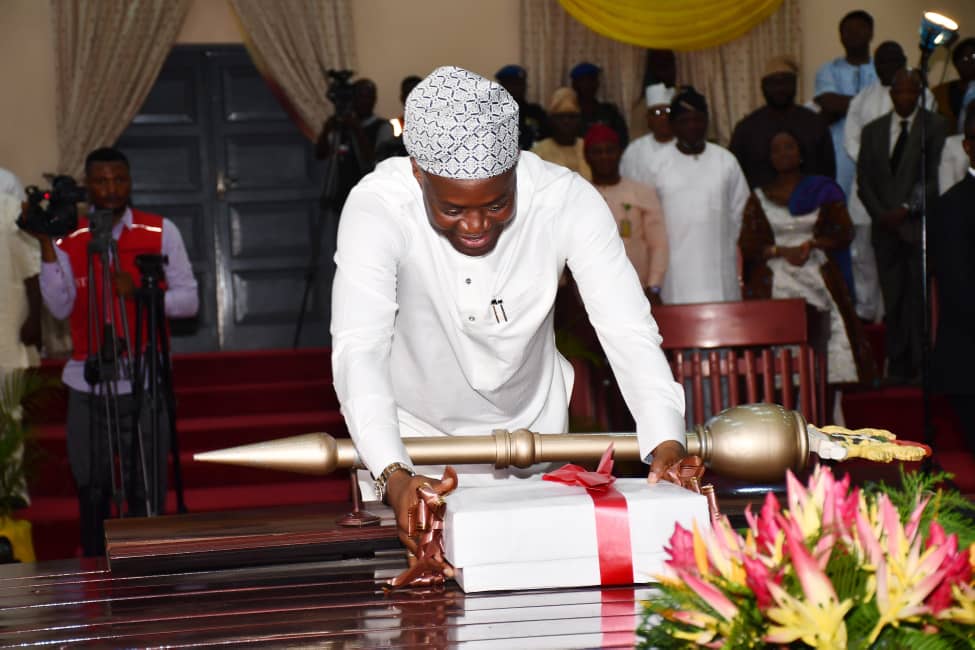
Oyo State Governor, Engineer Seyi Makinde, on Wednesday, presented a N208 billion 2020 budget estimates to the State House of Assembly for approval.
Governor Makinde while addressing the Assembly with a 16-page speech noted that his administration plans to be bullish with infrastructure development in the State by embarking 23 percent of the budget for the sector.
A statement by the Chief Press Secretary to the Governor, Mr. Taiwo Adisa indicated that the 23.93 percent allotted to infrastructure is the highest in the state’s history.
The Statement also indicated that in line with his administration’s belief that education remained the fastest way to take the people out of poverty and its commitment to delivering free and qualitative education in the State, the government has allocated the second highest percentage of the 2020 Budget, 22.37 per cent, to the education sector.
The Governor said: “I am here today to present to you the Oyo State Budget Proposal for the 2020 Fiscal Year. It is a budget that captures the aspirations of the good people of Oyo State. The farmers in Ido, Ilora, Ijaiye, and Akufo who wake up every morning hoping this is the day their relief will come. When the roads that link their farms to markets will be built and they can make more money for their toil.
“The market women and men in Gbagi Titun Market as well as the rural markets in Iresadu and Eruwa, whose hope is that the economy can be buoyant enough so that people can buy from them. The drivers and conductors on Iwo Road, Ogbomoso, Ipapo and Lalupon who do not want to spend all their takings on bus repairs. The civil servants at Agodi Secretariat who put in an honest day’s work and just want to get their salaries paid on time so they can care for their families.
“The students in public primary, secondary and tertiary institutions who want quality education so they can compete favourably with their counterparts worldwide. The old, the sick and infirm who want to go to a government hospital and get quality service without paying out of pocket. The small and medium scale business owners who want an enabling environment for their business to thrive.
“The big corporations who set up industries in Oyo State believing that government will play their role in providing a conducive environment for sustainable growth. It is a budget that every woman, man, and child in Oyo state can relate to and be proud of. A budget in keeping with our Roadmap for Accelerated Development in Oyo State 2019-2023.
“Mr Speaker Sir, Honourable Members, this is the first time I will be coming before you to present and defend a budget that is wholly this administration’s. Please permit me to share with you some of the key areas of the 2020 Oyo State Budget Proposal highlighting our revenue and expenditure plans and how this will contribute to the accelerated development of the economy of Oyo State.
“Let me start by saying that we are aiming for at least 70 per cent budget implementation. We believe we can even exceed this because we are not building castles in the air. Our proposed budget income matches our proposed expenditure.”
According to Governor Makinde, the capital expenditure of the State for the 2020 Budget was increased by 20 per cent compared to the 2019 Budget, with the capital expenditure estimate in the 2020 Budget proposal standing at N100,142,690,046 billion, representing 47.9 per cent of the budget.
The Governor added: “You will also note that our capital expenditure increased by about 20 per cent compared to the 2019 budget. Total capital expenditure of N100,142,690,046 billion is 47.9 per cent of the total budget estimate.
“The importance of this increase should not be lost on us. Increased allocation to capital projects directly contributes to a more buoyant economy and sustainable development. As stated earlier, we will not only be starting new projects, but also completing all ongoing viable projects from the previous administration.
“In all, Mr Speaker Sir, Honourable Members, I am happy to report that we have kept our promise to the people of Oyo State. When we set out to prepare the budget, our aim was to keep the budget realistic. To prepare a budget where projected revenue matches projected cost, unlike what has been the practice in the past.
“In 2019 for instance, the last administration projected N25.55Billion as revenue from MDAs and N91.59Billion from Statutory Allocations. These projections were higher than could be achieved. We have had to mark these down by 4.79 per cent for MDAs and 6.08 per cent from Statutory Allocations. However, we have reviewed Internal Generated Revenue (IGR) upwards based on various strategies we have put in place. We are expecting monthly revenue of at least Three Billion Naira starting from January 2020. You will be happy to hear that in the month of October, we were able to increase the state IGR by Four Hundred Million Naira, such that we had an IGR of Two Billion, Seven Hundred Thousand Naira recorded for that month.
“The last two sources of revenue are Capital Receipts which are down by about 10 per cent to N33.50Billion compared to the 2019 budget, and Loans for Capital Projects at N28.99Billion.
“It is, therefore, with a deep sense of responsibility that I present to you the Oyo State Budget Proposal for the 2020 Fiscal Year. I can assure that every kobo of the Two Hundred and Eight Billion, Eight Hundred and Two Million, Nine Hundred and Seventy Two Thousand, Eight Hundred and Seventy Eight Naira Zero Kobo is accounted for. Every single expenditure is geared towards facilitating the accelerated development of our beloved Oyo State.
“Mr Speaker Sir, Honourable Members of the House, I said at the outset that this budget is of the people and for the people. I stand by my word. With this budget, every citizen of Oyo State has a workable plan that they can identify with. It has been my honour to present it to you and my prayer is that you give it due consideration in a timely manner so that implementation may commence and Oyo State will indeed get on the path to accelerated development,” the Governor said.
He stated that the sum of N35.4 billion has been provided in the 2020 budget towards the completion of ongoing and proposed road projects in the three senatorial zones of the State.
The Governor maintained that the administration will see to the completion of the recently awarded Moniya-Ijaye-Iseyin road, which the contractor has agreed to complete in 12 months and other ongoing viable road projects in the State, adding that the government has concluded plans to collaborate with the Federal Government to rehabilitate the Oyo-Iseyin road.
He also announced the restructuring of the Oyo State Road Maintenance Agency (OYSROMA) and the directive to establish zonal offices in Oyo, Ogbomoso, Saki and Ibarapa to achieve an effective spread of its activities, adding that the ongoing Light Up Oyo State project through which Smart LED Street Lights were installed in Ibadan and solar lights in Oyo and Ogbomoso would be replicated across the major towns and cities in the State.
Governor Makinde further revealed that the 2020 Budget contained provisions for the procurement of new fire fighting vehicles, ambulances, water tankers and communication equipment for the security system.
Governor Makinde further said that in line with his Government’s four service point agenda, it has allocated 5.18 per cent and 4.43 per cent respectively to the Health and Agriculture sectors in the 2020 Budget proposal, noting that the Government remained committed to its determination to use agriculture to drive the State’s economy.
In the health sector, Governor Makinde stated that the major facelift and equipment provided to the Adeoyo State Hospital, Ring Road, Ibadan, to ensure quality healthcare delivery to the citizenry will be extended beyond the state capital, noting that General Hospitals in Eruwa, Tede and Iseyin would be renovated in the 2020 fiscal year.
He maintained that having noticed the lacuna in the area of personnel for the health sector, his Government has given approval for the recruitment of 500 medical and health workers for the State’s hospitals, College of Nursing and Midwifery as well as the College of Health Science and Technology.
The Governor noted that the administration has begun the implementation of policies that would transform farming activities, increase production and improve the quality of food crops, livestock export and industrial crops through the application of modern technology, noting that the ongoing effort to upgrade two of the nine Farm Settlements in Eruwa and Akufo into Farm Estates remained on track.
Governor Makinde announced the return of the Oyo State Agricultural Development Programme (OYSADEP) headquarters to Saki, promising that the administration will restructure the system and fully strengthen it for efficient and effective performance of its responsibilities.
He also informed the gathering that the legal controversy over the 10,000 metric tons capacity silo at Aawe had been settled out of court, with the contractor already back to site with an agreement to deliver the project in 10 months.