
Business
Nigerian govt takes ownership of funds held in bank accounts not linked to BVNs


The Abuja Division of the Federal High Court has granted a request by Attorney General of the Federation, Abubakar Malami, for a temporary forfeiture of all funds held in bank accounts not linked to BVNs — and whose ownership could not be absolutely identified.
Also to be seized by the Nigerian government are funds held in bank accounts without sufficient know-your-customer credentials, court documents seen by PREMIUM TIMES said.
Industry experts expressed strong reservations about a lack of specific legal framework for the unprecedented forfeitures and potential coercion of banks by the federal authorities in separate interviews with PREMIUM TIMES Saturday.
No estimates were immediately available, but it is widely held that billions of naira remained trapped in the unlinked bank accounts since 2015 when the Central Bank of Nigeria ordered commercial banks to stop attending to new enrollees.
The order followed an originating motion of notice filed by Mr. Malami on behalf of the Nigerian government on September 28.
Nnamdi Dimgba, the Federal High Court judge who presided over the ex-parte motion, granted all the nine reliefs sought by Mr. Malami —himself represented by a lawyer, Usman Dakas— on October 17.
The court ordered all the 19 deposit money banks, DMBs, operating in the country to release to Nigerian government names of accounts not yet connected to BVN; account numbers; their outstanding balances; domiciling locations; and domiciliary accounts without BVN and where they are domiciled.
Nigeria deposit money banks that were listed as respondents in the ex-parte suit are: Access Bank, Citi Bank, Diamond Bank, Ecobank, Fidelity Bank, First Bank and First City Monument Bank.
Others are: Guarantee Trust Bank, Heritage Bank, Keystone Bank, Skye Bank, Stanbic IBTC Bank, Standard Chartered Bank, Sterling Bank, Union Bank and United Bank for Africa.
The remaining three are: Unity, Bank Wema Bank and Zenith Bank.
The court also ordered all of them to disclose any investments made with funds and to withhold authorisation for any outward inflow of funds from the accounts. All the details are to be submitted to Nigeria Inter-Bank Settlement System, NIBSS, and the CBN for authentication.
The banks were also directed to publish all bank accounts not linked to BVN in national newspapers with a 14-day notice for individuals with interest in such accounts to come forward and justify why their funds should not be forfeited to the Nigerian government.
Mr. Dimgba also ordered the CBN, which was joined as 20th respondent alongside the 19 DMBs, to appoint an official who will examine all the details submitted to the apex bank for compliance.
The government argued the matter under Section 3 of the Money Laundering Act, 2011.
The section said banks must “ensure that documents, data or information collected under the customer due diligence process is kept up-to-date and relevant by undertaking reviews of existing records, particularly for higher risk categories of customers or business relationships.”
The BVN is a unique identification number that can be verified and used to transact business across all the banking platforms in Nigeria.
The CBN imposed the policy to capture customers’ data for financial transactions and check fraud in the banking system.
Registration for BVNs commenced on February 14, 2014, across the country. The CBN said over 20.8 million customers enrolled 40 million bank accounts before the October 31, 2015, final deadline for customers residing within the country.
The CBN extended the deadline for Nigerians in the diaspora to December 2016 to sign up for the BVN system. But hundreds of thousands home and abroad are still believed to be left behind.
“Illogical, hasty‘
A financial analyst who spoke with PREMIUM TIMES about the court order rebuked the Nigerian government for attempting to shore up its revenues by forcibly seizing funds owned by private individuals.
“There’s no basis for this desperate move by the federal government because customers who owned the funds met the required criteria at the time they set up their bank accounts,” said Ugodre Obi-Chukwu, a Lagos-based financial analyst. “This is an attempt to use federal might to coerce banks into submitting funds that belong to customers for its own use.”
The Nigerian government had fallen on hard times since 2014 when dwindling price of crude oil began to take its toll on the country’s revenues.
The Buhari administration, which assumed office in May 2015, has made concerted pushes to source funding to finance a bloated federal civil service and new capital projects, including borrowing from local and international markets.
The government also said it would rely on recovered loot to finance its budget this year.
While Mr. Obi-Chukwu recognised financial challenges confronting the administration, he maintained that no policy must be implemented by fiat in a democratic system.
“The Money Laundering Act they used to sway the judge is clearly not sufficient to confiscate personal funds,” he said. “There’s no law that allows for this specific action taken by the government as it stands.”
He advised the federal government to allow people to withdraw their funds from the bank accounts if they’re not willing to link them to BVN, especially since they weren’t identified as proceeds of crime.
Lawyers weigh in
Two legal practitioners interviewed by PREMIUM TIMES Saturday held slightly disparate views on the matter.
Liborous Oshoma, who runs a law firm in Lagos, condemned the order as “far-reaching and despotic” in nature.
“You can’t just drag banks to court and ask them to submit all funds in bank accounts which they’re holding in trust for private individuals,” Mr. Oshoma said.
“The funds are mostly personal deposits. In law, orders are supposed to be specific, directed and enforceable against individuals or institutions,” Mr. Oshoma said. “But we cannot see how the government assumed it could sue banks to enforce orders against individuals who have not been accused of any criminal offences.”
Mr. Oshoma said the Buhari administration did not fathom the possibilities of Nigerians who are serving long prison sentences abroad and may not be in tune with developments in the outside world.
“The despotic tendency of wanting to take what does not belong to them made them forget that people might be in conditions where they cannot come and claim their funds for the next 20 years or more,” Mr. Oshoma said.
“If the government is really desperate to get people’s money because they cannot be found, it should find sensible means of going about it and not resort to steps that are not in consonance with democracy,” he added.
Although he questioned the legal premise of the federal government’s attempt to seize the funds, Inibehe Effiong, also a Lagos-based lawyer, told PREMIUM TIMES the overarching goal of the move was understandable.
“The BVN is a policy of the federal government which is aimed at mitigating financial crimes in the system,” Mr. Effiong said. “The policy was backed by certain financial regulations which make it appropriate for the government to ask for a general freezing order of accounts whose owners cannot be ascertained.”
“But what I cannot understand is the legal structure upon which the policy is standing,” Mr. Effiong said.
Mr. Effiong said authorities should have sought details of bank accounts first, then examine them individually and isolate ones with suspicious traits.
“The government should have stopped at requesting for details of all the bank accounts. but not go as far as getting a blanket approval to withhold all funds.
“If they all the accounts based on their merits, they can sort out the ones with criminal traces and seek their forfeiture,” Mr. Effiong said.


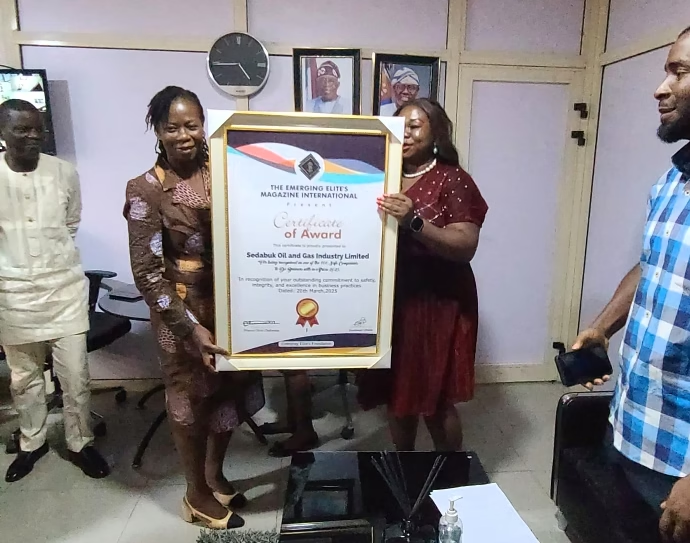
Sedabuk Oil and Gas Industry Limited has been listed among the 100 Safe Companies to Do Business With in Africa for 2025 by Emerging Elites Magazine International, in recognition of the firm’s integrity-driven operations, strict compliance culture, and employee-focused policies.
The award was presented to the Managing Director of the company, Engr. Adunola Oseni, at a ceremony attended by members of Sedabuk’s management and staff, alongside the editorial board and team of Emerging Elites Magazine in Lagos.
Presenting the award, the Editor-in-Chief of Emerging Elites Magazine International, Princess Olivia Chukwuma, said Sedabuk emerged after a “thorough, transparent and merit-based selection process” designed to identify African businesses that exemplify excellence and ethical conduct.
According to her, the 100 Safe Companies to Do Business With in Africa Award is an international initiative created to recognise indigenous African companies with proven records of integrity, safety, and best business practices, noting that awardees are continuously monitored and recertified every three years if standards are sustained.
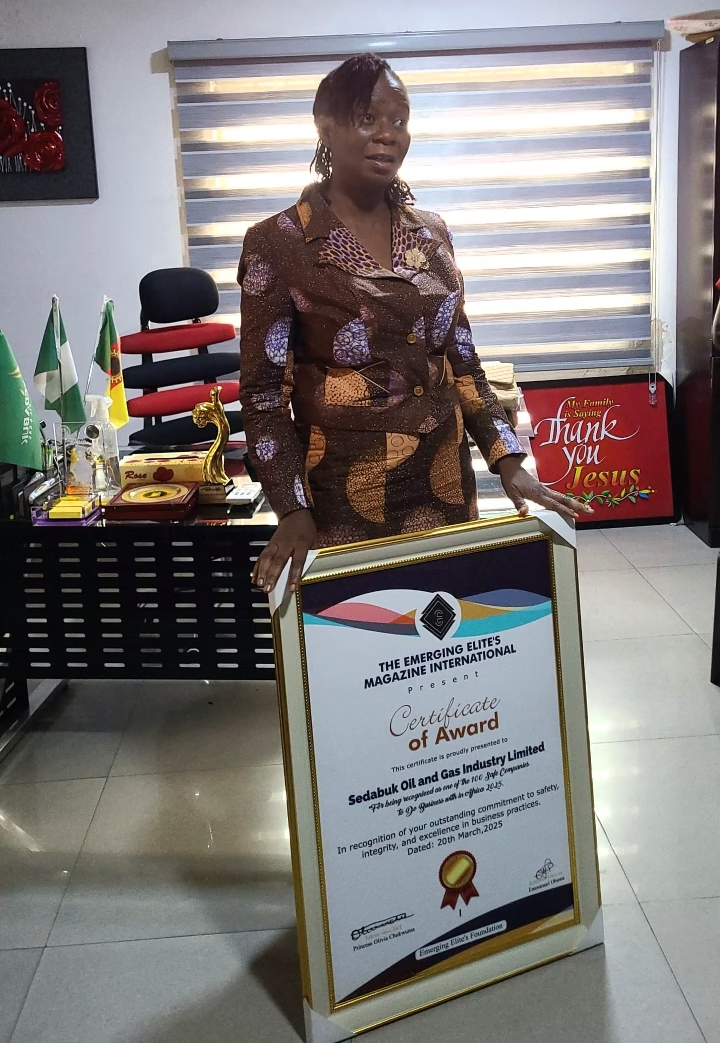
The MD of Sedabuk Oil and Gas Industry Limited, Engr. Adunola Oseni, poses with the Certificate of Award shortly after the company was recognised among Africa’s 100 safest companies to do business with.
Chukwuma said Sedabuk was selected for its employee-centric culture, stressing that the company has no record of unpaid salaries since inception, maintains fair wages, and prioritises staff welfare through initiatives such as its “One Nutritional Meal a Day” programme, which she described as “rare and commendable” in Nigeria’s oil and gas sector.
She also cited the firm’s zero-tolerance policy for fraud, recalling a June 2022 incident in which a pump attendant was sanctioned for under-dispensing fuel while affected customers were compensated, an action she said “clearly reflects Sedabuk’s philosophy of integrity in service delivery.”
Other factors that earned the company the award, she said, include its reputation for honouring contracts, absence of contract-related court cases, strict adherence to safety standards, and voluntary compliance with regulatory obligations, taxes, and statutory dues without coercion.
“With these attributes and more, Sedabuk Oil and Gas has become a beacon of hope—a new breed of Nigerian company that is trustworthy, valuable, and safe to do business with,” Chukwuma said, as she inducted the firm into the Hall of Fame of the 100 Businesses Safe to Do Business With in Africa 2025.

MD, Engr.Adunola Oseni and staff of Sedabuk Oil and Gas Industry Limited during the presentation of a Certificate of Award by The Emerging Elites Magazine International, honouring the company’s adherence to safety standards and best business practices.
Responding, the Managing Director, Engr. Adunola Oseni described the recognition as “a validation of our core values and a strong motivation to do more,” adding that the award belonged to the entire workforce of the company.
“We will continue to uphold integrity, safety, and transparency in all our operations, remain committed to staff welfare and regulatory compliance, and set standards that others in the industry can emulate,” the Sedabuk boss said.
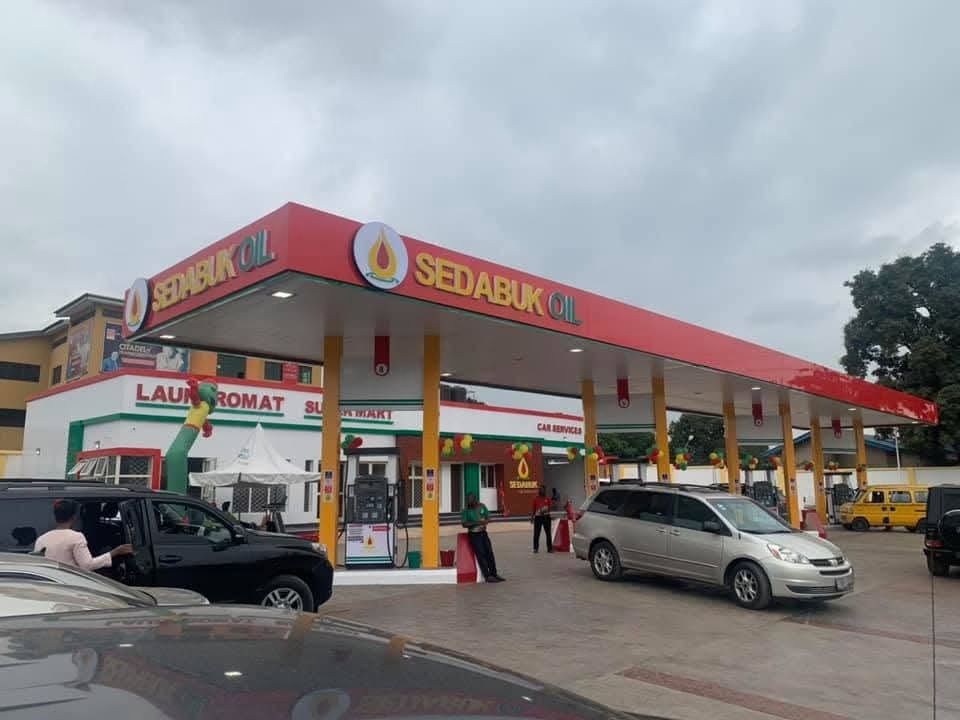
Sedabuk Oil and Gas Industry on Tuesday reinforced its reputation as a people-centred organisation as it rewarded outstanding employees with cash prizes totalling over ₦10 million at its 2025 Employee Recognition and Awards ceremony held in Lagos.
The event, which attracted over 300 staff members alongside top management officials from across the company’s divisions and subsidiaries, was organised to celebrate excellence, dedication, and loyalty within the Sedabuk workforce.
Speaking at the ceremony, the Managing Director, Engr. Adunola Oseni, described the occasion as one of the proudest moments in the company’s journey, noting that Sedabuk’s steady growth has been deliberately anchored on staff welfare and well-being. She said the company, from inception, made a firm commitment to put its people first, stressing that no organisation can truly thrive if its workforce is neglected.
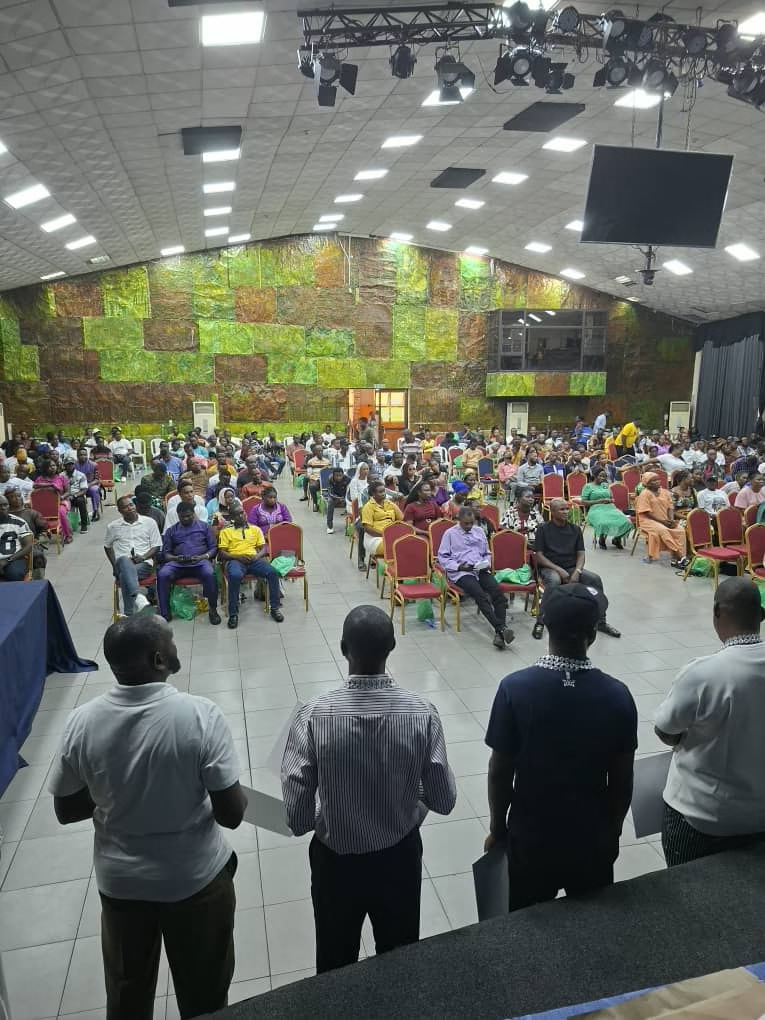
Oseni disclosed that Sedabuk has never owed or delayed salaries since it commenced operations, describing prompt payment as a mark of respect and responsibility. She added that the company reviewed and increased salaries twice in 2025, improved wages across the board, and sustained its seven-year-old One-Day-Meal Programme to ensure employees do not work hungry.
The managing director announced cash awards spanning retail operations, station-based roles, marts, laundromats, and group-wide excellence categories, explaining that the initiative was not just about financial rewards but about recognising hard work and reinforcing a culture of appreciation. According to her, a loyal and motivated workforce remains the company’s most valuable asset.
She assured staff that management is entering 2026 with stronger welfare policies, better incentives, and more opportunities, with the aim of positioning Sedabuk as one of the best organisations to work in Nigeria. Oseni further urged employees to raise the bar in the coming year by working harder, smarter, and together.
Several employees emerged winners across key categories, including Pump Attendant of the Year, Station Captain of the Year, Mart and Laundromat Excellence Awards, and Special Recognition honours.
The highlight of the ceremony was the Group Chairman’s Spirit of Excellence Award, where Adediran Segun Aderonke emerged Sedabuk Star of the Year with a ₦2 million prize, while Ibiloye Olayinka won the Most Outstanding Employee of the Year award with ₦1 million.
In his remarks, the Group Head, Human Resources and Administration, Mr. Adeleye Olusanjo, lauded the managing director for her consistent leadership and unwavering commitment to staff welfare, assuring employees that more incentives and improved support structures are already being planned for 2026.
The event was attended by senior executives, including the General Manager, Finance and Strategy, Mr. Aderoju Sola; the Group Head, Operations and Logistics, Mr. Rufus Enioshunwa; and the Group Head, Corporate Audit, Risks and Ethics, Mrs. Tolulope Omotola, among others.
Established in 2018, Sedabuk Oil & Gas Industry Ltd operates over 12 petrol stations across Lagos, Ogun, and Oyo states.
The Securities and Exchange Commission (SEC) has raised a red flag over two cryptocurrency products — Zugacoin and Samzuga GPT — warning the Nigerian public to steer clear of them.
In a strongly worded statement issued on Wednesday, the apex capital market regulator described the digital assets as unauthorised crypto schemes with no legal backing or regulatory approval in Nigeria.
According to the Commission, neither the promoters nor issuers of Zugacoin and Samzuga GPT are registered to operate in any capacity within the Nigerian capital market.
“Preliminary investigations revealed that Zugacoin and Samzuga GPT are meme coins,” the SEC said. “Meme coins generally have no use case, intrinsic value, or tangible projects backing them.”
The regulator added that the only perceived value of such coins often stems from aggressive promotion by their creators or community hype, making them prime candidates for “pump-and-dump” fraud — a deceptive scheme where promoters artificially inflate the price of a coin through misleading information before dumping it at peak value, leaving unsuspecting investors with massive losses.
“Once the promoters dump their coins and stop hyping the coin, the coin price typically falls and investors lose money,” the SEC warned.
The Commission urged members of the public to avoid engaging in the purchase or promotion of Zugacoin, Samzuga GPT, or any similar crypto assets, noting that anyone who chooses to invest in such schemes does so entirely at their own risk.
To further safeguard investors, the SEC advised the public to always verify the legitimacy of any virtual, crypto, or digital assets and their promoters through its official platforms:
https://home.sec.gov.ng/fintech-and-innovation-hub-finport/registered-fintech-operators/
www.sec.gov.ng/cmos
This warning is the latest in the SEC’s ongoing crackdown on fraudulent digital asset operations targeting unsuspecting Nigerians amid a rise in crypto-related scams.





-

 Politics3 days ago
Ibarapa East Assembly Hopeful, Ramon Congratulates Ajiboye, Says Emergence Good for Oyo APC
-
 Politics7 days ago
Makinde: My Successor Must Be Loyal to Oyo, Not Me
-
 Politics3 days ago
2027: Former Oyo Deputy Governor Adeyemo Emerges APC Chairman (See Full List)
-
 Politics7 days ago
Fintiri Dumps PDP for APC, Moves with Cabinet, 14 Adamawa Lawmakers