News
Israel-Palestinian conflict escalates as rockets fly, street violence flares

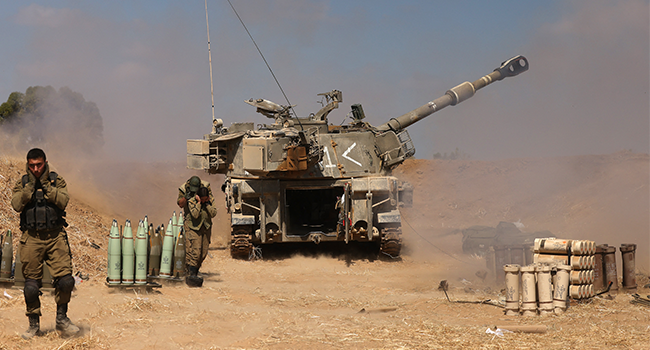
Israel faced an escalating conflict on two fronts Thursday, scrambling to quell riots between Arabs and Jews on its own streets after days of exchanging deadly fire with Palestinian militants in Gaza.
Despite diplomatic efforts to halt the violence, which US President Joe Biden said he hoped would end “sooner than later”, hundreds of rockets tore through the skies over the Gaza Strip overnight.
Israel’s civil aviation authority said it had diverted all incoming passenger flights headed for Tel Aviv’s Ben Gurion airport to Ramon airport in the south, due to the rocket fire.
Air raid warnings went off across Israel, including in the country’s north for the first time in years — which the army later said was a “false alarm”.
Israel’s air force launched multiple strikes, targeting what it described as locations linked to the “counterintelligence infrastructure” of Hamas, the Islamist group that controls Gaza, as well as the house of Iyad Tayeb, one of the movement’s commanders.
In Gaza, 67 people have been killed so far — including 17 children — and nearly 400 wounded in days of near relentless Israeli air strikes.
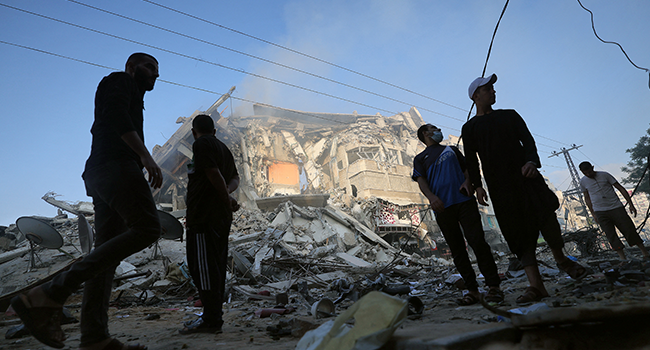
Palestinian men stand amidst debris near the al-Sharouk tower, which housed the bureau of the Al-Aqsa television channel in the Hamas-controlled Gaza Strip, after it was destroyed by an Israeli air strike, in Gaza City, on May 13, 2021. MOHAMMED ABED / AFP
On Wednesday, Hamas announced the death of its military chief in Gaza City, Bassem Issa, with the Israeli military saying it had killed three other senior figures as well.
Israeli strikes also destroyed a tower block housing Palestinian television channel Al-Aqsa, set up by Hamas.
Israel said Palestinian militants had launched around 1,600 rockets into its territory since Monday evening.
Seven people have been killed, including one six-year-old after a rocket struck the family home in southern Israel, the United Hatzalah volunteer rescue service said.
The past few days have seen the most intense hostilities in seven years between Israel and Gaza’s armed groups, triggered by weekend unrest at Jerusalem’s Al-Aqsa mosque compound, which is sacred to both Muslims and Jews.
‘Pogrom’
Coinciding with the aerial bombardments is surging violence between Arabs and Jews inside Israel.
On Wednesday night, Israeli far-right groups took to the streets across the country, clashing with security forces and Arab Israelis.
Police said they had responded to violent incidents in multiple towns, including Lod, Acre and Haifa, confirming 374 arrests shortly past midnight.
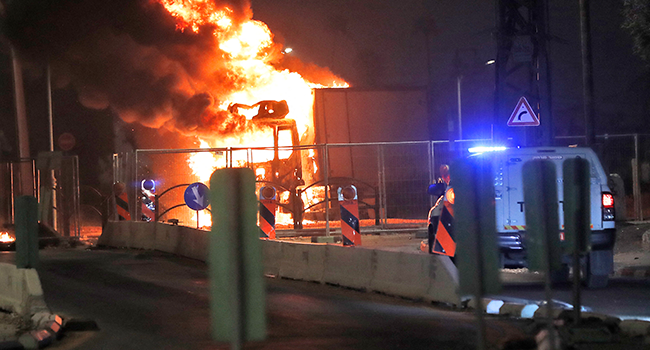
A truck burns at the entrance of the mixed Jewish-Arab city of Lod, where a state of emergency has been declared following civil unrest, on May 12, 2021. Ahmad GHARABLI / AFP
Israeli television aired footage of a far-right mob beating a man they considered an Arab until he lay unconscious on his back in a street in Bat Yam, near Tel Aviv.
“The victim of the lynching is seriously injured but stable,” Tel Aviv’s Ichilov Hospital said, without identifying him.
A state of emergency has been declared in the mixed Jewish-Arab city of Lod, where a synagogue and other Jewish property has been torched and an Arab resident was shot dead.
Israeli President Reuven Rivlin, in unusually strong language, denounced what he described as a “pogrom” in which “an incited and bloodthirsty Arab mob” had injured people and attacked sacred Jewish spaces.
In the occupied West Bank, a Palestinian man was killed during a confrontation with Israeli soldiers near the northern city of Nablus, the Palestinian health ministry said Thursday.
The death brings the number killed in clashes between Palestinians and Israeli forces in the West Bank to three on Wednesday alone.
“What has been happening these last few days in Israeli towns is unacceptable… Nothing justifies the lynching of Arabs by Jews and nothing justifies the lynching of Jews by Arabs,” Prime Minister Benjamin Netanyahu said, adding that Israel was fighting a battle “on two fronts”.
Stalled diplomacy
The UN Security Council has already held two closed-door videoconferences since Monday, with the United States — a close Israel ally — opposing adoption of a joint declaration, which it said would not “help de-escalate” the situation.
Netanyahu spoke later Wednesday with Biden, who said: “Israel has a right to defend itself”.
US Secretary of State Antony Blinken said he had spoken to Palestinian president Mahmud Abbas, urging an end to the rocket attacks.
Blinken had said earlier that a US envoy would travel to the Middle East to seek to calm tensions.
But the Israeli government has warned that “this is only the beginning”, and military spokesman Jonathan Conricus said strikes on Gaza would continue as Israel prepares for “multiple scenarios”.
“We have ground units that are prepared and are in various stages of preparing ground operations,” he told reporters Thursday.
Hamas leader Ismail Haniyeh has also threatened to step up attacks, warning that “if Israel wants to escalate, we are ready for it”.
The crisis flared last Friday when weeks of tensions boiled over and Israeli riot police clashed with crowds of Palestinians at Jerusalem’s Al-Aqsa mosque compound.
Nightly disturbances have since gripped Israeli-annexed east Jerusalem, leaving more than 900 Palestinians injured, according to the Palestinian Red Crescent.
The unrest has been driven by anger over the looming evictions of Palestinian families from the Sheikh Jarrah neighbourhood of east Jerusalem.


Traditional rites, medical outreach, sporting events and youth competitions feature in weeklong celebration
AGO-IWOYE came alive with cultural displays, sporting activities and community development initiatives as indigenes and residents gathered for the 2026 Ago-Iwoye Day celebration.
The weeklong programme, which began on Monday, October 5, brought together indigenes from across Nigeria and the diaspora to celebrate the town’s cultural heritage and promote unity and grassroots development.
The celebration opened with the traditional Woro Plucking Programme at Ojuade Olooto at 7am on Monday. This was followed by intellectual and strategy games at the Ebumawe Palace, where participants competed in chess, draughts, Scrabble and Ayo Olopon.
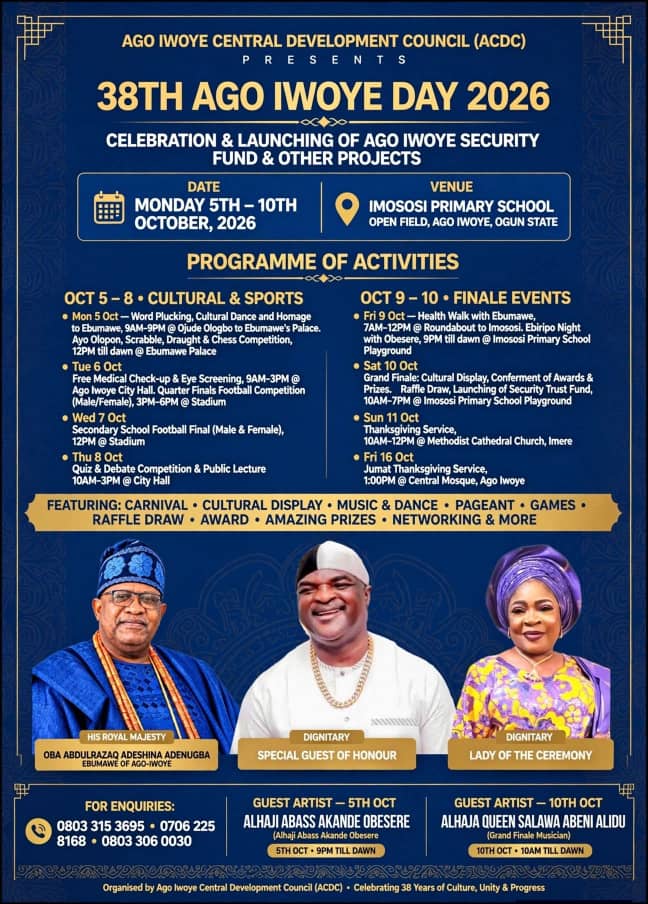
Health and sports featured prominently on Tuesday, October 6, as residents took part in a medical check-up and eye screening exercise at the Ago-Iwoye City Hall.
At the Ago-Iwoye Stadium, sports enthusiasts watched the table tennis finals and the final of the Quarters Football Competition.
The activities continued on Wednesday, October 7, with the finals of the secondary school football competition for male and female categories at the stadium.
Students returned to the spotlight on Thursday, October 8, for a quiz and debate competition at the City Hall. The academic activities were complemented by a public lecture on sustainable community development and youth empowerment.
On Friday, October 9, the Ebumawe of Ago-Iwoye led a health walk from the Omoedumare Roundabout at 7am, drawing residents into another activity designed to promote healthy living and community participation.
The day ended with Ebiripo Night at the Imososi Primary School Field, where music, dance and folklore accompanied celebrations around the town’s popular local delicacy.
The grand finale is scheduled for today, Saturday, October 10, at the Imososi Primary School Field, with traditional performances, civic honours and fundraising activities on the programme.
A thanksgiving service at the Methodist Cathedral, Imere, Ago-Iwoye, is expected to bring the celebration to a close on Sunday, October 11.
Speaking on the significance of the event, the Secretary of the Planning Committee, Dr Samuel O. Awobona, said the turnout demonstrated the commitment of indigenes and residents to preserving the town’s identity and advancing its development.
He said, “This weeklong celebration underscores our collective resolve to preserve our identity while driving grassroots development. The massive turnout across all generations reflects the enduring spirit of Ago-Iwoye.”
The annual celebration provides an opportunity for the community to showcase its traditions while bringing residents, young people and indigenes in the diaspora together around shared cultural and developmental goals.


2027: Oseni Support Islamic Group’s Building Project With N10m, Urges Voters to Prioritise Competence Over Religion

Oyo 2027: Alli’s campaign accuses Adekanmbi’s APM supporters of vandalising APC billboards

DIPHTHERIA OUTBREAK: ALLI QUERIES ₦9.9BN IMPACT FUNDS AS OYO LAGS IN CHILD VACCINATION



-
 Politics3 weeks ago
APM Rally: APC Tackles Makinde Over Use of ‘CAF-Rejected’ ₦5.5bn Stadium
-
News4 weeks ago
OYO 2027: ‘Fact-Check Always’ – Oseni’s Aide Replies Ex-AGF , Ojo Over Alli’s Campaign Billboard Claims
-
Politics3 weeks ago
Oyo: No APC Defection To APM, Makinde Lied — APM Scribe
-
Crime & Court4 weeks ago
Oyo school abduction: DSS to re-arraign five suspects Thursday