NIGERIA has witnessed a number of political crisis since independence, such as the Action Group crisis of 1962, the census crisis of 1962/63, the civil war of 1966-1970, the Federal election crisis of 1964/1965 amongst others.
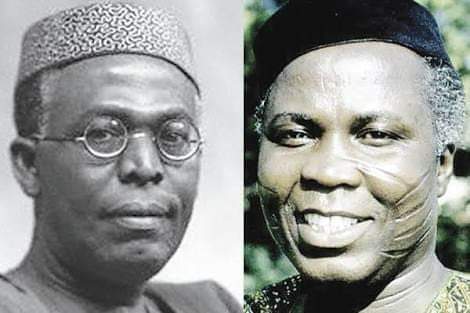
In 1945, a group of Nigerian Students who were by the time studying in Britain came together to form a Yoruba socio- cultural group named ‘Egbe Omo Oduduwa’. However, in 1951, led by Chief Obafemi Awolowo, the party was formed and Christened ‘Action Group’, AG. Other members of the party were Chief Samuel Ladoke Akintola, Chief Sonibare, Sir Adesoji Aderemi and Chief Bode Thomas. It is believed that the Egbe Omo Oduduwa metamorphosed into the Action Group.
Chief Awolowo later became the Premier of the Western Region on the platform of the party until 1955 when he moved to the central to become the official opposition leader of the parliament. The main objectives of the Action Group Party, AG were among others to bring and organize within its fold, all nationalists in the Western Region, so that they may work together as a united party, and submit themselves to party loyalty and discipline. Also, to prepare and present to the public programs for all departments of government, and to strive faithfully to ensure the effectuation of such programs through those of its members that are elected into the Western House of Assembly and Federal Legislature.
The Action Group which was the party in government in the Western Region was plunged into serious crisis early in 1962 over a number of irreconcilable differences between the leader of the party, Chief Obafemi Awolowo and his deputy, Chief Samuel Ladoke Akintola who by then was the Premier of the region after Awolowo had assumed the position of the leader of the opposition at the federal level. Unfortunately, in 1959, Awolowo failed in the federal election and his ambition to become the prime minister was frustrated . While he was still nursing this anger, the prime minister, Abubakar Tafawa Balewa requested him to form government of national unity which he turned down.
The reluctance of Chief Awolowo to support his deputy, Akintola as the Premier of Western Region when he was made the leader of opposition in the Federal House of Representatives in Lagos, also ignited the crisis as the newly appointed Premier, took independent decisions without consulting his leader who was then at the center as leader of opposition. Akintola and some others supported the move to join the ruling Northern People’s Congress, NPC, to form a government of national unity which did not go down well with Chief Awolowo.
Another circumstance that threatened the existence of the then Action Group, (AG) was the adoption of Democratic socialism as its ideology which was also not well received by the premier of western region, Akintola.
It is interesting to note that intra-party disagreement and mutual suspicious were the remote causes of this crisis. The intolerance within the rank and file of the leaders that later spread to other members of the party. The accusation and counter accusation of the leaders clearly revealed a deep seated hatred they had for each other.
In a related development, the Action Group’s leader, Awolowo had allegedly instructed the Premier of the Western Region, Akintola to refer important matters to him before any action was taken. This was considered to be an undue interference in the office of the Premier. Similarly, Awolowo had earlier suggested a nation-wide political campaign to create sufficient awareness for the electoral preparatory to the Federal Elections of 1964, but turned down by his deputy, Akintola who wanted the campaign to be restricted to Western Region alone. This increased the suspicion between the two leaders and Chief Awolowo believed that his deputy wanted to overthrow him as the leader of the party.
The ideological disparity between the two leaders could be likened to the event of Cold War when the United States of America led the West, and the East controlled by the Union of Soviet Socialist Republic, this was indeed a great challenge which Awolowo and Akintola failed to resolve.
However, the crisis brew open at the party’s Annual National Congress held on 2nd February, 1962 in Jos, when the Premier of the Western Region, Akintola and a few of his ministers failed to attend. The party broke into two factions, Chief Akintola and others having charged with anti party activities was advised to resign which he refused to and was consequently sacked by the Governor of the Region, Oba Adesoji Aderemi and replaced by Alhaji Dauda Adegbenro as the new Premier. Chief Akintola did not stop there, he went to court to challenge his removal as the Premier of Western Region.
When the newly appointed Premier convened the meeting of the House of Assembly, fracas broke out and the mace, a symbol of authority was destroyed. Thereafter, the police was called to maintain order and lock up the House of Assembly. Violence ensued between the two factions (Awolowo and Akintola’s loyalists) and there was widespread killings and burning of houses. The federal government, for the first time in the history of the provisions of the constitution invoked the emergency powers and declared a state of emergency in the Western Region. By the time the state of emergency was lifted after six months, Chief Awolowo, other Action Group leaders and their aides were jailed for treason.
After the collapse of Action Group, AG, Chief Akintola later formed the Nigerian National Democratic Party, NNDP. It should be noted that the crisis weakened the power of the opposition in the House of Representatives and made mockery of the parliamentary system of government. This portends that our political leaders cannot tolerate the opposing views of their colleagues. This crisis led to series of events and subsequently in the country before the military took over in 1966.