Connect with us

News

Dangote to Launch 25,000 Hectares of Rice Outgrower Scheme.

Published

on

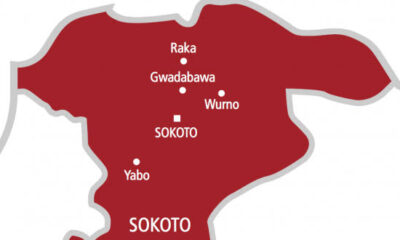
DANGOTE Rice, a subsidiary of Dangote Group is set to launch in Sokoto state it’s multi-million naira 25,000 hectares of rice outgrower scheme with a view to providing hundreds of thousands of employment opportunities for the rural communities inhabitants.

The group’s President , Aliko Dangote made this known at the weekend that the Company will on Wednesday, flag off with a pilot project of 500 ha by Gonroyo dam, which is the second largest in the country, after Kainji situated in Goronyo community.

The flag off ceremony to be performed by the governor of the state, Alhaji Aminu Tambuwa will witness seedlings being distributed to the primary local farmers who will in turn plant the seed after which Dangote Rice company will purchase from them for milling and final processing.

Sokoto state is the second after Jigawa out of the 14 states spread across the state where Dangote Rice plans to operate outgrower scheme to empower local farmers and create job opportunities for community dwellers and reduce migration to the cities.

Dangote Rice projects in the 14 states, when, operational, will generate a significant number of jobs and increase take-home income for smallholder farmers, all while diversifying Nigeria’s economy and reducing the nation’s food import bill.

Statistics from the Federal Ministry of Agriculture and Rural Development (FMARD) estimates that rice demand in Nigeria reached 6.3 million MT in 2015, with only 2.3 million MT of that demand satisfied by local production.

This local production shortfall leaves a gap of 4.0 million MT that is currently being filled through formal importation of rice or illegal imports over land borders.

By year-end 2017, Dangote Rice plans to produce 225,000 MT of parboiled, milled white rice. This will allow us to satisfy 4% of the total market demand within 1 year. Our model can then be successfully scaled to produce 1,000,000 MT of milled rice in order to satisfy 16% of the domestic market demand for rice over the next 5 years.

Due to the current economic crisis, domestic prices for agro-commodities have risen dramatically over the last 12 months, making local agriculture an attractive investment

Due to the current economic crisis, domestic prices for agro-commodities have risen dramatically over the last 12 months, making local agriculture an attractive investment. Dangote Rice Limited  seeks to take advantage of this economic trend and the favourable policies laid out in the FMARD’s Agricultural Transformation Agenda.

Dangote Rice has a mandate to locally high-quality milled, parboiled rice for the Nigeria market. This goal will be achieved by sourcing the raw material (paddy) required from the Dangote Rice Outgrower Scheme.

Through the Dangote Rice Outgrower Scheme, DRL will partner with outgrowers (smallholder and contract rice farmers) to cultivate and grow rice paddy. Specifically, DRL will provide inputs, technical assistance, extension services and land preparation services and equipment directly to farmers. At harvest, DRL will recoup the costs of inputs and services in-kind and will act as a guaranteed offtaker for paddy that meets certain pre-agreed quality standards. Smallholder farmers will provide land and labour.

The centralized outgrower model enables a high level of control over product quality and quantity. The purchasing price given to farmers will reflect each season’s market price and will be set after an extensive market price survey and consultation with all stakeholders.

In the short-term, Dangote Rice will be responsible for importing all of the inputs needed for cultivation and making them available to the outgrowers.

By end of 2017, Dangote Rice will have 25,000 Ha under rice cultivation across 3 sites in Northern Nigeria having identified rice-growing communities in Jigawa State (5,000 Ha), Sokoto State (10,000 Ha) and Zamfara State (10,000 Ha).

The 25,000 Ha will be farmed by nearly 50,000 outgrowers in the selected site areas. These outgrowers are already organized into cooperative associations. We will engage with these organizations to register and sign contracts with each farmer.

In addition to the outgrowers, an additional ~260 jobs will be created by year-end 2017. These individuals will serve as agronomists, credit officers and staff of the mill.

Upon harvest, Dangote Rice will offtake rice paddy and transport the paddy to be processed. One centralized mill will mill the stored paddy rice from all 3 sites.

Dangote Rice plans to produce one million MT of rice from 150,000 Ha in the next 5 years over. They intend to accomplish this by scaling the business model described above to more sites and rice growing communities. These communities have been identified and relationship building and sensitization has already begun. In addition to scaling the above model, DRL will establish and manage a high-quality seed development farm at Numan in Adamawa to reduce the costs of seeds.

Dangote Rice will establish raw material reception, drying, hulling, parboiling units and silos in strategic areas throughout the country near our additional outgrower communities. Each site will store dried, hulled, parboiled bran rice. DRL will then transport this bran rice to a mill, where finished rice will be produced.

Comments

News

Oseni mourns ex-Oyo lawmaker Akeem ‘Able’, says Oyo APC has lost loyal progressive

Published

on

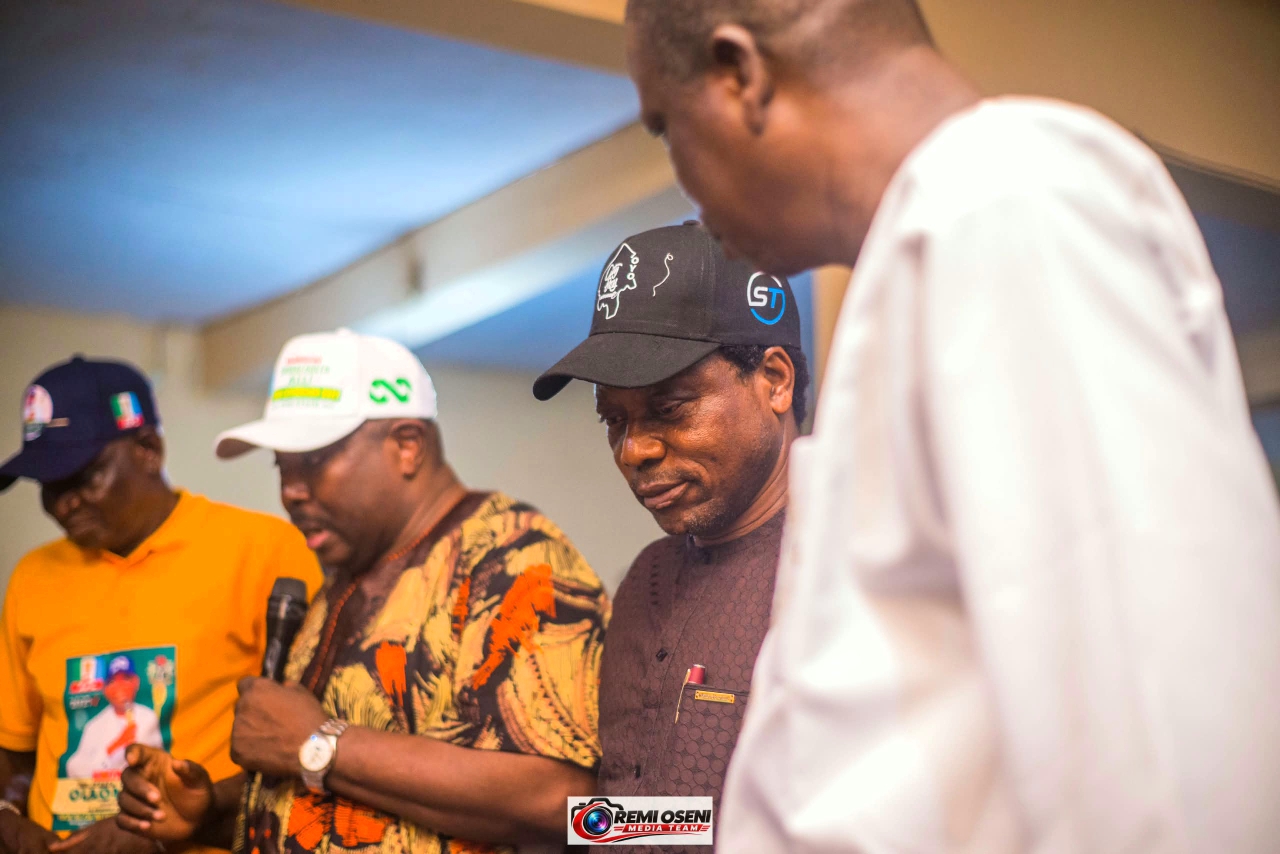
The lawmaker representing Ibarapa East/Ido Federal Constituency in the House of Representatives, Engr. Aderemi Oseni, has mourned the death of a chieftain of the All Progressives Congress (APC) in Oyo State and former member of the Oyo State House of Assembly, Hon. Akeem Abimbola Oladipupo, popularly known as Able, describing his demise as a painful loss to the progressive family.

Oladipupo, who represented Ibadan North-West Constituency in the Oyo State House of Assembly, was widely regarded as a grassroots politician and committed party loyalist until his passing.

Oseni, who is also the Chairman, House Committee on Federal Roads Maintenance Agency and the APC candidate for Oyo South Senatorial District, said the late politician’s death had created a vacuum within the party and among those who benefitted from his unwavering commitment to public service.

In a condolence statement issued on Monday by his Media Aide, Idowu Ayodele, and made available to journalists in Ibadan, the Oyo State capital, the federal lawmaker described the late Oladipupo as a dependable progressive, humble political actor and loyal party stalwart whose impact would remain indelible.

He said the deceased dedicated his life to serving humanity, strengthening the progressive movement and supporting the aspirations of many at the grassroots.

Oseni said, “The death of Hon. Akeem Abimbola Oladipupo (Able) came to me as a rude shock. Oyo State and the progressive family have indeed lost a committed, loyal and selfless leader whose passion for service, humility and dedication to the people stood him out.

“He was not just a politician but a bridge-builder, a dependable ally and a grassroots mobiliser who believed strongly in the ideals of our great party. His contributions to the growth of the APC in Oyo State and his service to humanity will remain unforgettable.”

The APC senatorial candidate noted that the late former lawmaker remained steadfast in promoting peace, unity and political development, adding that his simplicity and accessibility endeared him to many across political divides.

According to Oseni, the late politician’s legacy of service and sacrifice would continue to inspire younger politicians and party faithful.

He, however, urged members of the APC, associates and family members of the deceased to take solace in the remarkable life he lived and the positive impact he made during his lifetime.

Oseni also prayed for the repose of the deceased’s soul and for God to grant his family the fortitude to bear the painful loss.

Continue Reading

News

Governors Push N100,000 Minimum Wage to Ease Workers’ Economic Burden

Published

on

State governors have proposed a new national minimum wage of N100,000 for Nigerian workers as part of efforts to cushion them from the biting effects of inflation and the rising cost of living.

Governor AbdulRahman AbdulRazaq of Kwara State, who is also the Chairman of the Nigeria Governors’ Forum (NGF), disclosed the proposal on Saturday in a post by the state government’s official Facebook page. He said the move aims to improve workers’ welfare while ensuring that government finances remain sustainable.

“State governments recognise the urgent need to improve workers’ welfare in response to the current economic realities facing Nigerians,” AbdulRazaq said.

“We are actively engaging with the Federal Government and organised labour to arrive at a wage structure that is fair to workers and sustainable for government finances.”

The NGF chairman explained that ongoing discussions are focused on balancing the need to boost workers’ purchasing power with the capacity of governments to deliver essential public services and development projects.

“The goal is to improve the living conditions of workers while ensuring that states can continue to meet their obligations and sustain projects that directly impact citizens,” he added.

The proposed N100,000 minimum wage is expected to intensify national debates on salaries, inflation, and broader economic reforms as Nigerians continue to contend with rising food prices, transportation costs, and other living expenses.

Currently, Nigeria’s statutory minimum wage stands at N70,000 per month. Some states, including Lagos, Rivers, and Imo, are already paying above the national benchmark to support workers amid the country’s economic challenges.

Meanwhile, the Nigeria Labour Congress (NLC) has continued to call for a comprehensive review of salaries, insisting that workers deserve a living wage that reflects present-day economic realities rather than merely guaranteeing survival.

Continue Reading

News

Petrol hits N1,533/litre as cooking gas prices jump nationwide

Published

on

The average retail price paid by consumers for Premium Motor Spirit, popularly known as petrol, rose to N1,532.93 per litre in April 2026, representing a 23.69 per cent increase compared to the N1,239.33 recorded in the corresponding period of 2025, findings by the National Bureau of Statistics (NBS) have shown.

The sharp rise in petrol prices came amid mounting inflationary pressure and worsening living costs, with Nigerians grappling with soaring transportation and food expenses that have continued to shrink household purchasing power.

The NBS disclosed this in its Premium Motor Spirit (Petrol) Price Watch for April 2026, released on Friday.

The report further showed that on a month-on-month basis, petrol prices rose by 18.97 per cent from N1,288.54 recorded in March 2026, underscoring persistent volatility in the downstream petroleum market.

A breakdown of prices across states revealed that Yobe recorded the highest average retail price for petrol at N1,599.05 per litre during the review period.

Edo and Bauchi followed closely with average prices of N1,595.74 and N1,589.07, respectively.

However, Niger residents paid the least for petrol at an average of N1,403.89 per litre, while Sokoto and Katsina recorded N1,404.16 and N1,406.28 respectively.

At the zonal level, the South-South recorded the highest average retail price at N1,566.76 per litre, while the North-West posted the lowest at N1,508.81.

The latest petrol price increase comes as millions of Nigerians continue to battle the ripple effects of rising inflation, with higher energy costs worsening transportation fares and the prices of essential commodities.

Similarly, the NBS said the average retail price for refilling a 5kg cylinder of Liquefied Petroleum Gas, also known as cooking gas, rose by 13.73 per cent month-on-month to N8,706.93 in April 2026 from N7,655.73 recorded in March.
On a year-on-year basis, the price increased by 10.42 per cent from N7,885.60 recorded in April 2025.

Lagos recorded the highest average price for refilling a 5kg cylinder at N9,745.10, followed by Nasarawa at N9,451.70 and Bayelsa at N9,422.74.

In contrast, Anambra recorded the lowest average price at N7,204.76, while Ondo and Ogun followed with N7,239.49 and N7,825.75, respectively.

At the regional level, the North-West recorded the highest average retail price for refilling a 5kg cylinder at N9,025.07, followed by the North-East at N8,847.16, while the South-East posted the lowest average price at N8,224.37.

Also, the average retail price for refilling a 12.5kg cylinder of cooking gas increased by 13.89 per cent month-on-month to N22,382.20 in April 2026 from N19,652.83 in March.

Compared to April 2025, the price rose by 10.43 per cent from N20,268.06.

According to the NBS LPG Price Watch for April, Katsina recorded the highest average retail price for refilling a 12.5kg cylinder at N25,596.71, followed by Kogi at N24,558.25 and Gombe at N24,438.97.

Ogun recorded the lowest average price at N19,564.36, while Bauchi and Anambra followed at N20,178.87 and N20,511.90 respectively.

The North-West recorded the highest zonal average retail price for refilling a 12.5kg cylinder at N23,276.95, followed by the North-Central at N22,865.29, while the South-East posted the lowest average at N21,060.92.

The latest figures signal growing pressure on household energy costs, raising concerns over the implications for inflation and the cost of living in the coming months.

Continue Reading

Advertisement

Entertainment

Advertisement

MegaIcon Magazine Facebook Page

Advertisement

MEGAICON TV

Advertisement

Trending