
Business
Bottlenecks worsen vehicles clearance, ease of business

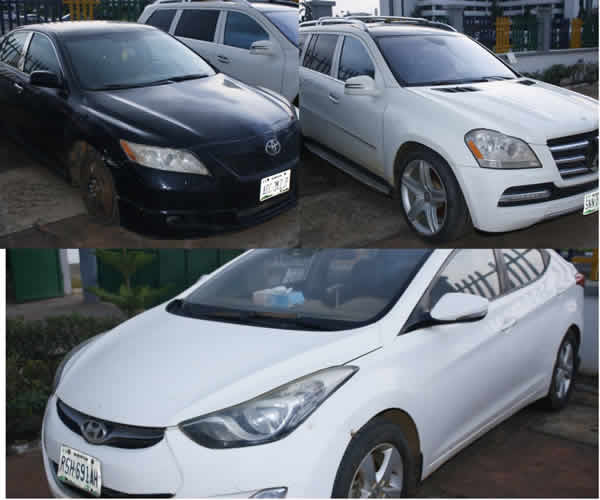

Lagos fixes bottleneck at NNPC junction, Ejigbo, Lagos …yesterday.
• Hundreds of dealers, and agents to be thrown out of business
• Used cars from China, and Europe not captured on the VIN system
• Dealers fear only Nigerian-used vehicles will be on market soon
• Lexus, and Mercedes-Benz are not included in the new valuation system
• Importers abandon older cars due to unreasonable duties
Hiccups in the vehicle valuation system of Nigeria Customs Service (NCS) may hamper the importation of used cars just as thousands of dealers and agents are on the verge of losing their livelihoods, investigations by The Guardian have revealed.
It was learnt that the controversial electronic Vehicle Identity Number (VIN) valuation system, despite having undergone review, is being sabotaged, causing pain to importers who face hurdles in the process of clearing their vehicles.
As the challenges linger, many importers have been forced to abandon their vehicles at the terminals, accumulating demurrages – a situation that has increased the costs of vehicle clearing and purchase.
Recall that the Customs service introduced the VIN Valuation policy in January 2022 to aid trade facilitation and enhance the cargo delivery process. The platform was intended to reduce human intervention and make clearing more seamless.
This was greeted with controversy as agents protested outrageous increases in tariffs due to inaccurate data and the valuation process.
Subsequently, NCS suspended its implementation to review the complaints, triggering a backlog of vehicles awaiting clearing and extreme port congestion.
Two months after the policy was re-introduced, the old complaints remained. Customs had disclosed that the valuation template has been designed with the base model (2013) being used for the new pricing.
Findings revealed that the reviewed VIN valuation policy is discriminatory, as it only works with standard chassis vehicles, while it excludes the non-standard chassis (damaged) vehicles.
It was also learnt that for a 2007 or 2009 vehicle under the non-standard chassis vehicles, the duties are different and not uniform.
Still, vehicles from Europe and Asia have not been captured in the new valuation system, forcing importers to do under-table dealing with clearing officials, compelling them to pay more than required.
Apart from vehicles from Europe and Asia, Mercedes Benz (ML and X-Class), Lexus and Range Rover are excluded from the valuation.
The National Publicity Secretary of the Association of Registered Freight Forwarders of Nigeria, (ARFFN), Taiwo Fatomilola, told The Guardian, “only American vehicles are computed in the VIN valuation platform, although Mercedes Benz and other high-powered vehicles like Lexus, Range Rover are not on the VIN system.”
According to clearing agents, once they apply for duty on such vehicles on the VIN system, it gives an error outcome, which means they have to apply to the Customs Area Controller (CAC) of the command for value identification.
Sources said such applications are processed at discretionary costs with customs officials turning the process into a money-making venture.
To get the valuation done on time, agents and importers pay special fees for fast-track. Otherwise, their vehicles would be delayed unnecessarily while accumulating demurrages. The Guardian learnt that the least amount paid for fast-track is N10,000. Agents also disclosed that they are extorted when vehicles go through physical inspection.
“If you bring N2,000, you wait for three days, but when you bring N5,000, they will take it immediately. Your cash determines when the CAC is available to sign the documents, which will join other documents on the table waiting before the approval will be given. For the processes through the CAC office, it will take you not less than N5,000.
“If you want to go for valuation assessment, cars go for around N7,000 to N10,000, it depends on the value you are bringing forth. If you want a lesser value, you have to pay more than that,” Fatomilola said.
The abrupt reduction of the age limit of vehicles from 12 to nine years has also been blamed for the sudden rise in the cost of vehicle clearance. Older cars already brought into the country are being abandoned, worsening congestion at the port.
This has also reduced the importation of used cars, as findings revealed that many importers have had their money trapped in abandoned vehicles.
Recently, the House of Representatives Committee on Customs and Excise said that even though the VIN Valuation policy is aimed at improving revenue generation and fast-tracking the process of clearing imported goods at the nation’s ports, the workings are illegal.
The Chairman of the Committee, Leke Abejide, during a tour of customs formations in Lagos last week said the ‘Standard VIN and the non-standard VIN’ as being operated by the service is illegal and that the lawmakers might scrap the platform.
A freight forwarder, George Okafor, said the major hitch in the policy was the assessment of non-standard vehicles, whose data had not been inputted into the Customs portal, saying their duty rate is outrageous.
He said brands of vehicles like Mercedes Benz 2003 M model and BMW with 17 digits were yet to be inputted into the system, thereby, making their clearance a herculean task.
Okafor said, on the other hand, in vehicles with 17 digits, which data had been captured in Customs’ portal, there were no issues in their duty assessment.
“This high valuation of vehicles is a result of NCS trying to meet the target given it, also it is trying to plug the gap left by the 20 per cent duty drop.
“The value of Mercedes and Corolla are very outrageous, if you are on 846, they use the new template, from 2003 – 2013 the cost is about N2.8 million, as against the N390,000 – N400,000 and most owners now abandon these vehicles, even though consultations and meetings are ongoing to find a solution to this anomaly.
“A situation where the duty of common automobiles such as Golf, Toyota Corolla and Matrix has gone up from N500,000, to between N1 million to N1.3 million now, is unacceptable as it has made vehicles unaffordable for ordinary Nigerians,” he said.
The Public Relations Officer of Registered Freight Forwarders of Nigeria, Chinedun Ogoke, said the practice where vehicles of the same model, but manufactured in different countries are charged separately frightens importers. He said due to the e-valuation, a vehicle imported at N1 million attracts as much as N2 million to N2.5 million clearing fee.
“We have a situation where two different types of evaluations are used on the same type of vehicle and you find a situation where, for example, you import a vehicle of N1 million and you are supposed to clear it with N500,000. But because of valuation, you are now clearing the vehicle with N2.5 million.
“The age limit for vehicles to be imported into Nigeria is 15 years. But Customs are not allowing that 15 years. They are giving us 10 years and this is also affecting importation. Government needs to look into this,” he said.
The Secretary, Lagos State Motor Dealer Association, Olaniran Adelana, stressed that the introduction of evaluation policies and hike in duty is increasing the price of automobiles in the country coupled with the rise in the cost of spare parts.
He said to clear a Toyota, depending on the model and age, one spends up N1.3 million to N1.4 million, saying: “If you clear these vehicles at such high cost, the selling prices will increase.
“The Corolla we used to sell N1.6 million is now N2.7 million. Same with other vehicles. Everything has escalated. And since vehicles depreciate, dealers decide to sell and get their money and stop car business to go look for other businesses to invest in.”
He said many car dealers have begun to source locally-used cars in the country just to remain in business, instead of waiting for a vehicle bought from America, which takes about two to three months before it arrives and gets stuck at the nation’s seaport.
Acting President of the Association of Nigerian Licensed Customs Agents (ANLCA), Dr. Kayode Farinto, lamented that older vehicles have become more expensive in Nigeria because vehicles above 12 years old now pay about a million naira as Customs duty.
“VIN Valuation doesn’t have values for vehicle models older than 12 years and most 2008 and 2009 vehicles are largely used by Nigerian youths for Uber and other e-hailing services. The implication is that older vehicles will be more expensive in Nigeria. We want the government to review the 12-year policy on used vehicles to 15 years.
“There is also a need to review the levies on used vehicles. While we understand the government’s zeal to realise all possible earnings, it will be appropriate to reduce the levy on used vehicles from 15 per cent to five per cent in a bid to ameliorate the sufferings of Nigerians,” he stated.
Farinto also called on the Ministry of Finance to address the challenge of persistent breakdown in the operations of the National Vehicle Registry (VREG), at the seaports, which average 48 hours every week.
The ANLCA acting president noted that the VREG delays hinder the Vehicle Identification Number (VIN) Valuation system for cargo evacuation, leaving freight forwarders and their importers to suffer demurrage and additional storage charges as a result of the delays.
He warned that, if the system failures with VREG continue, ANLCA would be forced to collate the fiscal losses occasioned by the delays and institute a legal process to get compensation from the finance ministry and the technical partners responsible for VREG.


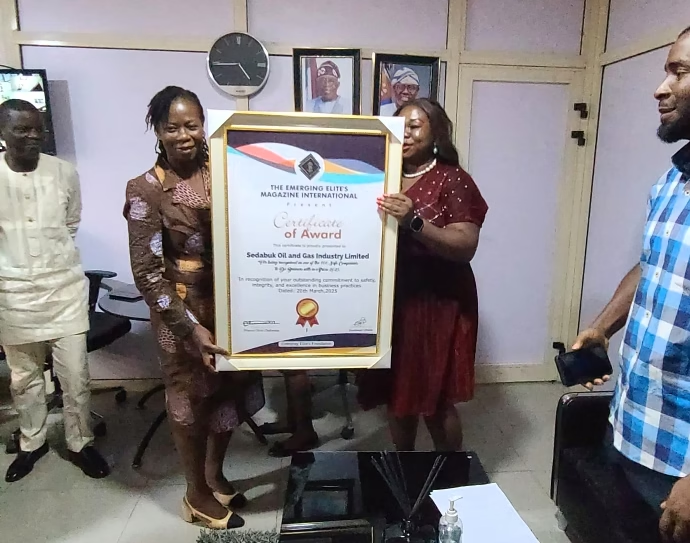
Sedabuk Oil and Gas Industry Limited has been listed among the 100 Safe Companies to Do Business With in Africa for 2025 by Emerging Elites Magazine International, in recognition of the firm’s integrity-driven operations, strict compliance culture, and employee-focused policies.
The award was presented to the Managing Director of the company, Engr. Adunola Oseni, at a ceremony attended by members of Sedabuk’s management and staff, alongside the editorial board and team of Emerging Elites Magazine in Lagos.
Presenting the award, the Editor-in-Chief of Emerging Elites Magazine International, Princess Olivia Chukwuma, said Sedabuk emerged after a “thorough, transparent and merit-based selection process” designed to identify African businesses that exemplify excellence and ethical conduct.
According to her, the 100 Safe Companies to Do Business With in Africa Award is an international initiative created to recognise indigenous African companies with proven records of integrity, safety, and best business practices, noting that awardees are continuously monitored and recertified every three years if standards are sustained.
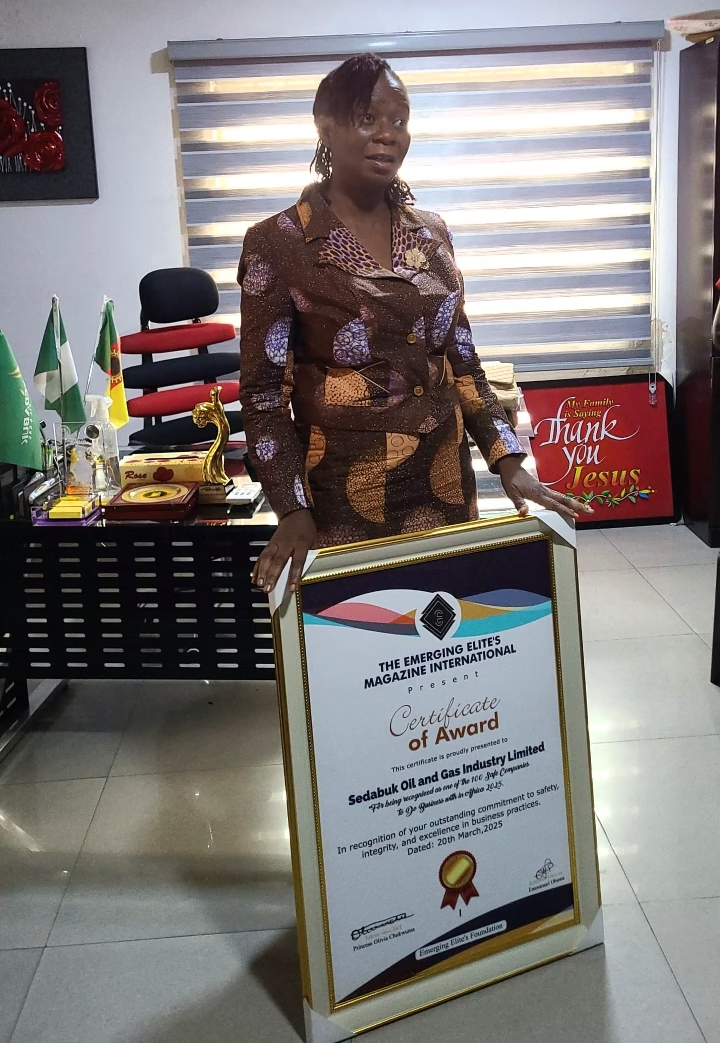
The MD of Sedabuk Oil and Gas Industry Limited, Engr. Adunola Oseni, poses with the Certificate of Award shortly after the company was recognised among Africa’s 100 safest companies to do business with.
Chukwuma said Sedabuk was selected for its employee-centric culture, stressing that the company has no record of unpaid salaries since inception, maintains fair wages, and prioritises staff welfare through initiatives such as its “One Nutritional Meal a Day” programme, which she described as “rare and commendable” in Nigeria’s oil and gas sector.
She also cited the firm’s zero-tolerance policy for fraud, recalling a June 2022 incident in which a pump attendant was sanctioned for under-dispensing fuel while affected customers were compensated, an action she said “clearly reflects Sedabuk’s philosophy of integrity in service delivery.”
Other factors that earned the company the award, she said, include its reputation for honouring contracts, absence of contract-related court cases, strict adherence to safety standards, and voluntary compliance with regulatory obligations, taxes, and statutory dues without coercion.
“With these attributes and more, Sedabuk Oil and Gas has become a beacon of hope—a new breed of Nigerian company that is trustworthy, valuable, and safe to do business with,” Chukwuma said, as she inducted the firm into the Hall of Fame of the 100 Businesses Safe to Do Business With in Africa 2025.

MD, Engr.Adunola Oseni and staff of Sedabuk Oil and Gas Industry Limited during the presentation of a Certificate of Award by The Emerging Elites Magazine International, honouring the company’s adherence to safety standards and best business practices.
Responding, the Managing Director, Engr. Adunola Oseni described the recognition as “a validation of our core values and a strong motivation to do more,” adding that the award belonged to the entire workforce of the company.
“We will continue to uphold integrity, safety, and transparency in all our operations, remain committed to staff welfare and regulatory compliance, and set standards that others in the industry can emulate,” the Sedabuk boss said.
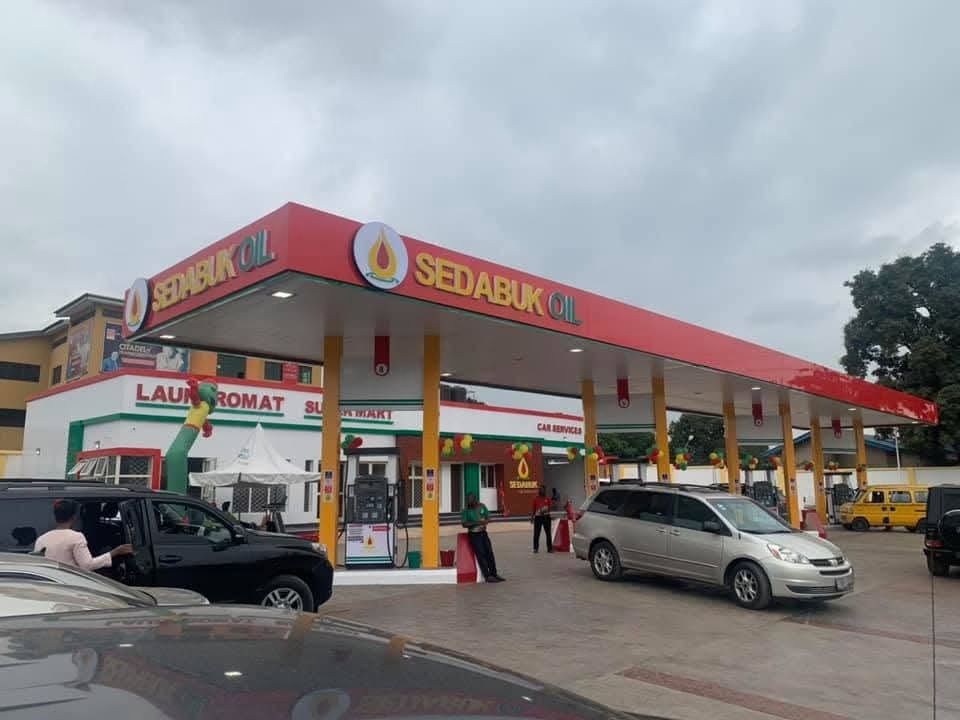
Sedabuk Oil and Gas Industry on Tuesday reinforced its reputation as a people-centred organisation as it rewarded outstanding employees with cash prizes totalling over ₦10 million at its 2025 Employee Recognition and Awards ceremony held in Lagos.
The event, which attracted over 300 staff members alongside top management officials from across the company’s divisions and subsidiaries, was organised to celebrate excellence, dedication, and loyalty within the Sedabuk workforce.
Speaking at the ceremony, the Managing Director, Engr. Adunola Oseni, described the occasion as one of the proudest moments in the company’s journey, noting that Sedabuk’s steady growth has been deliberately anchored on staff welfare and well-being. She said the company, from inception, made a firm commitment to put its people first, stressing that no organisation can truly thrive if its workforce is neglected.
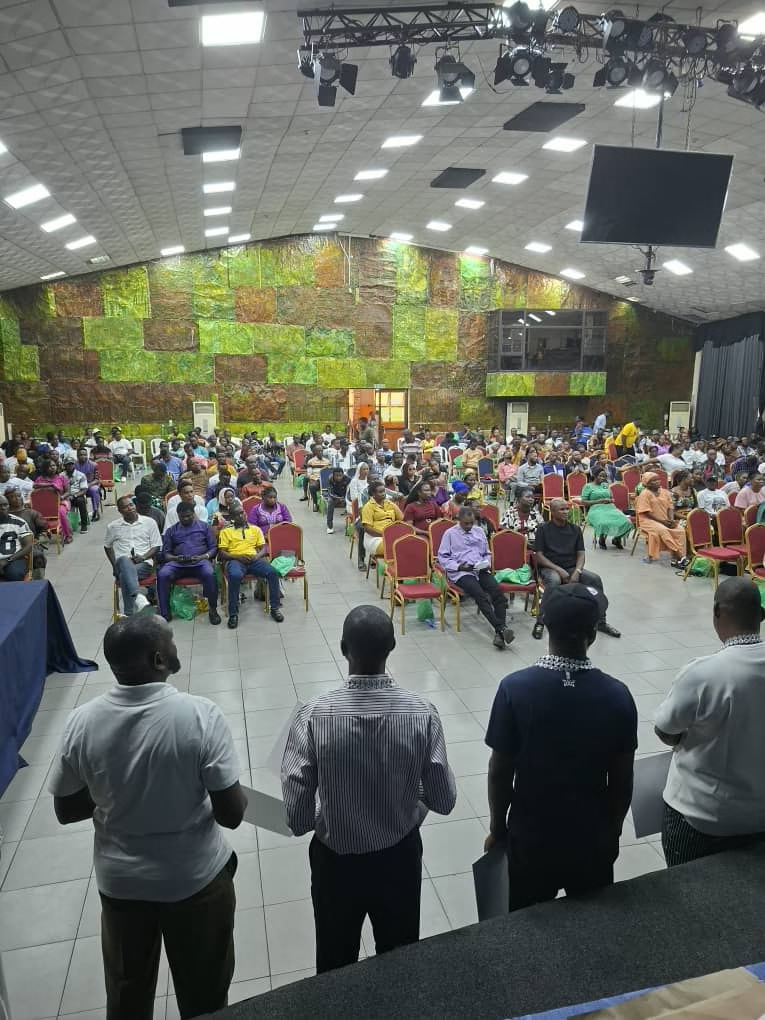
Oseni disclosed that Sedabuk has never owed or delayed salaries since it commenced operations, describing prompt payment as a mark of respect and responsibility. She added that the company reviewed and increased salaries twice in 2025, improved wages across the board, and sustained its seven-year-old One-Day-Meal Programme to ensure employees do not work hungry.
The managing director announced cash awards spanning retail operations, station-based roles, marts, laundromats, and group-wide excellence categories, explaining that the initiative was not just about financial rewards but about recognising hard work and reinforcing a culture of appreciation. According to her, a loyal and motivated workforce remains the company’s most valuable asset.
She assured staff that management is entering 2026 with stronger welfare policies, better incentives, and more opportunities, with the aim of positioning Sedabuk as one of the best organisations to work in Nigeria. Oseni further urged employees to raise the bar in the coming year by working harder, smarter, and together.
Several employees emerged winners across key categories, including Pump Attendant of the Year, Station Captain of the Year, Mart and Laundromat Excellence Awards, and Special Recognition honours.
The highlight of the ceremony was the Group Chairman’s Spirit of Excellence Award, where Adediran Segun Aderonke emerged Sedabuk Star of the Year with a ₦2 million prize, while Ibiloye Olayinka won the Most Outstanding Employee of the Year award with ₦1 million.
In his remarks, the Group Head, Human Resources and Administration, Mr. Adeleye Olusanjo, lauded the managing director for her consistent leadership and unwavering commitment to staff welfare, assuring employees that more incentives and improved support structures are already being planned for 2026.
The event was attended by senior executives, including the General Manager, Finance and Strategy, Mr. Aderoju Sola; the Group Head, Operations and Logistics, Mr. Rufus Enioshunwa; and the Group Head, Corporate Audit, Risks and Ethics, Mrs. Tolulope Omotola, among others.
Established in 2018, Sedabuk Oil & Gas Industry Ltd operates over 12 petrol stations across Lagos, Ogun, and Oyo states.

The Securities and Exchange Commission (SEC) has raised a red flag over two cryptocurrency products — Zugacoin and Samzuga GPT — warning the Nigerian public to steer clear of them.
In a strongly worded statement issued on Wednesday, the apex capital market regulator described the digital assets as unauthorised crypto schemes with no legal backing or regulatory approval in Nigeria.
According to the Commission, neither the promoters nor issuers of Zugacoin and Samzuga GPT are registered to operate in any capacity within the Nigerian capital market.
“Preliminary investigations revealed that Zugacoin and Samzuga GPT are meme coins,” the SEC said. “Meme coins generally have no use case, intrinsic value, or tangible projects backing them.”
The regulator added that the only perceived value of such coins often stems from aggressive promotion by their creators or community hype, making them prime candidates for “pump-and-dump” fraud — a deceptive scheme where promoters artificially inflate the price of a coin through misleading information before dumping it at peak value, leaving unsuspecting investors with massive losses.
“Once the promoters dump their coins and stop hyping the coin, the coin price typically falls and investors lose money,” the SEC warned.
The Commission urged members of the public to avoid engaging in the purchase or promotion of Zugacoin, Samzuga GPT, or any similar crypto assets, noting that anyone who chooses to invest in such schemes does so entirely at their own risk.
To further safeguard investors, the SEC advised the public to always verify the legitimacy of any virtual, crypto, or digital assets and their promoters through its official platforms:
https://home.sec.gov.ng/fintech-and-innovation-hub-finport/registered-fintech-operators/
www.sec.gov.ng/cmos
This warning is the latest in the SEC’s ongoing crackdown on fraudulent digital asset operations targeting unsuspecting Nigerians amid a rise in crypto-related scams.







-

 Politics2 days ago
Ibarapa East Assembly Hopeful, Ramon Congratulates Ajiboye, Says Emergence Good for Oyo APC
-

 Politics6 days ago
Makinde: My Successor Must Be Loyal to Oyo, Not Me
-

 Politics2 days ago
2027: Former Oyo Deputy Governor Adeyemo Emerges APC Chairman (See Full List)
-

 Politics6 days ago
Fintiri Dumps PDP for APC, Moves with Cabinet, 14 Adamawa Lawmakers