
Business
Appeals Court First to Rule in Favor of Coverage for COVID Shutdown



The attorney who filed the first U.S. lawsuit seeking insurance coverage for a business shut down because of coronavirus won the first policyholder victory in a state or federal appellate court that interpreted the meaning of “direct physical loss or damage.”
The Louisiana 4th Circuit Court of Appeals on Wednesday reversed a trial court decision that dismissed a lawsuit filed by Cajun Conti, the owner of a 500-seat restaurant in the New Orleans French Quarter.
All 77 federal and 44 state court appellate decisions so far have held that the coronavirus did not cause tangible damage to property that was covered under standard-form commercial property policies. But the Louisiana appeals court ruled in a 3-2 decision that a Lloyd’s of London syndicate owed coverage to Cajun Conti because its policy was ambiguous, so must be interpreted in favor of the policyholder.
John Houghtaling
Plaintiff’s attorney John W. Houghtaling II said none of the cases decided so far went to trial. He said he won because he was able to present “smoking gun” evidence at trial that the Insurance Service Office was aware that a virus contamination can trigger coverage under “all risk” commercial property policies. The ISO admitted that when its representatives met with the Louisiana insurance commissioner and other insurance regulators around the country in 2006 to seek approval of a standard-form virus exclusion, Houghtaling said.
“I didn’t make that up,” he said during a telephone interview on Thursday. “That was out of the mouths of the insurance industry.”
Mark Friedlander, communications director for the Insurance Information Institute, said the Louisiana decision is an outlier.
“We respect the appellate panel’s ruling but disagree with the decision,” Friedlander said in email. “We are confident courts across the country will continue to rule in favor of insurers in business interruption cases because there is ‘no physical loss present.’ Insurers have been prevailing in these cases because the policy language is very clear. Consequently, insurers cannot be held responsible for coronavirus-related losses.”
The attorney who represented Lloyd’s, Allen C. Miller of Phelps Dunbar in New Orleans, said in an email that the dissenting opinion in the case reflects the opinion of every federal and state appellate court that has ruled on the question of whether insurance coverage is owed for COVID-19 business-interruption losses. He noted that the 5th Circuit Court of Appeal, interpreting Louisiana law, had also rejected property insurance coverage in a lawsuit filed by Q Clothier and Louisiana Bone.
“The decisions have been unanimous, without a single dissent,” he said. We will pursue all options to address what we believe to be an outlier decision.”
Sponsored by SIAA
Only one appellate court so far has ruled in favor of a policyholder seeking coverage for income lost because of a COVID shutdown. The New York Appellate Division, 1st Department found that coverage was owed under pollution legal liability policy purchased by the New York Botanical Garden. That policy did not include the usual language that requires a “direct physical loss or damage.”
Cajun Conti owns the Oceana Grille, a restaurant in the heart of the touristy French Quarter that seats 500 and employed 200 before Gov. John Bel Edwards issued a March 16, 2020 executive order that forced restaurants throughout the state to close their dining rooms. Oceana reopened at 25% capacity two months later and continued to operate at less than 50% capacity for the next year.
The company had paid $91,000 to purchase a commercial property policy without the usual virus exclusion. The general manager testified that he would not have bought a policy with that exclusion because the restaurant serves raw oysters.
Cajun Conti filed a lawsuit against Lloyd’s on the same day it shut down, seeking a declaratory judgment that the insurer owed coverage for its losses because of the contamination to the premises. Orleans Parish Judge Paulette R. Irons ruled against a motion to dismiss filed by Lloyds, but after a trial ruled that no coverage was owed without making any written findings.
The 4th Circuit wrote three opinions; two for the majority and one for the dissent.
Writing for the majority, Chief Judge Terri F. Love, cited testimony from Dr. Lemuel Moye that supported the argument that the coronavirus had physically altered the property.
“The physical presence of COVID-19 substantially diminished the usable space of the property, as tables needed to be pushed farther apart, and resulted in economic losses due to the slowdown of the appellants’ business,” the opinion says. “Stated differently, the physical presence of infectious viral particles decreased the habitable portion of the insured property and caused a slowdown of business activities.”
Judge Joy Cossich Lobrano concurred, but wrote separately to say coverage was owed under a 2011 appellate court decision, Widder v. Louisiana Citizens Property Insurance Corp., that held lead contamination to a home had caused a direct physical loss because it had rendered the property unusable.
The two dissenters, in an opinion written by Judge Roland L. Belsome, said the trial court’s ruling in favor of Lloyds should have been upheld because there was no physical alteration to Cajun Conti’s property.
Rhonda Orin
Rhonda D. Orin, an insurance recovery attorney for the Anderson Kill law firm in Washington, D.C., said the fact that five appellate court judges wrote three opinions to explain their reasoning demonstrates the ambiguity that Cajun Conti was trying to prove. She said business owners who buy all-risk policies with no virus exclusions expect to be covered in circumstances where they are not allowed to use their property for the intended purpose.
Both Houghtaling and Orin pointed out that most of the decisions so far were decided in federal court at the summary judgment stage, meaning federal judges are interpreting state laws. Houghtaling said he would not have been able to present evidence that ISO considered viral contaminations to be compensable if his case had not gone to trial.
Attorneys for Marc Fisher LLC, a designer shoe distributor, also attempted to submit evidence about ISO’s statements to insurance regulators in a lawsuit that sought more than $100 million in damages. A state court judge dismissed the case after finding no coverage was owed because of a virus exclusion.
Nevertheless, Orin said the ISO’s comments to insurance regulators about the need for a virus exclusion in 2006 make for compelling evidence.
“Companies don’t go through the process of drafting exclusions and getting them approved by all 50 state insurance departments if they don’t need them,” she said.
Orin said she’s been practicing law long enough to see how tort liability in environmental law developed. Insurers that excluded coverage for pollution won early rounds, but then started losing cases.
She said the tide may be turning for COVID-19 business-interruption claims as well.
“I think this thing can turn on a dime and I think insurance companies think it can too and are worried about it,” she said.
James Sullivan, a policyholder attorney with the Calfee law firm in Cleveland, Ohio, said the decision demonstrates that business-interruption coverage is a matter of state law and should be decided by state courts rather than federal courts.
“Although it relies on Louisiana law, which sometimes differs from other states’ laws, this case shares at least two things in common with many other U.S. states,” Sullivan said in an email. “First, it relies largely upon the principle that ambiguous insurance policy language gets construed in the policyholder’s favor as a matter of law, and this same principle exists in most US states. Second, this case shares the same key question as most cases in U.S. state courts, which is how to interpret the phrase “direct physical loss or damage.”
He said it stands to reason that other state high courts may find insurance policy language to be ambiguous.
“Here in Ohio, where ambiguities are construed in favor of policyholders, we continue to wait and see how our Ohio Supreme Court will rule on this topic in a pending case,” he said.



Sedabuk Oil and Gas Industry Limited has been listed among the 100 Safe Companies to Do Business With in Africa for 2025 by Emerging Elites Magazine International, in recognition of the firm’s integrity-driven operations, strict compliance culture, and employee-focused policies.
The award was presented to the Managing Director of the company, Engr. Adunola Oseni, at a ceremony attended by members of Sedabuk’s management and staff, alongside the editorial board and team of Emerging Elites Magazine in Lagos.
Presenting the award, the Editor-in-Chief of Emerging Elites Magazine International, Princess Olivia Chukwuma, said Sedabuk emerged after a “thorough, transparent and merit-based selection process” designed to identify African businesses that exemplify excellence and ethical conduct.
According to her, the 100 Safe Companies to Do Business With in Africa Award is an international initiative created to recognise indigenous African companies with proven records of integrity, safety, and best business practices, noting that awardees are continuously monitored and recertified every three years if standards are sustained.

The MD of Sedabuk Oil and Gas Industry Limited, Engr. Adunola Oseni, poses with the Certificate of Award shortly after the company was recognised among Africa’s 100 safest companies to do business with.
Chukwuma said Sedabuk was selected for its employee-centric culture, stressing that the company has no record of unpaid salaries since inception, maintains fair wages, and prioritises staff welfare through initiatives such as its “One Nutritional Meal a Day” programme, which she described as “rare and commendable” in Nigeria’s oil and gas sector.
She also cited the firm’s zero-tolerance policy for fraud, recalling a June 2022 incident in which a pump attendant was sanctioned for under-dispensing fuel while affected customers were compensated, an action she said “clearly reflects Sedabuk’s philosophy of integrity in service delivery.”
Other factors that earned the company the award, she said, include its reputation for honouring contracts, absence of contract-related court cases, strict adherence to safety standards, and voluntary compliance with regulatory obligations, taxes, and statutory dues without coercion.
“With these attributes and more, Sedabuk Oil and Gas has become a beacon of hope—a new breed of Nigerian company that is trustworthy, valuable, and safe to do business with,” Chukwuma said, as she inducted the firm into the Hall of Fame of the 100 Businesses Safe to Do Business With in Africa 2025.

MD, Engr.Adunola Oseni and staff of Sedabuk Oil and Gas Industry Limited during the presentation of a Certificate of Award by The Emerging Elites Magazine International, honouring the company’s adherence to safety standards and best business practices.
Responding, the Managing Director, Engr. Adunola Oseni described the recognition as “a validation of our core values and a strong motivation to do more,” adding that the award belonged to the entire workforce of the company.
“We will continue to uphold integrity, safety, and transparency in all our operations, remain committed to staff welfare and regulatory compliance, and set standards that others in the industry can emulate,” the Sedabuk boss said.
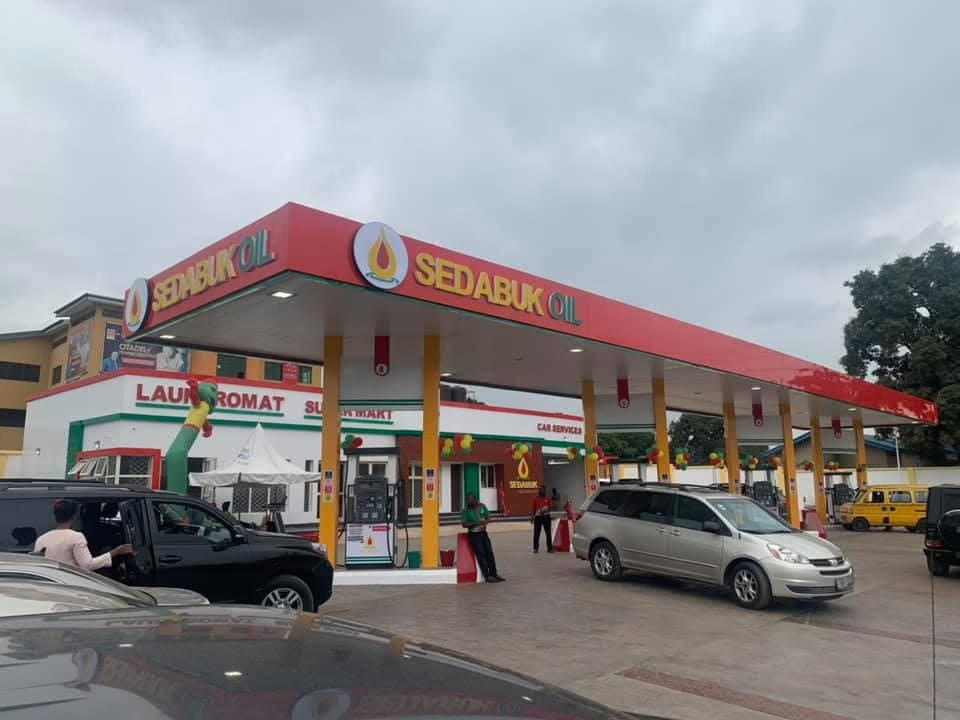
Sedabuk Oil and Gas Industry on Tuesday reinforced its reputation as a people-centred organisation as it rewarded outstanding employees with cash prizes totalling over ₦10 million at its 2025 Employee Recognition and Awards ceremony held in Lagos.
The event, which attracted over 300 staff members alongside top management officials from across the company’s divisions and subsidiaries, was organised to celebrate excellence, dedication, and loyalty within the Sedabuk workforce.
Speaking at the ceremony, the Managing Director, Engr. Adunola Oseni, described the occasion as one of the proudest moments in the company’s journey, noting that Sedabuk’s steady growth has been deliberately anchored on staff welfare and well-being. She said the company, from inception, made a firm commitment to put its people first, stressing that no organisation can truly thrive if its workforce is neglected.

Oseni disclosed that Sedabuk has never owed or delayed salaries since it commenced operations, describing prompt payment as a mark of respect and responsibility. She added that the company reviewed and increased salaries twice in 2025, improved wages across the board, and sustained its seven-year-old One-Day-Meal Programme to ensure employees do not work hungry.
The managing director announced cash awards spanning retail operations, station-based roles, marts, laundromats, and group-wide excellence categories, explaining that the initiative was not just about financial rewards but about recognising hard work and reinforcing a culture of appreciation. According to her, a loyal and motivated workforce remains the company’s most valuable asset.
She assured staff that management is entering 2026 with stronger welfare policies, better incentives, and more opportunities, with the aim of positioning Sedabuk as one of the best organisations to work in Nigeria. Oseni further urged employees to raise the bar in the coming year by working harder, smarter, and together.
Several employees emerged winners across key categories, including Pump Attendant of the Year, Station Captain of the Year, Mart and Laundromat Excellence Awards, and Special Recognition honours.
The highlight of the ceremony was the Group Chairman’s Spirit of Excellence Award, where Adediran Segun Aderonke emerged Sedabuk Star of the Year with a ₦2 million prize, while Ibiloye Olayinka won the Most Outstanding Employee of the Year award with ₦1 million.
In his remarks, the Group Head, Human Resources and Administration, Mr. Adeleye Olusanjo, lauded the managing director for her consistent leadership and unwavering commitment to staff welfare, assuring employees that more incentives and improved support structures are already being planned for 2026.
The event was attended by senior executives, including the General Manager, Finance and Strategy, Mr. Aderoju Sola; the Group Head, Operations and Logistics, Mr. Rufus Enioshunwa; and the Group Head, Corporate Audit, Risks and Ethics, Mrs. Tolulope Omotola, among others.
Established in 2018, Sedabuk Oil & Gas Industry Ltd operates over 12 petrol stations across Lagos, Ogun, and Oyo states.

The Securities and Exchange Commission (SEC) has raised a red flag over two cryptocurrency products — Zugacoin and Samzuga GPT — warning the Nigerian public to steer clear of them.
In a strongly worded statement issued on Wednesday, the apex capital market regulator described the digital assets as unauthorised crypto schemes with no legal backing or regulatory approval in Nigeria.
According to the Commission, neither the promoters nor issuers of Zugacoin and Samzuga GPT are registered to operate in any capacity within the Nigerian capital market.
“Preliminary investigations revealed that Zugacoin and Samzuga GPT are meme coins,” the SEC said. “Meme coins generally have no use case, intrinsic value, or tangible projects backing them.”
The regulator added that the only perceived value of such coins often stems from aggressive promotion by their creators or community hype, making them prime candidates for “pump-and-dump” fraud — a deceptive scheme where promoters artificially inflate the price of a coin through misleading information before dumping it at peak value, leaving unsuspecting investors with massive losses.
“Once the promoters dump their coins and stop hyping the coin, the coin price typically falls and investors lose money,” the SEC warned.
The Commission urged members of the public to avoid engaging in the purchase or promotion of Zugacoin, Samzuga GPT, or any similar crypto assets, noting that anyone who chooses to invest in such schemes does so entirely at their own risk.
To further safeguard investors, the SEC advised the public to always verify the legitimacy of any virtual, crypto, or digital assets and their promoters through its official platforms:
https://home.sec.gov.ng/fintech-and-innovation-hub-finport/registered-fintech-operators/
www.sec.gov.ng/cmos
This warning is the latest in the SEC’s ongoing crackdown on fraudulent digital asset operations targeting unsuspecting Nigerians amid a rise in crypto-related scams.








-

 Politics3 days ago
Ibarapa East Assembly Hopeful, Ramon Congratulates Ajiboye, Says Emergence Good for Oyo APC
-

 Politics1 week ago
Makinde: My Successor Must Be Loyal to Oyo, Not Me
-

 Politics3 days ago
2027: Former Oyo Deputy Governor Adeyemo Emerges APC Chairman (See Full List)
-

 News2 days ago
NERC orders DisCos to refund ₦20.33bn meter costs to customers