Connect with us

Politics

APC’s 2027 Domination Prospects in Southwest, Osun, and Oyo Overview

Published

on

Political analysts and Nigerians are keenly interested in the fate of the All Progressives Congress (APC) in Southwest Nigeria leading up to the 2027 general elections. The party has established a strong presence in states like Lagos, Ogun, Ondo, and Ekiti, sparking speculation about its ability to maintain supremacy.

Election outcomes often hinge on the advantage of incumbents. If the current APC-appointed governors in Southwest Nigeria continue their commendable efforts and fulfill commitments, they stand a good chance of garnering electoral support. Sustaining party control necessitates building on achievements, addressing public demands, and implementing impactful policies. The electorate’s confidence and votes will be closely tied to the governance record and visible development.

The APC’s future success hinges significantly on internal dynamics and unity. A cohesive party can efficiently plan and mobilize resources for election campaigns, presenting a strong front. To enhance its chances in the 2027 elections, the APC must effectively manage internal conflicts, champion diversity, and consider various interests, making it more appealing to voters.

For opposition parties aiming to challenge APC’s dominance in Southwest Nigeria, effective tactics and strength are paramount. A credible candidate lineup and compelling perspectives are essential for conveying alternative agendas to the electorate. A cohesive, well-organized opposition forming strategic partnerships poses a potential threat to the ruling party. The success of opposition parties will depend on exploiting APC weaknesses and resonating with public aspirations.

Politics in Southwest Nigeria ahead of the 2027 General Elections may be shaped by socioeconomic issues and public opinion. The electorate must evaluate how well the APC addresses concerns like infrastructure development, unemployment, healthcare, and education. Public opinion will be influenced by the party’s inclusivity in policymaking and responsiveness to the populace’s needs and aspirations. Socioeconomic variables, including changes in population, inter-ethnic relationships, and regional attitudes, could affect voting patterns.

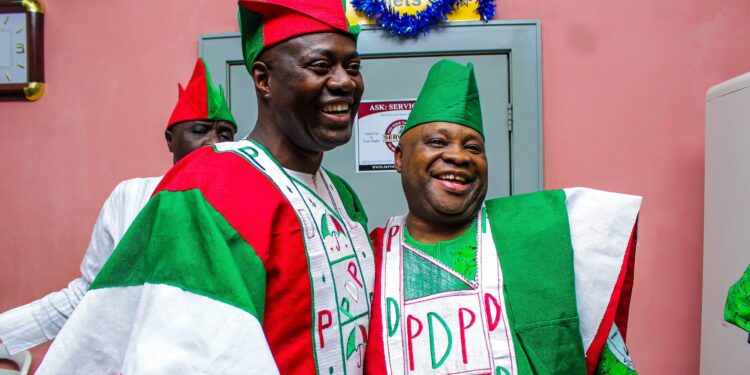
Speculation surrounds the potential defections of Sen. Ademola Adeleke and Engr. Seyi Makinde of the People’s Democratic Party (PDP) in Osun and Oyo states, respectively, to the APC before the next election cycle. Their performance as governors will play a pivotal role in this decision, considering whether they can leverage the APC as a platform to consolidate accomplishments and gain more political influence.

Possible motivations for defection include a desire to align with the national ruling party, obtaining resources, political clout, and collaboration with the federal government. Personal goals within their states, such as re-election or aspiring to higher political offices, may also influence their decisions.

The PDP would face significant setbacks if the governors in Osun and Oyo states defect, weakening the party’s position in these states and complicating resistance against the APC. The loss of experienced leadership could further impact the party’s cohesiveness and strength.

Potential defections may enhance the APC’s reach and election prospects, showcasing its ability to attract well-known politicians from rival parties. Voter responses in Osun and Oyo will vary, with some viewing defections as self-serving and opportunistic, while others may see them as strategic moves for progress.

The fluidity of Nigerian politics is underscored by the possibility of PDP governors defecting to the APC before the 2027 elections. Political calculations, personal goals, and government performance will shape their decisions, significantly impacting both parties and the political landscape in their respective states. Voter sentiments will play a crucial role in determining the ultimate impact on the 2027 election results.

In summary, Southwest Nigeria’s general elections in 2027 present an opportunity for the APC to either maintain or erode its lead in the region. Success requires leveraging incumbency advantage, internal harmony, proactive handling of socioeconomic issues, adept management of opposition dynamics, and effective engagement with the electorate. The electoral outcome will also be influenced by the strategies and strength of opposing parties, public opinion, and socioeconomic factors.


Olumide Paul Akomolafe
Journalist/Political Analyst
Email: Olumide0087@gmail.com

Comments

Politics

INEC declares Oyebanji winner, APC retains Ekiti

Published

on

The Independent National Electoral Commission has declared the Governor of Ekiti State and candidate of the All Progressives Congress, Biodun Oyebanji, winner of Saturday’s governorship election in the state.

The Returning Officer for the election, Prof. Adenike Oladiji, announced the result at about 3:13 a.m. on Sunday in Ado-Ekiti, saying Oyebanji polled 319,224 votes to defeat his closest rivals and secure a second term in office.

According to Oladiji, who is the Vice-Chancellor of the Federal University of Technology, Akure, the candidate of the Peoples Democratic Party, Oluwole Oluyede, garnered 40,543 votes, while the African Democratic Congress candidate, Dare Bejide, secured 12,872 votes.

She said 384,940 voters were accredited for the election, while 375,777 valid votes were recorded. The electoral umpire also announced that 6,332 votes were rejected, bringing the total number of votes cast to 382,109.

The declaration capped a governorship poll largely adjudged peaceful by observers and security agencies, despite complaints of malfunctioning Bimodal Voter Accreditation System machines, delayed commencement of voting in some polling units and allegations of voter intimidation by opposition parties.

INEC said voting was conducted in all the 2,445 polling units across the state’s 16 local government areas, noting that 2,257 units, representing 92.31 per cent, opened before 8.30 a.m., while 188 polling units commenced accreditation and voting before 10.30 a.m. after experiencing minor delays.

The commission also commenced uploading polling unit results to its Results Viewing Portal shortly after the completion of voting and counting in several centres.

The PDP candidate, Oluyede, had expressed dissatisfaction with the conduct of the exercise at Ugele/Arokun Ward in Ikere Local Government Area, alleging that many prospective voters were disenfranchised due to BVAS-related challenges.

Speaking with journalists after voting at Polling Unit 006, he further alleged cases of harassment and intimidation of voters in the area.

Some elderly voters at the polling unit also lamented difficulties encountered during accreditation and urged INEC to urgently rectify the technical glitches.

The ADC candidate, Bejide, similarly alleged irregularities during the exercise.
However, Oyebanji dismissed the claims, insisting that those making allegations of electoral misconduct should provide credible evidence to support them.

The governor, who voted at Polling Unit 003, Okelele, Ikogosi-Ekiti, in Ekiti West Local Government Area, described the election as satisfactory and urged eligible voters yet to cast their ballots to do so peacefully.

The Commissioner of Police in charge of election security, Abayomi Shogunle, said no case of vote-buying was reported to security agencies throughout the exercise.

Election observers commended the peaceful atmosphere that characterised the poll but raised concerns over procedural inconsistencies.

The First Vice-President of the Nigerian Bar Association, Sebastian Anyia, described the process as orderly and peaceful, saying voter turnout was encouraging.

Similarly, the Chief Executive Officer of the Nigerian Women Trust Fund, Brenda Anugwom, lauded the resilience of female voters, many of whom remained at polling units for several hours with their children to exercise their franchise.

Yiaga Africa, however, expressed concern over discrepancies involving ballot papers, result sheets and INEC’s published list of candidates, warning that such inconsistencies could create challenges during collation and reconciliation of results.

The election observer group urged INEC to provide further clarification on the final list of participating parties and candidates and issue clear guidance to electoral officials handling result documentation.

Ahead of the poll, INEC and security agencies had repeatedly assured residents of their preparedness to deliver a peaceful, credible and transparent election, deploying personnel and restricting vehicular movement to forestall electoral violence and other offences.

Continue Reading

Politics

Oyo APC rejects Makinde’s planned December LG poll, vows boycott

Published

on

The opposition All Progressives Congress (APC) in Oyo State has rejected plans by the administration of Governor Seyi Makinde to conduct another local government election on December 26, 2026, describing the proposed exercise as illegal, premature and a calculated move to retain political influence at the grassroots beyond the governor’s tenure.

The party declared that it would neither participate in the election nor remain silent over what it termed an attempt to squander public resources on a process allegedly designed to install loyalists in the 33 local government councils and 351 wards across the state.

The controversy followed the decision of the Oyo State Independent Electoral Commission (OYSIEC) to shift the date earlier fixed for January 2027 to December 26, 2026, after the Independent National Electoral Commission (INEC) released the timetable for the 2027 general elections.

The move has continued to generate debate among political observers, many of whom have questioned the urgency of conducting another council poll barely six months before the expiration of the tenure of the incumbent chairmen and councillors elected in the 2024 local government elections.

In a statement issued on Thursday in Ibadan by its Publicity Secretary, Olawale Sadare, the APC said it would not stop at boycotting the election but would also collaborate with “patriots and rational minds” to resist what it called an unnecessary expenditure of taxpayers’ money.

The party accused Governor Makinde of lacking commitment to local government autonomy, alleging that the administration had exercised undue control over council resources for more than seven years.

“The whole world knows that Governor Makinde does not believe in local government autonomy and, when it comes to democracy at the grassroots, he cannot be trusted for anything,” the statement said.

The APC alleged that the proposed poll was aimed at positioning individuals loyal to the governor in local councils before his exit from office on May 29, 2027, arguing that such a move would enable him to sustain political influence after leaving the Agodi Government House.

According to the opposition party, expectations among many residents are centred on ongoing efforts by the administration of President Bola Ahmed Tinubu to strengthen local government autonomy and ensure that councils enjoy direct access to their statutory allocations without interference from state governments.

The APC also linked what it described as poor development outcomes in some rural communities to the operation of the state-local government joint account system. It cited communities such as Ahoro Esiele and Yawota in Oriire Local Government Area, which have reportedly faced security challenges, as examples of areas where local government resources should have translated into visible improvements.

“It is sad that Governor Makinde appears determined to sustain a system that has left many rural communities vulnerable despite huge allocations accruing to local governments monthly,” the party said.

The opposition further dismissed the local government elections conducted in 2020 and 2024 as lacking credibility, alleging that winners emerged through predetermined outcomes rather than a transparent electoral process.

“The fraud called local government polls in 2020 and 2024 should be the last the people of Oyo State would witness. Governor Makinde and his supporters should bury any thought of staging another charade in which results are announced without genuine voting and public offices become tools for the diversion of public funds,” the statement added.

The APC consequently urged officials of OYSIEC to halt preparations for the proposed December election, warning against actions capable of undermining democratic values and public confidence in the electoral process.

As of the time of filing this report, neither the Oyo State Government nor OYSIEC had issued an official response to the allegations raised by the opposition party.

Continue Reading

Politics

2027: Oseni Mobilises Oyo Artisans, Traders, Targets One Million Votes for Tinubu

Published

on

The lawmaker representing Ibarapa East/Ido Federal Constituency in the House of Representatives, Aderemi Oseni, on Saturday mobilised thousands of artisans and traders across Oyo State in support of President Bola Tinubu’s re-election bid in 2027.

‎Oseni said the support base of the Remi Oseni Committee of Friends (ROCOF), in collaboration with other stakeholders, was intensifying efforts to deliver one million votes for the President in the state.

‎Oseni, Chairman of the House Committee on Federal Road Maintenance Agency (FERMA), said artisans and traders must see themselves as critical stakeholders in President Tinubu’s Renewed Hope Agenda, stressing that the success of the administration depends largely on grassroots participation.

‎The federal lawmaker spoke in Ibadan, the Oyo State capital, during a stakeholders’ engagement with members of the ROCOF Progressive Workers and Traders’ Associations.

‎In a symbolic show of political readiness, scores of traders and artisans displayed their Permanent Voter Cards (PVCs), while Oseni urged eligible Nigerians yet to register to obtain their voter cards ahead of the next general election.

‎He cautioned against vote-buying and vote-selling, warning that such practices threaten the future of democracy and mortgage the destiny of younger generations.

‎The meeting, according to Oseni, was also convened to deepen economic support for members through empowerment programmes targeted at strengthening businesses and improving livelihoods.

‎He announced that requests for a N250 million interest-free loan scheme for artisans and traders, construction of an artisans’ village with stable electricity supply, and health insurance support had received approval.

‎According to him, the loan facility will be administered through a microfinance bank under the Remi Oseni Foundation to ensure transparency, accessibility and sustainability.

‎He added that road and infrastructure projects across communities would remain a major priority.

‎Oseni, who is seeking to represent Oyo South Senatorial District  in the next election cycle, also used the meeting to explain his decision to pursue a Senate seat instead of his earlier governorship ambition.

‎He said the move followed consultations with party leaders and supporters.

‎According to him, supporters deserved clarity on the political direction of the movement.

‎He said: “We convened this stakeholders’ meeting to review our present position. Before now, our focus was on leading Oyo State through the governorship. That was our clear objective as a movement, but today, it has become evident that God is directing us towards the Senate.

‎“Our people needed to understand the reasons for this decision, the position of the party and what we have accepted in the overall interest of our political future. It is not enough for leaders to take decisions. We owe our supporters explanations and must carry them along.

‎“We have encouraged them to embrace this opportunity in good faith and believe that greater opportunities still lie ahead.

‎“Many of them felt our governorship ambition would have delivered greater benefits, but we have reassured them that the government remains supportive and the future is bright.

‎“We have equally assured the President that our decision to pursue the Oyo South Senate seat will not affect the one million votes earlier promised him, because ROCOF structures across the 33 local government areas are fully mobilised and committed to his re-election.”

‎On the crisis within the All Progressives Congress (APC), Oseni said efforts were ongoing to reconcile aggrieved members, expressing confidence that outstanding differences would soon be resolved.

‎He described competing interests within the party as a reflection of the APC’s growing strength and political attractiveness.

‎Earlier, the Oyo State Coordinator of ROCOF Progressive Workers and Traders’ Associations, Alhaji Munirudeen Adegoke, described Oseni’s empowerment drive as a strategic investment capable of reducing unemployment, youth restiveness and poverty.

‎Adegoke said meaningful empowerment for artisans and traders must go beyond temporary palliatives.

‎According to him, sustainable support requires deliberate policies that guarantee access to capital, improved infrastructure and social protection.

Continue Reading

Advertisement

Entertainment

Advertisement

MegaIcon Magazine Facebook Page

Advertisement

MEGAICON TV

Advertisement

Trending