Opinion
Aliko Dangote’s Costly Libido Mess | By Festus Adedayo
Published
5 years agoon
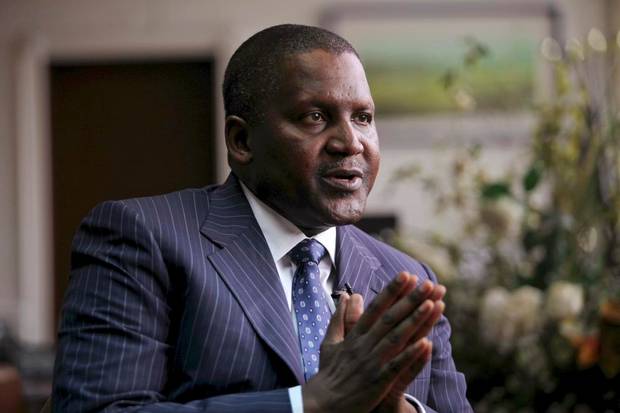
How can a man fight very difficult life battles, vanquish them all, be a household name in the world as a result of his handsome laurels in business and then, all of a sudden, get picked up effortlessly on the bed by women as they do snails in farm furrows? This is the question on the lips of the world as Africa’s richest man, Aliko Dangote, confronts his deconstruction by some self-confessed mistresses Autumn Spikes and Bea Lewis.
This Dangote costly mess on cozy beds has spiked globally, diverting riveting attention to the Kano-born business dinosaur. Lewis claimed she had been Aliko’s mistress for ten years. World’s attention then shifted from Aliko’s multiple billions, his unassuming simplicity and his world class monstrous refinery, to the narrative of licit or illicit romance. Lewis had, in January this year, shared photographs of their tryst on her Instagram handle. An American restaurateur, she alleged that Aliko broke her heart. Using the metaphor of broken earthenware, she said the billionaire broke her fragile heart into more than a thousand fragments.
To convince Doubting Thomases who might have controverted her claims that she was talking about same boardroom dinosaur, Aliko, Lewis shared photographs of her and Dangote in a dalliance. The lady even went a step further to share with the world what she called her derivables from the tryst.
Then another lady hopped on the rendezvous. Identified as Autumn Spikes, an African American, she posted a video that went viral of her and Dangote. The clip revealed Africa’s richest man lying on the same couch down by his voluptuous nemesis and a part of his buttocks shyly winking to the world.
In further public interventions by Spikes, it became obvious that the video was a mere “Statement of the Problem,” an attempt to dig a fertile ground, where to situate an ultimate plan to conveniently squeeze cash from Africa’s richest billionaire. Last Thursday, in another post from her handle, @allounda1, Spikes escalated the narrative. Therein, she alleged that Dangote had insulted her by offering a mere $15,000, as well as another $2,500 monthly to shut her mouth, so as not to turn the affair into a global love snafu. Rather than these offers, however, to keep the mess off the streets, she said she was demanding a princely sum of $5 million before she could enter a Non-Disclosure Agreement (NDA) that Dangote demanded.
An acclaimed British professor was once quoted to have said that all the libraries in the world put together do not smell as sweetly as the scent of a woman’s groin. Is this why great men in the world put their greatness in the scabbard when engaged in appropriate or inappropriate relationship with women? Perhaps this is why men, on sighting women, engage in actions they would otherwise never have if they were in possession of their senses? So, is there a mechanism in man-woman interface that is filled with an unspoken and even unknown mesmerism and chemistry? What is it about women that the greatest of all men crumble at the sight and feel of their allure? Why do men whose brains have taken to the top seem to warehouse such brains while in romance with women, thereby making them easy prey or prisoner in-between the succulence of the female anatomy? Are women’s brains superior to men’s and reason why French call them the destructive female, femmes fatale?
Whatever Aliko went through or is going through in the hands of Spikes and Lewis is the usual story that so many great men went/go through in the hands of women. It only comes in different dimensions. Gaius Julius Caesar, Roman General and statesman, reputed to be a major force who played critical roles in the demise of the Roman Republic, as well as the rise of the Roman Empire, also could not resist the thighs of Cleopatra. Daughter of Ptolemy XII, Cleopatra became the Pharaoh after her father’s demise. She was reputed to be a very beautiful woman and specifically described as “a woman of surpassing beauty” with a “charming voice” by Cassius. More than this, Cleopatra was a diplomat imbued with great intellectual prowess, a mathematician and was noted to be astounding for her ability to speak nine languages. At first sight, Cleopatra ogled and desired the Great Caesar and was determined to get him. One day, she organized for a cruise on the Nile River to be undertaken by her and Caesar, in her posh royal barge. By the time they both returned to Alexandria, Cleopatra was pregnant with Caesar’s child who was later named Caesarion.
The narrative of the biblical man of valour Samson, plucked off his prowess by Delilah like a chicken, has been an example over the centuries used to exemplify how powerful men in history are easily captured by women. It is said that women are men’s easiest weak link through which they can be captured and emasculated.
In my quest for an understanding of the dissembling role women played in the lives of powerful men in African history, I spoke with the Iku Baba Yeye, the Alaafin of Oyo, Oba Lamidi Adeyemi, yesterday. Alaafin took his time to narrate to me the story of that infamous man in Old Oyo Empire, notorious for unbridled wickedness, Bashorun Gaa. Though I had always cited this story to back up earlier submissions, I couldn’t resist retelling the Alaafin’s variant of it. In it, Gaa was captured through a young lady called Agbonin, though not directly through his libidinous craving.
Being the Old Oyo Empire’s prime minister and lord marshal in the 16th century, Gaa stood in that position from 1750–1774 and oversaw the reigns of four Alaafins of Oyo, even contributing to the death of three of them. Gaa’s military prowess and mastery of the geography of war gave the Empire all-round conquests in wars Oyo fought during this period. As head of the Oyo Mesi (the Oyo council of Kingmakers) he held awesome powers, especially taking into cognizance the fact that the Alaafins he was their Prime Minister were tyrannical. He also acquired so much power during the period. He was said to be so powerful that he could turn to any animal of his choice. More than these however, Gaa’s talismanic fetish powers and prowess befuddled his sense of reasoning, which made a classical tyrant of him.
He was equally accused of instigating criminal activities in the empire, aiding, abetting and serving as cover-up for crimes traced to members of his household, as well as serial killings his sons and the head of his slaves were notorious for committing. Power drunk, Bashorun Gaa became uncontrollable, even to Alaafin Abiodun Adegorolu (Adegoolu) who reigned from 770–1789. Adegoolu’s reign was remarkable in Oyo’s history as that of prosperity. The wealth of the nation was so humongous that women gleefully sang of how, during his reign, they offhandedly sewed costly velveteen cloth materials.
Gaa hijacked and diverted all the apparatuses of political machinery and power of Oyo kingdom to himself, including all the homage, tributaries which constituted the material paraphernalia of benefits that the Alaafin was entitled to by culture and history. If Alaafin Abiodun allowed these excesses of his Prime Minister, who was so powerful that he had over 500 aides and a palace of his own, he was bound to lose the de facto power to administer the empire.
Then Alaafin Abiodun and close-knit members of his inner cabinet devised a way of neutralizing Bashorun Gaa. The Alaafin’s daughter, Agbonin, an itinerant kolanut hawker, was selected as the bait and eventually went into martyrdom to castrate Gaa. Agbonin sold this particular variant of kola called gbanja, with its multiple faces. Knowing that she could not have an immediate access to Gaa, the kolanuts she hawked were soaked in potion and the immediate target was Gaa’s closest aide and indeed, his Chief of Staff, called Gbagi. Gbagi and Gaa were both steeped in metaphysical explorations. They went together to seek spiritual powers. It was said that every of those powers acquired by Gaa, Gbagi duplicated. Those potions were in turn tested on various animals to ascertain their efficacy. As she hawked the kola by Gaa’s palace one day, Gbagi invited her in and was mesmerized by her beauty.
A friendship was thus struck between them and off course, purchase of the gbanja which, unbeknown to him, was for him to inexplicably desire Agbonin. To try the efficacy of the potion, Agbonin was instructed to distance self from Gaa’s palace for a while and by the time she returned, it was obvious from his utterances that Gbagi was already starved of her presence. So on this day, as he got engaged with Agbonin, Gaa had made futile attempts to get across to Gbagi from the inner court of the palace and was forced to saunter to the front of the palace. A bitter exchange then began. Other aides who couldn’t stand the Chief of Staff’s prowess then revealed that he was having an amorous relationship with Gaa’s enemy – Alaafin Abiodun’s daughter.
Furious, he called Gbagi all manner of names and threatened to behead him. The latter called his bluff. As Gaa made to enter his palace, Gbagi hit him with a dissembling belt of paralysis called onde which instantly paralyzed him. Agbonin was killed immediately as reprisal by palace courtiers and as Gbagi ran to Alaafin Abiodun’s palace to ask that the Bashorun be immediately captured, one other aide shot him dead. Gaa was reportedly incinerated alive by loyalists of the Alaafin, as a way of ensuring the non-reincarnation of his wickedness. Another variant of the Gaa’s capture is however a bit different. It says that the Prime Minister was looking for an antelope for ritual sacrifice and when Agboin came hawking kolanuts and told him her name, which in Yoruba translates into antelope, he wickedly asked her to be murdered in place of the animal.
I told this longish story and the preceding ones to establish how women are usually the albatrosses of great men in history. Celebrated Juju musician of post-war Nigeria, Ayinde Bakare, was reported to have been a victim of this age-long libidinous trap. Having gone for a gig at the Lagos Island area on October 1, 1972, while on the bandstand, a woman was said to have been positioned at a vantage point, even as she winked coquettishly at the Juju maestro to arrest his attention. Bakare momentarily halted the musical session and walked to the backstage to meet the woman. He was never seen alive thereafter. Policemen retrieved his body days after from the lagoon and gave him and other bodies a mass burial. The ‘Bakare’ mark on his hand was what reminded a policeman who took particular notice of the incision, when report was made by his family at the police station, that the famous musician was one of the mass-buried bodies. Bakare was subsequently exhumed after twenty days and given proper burial by his colleagues, Ebenezer Obey, IK Dairo, Sunny Ade, Adeolu Akinsanya and others.
Today, as since the beginning of creation, women have remained the most poisonous bait deployed to whittle down the power of men. It is more efficacious if such a man has a burningly incontrollable libido. Women have been used to destroy empires, huge conglomerates and even homes. It was that same power that Spikes and Lewis apparently used on the richest man in black Africa. It is said that every man who has blood flowing in his groins cannot resist the incandescent flame of the libido and that when that candle is burning, the brain goes into hibernation mode.
Aliko Dangote is carrying his own cross of libido with Spikes and Lewis. He sure needs the same famous, celebrated brains that culminated in his financial wizardry and legendary business success now. It may not be outlandish to say that, like every man who had fallen prey to a woman’s bait before him, that famous cerebrum was in abeyance while the escapades were glowing. To get out of these entanglements, he needs same brains that made him the first in Africa. Now, as Africa’s most accomplished business mogul tries to extricate himself from his libidinous maze, who is the next victim?
Related
You may like
Growing support has continued to trail a youthful politician and technology advocate, Hon. Khalil Mustapha Adegboyega, popularly known as Repete, as many youths in Ibadan North Federal Constituency expressed confidence in his leadership style and vision for development.
Across several communities within the constituency, residents, particularly students, artisans and young professionals, described Repete as one of the emerging political figures with strong grassroots appeal and a passion for youth empowerment.
Supporters said his growing popularity stems from his consistent advocacy for innovation, entrepreneurship and skills development aimed at addressing unemployment and creating opportunities for young people.
As an engineer and technology enthusiast, Repete is also said to possess a deep understanding of the evolving digital economy and the need to position youths for global competitiveness.
Many of his supporters noted that his approach to leadership focuses on practical solutions, mentorship and capacity-building initiatives capable of helping young people become self-reliant and economically productive.
Some community stakeholders who spoke on his rising profile said his humility, accessibility and relationship with the grassroots have continued to endear him to many residents within the constituency.
They added that Repete’s engagement with youths and community groups reflects his commitment to inclusive governance and people-oriented representation.
Observers within the constituency also maintained that the increasing support for the politician reflects a growing desire among residents for a new generation of leaders driven by innovation, competence and accountability.
According to them, many young people see Repete as a symbol of hope and progressive leadership capable of contributing meaningfully to the development of Ibadan North Federal Constituency.
Related
The All Progressives Congress (APC) in Oyo State stands on the edge of a consequential decision—one that may define not only its fortunes in Ibadan North Federal Constituency but also its broader political relevance in the state.
As the countdown to the party primaries intensifies, the question before APC leaders is no longer routine. It is strategic. It is urgent. And it is decisive: will the party align with the clear preference of the people or risk repeating costly political miscalculations?
At the centre of this debate is Hon. Khalil Mustapha Adegboyega, widely known as Repete—a name that has, over time, evolved from a political identity into a grassroots phenomenon.
A Candidate Rooted in the People
In contemporary Nigerian politics, where voter awareness is rising and expectations are shifting, candidates are increasingly judged not by promises but by presence. On this scale, Adegboyega stands tall.
His political journey is marked by consistent engagement with constituents—far beyond the optics of election seasons. From youth empowerment initiatives that provide practical skills and startup support, to sustained interventions in healthcare access for the elderly and indigent, his footprint across Ibadan North reflects a model of leadership anchored on service.
Unlike the transactional approach that often defines political relationships, Adegboyega’s connection with the people appears organic—built on trust, accessibility, and continuity. These are not mere campaign attributes; they are political assets.
The Danger of Political Disconnect
History offers the APC a clear lesson: parties that ignore grassroots sentiment often pay a heavy electoral price. The imposition of candidates perceived as distant or untested has, in several instances, resulted in voter apathy, internal dissent, and eventual defeat at the polls.
Ibadan North presents no exception.
With opposition parties closely monitoring the APC’s internal dynamics, any misstep in candidate selection could provide a ready opening. A divided house, coupled with a candidate lacking widespread acceptance, is a formula the opposition is well-positioned to exploit.
The implication is straightforward: this is not merely about party loyalty; it is about electoral viability.
Echoes from the Grassroots
Across the length and breadth of Ibadan North—markets, motor parks, religious centres, and community gatherings—a consistent pattern emerges in political conversations. The name “Repete” resonates with familiarity and acceptance.
Such organic support is not easily manufactured. It is cultivated over time through visible impact and sustained presence. For a party seeking electoral certainty in a competitive environment, this level of grassroots validation is not just desirable—it is critical.
A Test of Leadership and Judgment
For the APC leadership in Oyo State, the moment calls for clarity of purpose. Decisions driven by narrow interests, personal alignments, or short-term calculations may carry long-term consequences.
The task, therefore, is to balance internal considerations with external realities. Elections are ultimately decided by voters, not by party caucuses. A candidate who commands public confidence offers the strongest pathway to victory.
The Stakes Are Clear
Ibadan North is too strategic a constituency for experimentation. The cost of error is not limited to a single seat; it extends to party cohesion, credibility, and future positioning within the state’s political landscape.
In this context, the argument for Adegboyega is less about sentiment and more about strategy. His visibility, acceptability, and record of engagement place him in a strong position to consolidate support and mobilise voters effectively.
Conclusion: A Choice with Consequences
As the APC moves closer to its primaries, the decision before it is both simple and significant: align with a candidate who reflects the mood of the electorate or risk conceding advantage to a watchful opposition.
In politics, moments such as this often separate foresight from hindsight.
For APC in Ibadan North, this may well be one of those defining moments.
Aderibigbe Akanbi, a political analyst, writes from Ibadan.
Related
Opinion
Ibarapa East: Yusuf Ramon’s Quest for Responsive Representation
Published
3 months agoon
February 14, 2026As the road to 2027 gradually unfolds across Oyo State, political conversations are shifting from routine permutations to deeper questions about competence, generational leadership, and measurable impact. In Ibarapa East, that conversation has found a new voice in Yusuf Abiodun Ramon — a Lanlate-born technocrat whose entry into the race for the State House of Assembly is redefining what representation could mean for the constituency.
In a political environment often dominated by familiar faces and conventional calculations, Ramon presents a profile shaped by technical discipline, structured thinking, and solution-driven engagement. His professional background, anchored in analytical precision and systems management, forms the foundation of his public service aspiration.
For him, representation must move beyond ceremonial presence to practical responsiveness — laws that reflect local realities, oversight that protects public resources, and advocacy that translates into visible development.
Ramon argues that the future of Ibarapa East lies in leadership that listens deliberately, plans strategically, and delivers measurably. He speaks of strengthening rural infrastructure, expanding youth-driven economic opportunities, and institutionalising transparency as core pillars of his agenda. In his view, governance must not merely be symbolic; it must be structured, accountable, and people-centred.
Rooted in Ile Odede, Isale Alubata Compound, Ward Seven of Ibarapa East Local Government, and maternally linked to Ile Sobaloju, Isale Ajidun Compound, Eruwa, Ramon’s story is not one of distant ambition but of lived experience. He is, in every sense, a son of the soil — shaped by the same roads, schools, and economic realities that define daily life in Ibarapa East.
“I was born here. I grew up here. I understand our struggles, our strengths, and our untapped potential,” he says. “Representation must go beyond occupying a seat; it must translate into preparation, competence, and genuine commitment to development.”
His academic journey mirrors that philosophy of steady growth. He began at Islamic Primary School, Lanlate (1995–2001), proceeded to Baptist Grammar School, Orita Eruwa (2001–2007), and later earned a National Diploma in Mechanical Engineering Technology from Federal Polytechnic, Ilaro, between 2009 and 2011. Refusing to plateau, he advanced his intellectual horizon and is now completing a Bachelor of Science in Business Administration at the University of Lagos. “Education,” he reflects, “is continuous capacity building. Leadership today requires both technical knowledge and administrative insight.”
That blend of engineering precision and managerial training has defined a professional career spanning more than a decade. Shortly after his diploma, Yusuf joined Mikano International Limited as a generator installer, gaining hands-on experience in industrial power systems — a sector central to Nigeria’s infrastructural backbone. He later transitioned into telecommunications at Safari Telecoms Nigeria Limited, where he received specialized training in Industrial, Scientific, and Medical radio bands, strengthening his expertise in network operations.
In 2013, he became a Field Support Engineer at Netrux Global Concepts Ltd., then a leading ISM service provider in Nigeria. Over four formative years, he immersed himself in telecom infrastructure deployment and maintenance, mastering field coordination, logistics management, and real-time technical problem-solving.
Since July 2017, he has served as a Field Support Engineer with Specific Tools and Techniques Ltd., a power solutions firm providing services to major operators including MTN Nigeria and Airtel Nigeria. In that capacity, he operates at the frontline of ensuring energy reliability and network uptime — responsibilities that demand discipline, accountability, and systems thinking.
For political observers in Ibarapa East, this trajectory matters. It reflects more than résumé credentials; it speaks to a mindset anchored in efficiency, coordination, and measurable outcomes — qualities increasingly demanded in legislative representation.
Beyond the private sector, Ramon’s political exposure is neither sudden nor superficial. A loyal member of the progressive political family in Lagos, he once served as a personal assistant to a former lawmaker, gaining practical insight into legislative procedure and constituency engagement. Within his community, he has quietly extended financial support to small-scale entrepreneurs and students — modest but consistent interventions rooted in personal responsibility.
“My interest is my people,” he states firmly. “Ibarapa East deserves strategic, responsive, and capable leadership at the State Assembly. We must move from rhetoric to results.”
Across the constituency — from Lanlate to Eruwa — development priorities remain clear: youth employment, vocational empowerment, rural road rehabilitation, stable power supply, agricultural value-chain expansion, improved educational standards, and stronger lawmaking that directly reflects community needs.
Political analysts argue that Ramon’s technocratic background positions him uniquely at the intersection of policy formulation and practical implementation. At a time when national discourse increasingly favours competence over grandstanding, his profile resonates with a broader generational shift toward performance-driven governance. His engineering discipline reinforces problem-solving; his business training strengthens administrative understanding; his grassroots roots anchor his empathy.
For Ibarapa East, the 2027 election cycle may represent more than a routine democratic exercise. It may mark a recalibration of expectations — a demand for representation that understands both the soil beneath its feet and the systems that drive modern development. As political alignments gradually crystallize in Oyo State, Yusuf Abiodun Ramon’s declaration signals the arrival of a candidate seeking to translate private-sector structure into public-sector impact.
One thing is clear: the conversation about the future of Ibarapa East has begun — and it is now framed around competence, credibility, and capacity.
Oluwasegun Idowu sent in this piece from Eruwa, Ibarapa East LG, Oyo State
Related
Advertisement
Entertainment
Adekunle Gold, Simi welcome twins
Ayefele drops new album, Reflections
Reggae Legend, Jimmy Cliff, Dies At 81
Photos: Davido blows $3.7m on lavish Miami white wedding for Chioma
FAAN probes K1 for spilling alcohol on airport officer during boarding
Odunlade Adekola loses father
MegaIcon Magazine Facebook Page
MEGAICON TV
Advertisement
Trending
-
Politics1 day ago2027: APC Perfects Consensus Strategy for Oyo
-
Politics2 days ago2027: Oyo APC Set for Credible Direct Primaries, Says Alake Adeyemo
-
News1 week agoTCN plans power outage in Ibadan over substation maintenance
-
Crime & Court10 hours agoEx-Power Minister Mamman Jailed 75 Years Over ₦33.8bn Fraud