Politics
2027: APC’s Oyo North Senate Ticket – A Race to Watch


As political activities steadily intensify ahead of the 2027 general elections, the unfolding contest within the All Progressives Congress (APC) for the Oyo North senatorial ticket has become one of the most engaging political conversations in Oyo State. What initially appeared to be a settled matter has reopened dramatically following the declaration by the incumbent, Senator Abdulfatai Buhari, that he will not seek a fourth term at the National Assembly. Buhari, who has served three consecutive terms and maintained a broad influence in Oke-Ogun and some parts of Ogbomoso, has instead shifted focus to the 2027 governorship race—a move that has reshaped political permutations within APC.
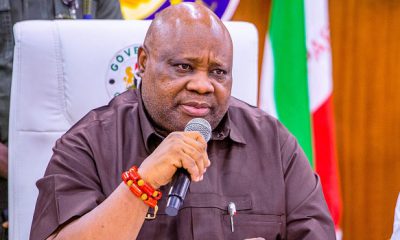
File photo : Senator Abdulfatai Buhari,
For over a decade, Buhari’s stabilising presence gave APC a reliable advantage in Oyo North. His vast constituency outreach, signature empowerment schemes, and his ability to connect with the average voter contributed to the party’s dominance across the district. His decision not to re-contest has, however, reignited longstanding agitation within Oke-Ogun, whose stakeholders have consistently argued that the senatorial seat had been over-concentrated in Ogbomoso. With Buhari acknowledging the evolving political expectations and redirecting his ambition toward Agodi Government House, the road to 2027 has become wide open.
Oyo North, comprising thirteen local government areas spread across Ogbomoso and Oke-Ogun zones, is renowned for its political diversity and shifting alliances.Oyo North, comprising thirteen local government areas spread across Ogbomoso and Oke-Ogun zones, is renowned for its political diversity and shifting alliances. Its LGAs—Atisbo, Irepo, Iseyin, Itesiwaju, Iwajowa, Kajola, Ogbomosho North, Ogbomosho South, Olorunsogo, Orelope, Ori Ire, Saki East, and Saki West —host distinct political tendencies that often determine outcomes at both primary and general elections. With Buhari’s exit, attention has now shifted to three major aspirants whose growing activities, consultations and subtle mobilisation have set the stage for a high-stakes internal contest.
One of the most prominent names is Professor Adeolu Akande, a lawyer, journalist, political scientist and former Chief of Staff to the late former Governor Abiola Ajimobi. Akande, who also served as ex-Chairman of the Nigerian Communications Commission (NCC), remains one of the most intellectually grounded figures in Oyo APC.
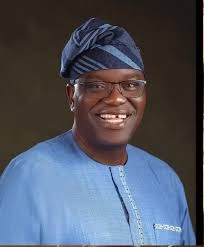
Prof. Adeolu Akande
Akande is from Otu, in Itesiwaju local government. His experience cuts across national politics, public administration and regulatory governance. He previously served as Deputy Chief Press Secretary to Vice President Atiku Abubakar in 2001 before becoming Special Assistant on Research and Communication Strategies to President Olusegun Obasanjo in 2003. With such a robust background, many within APC view him as a candidate who can elevate the district’s legislative relevance in Abuja. His appeal lies in his technocratic depth, policy expertise and the strategic calm. The major challenge he faces, however, is the absence of electoral history. Unlike other aspirants who have been repeatedly tested at the polls, Akande must convince delegates that the sophistication of his administrative record can translate effectively into political deliverables at the grassroots. Nevertheless, his early consultations suggest that he is already consolidating structures across Oyo North and strengthening bonds with critical party actors whose influence often shapes delegate loyalty.
Another strong contender is Mrs Hannah Olawunmi Ogunesan, a former Head of Service (HOS) in Oyo State and a respected administrator from Saki East Local Government.

Mrs. Hannah Ogunesan
Known for her firm yet inclusive style during the Ajimobi administration, Ogunesan commanded significant influence across the state’s civil service and political structures. Her involvement in identifying, mentoring and empowering political office holders, especially in the zone during her tenure has given her a strong grassroots presence, and also among women and civil service-oriented political blocs. Her candidacy introduces a compelling gender dimension in a district historically dominated by male politicians. Reports within political circles suggest she enjoys quiet goodwill from the presidency, especially through her relationship with First Lady Senator Oluremi Tinubu and that of late governor’s wife, Chief Florence Ajimobi. This has contributed to growing excitement among women’s groups and party members eager to see greater female representation at the federal level. Yet, like Akande, Ogunesan will have to overcome the perception of being new to direct electoral contests. She must intensify her engagements and demonstrate that administrative discipline can be transformed into political structure strong enough to win a senatorial primary and general elections.
In a related development, her relationship with the incumbent occupant of the seat, Sen. Buhari could be referenced to as an added advantage to her political aspiration.
The third formidable aspirant is Hon. Kareem Tajudeen Abisodun, popularly known as ‘Were’, a three-term member of the House of Representatives.
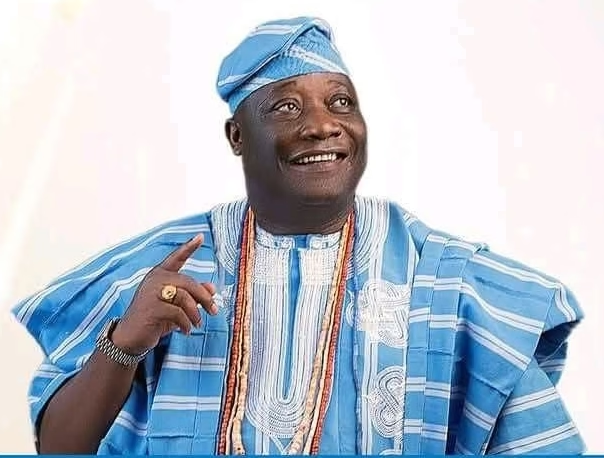
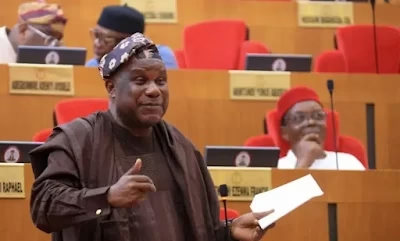
Hon. Tajudeen Kareem Abisodun Were
Representing Saki West/Saki East/Atisbo Federal Constituency. Tajudeen Were, is believed to have built a loyal constituency network anchored on continuous grassroots engagement which has given him rhythmic electoral victories. His current role as Chairman of the House Committee on Aviation Technology has further elevated his profile and broadened his connections within the national assembly. His biggest advantage lies in his electoral pedigree; he has survived tough contests and won repeatedly, making him the most field-tested contender among the trio. Across Saki East, Saki West and Atisbo, he is believed to be able to influence an impressive delegate base that may provide a strong launchpad into the primaries. However, while his political machinery is solid in parts of Oke-Ogun, he must expand his influence beyond his familiar territory into Kajola, Iwajowa and Ogbomoso axis, among other several local governments within Oyo North Senatorial district, where political loyalty is often determined by long-term relationships, not federal-level visibility. Without broadening his coalition, he faces the risk of a limited geographical advantage in a race that requires district-wide consolidation.
Beyond the individual strengths of the aspirants, the APC contest in Oyo North is deeply tied to internal power configurations. Stakeholders at the state level, including influential members of the late Ajimobi’s political family, Abuja-based powerbrokers and strategic party elders across Oke-Ogun, will be decisive in determining who secures the ticket. The influence of Senator Buhari remains particularly significant. Though now focused on the governorship, his political structure—built over twelve years—may tilt the scales in favour of an aspirant whose emergence does not conflict with his broader generational ambition. Delegates, under the APC’s primary framework, hold immense power. How the aspirants navigate ward leadership, LGA executives and zonal caucuses will ultimately decide their fate.
Grassroots mobilisation remains the heartbeat of electoral success in Oyo North. The district’s political culture demands consistent local engagement, especially with farmers, artisans, traditional rulers, youth organisations, market unions, religious leaders, community leadership and development associations. Any aspirant hoping to emerge must match or surpass the level of penetration Buhari achieved. This includes organising town hall meetings, expanding ward structures and articulating development plans that resonate across the district’s socio-economic landscape.
Funding will also shape the race. Senatorial contests require robust financial capacity to mobilise supporters, maintain campaign offices, fund consultations and execute strategic outreach. Akande’s connections in both public and private sectors, Ogunesan’s blended support across civil service networks and women-based organisations, and Kareem’s constituency-driven structure all present varying financial strengths. Yet, the campaign’s effectiveness—not just capacity—will be the determining factor.
As the primaries inch closer, the outcome will have far-reaching implications for the general election. A united APC increases the likelihood of retaining the seat, but a divisive or poorly managed primary could trigger internal fractures, defection of aggrieved blocs or parallel mobilisation that opposition parties may readily exploit. APC must present a strong, cohesive front if it hopes to maintain control in 2027.
The race for the APC ticket in Oyo North stands today as a defining moment for the party. With a technocrat in Akande, a barrier-breaking administrator in Ogunesan and a seasoned legislator in Kareem, the contest presents a rich blend of intellectual capacity, gender representation and electoral competence. Whoever emerges must not only win the trust of delegates but also articulate a vision capable of uniting a politically diverse district.
As political manoeuvres intensify, alliances broaden and silent negotiations unfold, Oyo North remains one of the most intriguing battlegrounds to watch ahead of 2027—an arena where experience, ambition and strategy will ultimately determine the future of APC’s dominance.










IGP Disu seeks NIPR partnership to boost public trust in police

2027: Wike backs Tinubu, says PDP will field candidates