Connect with us

News

2027 Elections: Experts Decry Leadership Failure, Chart Way Forward at SWEGOP Anniversary

Published

on


EFCC, ICPC strong in law, weak in action – Akande

• Online publishers must rescue Nigeria’s democracy – Farounbi


As Nigeria inches closer to the 2027 general elections, prominent voices in media, governance, and civil society have expressed concern over the country’s deepening leadership deficit, warning that continued public distrust, systemic corruption, and elite capture could threaten democratic consolidation.

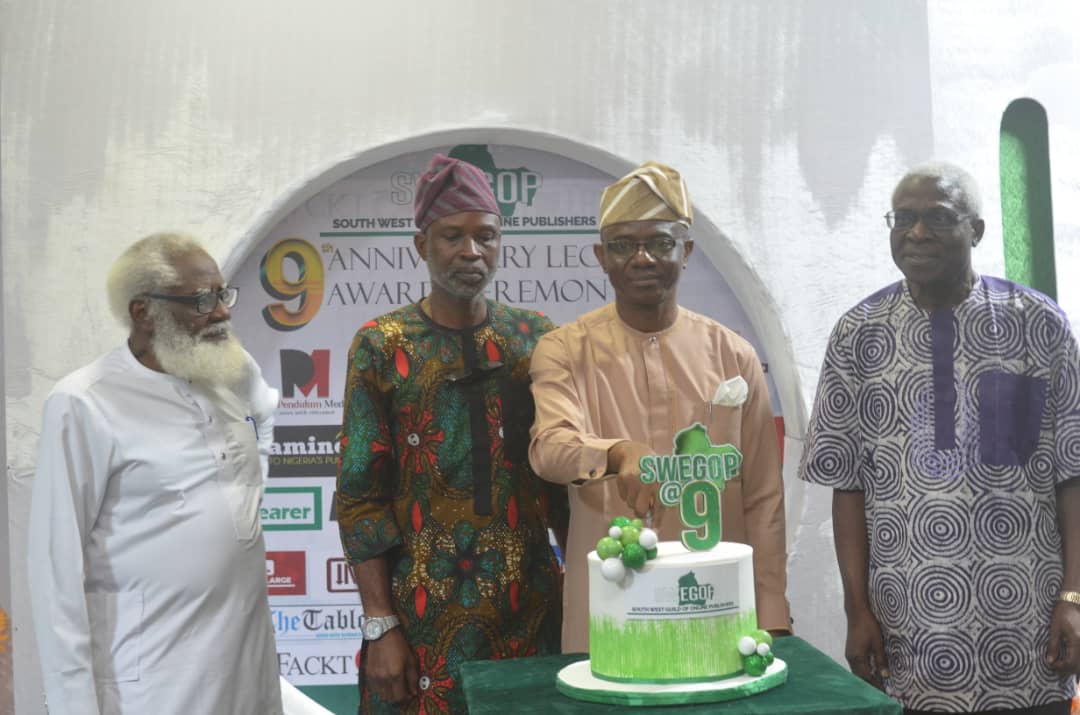
The alarm was sounded on Wednesday at the 9th Anniversary Lecture and Award Ceremony of the South West Guild of Online Publishers (SWEGOP), held at the International Conference Centre, University of Ibadan, Oyo State. The event drew a cross-section of journalists, academics, diplomats, and public policy experts who gathered to reflect on the theme of good governance and national rescue.

Delivering the keynote on behalf of the Guest Lecturer, Prof. Adeolu Akande, a respected journalist, editor, and former presidential spokesperson, Dr. Idowu Johnson presented a critical evaluation of Nigeria’s governance architecture, warning that the country has been “captured by the bourgeoisie,” leaving democratic ideals hollow and leadership without legitimacy.

“The Nigerian state has been hijacked by an elite class whose primary interest is accumulation and self-preservation,” Johnson said. “Until we address this structural distortion, we cannot talk about good governance, justice, or national development.”

He noted that more than sixty years after independence, millions of Nigerians still lack access to basic social services such as education, healthcare, housing, and food. Johnson recalled a time in the 1970s when modest salaries could afford decent living and personal growth, contrasting it with today’s harsh economic realities.

According to him, Nigeria’s progressive decline in service delivery is evident in the education sector, where PhD tuition at the University of Ibadan has risen from ₦19,000 in 2003 to over ₦300,000 in recent years, while academic staff salaries have barely moved. This, he said, has made education inaccessible to many and worsened the brain drain.

Johnson described the state of healthcare as equally worrisome, recalling how Lagos once had functional and free primary healthcare centres during his childhood. He lamented that the collapse of such essential systems has pushed the country deeper into poverty, insecurity, and underdevelopment.

The speaker identified corruption, lack of accountability, money politics, ethno-religious manipulation, and abuse of the rule of law as major barriers to good governance. He criticized the failure of anti-corruption agencies like EFCC and ICPC, noting that despite having strong legal frameworks, they remain weak in execution and selective in enforcement.

“Impunity thrives because nobody has been punished. Those who destroyed the economy still walk free and even contest elections. The institutions exist, but they lack political will and courage,” Johnson said.

The Don stressed that the 2027 elections represent a critical opportunity to reform Nigeria’s democratic process and rebuild public trust. Among his recommendations were electoral reforms, including electronic transmission of results, recovery of looted funds, institutional strengthening, and the enforcement of campaign finance laws.

Johnson also challenged journalists and citizens to go beyond commentary and actively participate in politics. “Why can’t media professionals or the average Nigerian run for governor or president?” he asked. “Because politics has been monetized. A governorship race can cost up to ₦50 billion—this must change.”

Earlier in his welcome address, SWEGOP President, Pastor Bisi Oladele, described the lecture as a timely intervention to address the widening gap of trust between government and the governed. The ex-Nation Newspaper Southwest Bureau Chief  said SWEGOP remains committed to professionalising online journalism, defending press freedom, and promoting civic education.

“We are building a Guild that holds power accountable and empowers the people,” Oladele said. “We want to transform online publishing in Nigeria into a credible, ethical, and development-focused sector.”

Also speaking, former Nigerian Ambassador to the Philippines and veteran journalist, Dr. Yemi Farounbi, underscored the media’s central role in shaping the nation’s democratic future. He urged online publishers to become watchdogs of democracy by fact-checking claims, investigating corruption, and tracking campaign promises.

“You cannot recycle the same politicians and expect different results,” Farounbi said. “Online media must educate the masses, mobilise the youth, and expose the rot in the system. That is the only way to reclaim Nigeria.”

He also emphasized the need to amplify the voices of minority groups, women, and the opposition, while discouraging hate speech and promoting issue-based campaigns that strengthen national unity.

In a goodwill message, Mr. Awowole Brown, representing Alhaji Aliko Dangote, commended SWEGOP for its resilience and reaffirmed Dangote Group’s support for independent media. He acknowledged the financial struggles faced by journalists and praised their continued commitment to public interest.

“Despite poor remuneration and hostile working conditions, journalists remain undeterred. Their contributions are invaluable, and as a brand, we recognise their growing influence and integrity,” Brown stated.

Comments

News

Iran War Disrupts Oil Supply, Global Loss Hits $50bn

Published

on

The global oil market has recorded losses exceeding $50bn following massive supply disruptions triggered by the ongoing Iran war, which has now stretched to nearly 50 days.

Data from energy analytics firm Kpler showed that more than 500 million barrels of crude oil and condensate have been wiped off the global market since the crisis began in late February, making it the largest energy supply disruption in modern history.

Iran’s Foreign Minister, Abbas Araqchi, on Friday said the Strait of Hormuz had been reopened after a ceasefire agreement reached in Lebanon.

However, tensions escalated again on Saturday as Tehran warned it could shut the strategic waterway if the United States sustains its blockade of Iranian ports.

Also, U.S. President Donald Trump expressed optimism that a deal to end the conflict could be reached “soon,” although he did not provide a definite timeline.

Analysts warned that the scale of disruption could have prolonged effects on global energy stability, with shocks expected to linger for months or even years.

Providing context, Principal Analyst at Wood Mackenzie, Iain Mowat, said the 500 million barrels lost is equivalent to grounding global aviation demand for 10 weeks, halting all road transport worldwide for 11 days, or shutting down the entire global oil supply for five days.

Further estimates showed that the lost volume is nearly equal to one month of oil demand in the United States or more than a month’s supply for Europe. It also represents about six years of fuel consumption by the U.S. military and could power global shipping activities for approximately four months.

The crisis has significantly affected oil-producing nations in the Gulf, with output losses reaching about eight million barrels per day in March—roughly equivalent to the combined production of two of the world’s largest oil companies.

Jet fuel exports from major producers, including Saudi Arabia, Qatar, the United Arab Emirates, Kuwait, Bahrain, and Oman, dropped sharply from 19.6 million barrels in February to just 4.1 million barrels recorded across March and April combined. Analysts said the shortfall could have powered about 20,000 round-trip international flights.

With crude prices averaging around $100 per barrel since the onset of the conflict, the lost volumes translate to an estimated $50bn in revenue. Experts noted that this figure is equivalent to about one per cent of Germany’s annual Gross Domestic Product, or roughly the size of the economies of smaller European countries.

Meanwhile, global onshore crude inventories have declined by about 45 million barrels in April alone, while total production outages have risen to approximately 12 million barrels per day since late March.

Industry experts cautioned that unless a lasting resolution is reached, the disruption could intensify volatility in global oil markets, worsen inflationary pressures, and further strain fragile economies worldwide.

Continue Reading

News

Oseni Secures Prestigious City People Political Award Nomination

Published

on

A member of the House of Representatives representing Ibarapa East/Ido Federal Constituency and Chairman of the House Committee on Federal Roads Maintenance Agency, Aderemi Oseni, has been nominated for a Special Award in Politics at the 2026 City People Political Awards.

The nomination was conveyed in a letter dated April 13, 2026, signed by the Publisher/Editor-in-Chief of City People Magazine, Seye Kehinde.

The development was disclosed in a statement issued by Oseni’s media aide, Idowu Ayodele, and made available to journalists in Ibadan on Thursday.

According to the statement, the lawmaker earned the nomination in recognition of his “outstanding contributions to politics in Oyo State, particularly in Ibarapa East/Ido Federal Constituency.”

The organisers noted that Oseni emerged as a nominee following a comprehensive review of performances across sectors by the award’s selection committee.

Part of the letter read, “Having performed creditably well in your sector last year, the Organising Committee presented you as a nominee in your sector.”

The award ceremony is scheduled to hold on Sunday, May 3, 2026, at Etal Hall, Kudirat Abiola Way, Oregun, Ikeja, Lagos, at 4pm.

The City People Awards is an annual event that recognises individuals who have distinguished themselves in governance, public service and other sectors of national development.

Continue Reading

News

Kaduna Electric to prosecute, expose attackers of staff

Published

on

The Kaduna Electricity Distribution Company has announced a crackdown on individuals who assault its staff, warning that offenders will face prosecution and public exposure.

In a statement issued on Thursday, the company expressed concern over what it described as a “disturbing surge” in attacks on its field workers and third-party partners.

It noted that the affected personnel were mainly engaged in meter installation, revenue collection and maintenance of electricity infrastructure.

According to the firm, the increasing cases of harassment, physical assault and unlawful detention of its workers pose a serious threat to employee safety and the stability of electricity service delivery across its franchise areas.

The Deputy Managing Director, Abubakar Mohammed, said the company would no longer tolerate any form of aggression against its workforce.

“Let this serve as a clear warning to anyone who engages in the assault of our staff. Kaduna Electric will pursue every case to its logical conclusion,” he said.

“We will work closely with security agencies to ensure offenders are brought to justice and face the full weight of the law,” Mohammed added.

He further disclosed that the company would publicly reveal the identities of individuals found culpable.

According to him, names, photographs and other details of offenders would be published on the company’s official platforms as well as in national and local media.

“This measure is intended to ensure accountability and serve as a strong deterrent. Anyone who chooses to attack our personnel should be prepared not only to face prosecution but also public exposure,” he added.

The company stressed that assaults on utility workers attract serious legal and financial consequences, noting that offenders risk criminal charges that may lead to fines or imprisonment.

It added that perpetrators could also face civil liabilities, including compensation for medical treatment, psychological trauma and loss of work hours.
While condemning the attacks, Kaduna Electric urged customers to adopt peaceful and lawful means of resolving disputes.

It advised aggrieved customers to channel complaints through its customer service units or appropriate regulatory bodies.

The management reaffirmed its commitment to protecting its workforce and partners, stressing that a safe working environment is essential for delivering reliable and efficient electricity services.

Although disputes between electricity providers and consumers are often linked to billing issues, metering challenges and service delivery concerns, the company maintained that such matters must be resolved through dialogue, insisting that violence against its staff will no longer be tolerated.

Continue Reading

Advertisement

Entertainment

Advertisement

MegaIcon Magazine Facebook Page

Advertisement

MEGAICON TV

Advertisement

Trending