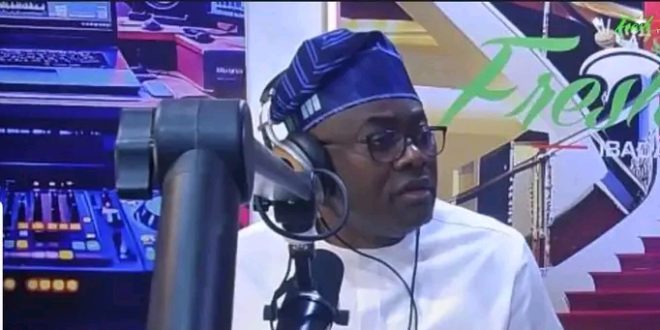
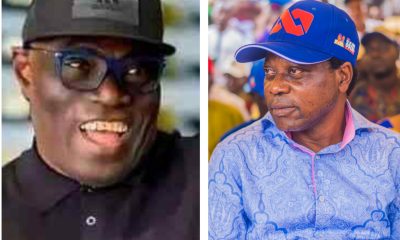
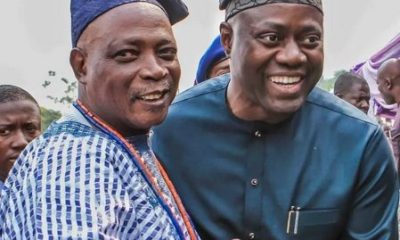
I knew that Governor Makinde would provide us with a hundred and twenty minutes of comic relief and at the same time, I knew he is bound to commit unforced errors which would further expose his shenanigans.
The outgoing Governor of Oyo state did not disappoint on both fronts.
Personally, I understand the need for him to have one final valedictory Media Chat.
The atmosphere might be too hot for him to even think of such luxury after the general election in 2027. So, if he’s got the opportunity now, why not take a shot at it?
I must however say that the Governor displayed his insensitivity right from the choice of the Studio the Chat was aired.
Shortly before the Media Chat commenced, I came across a release signed by the Chairman of the Nigeria Union of Journalist, NUJ, BCOS Chapel, Com. Ademola Balogun.
Com. Balogun was full of lamentations concerning the very terrible state of the Oyo state Broadcasting Corporations, BCOS.
He was of the very strong opinion that the BCOS should have meaningful opportunities to cover Government activities.
He also called on Governor Seyi Makinde to empower the BCOS to invest in modern studio, transmitting equipment, digital broadcasting facilities and online platforms.
Com. Ademola spoke extensively about Staff welfare and other issues.
Sadly, while Governor Seyi Makinde has been consistent in empowering a particular Radio station, the Broadcasting Corporations of Oyo state, BCOS has been dying slowly.
Unfortunately, I have no good news for Com. Ademola. His lamentations will definitely fall on stone deaf ears. It is too late for Governor Makinde to change his ways. I just pray that the Governor would not wake up one day and sold off whatever remains of the Corporation.
That is just by the way. Let me address Governor Makinde’s Media Chat for whatever it is worth. The Governor spent a whole two hours venting anger and spreading outright lies and half-truths.
I am surprised that Governor Makinde has not seen any reason for him to have a second thought about his awkward and reckless comments about the Law Profession.
I am saying this because, for the second time, his Deputy was sitting closely beside him and yet, he felt like it was humorous for him to take a dig at Senator Sarafadeen Abiodun Alli, the All Progressives Congress, APC Gubernatorial candidate, regarding his misconceived failure as a Law practitioner.
He repeated the ignorant and reckless comments about Senator Alli, not being a Senior Advocate of Nigeria and for that reason, according to Governor Seyi Makinde, the Oyo South Senator is not an accomplished Legal Practitioner.
He had made that same reckless comments a couple of weeks ago and at that time also, the Deputy Governor was beside him!
The respectable man is an accomplished Lawyer of many years of experience, who had trained a lot of successful Lawyers.
I also wonder, how people like Dr. Nureni Adeniran and Olasunkanmi Olaleye, who are also Lawyers and have been working with Governor Seyi Makinde over the years would feel about those reckless comments coming from their Boss.
If you want to follow Governor Seyi Makinde’s reasoning, if you are a teacher and you did not rise to the status of a School Principal or Head teacher, then, you’re a failure.
If you are a Military Personnel and you didn’t rise to the position of a General, you’re a failure!
Any time I saw the Governor arguing in this regard, I always asked myself if he was actually himself, because, for me, only a drunkard is capable of reasoning in that manner, or, perhaps, some young elements who had taken so much banned substances.
I have carefully analyzed the 120 minutes Media Chat and I saw that Governor Seyi Makinde spent so much time treating two issues.
The first, being his frustration about his perceived betrayal by president Bola Ahmed Tinubu and the second being his failed attempt to rewrite the Constitution of Nigeria regarding the financial autonomy for Local Governments.
The birthday boy tried to work him through the crisis at the Circular Road, but it was obvious that the main reasons behind Governor Makinde’s Media Chat were grounded on his firm beliefs that Tinubu breached certain agreements with him and others in 2023 and his warped opinion about how the Local Governments should operate within our Federation.
Let’s start with Governor Seyi Makinde’s allegations against Tinubu.
According to him, in 2023, an agreement was signed between certain individuals, including himself.
He said there was an agreement that a Government of National Unity would be formed by president Tinubu after he won the presidential election of 2023 and that he and the Governor of Lagos state, Babajide Sanwo-Olu were signatories to that agreement.
According to him, president Tinubu was not a signatory to the agreement but he was informed after the agreement was signed!
He went further to say that on the strength of that agreement, he presented Bimbo Adekambi as a Ministerial nominee because the president had earlier told him that he wanted to appoint the Minister for Budget and Planing from Oyo state.
To his chagrin and disappointment, president Tinubu settled for Bayo Adelabu and asked him to own the nomination of the former Minister for power, a request he claimed he rejected.
He therefore concluded that all the Ministers nominated from the South West are from Bourdilon.
I have carefully analyzed this confession by Governor Seyi Makinde and I have a few questions for him.
Why is it that Governor Seyi Makinde is the only one complaining about a breached agreement?
Why did it take him all these long to come out with this fact?
What was the criteria for the nomination of Bimbo Adekambi? Did he just take a random decision to choose Adekambi without a prior relationship between the two of them or what?
How does Governor Seyi Makinde want to convince any right thinking person that he believed an agreement would be binding on Tinubu on the strength of Governor Sanwo-Olu’s alleged signature?
For me, that doesn’t make any sense, most especially, for an ” accomplished Engr” like Seyi Makinde!
I am surprised that Governor Makinde leaves out what he benefited from the alignment with Tinubu in 2023.
Remove the alignment with Tinubu in 2023, Seyi Makinde was a goner and the fact that he was able to secure a second term in office ought to have been enough for him.
I am also surprised that Governor Makinde didn’t understand that he was advertising his penchant for serial betrayal and greed when he was relating the events that shaped his re-election in 2023.
It was all about him and the decisions he took, not only affected the Peoples Democratic Party, PDP alone, it also affected certain candidates of his party during the first ballot in 2023.
Now, to the issue of Local Government Autonomy.
Governor Seyi Makinde is a very funny individual. He was very clear about his position on Local Government Autonomy in 2023.
His position was that he never even believed in their existence and I was amused when the birthday boy was saying that despite his position on Local Government Autonomy in 2023, he was still able to win in 31 Local Governments, signifying the fact that the people of Oyo state believed Governor Makinde’s explanations.
I am extremely happy that Governor Seyi Makinde has not changed his opinion on how Local Governments should operate within the Federating units.
He is still stuck on the fact that the 33 Local Governments in Oyo state should be appendages to the State Government, even, in spite of the Judgment of the Supreme Court granting them full financial autonomy.
I am shocked that Governor Seyi Makinde could attempt to confuse what happened between the Lagos state Government when Tinubu was Governor of the state and the Federal Government during Obasanjo’s period, with the illegalities he has been perpetuating with the resources 33 Local Governments.
There is a clear distinction between both scenarios.
In the case of Tinubu as Governor of Lagos state, the Lagos state Government created more Local Governments and the Federal Government was of the opinion that the state Government was wrong to have done so.
As a result of this misunderstanding, the Federal Government stopped the monthly allocations for the Local Governments in Lagos state and it led to a Judicial dispute.
In the end, the Supreme Court held that the Local Governments created by the Lagos state Government were incohate, but it faulted the Federal Government for withholding the monthly allocations belonging to the Local Governments in Lagos state.
Lagos state Government thereafter recognized and administered the newly created Local Governments as Local Government Development Areas and many states have since copied the template, including Oyo state.
In the present scenario, the president, through the Attorney general of the Federation approached the Supreme Court and sought to secure full financial autonomy for the 774 Local Governments and the Supreme Court agreed to the request.
I have been asking myself, why is it that Governor Seyi Makinde is having problems with that judgement?
The monthly allocations released to the 33 Local Governments are released against their names.
Is Governor Seyi Makinde saying that it is proper for a Governor to still be the supervisor for the 33 Local Governments?
How does the judgment of the Supreme Court translate to the Federal Government trying to take control of the 774 Local Governments?
Yorubas will always say that a dog can not stand watch over two different buildings. ( Aja kii roro, ko so ojule meji po).
I was also surprised to hear Governor Seyi Makinde talking about the fact that, instead of full financial autonomy for the Local Governments, he preferred to discuss about how the Local Governments could be empowered to survive without monthly allocations from Abuja.
Haba! Governor Makinde!! Gently now.
You are depriving the Local Governments of their entitlements and you except them to thrive. How would that happen?
Why didn’t we start with the state? Can Oyo state survive without monthly allocations?
I think everyone can now see that Bimbo Adekambi as Governor, would never allow the Local Governments to breathe.
On the other hand, Senator Sarafadeen Abiodun Alli has promised to guarantee full financial autonomy for the 33 Local Governments and the implementation of the policy requires no rocket science. All it requires is the will.
There is an existing judgment of the Supreme Court which has outlined the steps to be taken by any willing state Government.
Sarafa Alli only needs to direct relevant stakeholders at the Local Governments to comply with the judgment and that is the end of the matter.
What is so difficult in that, if you are not covetous?
I might have to do this piece in series but I will like to warn the residents of the Circular Road.
You heard Governor Seyi Makinde. He is promising you nothing.
My only problem with him is his attempts to shift the blame of the chaos he orchestrated at the Circular Road on the late Governor Abiola Ajimobi.
He even said that that the Government of Ajimobi defrauded residents of the Circular Road!
Sometimes, people like Governor Seyi Makinde needs no one to enchant them. Their character is an enchantment on itself.
If you’re saying that the Governments of the late Ajimobi defrauded residents of the Circular Road, is Bimbo Adekambi not an integral part of that Government and that is before you begin to ask the Governor for proofs.
I enjoyed Governor Seyi Makinde’s valedictory Media Chat, while looking forward to the new era awaiting him next year.
My father used to tell us that the mouth of the liar does not ooze blood. ( Enu opuro kii seje).
By the way, I saw that Governor Seyi Makinde never mentioned anything about the report of the Judicial Commission of Inquiry into the abduction of Teachers and Pupils of Yawota and Esinele communities of Oriire Local Government.
How far now?
Sola Abegunde.