Connect with us

Top Stories

17 Things You Should Never Do In Europe

Published

on

Travelers beware:  The authorities in Europe are really cracking down. Italy recently made headlines due to all the strict new regulations across the country, from a law prohibiting anyone from sitting on Rome’s Spanish Steps to fines for wearing flip-flops in Cinque Terre. Now, you can add stealing sand from a beach. You read that right: Two French tourists are facing up to six years of jail time for taking sand from a beach on the island of Sardinia.

And it’s not just Italy: Countries across the Continent are fining tourists for the most unlikely offenses. Last year, two tourists got fined €25 (about $27) for getting lost in a Metro station in Paris. This summer, a surprised traveler in Mallorca was fined €100 ($111) for buying goods from an illegal street vendor. Meanwhile, in the Mallorcan town of Magaluf, lawmakers have published a list of 64 banned actions with penalties ranging from €100 ($111) to €3,000 ($3,335) for everything from damaging flowers to climbing trees. The island city of Hvar, Croatia will fine you for a lengthy list of inappropriate public behavior, including walking around in a swimsuit—a €600 ($667) fine. And in Amsterdam, which is known for its brothels and marijuana cafés, the city recently launched the Enjoy and Respect campaign, with fines for drinking in public, making noise, littering and more.

Supporters say it’s all an attempt to keep unruly tourists in line. “Young tourists are welcome, but they will have to learn how to behave here,” Hvar’s fed-up mayor Rikardo Novak told local media when he instated those fines.

Critics say all these rules are way too punitive. The move has sparked debates online with some saying it’s a sure-fire way to turn off tourists. But maybe that’s the point? Stephen Hodes, the founder of an independent think tank called Amsterdam in Progress, says he thinks Amsterdam hasn’t been strict enough. ”There are too many tourists,” he says. “The only thing to do is to take radical measures, otherwise it’s a consumption ghetto, not a city where people live.”

Whatever the case, these rules aren’t going anywhere. So before you plan a trip to Europe, check out these 17 regulations that just might get you in big trouble and turn that dream European vacation into a nightmare.

1. Stealing Sand: As those French travelers discovered, Sardinia wants people to keep their hands off its sand. A 2017 law made it illegal to remove sand, pebbles and shells, with fines of up to €3,000 (about $3,330). Last year, a tourist from the UK got fined €1,000 ($1,100) for stealing sand.

2. Traveling with Designer Rip-Offs: Leave that fake Rolex at home. In France, tourists can get fined up to €300,000 ($334,000) for bringing counterfeit goods into the country. Other countries like Austria, Ireland and Croatia are similarly strict.

3. Ripping Your Currency: Be careful how you handle your money in Turkey: Defacing or tearing up the local currency can carry a prison sentence of between six months to three years.

4. Wearing a Bikini… and Nothing Else: In many parts of Europe, including the Spanish island of Mallorca and the Croatian towns of Split and Hvar, it’s against the law to wear only a bikini or swimming shorts in the street. Authorities may impose fines if people are caught wearing swimwear away from the beach; in Mallorca that even extends to the seafront promenade.

5. Peeing in the Ocean: Really? Portugal has a bizarre law on the books saying that you can get busted for using the ocean as your toilet. Here’s the thing: Who will ever know?

6. Wearing a baggy swimsuit: Sorry guys, but if you’re headed to a public pool in France, you’ll need to learn those trunks at home and don a tight-fitting Speedo-type swimsuit instead.

7. Behaving Badly: Signs reading “Save Your Money and Enjoy Hvar” greet tourists at the entrances to the center of the town in Croatia, graphically detailing offenses and the corresponding penalties. The highest fine, €700 ($778), is for public alcohol-drinking, eating or sleeping.

8. Taking Selfies: Better to just ask a fellow tourist to snap a photo for you. In the center of Milan, selfie sticks were recently banned—in addition to glass bottles and food trucks—as authorities try to limit littering and anti-social behavior.

9. Wearing Heels at Historic Sites: Save your fancy outfits for dinner. Heels are banned at certain Greek archaeological sites, including the Acropolis.

10. Driving in Sandals: Proper footwear required! Driving while wearing flip-flops or sandals is a criminal offense in Spain, and comes with a fine of €200 ($222).

11. Hiking in the Buff: In 2011, a Swiss court made it illegal to hike naked. The case came about after a German man strode nude past a family picnicking near the Swiss Alps. Naked hiking had become increasingly popular in the years before the court ruling.

12. Running out of Fuel: Cruising on Germany’s Autobahn? Make sure your fuel tank is topped off. It’s illegal to run out of fuel while driving on the famed road.

13. Kissing on a Train Platform: Lips off! Couples have been banned from kissing on train stations in Manchester, England (a more recent law) and France (on the books since 1910). The reason? It holds up commuters and rail delays.

14. Driving Without a Breathalyzer: It’s illegal in France to drive without a breathalyzer in the car. Although the on-the-spot fine of €11 ($12) is no longer carried out by the government, it remains against the law.

15. Jaywalking: Germany takes its road safety very seriously. It’s a common social rule not to cross a pedestrian crossing before the light turns green. If you make a run for it, you could be fined €5-€10 ($5-$11).

16. Public Drinking: Holiday resorts across the Spanish island of Mallorca stepping up sanctions against rowdy tourists with a range of new penalties. Tourists and locals could face fines of up to €600 ($667) if caught drinking on the street.

17. Hailing a Cab if You’re Sick: The Public Health (Control of Disease) Act of 1984 makes it illegal to flag down a taxi in England if you have a “notifiable” disease without telling the driver. Then the driver can decide whether he/she wants to take you where you need to go. Our guess? You’re not going anywhere.


By Laura Begley Bloom

Source: Forbes



Comments

Crime & Court

Ondo methanol deaths: Police arrest suspected producer, 14 others

Published

on

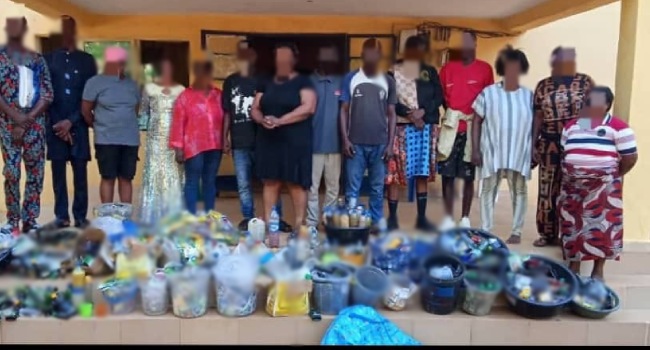
Some of the suspects arrested by the police

The Ondo State Police Command has arrested a suspected producer of substances believed to contain methanol following the sudden deaths of about 30 residents of Araromi-Obu and other communities in Odigbo Local Government Area of the state.

The suspect, whose identity was not disclosed, was arrested after the police commenced an investigation into the deaths reportedly linked to the consumption of suspected contaminated alcoholic drinks and concoctions.

The state Police Public Relations Officer, DSP Abayomi Jimoh, disclosed this in a statement made available to journalists on Sunday evening.

Jimoh said the suspect was assisting the police with the investigation, adding that substances suspected to contain methanol had also been recovered.

He said the recovered substances had been subjected to further investigation and forensic examination to determine their exact composition and establish whether they were linked to the reported deaths.

The police spokesperson added that the bodies of the deceased were also undergoing medical and forensic procedures to establish the actual cause of death.

He said, “The outcome of these examinations is expected to provide further medical evidence regarding the actual cause of the deaths.”

Jimoh further disclosed that operatives of the state Criminal Investigation Department had arrested 14 other suspects comprising alleged sellers and consumers of the drinks and concoctions at different locations in the affected communities.

The development came days after the Ondo State Government confirmed that 29 people had died following the suspected consumption of contaminated alcoholic beverages in Araromi-Obu and other communities in Odigbo LGA.

The state Commissioner for Health, Banji Awolowo-Ajaka, who disclosed this on Friday, said 60 cases had so far been recorded.

According to him, three of the affected persons were receiving treatment in hospitals, while 27 others were under medical observation.

The commissioner said about 95 per cent of those affected were males aged between 16 and 55.

He listed the affected communities as Orita Odigbo, Araromi-Obu, Newtown, Odole, Okele and Oniparaga.

Awolowo-Ajaka said the victims presented symptoms including headache, body pain, general weakness, visual impairment, difficulty in breathing and altered consciousness.

He added that some of the patients deteriorated rapidly and died within a few hours.

Following the development, the Commissioner of Police, Felix Ohagwu, directed sustained enforcement against the production, distribution and sale of unapproved, adulterated or otherwise dangerous alcoholic substances across the state.

The police said the investigation was ongoing, while the forensic examination of the recovered substances and the remains of the deceased would help determine the exact cause of the deaths.

Continue Reading

Health

Ondo bans unverified alcohol after 29 die

Published

on

The Ondo State Government has ordered the immediate ban on the sale and distribution of unverified alcoholic drinks and other substances following the deaths of 29 people in Odigbo Local Government Area of the state.

The government also directed security agencies to take immediate action against the sale and distribution of illegal and unapproved products across the state.

The Commissioner for Information and Orientation, Idowu Ajanaku, announced the directive in a statement on Saturday following the deaths and reported cases of illness in several communities in Odigbo.

The state Commissioner for Health, Dr Banji Awolowo-Ajaka, had earlier confirmed that 29 people had died after consuming a suspected contaminated alcoholic drink, while 60 suspected cases had been recorded.

Ajaka said three of the affected persons were receiving treatment in hospitals, while 27 others were under medical observation.

According to him, 95 per cent of those affected were males aged between 16 and 55, with cases reported mainly in Orita Odigbo, Araromi-Obu, Newtown, Odole, Okele and Oniparaga communities.

The commissioner listed the symptoms recorded among the victims as headache, body pain, general weakness, visual disturbance, difficulty in breathing and altered consciousness.

He said some of the patients deteriorated rapidly, resulting in death within a few hours.

Ajaka, however, said the government had yet to establish scientifically that the suspected alcoholic drink was responsible for the deaths.

“The pattern of illness and reported history of exposure have raised strong epidemiological suspicion of exposure to a probable toxic alcoholic substance.

“However, we are yet to have laboratory evidence of the cause of the deaths,” he said.

The commissioner said 36 blood and urine samples had been collected from affected persons for laboratory analysis, while samples of the suspected alcoholic substances had also been submitted for toxicological investigations.

Meanwhile, the state government said scientific officers from the Ministry of Health had been deployed to the affected communities to investigate the substance suspected to be responsible for the deaths and determine its exact composition.

The government urged residents to stop purchasing or consuming unverified alcoholic drinks and other substances, particularly products packaged in sachets or bottles without the approval of the National Agency for Food and Drug Administration and Control.

It also warned sellers and distributors against purchasing, selling or making available for public consumption any substance whose source, content or regulatory status could not be verified.

“Anyone found violating this directive will face the full wrath of the law,” the government warned.

The government said the directive was aimed at preventing further loss of lives and ensuring that the incident did not spread to other parts of the state.

It urged residents to remain vigilant and report suspicious products and activities to the relevant authorities.

The government said the directive was part of the efforts of the administration of Governor Lucky Orimisan Aiyedatiwa to unravel the circumstances surrounding the deaths, protect residents and prevent further casualties.

It assured residents that the investigation would continue until the substance responsible for the deaths, if confirmed, was identified.

Continue Reading

News

Nigeria’s Oil Output Rises to 1.68m Barrels Per Day

Published

on

Nigeria’s crude oil and condensate production rose to 1.68 million barrels per day in August 2026, representing a 0.4 per cent increase from the 1.67 million barrels per day recorded in July.

The Nigerian Upstream Petroleum Regulatory Commission disclosed this in its latest production report released on Sunday.

Excluding condensate, the country produced an average of 1,500,190 barrels of crude oil per day in August, allowing Nigeria to meet its Organisation of Petroleum Exporting Countries quota for the fourth consecutive month.

Daily combined crude oil and condensate production ranged between 1.64 million barrels and 1.71 million barrels during the month under review.

A breakdown of production by terminals showed that Bonny Terminal recorded the highest output at 320.04 thousand barrels per day, followed by Forcados Terminal with 317.40 thousand barrels per day.

Qua Iboe Terminal recorded an average production of 171.72 thousand barrels per day, while Escravos Oil Terminal posted 131.71 thousand barrels per day.

Bonga ranked fifth among the highest-producing terminals, with an average output of 92.50 thousand barrels per day.

The NUPRC attributed the modest improvement in August production largely to the resolution of operational challenges involving the Single Buoy Mooring at the Erha field.

The commission said the challenges had adversely affected production in the preceding month.

“The restoration of normal evacuation and production operations at the asset contributed positively to overall production volumes during the period under review,” the commission’s spokesperson, Eniola Akinkuotu, said in a statement on Sunday.

The regulator added that production activities across most other producing assets remained relatively stable during the month.

“Production activities across most other producing assets remained relatively stable, with operators sustaining implementation measures aimed at optimising production efficiency, maintaining asset integrity, and minimising operational disruptions,” the statement said.

The latest figures indicate a continued improvement in Nigeria’s oil production, with the country maintaining its OPEC quota compliance for the fourth consecutive month.

Continue Reading

Trending

All Rights Reserved. Copyright © 2026 MegaIcon Magazine