News
US House Speaker, Pelosi lands in Taiwan despite China’s warnings

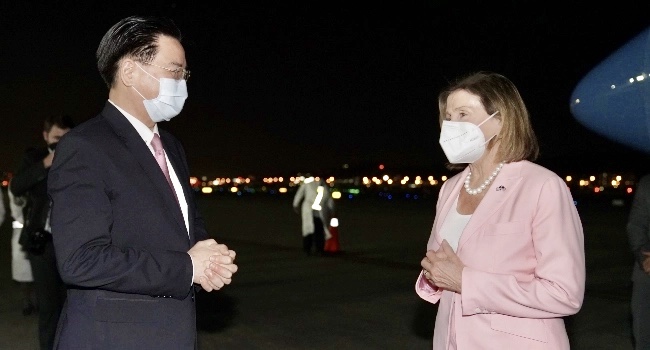
United States House Speaker Nancy Pelosi landed in Taiwan on Tuesday evening, defying a string of increasingly stark warnings and threats from China that have sent tensions between the world’s two superpowers soaring.
Pelosi, second in line to the presidency, is the highest-profile elected US official to visit Taiwan in 25 years and Beijing has made clear that it regards her presence as a major provocation, setting the region on edge.
Live broadcasts showed the 82-year-old lawmaker, who flew on a US military aircraft, being greeted at Taipei’s Songshan Airport by foreign minister Joseph Wu.
“Our delegation’s visit to Taiwan honours America’s unwavering commitment to supporting Taiwan’s vibrant Democracy,” Pelosi’s official Twitter account tweeted moments after she arrived.
She added her visit “in no way contradicts” US policy towards Taiwan and Beijing.
Pelosi is currently on a tour of Asia and while neither she nor her office confirmed the Taipei visit, multiple US and Taiwanese media outlets reported it was on the cards — triggering days of building anger from Beijing.
The People’s Liberation Army said it was on “high alert” and would “launch a series of targeted military actions in response” to the visit.
“Those who play with fire will perish by it,” Beijing’s foreign ministry added.
No need for ‘crisis’
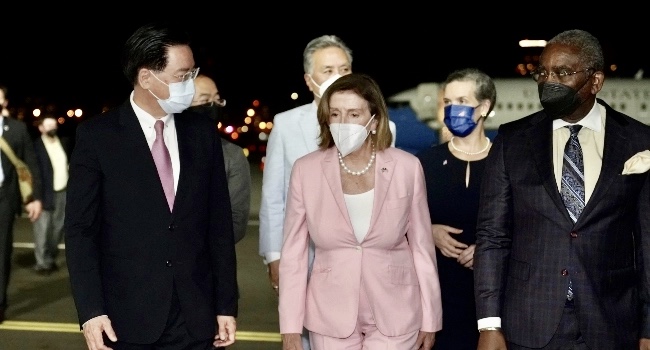
TAIWANESE FOREIGN MINISTRY / HANANADOLU AGENCYAnadolu Agency via AFP
China considers self-ruled, democratic Taiwan as its territory and has vowed to one day seize the island, by force if necessary.
It tries to keep Taiwan isolated on the world stage and opposes countries having official exchanges with Taipei.
In a call with US President Joe Biden last week, Chinese President Xi Jinping warned Washington against “playing with fire” on Taiwan.
While the Biden administration is understood to be opposed to a Taiwan stop, White House National Security Council spokesman John Kirby said Pelosi was entitled to go where she pleased.
“There is no reason for Beijing to turn a potential visit consistent with longstanding US policies into some sort of crisis,” he told reporters.
The last House Speaker to visit Taiwan was Newt Gingrich in 1997.
Kirby reiterated that US policy was unchanged toward Taiwan.
This means support for its self-ruling government, while diplomatically recognising Beijing over Taipei and opposing a formal independence declaration by Taiwan or a forceful takeover by China.
Moscow said it was “absolutely in solidarity with China”, calling the prospect of a Pelosi visit “pure provocation”.
China has refused to condemn Russia’s invasion of Ukraine and has been accused of providing diplomatic cover for the Kremlin by blasting Western sanctions and arms sales to Kyiv.
As Pelosi’s plane neared Taipei Chinese state media said advanced Su-35 fighter jets were crossing the Taiwan Strait. The brief report had no details on the timing or precise location of the crossing.
Taiwan’s military later released a statement denying that any Su-35s had crossed the Taiwan Strait.
All eyes on Taiwan
Pelosi left Kuala Lumpur Tuesday after meeting Malaysian Prime Minister Ismail Sabri and Foreign Minister Saifuddin Abdullah.
So many people were tracking the US military plane ferrying her on FlightRadar that the website said some users experienced outages.
The plane took a circuitous route that studiously avoided the South China Sea — which Beijing claims — before heading up the east coast of the Philippines.
Press access around Pelosi has been tightly restricted and limited to a handful or short statements confirming meetings with officials.
Her itinerary includes stops in South Korea and Japan — but the prospect of a Taiwan trip had dominated attention.
Before her arrival, Taipei’s government had stayed silent on whether she would visit even as local media published reports showing her presence was all but guaranteed.
The capital’s famous Taipei 101 skyscraper was illuminated with the words “Speaker Pelosi… Thank You” on Tuesday night before her plane arrived.
‘Seek to punish Taiwan’
Taiwan’s 23 million people have long lived with the possibility of an invasion, but that threat has intensified under Xi, China’s most assertive ruler in a generation.
“Beijing shouldn’t get to decide who can visit Taiwan or how the US should interact with Taiwan,” Wang Ting-yu, a lawmaker from the ruling Democratic Progressive Party, told AFP ahead of the visit.
“I think China’s open intimidation is counter-effective.”
Bonnie Glaser, director of the Asia programme at the US-based German Marshall Fund think tank, said the probability of Beijing choosing war was “low”.
“But the probability that… (China) will take a series of military, economic, and diplomatic actions to show strength & resolve is not insignificant,” she wrote on Twitter.
Taipei’s Council of Agriculture on Tuesday said China had suspended the import of some Taiwanese goods, including some fishery products, tea, and honey. The council said China cited regulatory breaches.
Pelosi’s potential visit has been proceeded by a flurry of military activity across the region that highlights how combustible the issue of Taiwan is.
Last week both Taiwan and China held live-fire drills.


Traditional rites, medical outreach, sporting events and youth competitions feature in weeklong celebration
AGO-IWOYE came alive with cultural displays, sporting activities and community development initiatives as indigenes and residents gathered for the 2026 Ago-Iwoye Day celebration.
The weeklong programme, which began on Monday, October 5, brought together indigenes from across Nigeria and the diaspora to celebrate the town’s cultural heritage and promote unity and grassroots development.
The celebration opened with the traditional Woro Plucking Programme at Ojuade Olooto at 7am on Monday. This was followed by intellectual and strategy games at the Ebumawe Palace, where participants competed in chess, draughts, Scrabble and Ayo Olopon.

Health and sports featured prominently on Tuesday, October 6, as residents took part in a medical check-up and eye screening exercise at the Ago-Iwoye City Hall.
At the Ago-Iwoye Stadium, sports enthusiasts watched the table tennis finals and the final of the Quarters Football Competition.
The activities continued on Wednesday, October 7, with the finals of the secondary school football competition for male and female categories at the stadium.
Students returned to the spotlight on Thursday, October 8, for a quiz and debate competition at the City Hall. The academic activities were complemented by a public lecture on sustainable community development and youth empowerment.
On Friday, October 9, the Ebumawe of Ago-Iwoye led a health walk from the Omoedumare Roundabout at 7am, drawing residents into another activity designed to promote healthy living and community participation.
The day ended with Ebiripo Night at the Imososi Primary School Field, where music, dance and folklore accompanied celebrations around the town’s popular local delicacy.
The grand finale is scheduled for today, Saturday, October 10, at the Imososi Primary School Field, with traditional performances, civic honours and fundraising activities on the programme.
A thanksgiving service at the Methodist Cathedral, Imere, Ago-Iwoye, is expected to bring the celebration to a close on Sunday, October 11.
Speaking on the significance of the event, the Secretary of the Planning Committee, Dr Samuel O. Awobona, said the turnout demonstrated the commitment of indigenes and residents to preserving the town’s identity and advancing its development.
He said, “This weeklong celebration underscores our collective resolve to preserve our identity while driving grassroots development. The massive turnout across all generations reflects the enduring spirit of Ago-Iwoye.”
The annual celebration provides an opportunity for the community to showcase its traditions while bringing residents, young people and indigenes in the diaspora together around shared cultural and developmental goals.



DIPHTHERIA OUTBREAK: ALLI QUERIES ₦9.9BN IMPACT FUNDS AS OYO LAGS IN CHILD VACCINATION

Governor Seyi Makinde’s Media Chat: A Hundred And Twenty Minutes Of Trash Talk | By Sola Abegunde
Makinde’s media chat a waste of time, says Oyo APC



-
 Politics3 weeks ago
APM Rally: APC Tackles Makinde Over Use of ‘CAF-Rejected’ ₦5.5bn Stadium
-
Politics4 weeks ago
Sunday Bandit Attack: Oyo APC Queries Makinde Over N7.8bn Surveillance Aircraft
-
Opinion4 weeks ago
Seven Factors That Keep Sharafadeen Alli Ahead in 2027 Oyo Governorship Race
-
Crime & Court4 weeks ago
Ondo methanol deaths: Police arrest suspected producer, 14 others