News
Taliban replace women’s ministry with notorious vice department

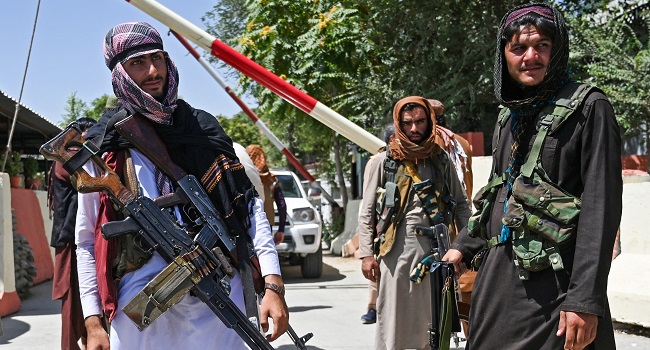
The Taliban appeared Friday to have shut down the government’s ministry of women’s affairs and replaced it with a department notorious for enforcing strict religious doctrine during their first rule two decades ago.
And in a further sign the Taliban’s approach to women and girls had not softened, the education ministry said only classes for boys would restart Saturday in an order for secondary schools to reopen.
In Kabul, workers were seen raising a sign for the Ministry for the Promotion of Virtue and Prevention of Vice at the old Women’s Affairs building in the capital.
Several posts have appeared on Twitter in the last 24 hours showing women workers from the ministry protesting outside the building, saying they had lost their jobs.
No official from the Taliban responded Friday to requests for comment on the matter.
Also on Friday, the education ministry issued a statement ordering male teachers back to work and said secondary school classes for boys would resume on Saturday.
“All male teachers and students should attend their educational institutions,” a statement said, making no mention of women teachers or girl pupils.
Most schools in Afghanistan are segregated by sex.
Basic rights
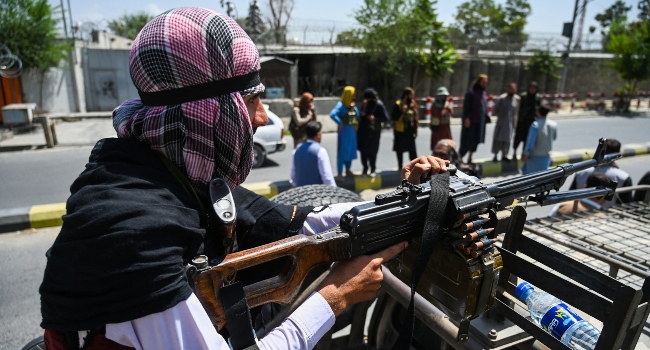
A Taliban fighter mans a machinegun on top of a vehicle as they patrol along a street in Kabul on August 16, 2021, after a stunningly swift end to Afghanistan’s 20-year war, as thousands of people mobbed the city’s airport trying to flee the group’s feared hardline brand of Islamist rule. Wakil Kohsar / AFP
Despite insisting they will rule more moderately this time around, the Taliban have not allowed women to return to work and introduced rules for what they can wear at university.
A new Taliban government announced two weeks ago had no women members or even a ministry to represent their interests.
Although still marginalised, Afghan women have fought for and gained basic rights in the past 20 years, becoming lawmakers, judges, pilots and police officers.
Hundreds of thousands have entered the workforce — a necessity in some cases as many women were widowed or now support invalid husbands as a result of two decades of conflict.
But since returning to power on August 15, the Taliban have shown no inclination to honour those rights.
When pressed, Taliban officials say women have been told to stay at home for their own security but will be allowed to work once proper segregation can be implemented.
During the Taliban’s first rule from 1996 to 2001, women were largely excluded from public life including being banned from leaving their homes unless accompanied by a male relative.
Enforcers from the Ministry for the Promotion of Virtue and Prevention of Vice were known to lash women found walking alone.
They were also responsible for strictly implementing other hardline interpretations of Islam, such as compulsory attendance at prayers, and no trimming of beards for men.
People reacted angrily on social media Friday in support of a group of women seen on Twitter protesting outside the ministry.
“No one hears our women,” said Twitter user Somaya, while another asked, “what else can we expect from these animals?”


Traditional rites, medical outreach, sporting events and youth competitions feature in weeklong celebration
AGO-IWOYE came alive with cultural displays, sporting activities and community development initiatives as indigenes and residents gathered for the 2026 Ago-Iwoye Day celebration.
The weeklong programme, which began on Monday, October 5, brought together indigenes from across Nigeria and the diaspora to celebrate the town’s cultural heritage and promote unity and grassroots development.
The celebration opened with the traditional Woro Plucking Programme at Ojuade Olooto at 7am on Monday. This was followed by intellectual and strategy games at the Ebumawe Palace, where participants competed in chess, draughts, Scrabble and Ayo Olopon.
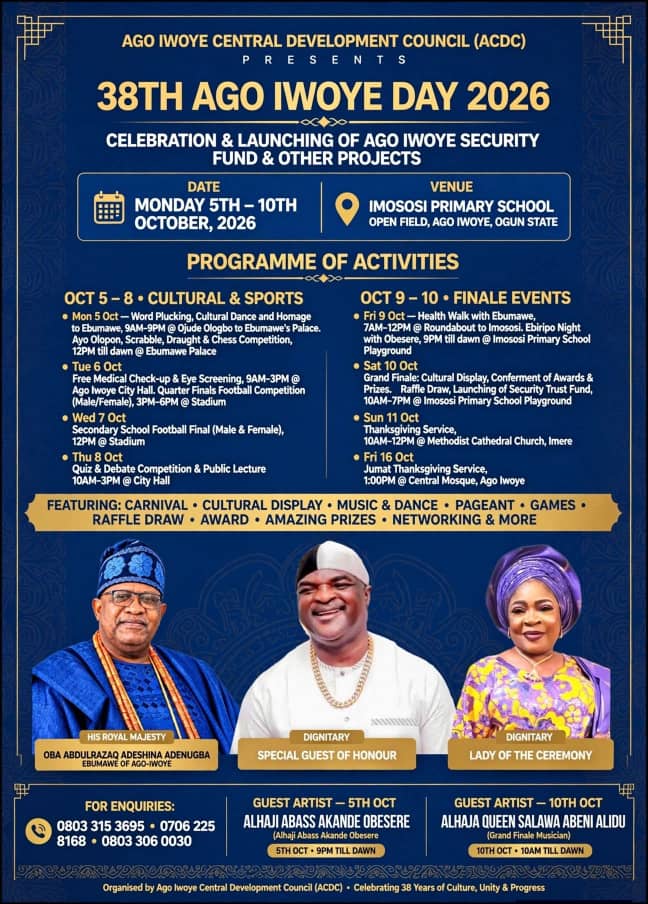
Health and sports featured prominently on Tuesday, October 6, as residents took part in a medical check-up and eye screening exercise at the Ago-Iwoye City Hall.
At the Ago-Iwoye Stadium, sports enthusiasts watched the table tennis finals and the final of the Quarters Football Competition.
The activities continued on Wednesday, October 7, with the finals of the secondary school football competition for male and female categories at the stadium.
Students returned to the spotlight on Thursday, October 8, for a quiz and debate competition at the City Hall. The academic activities were complemented by a public lecture on sustainable community development and youth empowerment.
On Friday, October 9, the Ebumawe of Ago-Iwoye led a health walk from the Omoedumare Roundabout at 7am, drawing residents into another activity designed to promote healthy living and community participation.
The day ended with Ebiripo Night at the Imososi Primary School Field, where music, dance and folklore accompanied celebrations around the town’s popular local delicacy.
The grand finale is scheduled for today, Saturday, October 10, at the Imososi Primary School Field, with traditional performances, civic honours and fundraising activities on the programme.
A thanksgiving service at the Methodist Cathedral, Imere, Ago-Iwoye, is expected to bring the celebration to a close on Sunday, October 11.
Speaking on the significance of the event, the Secretary of the Planning Committee, Dr Samuel O. Awobona, said the turnout demonstrated the commitment of indigenes and residents to preserving the town’s identity and advancing its development.
He said, “This weeklong celebration underscores our collective resolve to preserve our identity while driving grassroots development. The massive turnout across all generations reflects the enduring spirit of Ago-Iwoye.”
The annual celebration provides an opportunity for the community to showcase its traditions while bringing residents, young people and indigenes in the diaspora together around shared cultural and developmental goals.



2027: Oseni Support Islamic Group’s Building Project With N10m, Urges Voters to Prioritise Competence Over Religion

Oyo 2027: Alli’s campaign accuses Adekanmbi’s APM supporters of vandalising APC billboards

DIPHTHERIA OUTBREAK: ALLI QUERIES ₦9.9BN IMPACT FUNDS AS OYO LAGS IN CHILD VACCINATION



-
 Politics3 weeks ago
APM Rally: APC Tackles Makinde Over Use of ‘CAF-Rejected’ ₦5.5bn Stadium
-
News4 weeks ago
OYO 2027: ‘Fact-Check Always’ – Oseni’s Aide Replies Ex-AGF , Ojo Over Alli’s Campaign Billboard Claims
-
Politics3 weeks ago
Oyo: No APC Defection To APM, Makinde Lied — APM Scribe
-
Crime & Court4 weeks ago
Oyo school abduction: DSS to re-arraign five suspects Thursday