Connect with us

Top Stories

Stakeholders task govt. on need of formulating central database for improving on security 

Published

on

NIGERIA as the most populous black nation, privacy is believed to be a fundamental human right as enshrined by the constitution. But, it is disheartening that comprehensive data protection legislation has yet to be enacted as one of the fundamental human rights, even as several government and private organizations routinely collect and process personal data.

According to the broadly phrased Section 37 of the constitution which applies to personal data protection, states ‘ the privacy of citizens, their homes, correspondence, telephone conversations and telegraphic communications is hereby guaranteed and protected’.

However, the existing regulatory frameworks fall short of providing Nigerians with an adequate level of personal data protection as these frameworks fail to clearly define the level of protection afforded to the personal data collected , nor do they clearly state the obligations relating to how personal data should be handled.

Interestingly, checks revealed that Ghana has a data protection law, however, regrettably, so many organizations are collecting data and storing data, hence weakened the whole essence of the law.

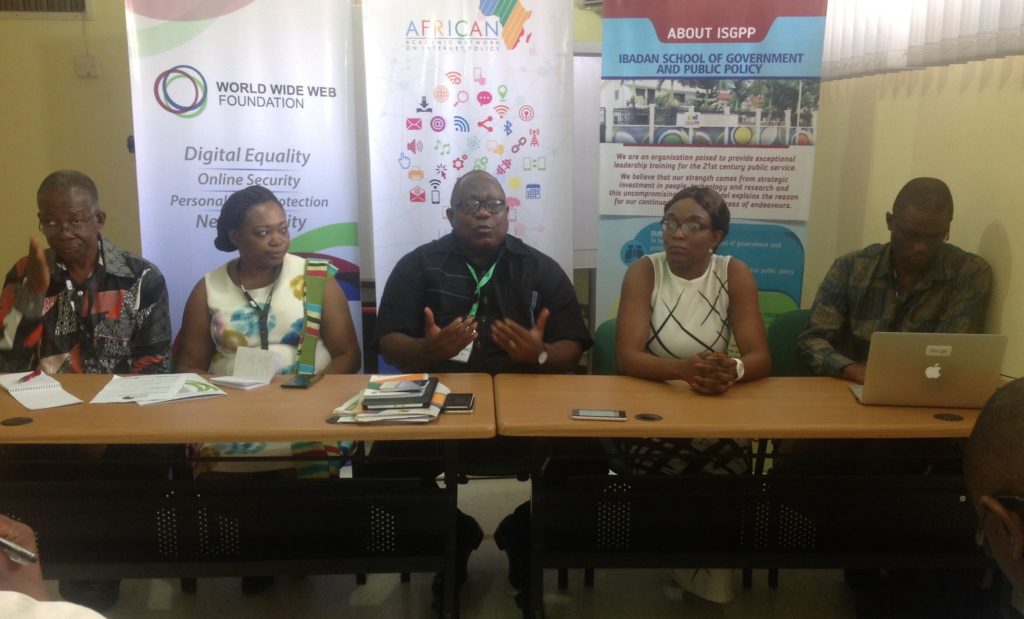
Very recently, African internet stakeholders under the aegis of African Academic Network on Internet Policy, who converged at the International Institute for Tropical Agriculture, IITA, Ibadan, the capital of Oyo State to attend the maiden edition of Data Privacy and Protection conference, have jointly tasked the government on the urgent need to have a single authority that would be responsible for collecting, sharing and management of personal data so as to ensure its security, avoid multiplicity of data as well as waste of resources.

The stakeholders who averred that privacy is a fundamental human right guaranteed by the constitution, also called for the enactment of a data protection act that contains data protection principles consistent with those contained in the African Union Convention on Cyber Security and Personal Data Protection and the EU’s General Data Protection Regulation (GDPR).

The conference which was supported by Google had in attendance data protection and internet experts, students, professional bodies, government, civil society, private business representatives and other stakeholders who encouraged the Civil Society Organizations (CSOs) to engage in public interest litigation to protect privacy, raise consumer awareness about protecting their personal information and advocate for the use of privacy enhancing technologies.

Speaking at the two day conference (Monday December 4, 2017/ Tuesday December 5, 2017), the Executive Vice Chairman, Ibadan School of Government and Public Policy, ISGPP, Dr. Tunji Olaopa explained, ’we are informed from the recognition that the contributions of Africa to the growth of internet policy has been very weak and we narrow down to the unfortunate dimension of even the African researchers not really contributing to the global conversation and if you know the extent to which internet is impacting presently and to impact in the future. Our fear was that African must avoid going into another recolonization.

‘So, to that end, a roundtable was organized in May and the challenges were highlighted. It then became very imperative to assemble the leading African experts both in Africa and diaspora to organize a network which gave birth to African Academic Network. In trying to address the gaps (Policy and Research) militating against African’s contribution, we then highlight a whole lot of symmetric areas. We have started with data privacy and security’, he continued.

Dr. Godfred Frempong of CSIR Science and Technology and Research Institute, in his submission, emphasized on the importance of data, just as he described it as a prominent weapon.

He further observed that the way data is collected, managed in Africa must be looked at critically. Worried about poor harmonization of data by various governments’ authorities, Frempong added, ‘So many organizations are collecting the same personal data. For example if you are privileged to travel, the immigration authority will collect data on you, National Insurance Authority is collecting data on us, National Identification Authority is collecting data, Electoral Commission is collecting data, Driving and Vehicle Registration Authority is collecting data, the banks are collecting data, National Identity Management Commission, Integrated Payroll and Personnel for Public Servant, Sim card registration by NCC and anywhere you go, they ask you about your personal data’, he lamented.

Concerned about data security, Mr. John Walubengo from Multimedia Centre, University of Kenya expressed displeasure over the activities of private business players who collect information such as the telecom operators, mobile banking in which they computerize or save data in digital format without prioritizing its protection. ‘How do you protect this information to ensure that it doesn’t fall into wrong hands?’, he queried.

Similarly, he stressed on the need to have a framework forcing the data collectors or controllers to adapt to minimum standard of protection. ‘We need to look at data security as protecting citizens’ right and privacy, so that all citizens in Africa are able to enjoy that security of the data collector which the businesses may not prioritize’ said Walubengo.

Also contributing, the Senior Policy Manager, World Wide Web Foundation, Mrs. Nnenna Nwakanma, who highlighted various opportunities available on the internet, described data as the biggest economy with its ability to tailor marketing to individuals. ‘Who ever have data has wealth. If you talk about the biggest companies online today they are no longer software or hardware companies, but data companies’, said Nwakanma.

She however cautioned that while data has becomes a goldmine for the digital economy, it could also hurt if not well handled, both by the data providers and handlers.

Another contentious issue at the conference was privacy protection which Mrs. Tope Ogundipe, Director of Programs, Paradigm Initiative noted that should be seen first as human rights issue rather than been posited as an economic one. She charged Nigerians to ask questions on how the barrage of data they provide to agencies are kept and used. She therefore recommended that the use of data must be in accordance with the purpose for which it was collected, stressing that consent of the individual must be obtained prior to collecting his or her personal data.

Ogundipe finally added, ‘rights of the individual to seek legal remedies for misuse or unauthorized access to personal data must be guaranteed’.
With the huge success recorded at the just concluded conference, the network planned to involve more critical stakeholders to further discussion and create platforms for engagement and training of people.

The core objective, according to the stakeholders is to see a continental approach to the desired policies.

By Idowu Ayodele.

Comments

Metro

Woman allegedly sets co-wife, two children ablaze in Kano

Published

on

Residents of the Hotoro area of Kano were thrown into panic after a woman allegedly set her co-wife and two children ablaze in a late-night domestic attack.

The incident occurred on Monday night in the Mai Allo area of Hotoro, leaving four persons with varying degrees of burns.

The victims — a 28-year-old woman and her two children aged seven and three — are currently receiving treatment at the National Orthopaedic Hospital, Dala and Murtala Muhammad Specialist Hospital.

Their father, who reportedly sustained injuries while attempting to rescue the victims from the inferno, is also undergoing treatment.

A relative of the family informed that they received a distress call around 3am informing them that the woman, her husband and the children had been set ablaze.

According to the source, the victim had spent less than two weeks in her matrimonial home before the attack occurred.

“She is about 28 years old. The children are from her previous marriage. They are stepchildren to the husband, who works as a tricycle rider,” the relative added.

Residents of the area described the incident as horrifying and called on security agencies to ensure justice was served.

“We are shocked by what happened. This kind of violence has no place in our community,” a resident said.

The suspect has since been taken into custody at the Mariri Police Division.
As of the time of filing this report, the Kano State Police Command had yet to issue an official statement on the incident.

Continue Reading

Crime & Court

UNIBEN killing: Edo security squad arrests 12 suspected cultists, seals initiation centres

Published

on

Security operatives in Edo State have arrested 12 suspected cultists and sealed two apartments allegedly used as initiation centres during coordinated raids across parts of Benin City following the killing of a young man near the gate of the University of Benin.

The operation, code-named “Operation Flush Out Cultists and Kidnappers,” was carried out by the state’s Special Security Squad after the killing recorded on Sunday, May 10, 2026.

The development was disclosed in a statement issued on Tuesday by the Chief Press Secretary to Governor Monday Okpebholo, Patrick Ebojele.

According to the statement, the Chief Security Officer and Principal Security Officer to the governor led the raids conducted in Ekosodin, Isihor, Old Road off S&T Barracks, Airport Road, 19th Street Ugbowo, Ogba-Evbuodia and Evbuomore Quarters, all in Benin City.

Spokesman for the security squad, Noah Idemudia, alleged that some youth leaders within communities in the state were aiding violent crimes and harbouring criminal elements.

He said intelligence reports indicated that sophisticated weapons used in deadly attacks were often traced to communities across the state.

“Reports reaching us indicate that some persons are allegedly harbouring criminals. Intelligence reports also suggest that sophisticated weapons used in deadly attacks on citizens are allegedly sourced from communities.

“The governor is warning community leaders to maintain peace in their various communities and ensure that no unlicensed weapons are found in their possession, as they will be held liable and treated as criminals,” Idemudia said.

He, however, clarified that the 12 suspects arrested were not directly linked to the killing near the university gate.

According to him, the suspects were allegedly identified as members of different cult groups after security operatives reportedly discovered symbols, signs and other incriminating materials on them during the raids.

Idemudia added that the suspects had been handed over to the Anti-Cultism Unit of the Nigeria Police Force for profiling and further investigation.

Speaking on the properties sealed during the operation, he said one of the apartments was allegedly being used as a cult initiation centre.

He explained that operatives came under attack while attempting to arrest suspects at the location, forcing authorities to seal the premises and invite the property owner for questioning.

He added that another apartment raided allegedly contained shrines and fetish items scattered across several rooms, which investigators suspect were being used for initiation into different confraternities.

According to him, the owner of the property had also been invited for questioning by security agencies.

“The governor has warned those sponsoring cultism and violent killings in the state to desist immediately.

“Anyone found aiding criminality in Edo State will face the full weight of the law, as the state will no longer be conducive for criminal elements,” Idemudia added.

He also warned against unlawful gatherings, alleging that some cult groups were planning anniversary celebrations across the state.

Continue Reading

Crime & Court

Ex-Power Minister Mamman Jailed 75 Years Over ₦33.8bn Fraud

Published

on

A Federal High Court in Abuja on Wednesday convicted and sentenced former Minister of Power, Saleh Mamman, to a cumulative 75 years imprisonment in absentia over a ₦33.8bn money laundering scandal linked to the Zungeru and Mambilla hydroelectric power projects.

The trial judge, Justice James Omotosho, found Mamman guilty on all 12 counts bordering on conspiracy and money laundering filed against him by the Economic and Financial Crimes Commission.

The judge ruled that the prison terms would run consecutively, bringing the total sentence to 75 years.

Justice Omotosho held that Mamman deliberately absented himself from court on the day of judgment and during the previous adjourned sitting in a bid to frustrate the administration of justice.

He agreed with counsel for the EFCC, Rotimi Oyedepo (SAN), that the Administration of Criminal Justice Act, 2015 empowered the court to proceed with sentencing despite the defendant’s absence.

The court consequently sentenced the former minister to seven years imprisonment each on Counts 1, 2, 3, 6, 7, 8, 9, 10, 11 and 12 without an option of fine.

Mamman was also sentenced to three years imprisonment on Count 4 with an option of a ₦10m fine, and two years imprisonment on Count 5 without an option of fine.

Justice Omotosho further ordered that the sentence would commence from the date of Mamman’s arrest since he was convicted in absentia.

The judge directed security agencies within and outside Nigeria, including Interpol, to arrest the convict wherever he is found and hand him over to the Nigerian Correctional Service to serve his jail term.

The court also ordered the final forfeiture of two Abuja properties linked to the former minister, alongside various sums recovered in different currencies by anti-graft agencies.

In addition, the court ordered Mamman to refund the outstanding balance from the ₦22bn already traced to the Zungeru and Mambilla hydroelectric power projects out of the ₦33.8bn allegedly diverted.

The conviction followed a lengthy trial instituted by the EFCC, which accused Mamman of conspiring with ministry officials and private companies to divert funds earmarked for the two power projects.

Mamman was arraigned on July 11, 2024 on a 12-count charge and pleaded not guilty.

During the trial, the EFCC called 17 witnesses and tendered 43 exhibits to support its case.

Following the close of the prosecution’s case, the former minister filed a no-case submission on November 19, 2025, contending that the EFCC had failed to establish sufficient evidence against him.

However, Justice Omotosho, in a ruling delivered on December 11, 2025, dismissed the application and held that the prosecution had established a prima facie case requiring the defendant to open his defence.

The matter was subsequently adjourned for continuation of defence before Wednesday’s judgment brought the proceedings to a close.

The case, regarded as one of the most significant corruption convictions in recent years, stemmed from Mamman’s arrest and detention by the EFCC on May 10, 2021.

Continue Reading

Advertisement

Entertainment

Advertisement

MegaIcon Magazine Facebook Page

Advertisement

MEGAICON TV

Advertisement

Trending