
Top Stories
Opinion: The pandemic is no time for fiscal distancing | By Akinwumi Adesina


These are very difficult days, as the world faces one of its worst challenges ever: the novel coronavirus pandemic. And it seems almost no nation is spared. As infection rates rise, so does panic across financial markets, as economies drastically slow down and supply chains are severely disrupted.
Extraordinary times call for extraordinary measures. As such, it can no longer be business as usual.
Each day, the situation evolves and requires constant reviews of precautionary measures and strategies. In the midst of all this, we must all worry about the ability of every nation to respond to this crisis. And we must ensure that developing nations are prepared to navigate these uncharted waters fully.
That’s why I support the UN Secretary-General Antonio Guterres’ urgent call for special resources for the world’s developing countries.
In the face of this pandemic, we must put lives above resources and health above debt. Why? Because developing economies are the most vulnerable at this time. Our remedies must go beyond simply lending more. We must go the extra mile and provide countries with much-needed and urgent financial relief — and that includes developing countries under sanctions.
According to the independent, global think tank ODI in its report on the impact of economic sanctions, for decades, sanctions have decimated investments in public health care systems in quite a number of countries.
Today, the already stretched systems as noted in the 2019 Global Health Security Index will find it difficult to face up to a clear and present danger that now threatens our collective existence.
Only those that are alive can pay back debts.
Sanctions work against economies but not against the virus. If countries that are under sanctions are unable to respond and provide critical care for their citizens or protect them, then the virus will soon “sanction” the world.
In my Yoruba language, there is a saying. “Be careful when you throw stones in the open market. It may hit a member of your family.”
That’s why I also strongly support the call by the UN Secretary-General that debts of low-income countries be suspended in these fast-moving and uncertain times.
But I call for even bolder actions, and there are several reasons for doing so.
First, the economies of developing countries, despite years of great progress, remain extremely fragile and ill equipped to deal with this pandemic. They are more likely to be buried with the heavy fiscal pressure they now face with the coronavirus.
Second, many of the countries in Africa depend on commodities for export earnings. The collapse of oil prices has thrown African economies into distress. According the AFDB’s 2020 Africa Economic Outlook, they simply are not able to meet budgets as planned under pre-coronavirus oil price benchmarks.
The impact has been immediate in the oil and gas sector, as noted in a recent CNN news analysis.
In the current environment, we can anticipate an acute shortage of buyers who, for understandable reasons, will reallocate resources to addressing the Covid-19 pandemic. African countries that depend on tourism receipts as a key source of revenue are also in a straightjacket.
Third, while rich countries have resources to spare, evidenced by trillions of dollars in fiscal stimulus, developing countries are hampered with bare-bones resources.
The fact is, if we do not collectively defeat the coronavirus in Africa, we will not defeat it anywhere else in the world. This is an existential challenge that requires all hands to be on deck. Today, more than ever, we must be our brothers and sisters’ keepers.
Around the world, countries at more advanced stages in the outbreak are announcing liquidity relief, debt restructuring, forbearance on loan repayments, relaxation of standard regulations and initiatives.
In the United States, packages of more than $2 trillion have already been announced, in addition to a reduction in Federal Reserve lending rates and liquidity support to keep markets operating. In Europe, the larger economies have announced stimulus measures in excess of 1 trillion Euros. Additionally, even larger packages are expected.
As developed countries put in place programs to compensate workers for lost wages for staying at home for social distancing, another problem has emerged — fiscal distancing.
Think for a moment what this means for Africa.
The African Development Bank estimates that Covid-19 could cost Africa a GDP loss between $22.1 billion, in the base case scenario, and $88.3 billion in the worst case scenario. This is equivalent to a projected GDP growth contraction of between 0.7 and 2.8 percentage points in 2020. It is even likely that Africa might fall into recession this year if the current situation persists.
The Covid-19 shock will further squeeze fiscal space in the continent as deficits are estimated to widen by 3.5 to 4.9 percentage points, increasing Africa’s financing gap by an additional $110 to $154 billion in 2020.
Our estimates indicate that Africa’s total public debt could increase, under the base case scenario, from $1.86 trillion at the end of 2019 to over $2 trillion in 2020, compared to $1.9 trillion projected in a ‘no pandemic’ scenario. According to a March 2020 Bank report, these figures could reach $2.1 trillion in 2020 under the worst case scenario.
This, therefore, is a time for bold actions. We should temporarily defer the debt owed to multilateral development banks and international financial institutions. This can be done by re-profiling loans to create fiscal space for countries to deal with this crisis.
That means that loan principals due to international financial institutions in 2020 could be deferred. I am calling for temporary forbearance, not forgiveness. What’s good for bilateral and commercial debt must be good for multilateral debt.
That way, we will avoid moral hazards, and rating agencies will be less inclined to penalize any institution on the potential risk to their Preferred Creditor Status. The focus of the world should now be on helping everyone, as a risk to one is a risk to all.
There is no coronavirus for developed countries and a coronavirus for developing and debt-stressed countries. We are all in this together.
Multilateral and bilateral financial institutions must work together with commercial creditors in Africa, especially to defer loan payments and give Africa the fiscal space it needs.
We stand ready to support Africa in the short term and for the long haul. We are ready to deploy up to $50 billion over five years in projects to help with adjustment costs that Africa will face as it deals with the knock-on effects of Covid-19, long after the current storm subsides.
But more support will be needed. Let’s lift all sanctions, for now. Even in wartime, ceasefires are called for humanitarian reasons. In such situations, there is a time to pause for relief materials to reach affected populations. The novel coronavirus is a war against all of us. All lives matter.
For this reason, we must avoid fiscal distancing at this time. A stitch in time will save nine.
Social distancing is imperative now. Fiscal distancing is not.
Akinwumi A. Adesina is President of the African Development Bank Group


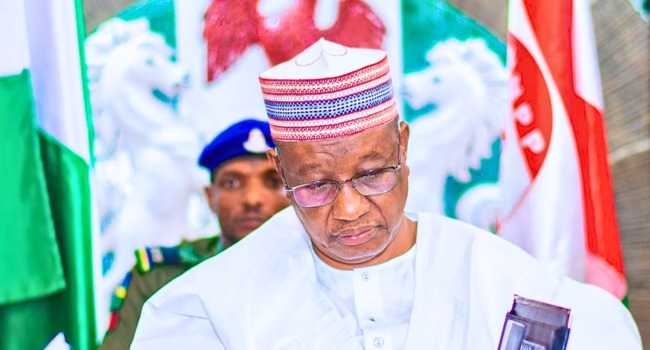
The Kano State House of Assembly has initiated impeachment proceedings against Deputy Governor Aminu Abdussalam Gwarzo over allegations of gross misconduct, abuse of office, and breach of public trust.
The notice was presented yesterday during plenary by the Majority Leader, Lawan Hussaini Dala, who said the action follows Section 188 of the 1999 Constitution of the Federal Republic of Nigeria.
Dala said the allegations stem from Abdussalam’s tenure as Commissioner for Local Government (2023–2024) and his current role as deputy governor. He accused the deputy governor of diverting funds meant for the 44 local government councils.
According to the majority leader, Abdussalam allegedly received N1.5 million monthly from each council between June 2023 and January 2024, totaling N462 million. Between February and July 2024, he allegedly collected N3.255 million monthly from each council under the guise of special assignments, amounting to N726 million.
Dala also accused the deputy governor of abuse of office, claiming he facilitated payments of N10 million from each council to NovoMed Pharmaceuticals Limited, totaling N440 million, in violation of state procurement laws.
“The misuse of official capacity to confer undue advantage constitutes abuse of power and undermines public trust,” Dala told lawmakers, adding that the allegations amount to gross misconduct under the Constitution.
The impeachment notice was reportedly endorsed by 38 lawmakers, meeting the constitutional threshold to proceed. The Speaker has acknowledged receipt, and the House is expected to serve the allegations on the deputy governor.
If approved, a panel may be constituted by the state Chief Judge to investigate the claims.
As of filing, Abdussalam had yet to respond publicly to the allegations.
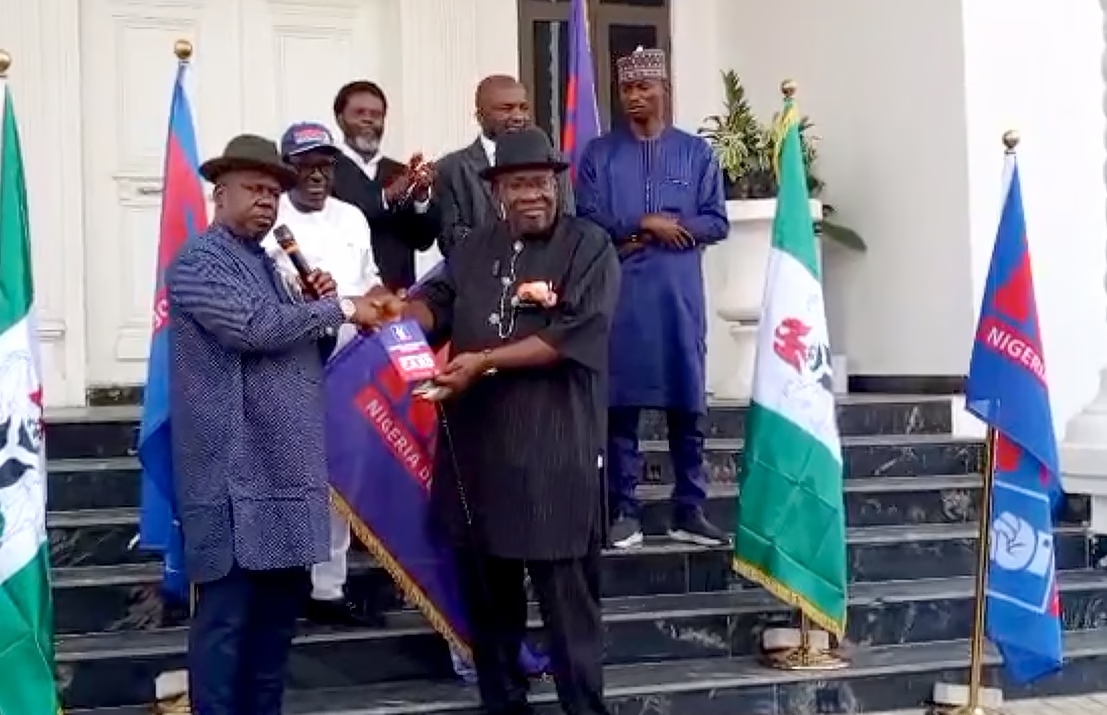
The Senator representing Bayelsa West, Seriake Dickson, on Thursday announced his resignation from the Peoples Democratic Party (PDP), declaring that he had joined the newly registered Nigeria Democratic Congress (NDC).
Dickson, a former governor of Bayelsa State, made the announcement during a media briefing in Abuja, attributing his decision to what he described as irreconcilable differences within the PDP.
The lawmaker said the emergence of the NDC would strengthen Nigeria’s democratic system by providing a credible opposition platform.
According to him, the party recently received its certificate of registration from the Independent National Electoral Commission.
He said, “Last week INEC issued a certificate of registration and we now have the newest party in Nigeria known as the Nigeria Democratic Congress and our symbol is victory, the victory sign.
“So, my dear Nigerians, you now have a credible alternative opposition party known as the Nigeria Democratic Congress.”
Dickson noted that although the party’s registration took longer than expected, its eventual approval was a welcome development for the country’s democratic landscape.
“Yes, it is coming at this time. We would have wished it started some years or months back. We don’t control INEC and their processes; they delayed. We don’t also control the judiciary, but thank God it has finally arrived,” he said.
The senator also stressed that Nigeria’s democracy must not slide into a one-party system, insisting that political diversity remained vital for national stability.
“This nation cannot be a one-party state. Nigeria cannot be a one-party state. Nigeria is not designed to be a one-party state.
“We are a very diverse nation culturally, religiously and politically and that is the beauty of our country.
“So anyone or any party promoting one-party rule in Nigeria is mistaken. We build political parties and get involved in movements to access power for the good of the people, not for our personal benefit,” he added.
Meanwhile, the Independent National Electoral Commission recently announced the registration of two new political parties.
The parties are the Democratic Leadership Alliance and the Nigeria Democratic Congress, bringing the total number of registered political parties in Nigeria to 21.
The announcement was made by the INEC Chairman, Prof. Joash Amupitan, during the commission’s first quarterly consultative meeting with political party stakeholders for 2026.
According to him, the Democratic Leadership Alliance completed the required verification process, while the Nigeria Democratic Congress was registered in compliance with a Federal High Court order.
The National Drug Law Enforcement Agency (NDLEA) has arrested a 58-year-old alleged drug lord, Uzoma Valentine Ilomuanya, who had reportedly been on the agency’s wanted list and that of British authorities for over 15 years.
Ilomuanya was apprehended in Lagos on Monday, February 23, 2026, following what the agency described as a high-level, coordinated operation by officers of its Special Operations Unit.
The development was disclosed in a statement issued on Wednesday by the Director of Media and Advocacy of the agency, Femi Babafemi.
Babafemi said the suspect’s arrest ended a prolonged manhunt linked to his alleged involvement in drug trafficking activities across Nigeria and the United Kingdom.
According to the statement, Ilomuanya was first arrested in February 2003 in the United Kingdom and convicted for drug trafficking.
He was sentenced to nine years imprisonment but was released after serving two years following a successful appeal.
Babafemi added that the suspect was again arrested in the UK in July 2011 over drug-related offences.
He said, “He was granted administrative bail but jumped jurisdiction and fled to Nigeria.
“Typical of a recidivist, Ilomuanya was in November 2018 arrested in Nigeria by NDLEA operatives following the discovery of two clandestine methamphetamine laboratories in his Obinugwu, Orlu Local Government Area country home in Imo State and at his No. 3 Barrister Declan Uzoma Close, Lagos residence where officers recovered 77.960 kilograms of methamphetamine and extensive production equipment.
“He was subsequently charged before a Federal High Court in Lagos, after which he jumped court bail and has been on the run since then.”
Reacting to the development, the Chairman and Chief Executive Officer of the NDLEA, Brig. Gen. Mohamed Buba Marwa (retd.), described the arrest as a major breakthrough in the agency’s ongoing war against drug trafficking networks.
Marwa said the operation demonstrated the agency’s resolve to track down criminal elements regardless of how long they evade the law.
He said, “This arrest serves as a stern warning to those who think they can hide behind borders to escape justice.
“Whether you jump bail in London or set up clandestine labs in your village, the long arm of the NDLEA will eventually catch up with those who choose to undermine the health, security, and future of our nation.
“We remain committed to our international collaborations to ensure that Nigeria is not used as a sanctuary for global drug lords.”
Marwa also commended officers of the Special Operations Unit for their professionalism and persistence in tracking down the suspect.
He added that the agency would continue to strengthen intelligence-driven operations and international cooperation to dismantle drug trafficking networks operating within and beyond Nigeria.



-
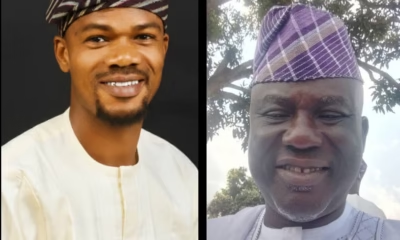
 Politics2 days ago
Ibarapa East Assembly Hopeful, Ramon Congratulates Ajiboye, Says Emergence Good for Oyo APC
-
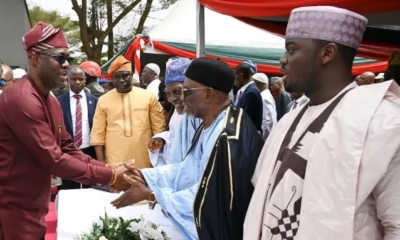
 Politics7 days ago
Makinde: My Successor Must Be Loyal to Oyo, Not Me
-
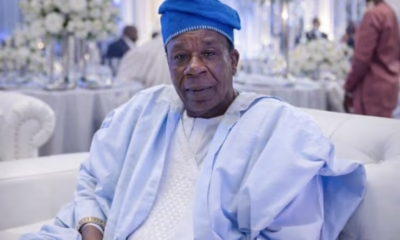
 Politics3 days ago
2027: Former Oyo Deputy Governor Adeyemo Emerges APC Chairman (See Full List)
-
 Politics7 days ago
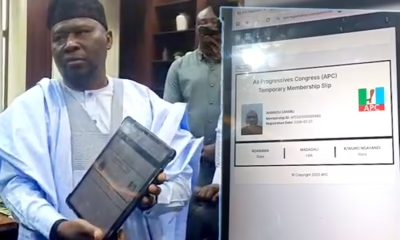
Fintiri Dumps PDP for APC, Moves with Cabinet, 14 Adamawa Lawmakers