Connect with us

Top Stories

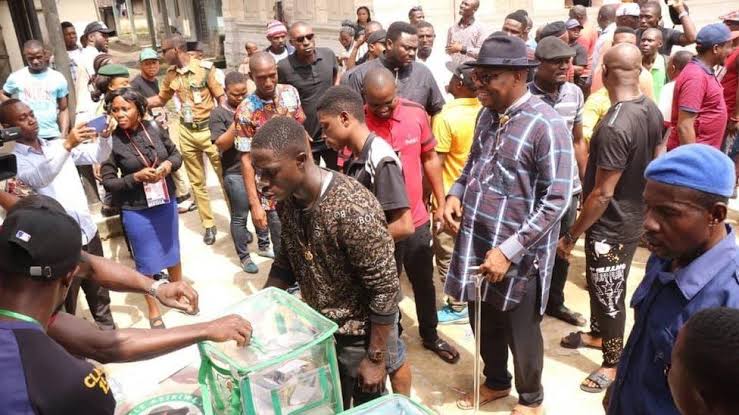
Nigerian journalists attacked, threatened while covering Bayelsa, Kogi selections

Published

on

Nigerian authorities should investigate and hold accountable those responsible for the harassment of journalists working to cover the November 16 gubernatorial and federal assembly elections in Kogi and Bayelsa states, the Committee to Protect Journalists said today.

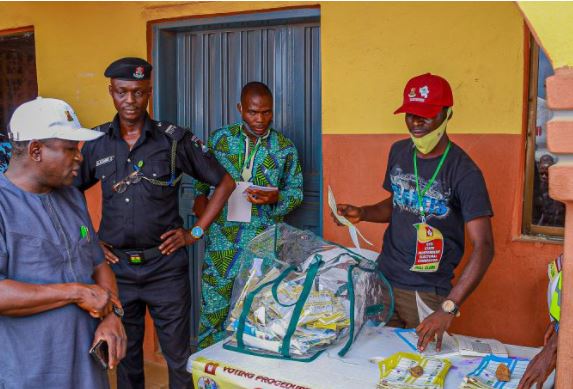
Armed men threatened and harassed reporters, security forces barred journalists from entering electoral buildings, and demonstrators threw stones at reporters trying to cover the elections, according to news reports and journalists who spoke to CPJ.

The elections in these two states followed nationwide elections in February, which were also marred by violence against journalists, as CPJ reported at the time.

“Journalists play an indispensable role in the conduct of credible elections and should never be the subject of threats, violence, or harassment,” said Angela Quintal, CPJ’s Africa program coordinator, from Washington, D.C. “Nigerian authorities must investigate all allegations made by journalists about interference in their work covering the November 16 elections in Kogi and Bayelsa states.”

In Kogi state, Chinedu Asadu, a reporter with the privately owned The Cable online newspaper, told CPJ in a phone call that police officers seized his cell phone for 15 minutes when he attempted to take photos of a politician giving money to women waiting to cast their votes. After police returned his phone, Asadu said another officer made threatening comments, and he feared the officer would harm him, so he left the polling place.

Lolafunke Ogunlolu, a journalist with the privately owned Africa Independent Television broadcaster, told CPJ in a phone call that a group of armed men threatened to beat her after they saw her film them assaulting a woman at a polling station in Aiyetorogbede, Kogi state.

Ogunlolu said the men, whose identities she could not determine, demanded she delete all the pictures and videos she took of them. Ogunlolu said one man was about to hit her and take her phone when another stopped him after recognizing Ogunlolu as a reporter with the station.

Two journalists with the privately owned Splash FM radio station, Tobi Kusimo and David Bello, told CPJ in phone conversations that a group of demonstrators in Aiyetoro Gbede, a town in Kogi state, threw stones at their van when they tried to interview a polling officer. The journalists said they fled after demonstrators broke their rear windshield and otherwise damaged their vehicle, and appeared angry enough to kill them.

“If we had waited for two additional seconds, only God knows what would have happened,” Bello told CPJ.

In a separate case, Sam Egwu, a journalist with the privately owned newspaper The Nation, and Sunday Amachi, a reporter with the government-owned Kogi State Radio broadcaster, told CPJ via phone that a group of demonstrators in Anyigba, in Kogi state, surrounded their car while they drove to a polling place and threw stones at their vehicle.

“In fact, they destroyed our vehicle. It was a miracle we left that place unhurt,” said Egwu.

Egwu and Amachi told CPJ that protesters alleging election interference barricaded all exit routes and surrounded their car. Protesters climbed on their car in an attempt to force the journalists out, but the demonstrators dispersed after security forces fired their weapons, Egwu said.

In Bayelsa state, four unidentified individuals wielding canes and bottles intercepted Adejumor Kabir, a reporter with the Premium Times newspaper, while he was traveling to the main office of Nigeria’s Independent National Electoral Commission, he told CPJ via phone. The individuals forced his driver to leave, and drove Kabir to an isolated area in Opolo, in Yenagoa, the state capital, where they interrogated him for two hours, he told CPJ. Kabir said his abductors had mistaken him for a government official and, after questioning and accusing him of manipulating election results, they released him.

Kabir then traveled to the Independent National Electoral Commission office to cover the collation of the results, but police blocked him and other reporters from entering the building, even though they identified themselves as journalists, Kabir said. He said the officers told the journalists that they were working on orders from above not to admit members of the press.

CPJ’s calls and text messages to Oluwole Ozassi-Uzi, the Independent National Electoral Commission spokesperson, went unanswered. The head of voter education in Bayelsa State, Wilfred Ifogah, told journalists that security officials “misunderstood INEC instructions” when they bared reporters from entering the commission’s office, according to a report by Premium Times.

In a text message to CPJ, Nigerian police spokesperson Frank Mba said he was not aware of any assaults on journalists and said, “The safety and wellbeing of journalists and media practitioners generally was of paramount importance to the Nigeria Police Force.”

Comments

Politics

2027: APC Perfects Consensus Strategy for Oyo

Published

on


Ahead of the 2027 general elections, the national leadership of the All Progressives Congress (APC) on Tuesday held a high-level strategic meeting with the Oyo State chapter of the party as part of efforts to reposition the APC for victory and prevent internal crisis ahead of the polls.

The development was first scooped by OYOINSIGHT.COM which quoted multiple party sources familiar with the closed-door deliberations.

Sources disclosed that the meeting, held in Abuja, focused largely on a consensus arrangement being considered by stakeholders of the party in Oyo State, in line with political templates reportedly being adopted in Lagos and Ogun states ahead of the next electoral cycle.

Party insiders said the move was aimed at strengthening unity within the fold of the opposition party in the state, minimising rancour during the primaries and presenting a formidable front against rival parties in 2027.

It was further gathered that some members of the state executive committee may have been subtly informed about preferred consensus candidates being considered for elective positions across the state.

Though details of the deliberations were still sketchy as of press time, sources hinted that the national leadership stressed the need for cohesion, discipline and strategic alignment among stakeholders to improve the party’s electoral fortunes in Oyo.

Those at the meeting included the Oyo APC Chairman, Moses Alake Adeyemo; the state secretary, Fatai Adesina Adeniyi; the Publicity Secretary, Olawale Sadare; the Organising Secretary, Aderemi Adepoju; and the Legal Adviser, Sunday Aborisade.

Others were the Women Leader, Adekemi Opatunde; the Youth Leader, Olalekan Oladejo; Joshua Oyebamiji; Tunde Oloyede; Sunday Babalola; Joseph Omoniyi; and Mojeed Adebayo.

As of the time of filing this report, the party had yet to issue an official statement on the outcome of the meeting.

Continue Reading

Politics

2027: Oyo APC Set for Credible Direct Primaries, Says Alake Adeyemo

Published

on

The Chairman of the All Progressives Congress (APC) in Oyo State, Chief Moses Alake Adeyemo, on Monday assured aspirants and party members that the party would conduct transparent, peaceful and credible direct primaries ahead of the 2027 general elections.

Adeyemo declared that no aspirant would be victimised or denied a level playing field, stressing that the party leadership remained committed to internal democracy and progressive ideals.

The former deputy governor spoke while receiving members of the APC Screening and Appeal Committees deployed from the party’s National Secretariat in Abuja at the APC Secretariat in Oke-Ado, Ibadan.

He disclosed that although the party initially explored consensus arrangements across elective positions, prevailing realities indicated that direct primaries would be conducted in some areas, including the governorship contest.

Adeyemo said the party had already put necessary structures in place to ensure a hitch-free exercise capable of strengthening unity within the APC.

He said: “We set machineries in motion for us to achieve the aim of consensus across board but reports available to me indicate that we would have to go by the second option which is direct primary in certain cases including the governorship ticket.

“To this end, we shall work towards organising free, fair and credible exercise in all the affected areas even as we cannot rule out the possibility of some aspirants having a rethink and supporting the consensus arrangement as necessary.

“Where we have more than an aspirant, Abuja would send people to conduct primaries and we at the state level would provide the required support to make everything work out in the interest of our great party.”

The APC chairman explained that all registered party members would participate fully in the exercise at their respective wards on dates to be announced by the National Secretariat.

According to him, affirmation would be adopted in areas where consensus candidates emerge, while voting would be conducted wherever direct primaries become necessary.

“For consensus, members will lend their voices for affirmation while voting will be done in the cases of direct primary,” he added.

Speaking earlier, Chairman of the Screening Committee and former Speaker of the Ondo State House of Assembly, Rt. Hon. Taofiq AbdusSalam, assured party faithful that the committee would carry out a thorough, transparent and unbiased screening process.

He said only eligible aspirants would be cleared to participate in the primaries and eventually fly the APC flag in the forthcoming elections.

Other members of the Screening Committee are Kamal Sanusi (Secretary), Smart Oluwole, Tunde Kolade and Olabamiji Agunloye.

Members of the Screening Appeal Committee are Jibola Oduwole (Chairman), Abimbola Jack (Secretary) and Jelil Jimoh.

Continue Reading

Politics

NDC zones 2027 presidency to South, reserves 2031 for North

Published

on

The Nigeria Democratic Congress on Saturday zoned its 2027 presidential ticket to Southern Nigeria, declaring that the party’s candidate would serve a single four-year term if elected.

The decision was reached during the party’s national convention held in Abuja amid growing momentum within the opposition platform following a wave of high-profile defections from other political parties.

Announcing the development on its official social media handle, the party stated, “NDC presidential ticket is zoned to the South!!”

The party also resolved that its 2031 presidential ticket would be ceded to Northern Nigeria as part of efforts to maintain regional balance and internal equity.

The convention comes as key opposition figures, including former Labour Party presidential candidate, Peter Obi, and former New Nigeria People’s Party presidential candidate, Rabiu Kwankwaso, joined party leaders and delegates at the Abuja gathering.

Saturday’s convention is expected to ratify several recent decisions taken by the party’s National Executive Committee, including zoning arrangements, amendments to the party constitution, and the election of new national executives.

According to the convention agenda obtained by journalists, discussions centred on zoning, ratification of the amended constitution, and leadership restructuring ahead of the 2027 general elections.

The NDC has in recent weeks witnessed a surge in defections from rival opposition parties, particularly the African Democratic Congress and the Peoples Democratic Party.

On Tuesday, no fewer than 17 members of the House of Representatives defected from the ADC to the NDC.

Their defections were formally announced during plenary at the House of Representatives.

The lawmakers include Yusuf Datti, Uchenna Okonkwo, Adamu Wakili, Thaddeus Attah, George Ozodinobi, Lilian Orogbu, Oluwaseyi Sowunmi, Peter Aniekwe, Mukhtar Zakari, George Oluwande and Munachim Umezuruike.
Others are Emeka Idu, Jesse Onuakalusi, Ifeanyi Uzokwe, Afam Ogene, Murphy Omoruyi and Abdulhakeem Ado.
The defections came barely two days after Obi and Kwankwaso formally joined the NDC from the ADC.

The duo were presented with the party’s membership cards last Sunday shortly after a closed-door meeting with party leaders.

A former Governor of Bayelsa State and NDC national leader, Seriake Dickson, officially welcomed the opposition figures into the party.

Obi had attributed his exit from the ADC to worsening internal crises, external interference and what he described as increasing hostility within party structures.

The former Anambra State governor said Nigeria’s political environment had become increasingly toxic, marked by intimidation, insecurity and sustained scrutiny of opposition figures.

He also lamented that institutions meant to protect citizens were now often deployed against them, while individuals committed to genuine public service faced mounting pressure both publicly and privately.

Continue Reading

Advertisement

Entertainment

Advertisement

MegaIcon Magazine Facebook Page

Advertisement

MEGAICON TV

Advertisement

Trending