Connect with us

Crime & Court

Makinde inaugurates state’s anti-corruption agency

Published

on

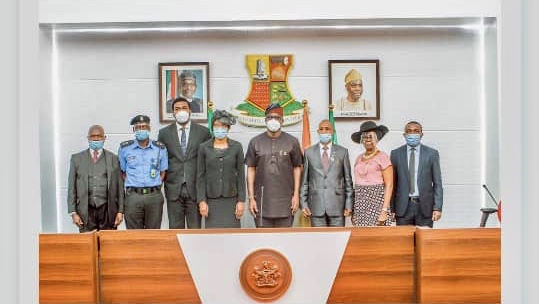
Oyo state governor, Mr. Seyi Makinde has inaugurated the state’s anti-corruption commission, declaring that his administration’s zero tolerance for corruption remains unshakable.

The governor, who was speaking inside the Executive Council Chamber of the Governor’s Office, Agodi, Ibadan, said that with the inauguration, Oyo State as Pacesetter State, will become a worthy reference for other states across the country.

Speaking on Tuesday  at the swearing-in ceremony of members of the Oyo State Anti-Corruption Agency (OYACA), the governor declared that the commission will have no political bias.

A statement by the Chief Press Secretary to the governor, Mr. Taiwo Adisa, quoted the governor as warning against all forms of corrupt practices, noting that the establishment of the agency was to sanitise the public/civil service and ensure that everyone carries out their responsibilities without corruption.

It will be recalled that the bill for the establishment of the agency was forwarded to the House of Assembly shortly after Makinde assumed office in 2019.

The governor said: “The journey to this inauguration formally started about a year ago with the signing of the Oyo State Anti-Corruption Law 2019. The law is primarily directed at sanitising the public/civil service and ensuring that both public and civil servants at both the state and local government levels carry out their responsibilities without institutionalised corruption.

“When I was campaigning, we knew corruption was an issue and I basically divided corruption into two broad categories. We have the routine one, which the Okada riders, micra drivers, other people too engage in.

“We meet policemen on the road and give them N50 or N100 because we don’t want any trouble. We just want to pay and go or people come into the Secretariat and they want to get tax clearance for their lands, documents, even things that are as simple as validation of their state or local government of origin certificate, they pay some money and go. That is what I call routine corruption.

“What can kill us and what is killing us is the systemic corruption or the institutionalised corruption.

“What I earn as the salary of a governor is about N600,000 and I am living at a level where I spend on a monthly basis N6,000,000, that is systemic corruption and it is institutionalized. We will be lying to ourselves if we do not acknowledge the endemic corruption in the system.

“With the inauguration of the Oyo State Anti-Corruption Agency, OYACA, we are sending out a clear message here in Oyo State. We have zero tolerance for corruption. So, any person, elected, employed or engaged in any capacity in the public or civil service in Oyo State, who accepts or promises to accept money, fees, donations, loans, gifts, or any other reward for rendering a service to members of the public will be investigated and be made to face the full wrath of the law.

“It will no longer be business as usual. Public/civil servants are called to serve, not to steal. And I trust that the members of OYACA will do all within their powers to ensure that all matters brought to their attention are judiciously handled. There are to be no sacred cows. Anyone who runs afoul of this law will be prosecuted swiftly.”

Governor Makinde equally implored residents of the state to take advantage of the anti-corruption agency to duly report any civil or public officer demanding bribe or any form of gratification to render services.

He described members of the agency as people with high integrity and pedigree, and urged them to continue to maintain their standard of integrity, saying : “I ask that members of this agency continue to maintain the track records for which you were picked individually.

“The goal should be that Oyo State public/civil service becomes the benchmark for the entire country. Of course, institution such as FRSC started here in Oyo State and it was adopted nationally. So, it is not the first time that we are setting the standard and the pace for the entire country.

“I will always maintain that for us to build the Nigeria we dream of, we must create strong systems and institutions. We must also be willing to work and make sacrifices for those systems to function correctly. This agency is part of the system we are putting in place. Instead of offering a bribe to get ahead of a particular contract or promotion, why not be patient and await your turn?

“Corruption works with a giver and a receiver. One side of it is the side of demand. If there is no demand, there won’t be a supply. So, there is the demand side and there is supply side. I don’t know whether it is elastic but I do know the two exist. So, I urge the good people of Oyo State to refrain from offering bribes and to refuse to give bribe to any public officer even if they insist on it.”

The governor indicated that there are many channels to report misconduct to the agency, urging that residents of the state use the feedback channels already put in place by his government to report any official including himself.

“We have many channels to report such misconduct and there will be more channels on the way. For now, please make use of our feedback channels to make a report against any public officer who is involved in corruption including me.

“Some people may use my name to say His Excellency said we should do this or that. Please, I don’t have any agent or anyone to act on my behalf. So, report me to the agency. I promise I will come and defend myself for any report that comes to you regarding me, so also the rest of the cabinet.

“Let me also say this, it has nothing to do with politics. It is not PDP or APC and you are not to be used to witch-hunt anybody. Corruption does not know PDP or APC. So, let our people on the other side know that we will ask them to account for their stewardship if there is a need for that. If they go to town to say they are being witch-hunted, they will prove their innocence in the law court but not in front of you,” the governor added.

In her remarks, the chairman of the agency, Retired Justice Eni Esan, former president of the state customary court of appeal, assured that the agency would do its best to fulfil its mandate and assist the state government in sanitising the public service.

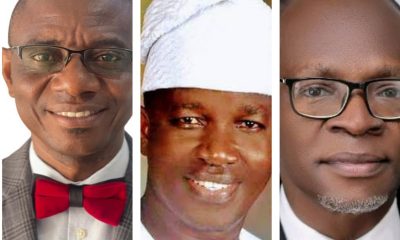
Other members of the anti-corruption agency are Barrister Temitope Ayorinde, Prince Oyebade Oyedapo, AS Asaolu, Esther Olapade, Ihindero Lawrence and Ibrahim Tijani, who will act as the secretary of the agency.

Comments

Crime & Court

UNIBEN killing: Edo security squad arrests 12 suspected cultists, seals initiation centres

Published

on

Security operatives in Edo State have arrested 12 suspected cultists and sealed two apartments allegedly used as initiation centres during coordinated raids across parts of Benin City following the killing of a young man near the gate of the University of Benin.

The operation, code-named “Operation Flush Out Cultists and Kidnappers,” was carried out by the state’s Special Security Squad after the killing recorded on Sunday, May 10, 2026.

The development was disclosed in a statement issued on Tuesday by the Chief Press Secretary to Governor Monday Okpebholo, Patrick Ebojele.

According to the statement, the Chief Security Officer and Principal Security Officer to the governor led the raids conducted in Ekosodin, Isihor, Old Road off S&T Barracks, Airport Road, 19th Street Ugbowo, Ogba-Evbuodia and Evbuomore Quarters, all in Benin City.

Spokesman for the security squad, Noah Idemudia, alleged that some youth leaders within communities in the state were aiding violent crimes and harbouring criminal elements.

He said intelligence reports indicated that sophisticated weapons used in deadly attacks were often traced to communities across the state.

“Reports reaching us indicate that some persons are allegedly harbouring criminals. Intelligence reports also suggest that sophisticated weapons used in deadly attacks on citizens are allegedly sourced from communities.

“The governor is warning community leaders to maintain peace in their various communities and ensure that no unlicensed weapons are found in their possession, as they will be held liable and treated as criminals,” Idemudia said.

He, however, clarified that the 12 suspects arrested were not directly linked to the killing near the university gate.

According to him, the suspects were allegedly identified as members of different cult groups after security operatives reportedly discovered symbols, signs and other incriminating materials on them during the raids.

Idemudia added that the suspects had been handed over to the Anti-Cultism Unit of the Nigeria Police Force for profiling and further investigation.

Speaking on the properties sealed during the operation, he said one of the apartments was allegedly being used as a cult initiation centre.

He explained that operatives came under attack while attempting to arrest suspects at the location, forcing authorities to seal the premises and invite the property owner for questioning.

He added that another apartment raided allegedly contained shrines and fetish items scattered across several rooms, which investigators suspect were being used for initiation into different confraternities.

According to him, the owner of the property had also been invited for questioning by security agencies.

“The governor has warned those sponsoring cultism and violent killings in the state to desist immediately.

“Anyone found aiding criminality in Edo State will face the full weight of the law, as the state will no longer be conducive for criminal elements,” Idemudia added.

He also warned against unlawful gatherings, alleging that some cult groups were planning anniversary celebrations across the state.

Continue Reading

Crime & Court

Ex-Power Minister Mamman Jailed 75 Years Over ₦33.8bn Fraud

Published

on

A Federal High Court in Abuja on Wednesday convicted and sentenced former Minister of Power, Saleh Mamman, to a cumulative 75 years imprisonment in absentia over a ₦33.8bn money laundering scandal linked to the Zungeru and Mambilla hydroelectric power projects.

The trial judge, Justice James Omotosho, found Mamman guilty on all 12 counts bordering on conspiracy and money laundering filed against him by the Economic and Financial Crimes Commission.

The judge ruled that the prison terms would run consecutively, bringing the total sentence to 75 years.

Justice Omotosho held that Mamman deliberately absented himself from court on the day of judgment and during the previous adjourned sitting in a bid to frustrate the administration of justice.

He agreed with counsel for the EFCC, Rotimi Oyedepo (SAN), that the Administration of Criminal Justice Act, 2015 empowered the court to proceed with sentencing despite the defendant’s absence.

The court consequently sentenced the former minister to seven years imprisonment each on Counts 1, 2, 3, 6, 7, 8, 9, 10, 11 and 12 without an option of fine.

Mamman was also sentenced to three years imprisonment on Count 4 with an option of a ₦10m fine, and two years imprisonment on Count 5 without an option of fine.

Justice Omotosho further ordered that the sentence would commence from the date of Mamman’s arrest since he was convicted in absentia.

The judge directed security agencies within and outside Nigeria, including Interpol, to arrest the convict wherever he is found and hand him over to the Nigerian Correctional Service to serve his jail term.

The court also ordered the final forfeiture of two Abuja properties linked to the former minister, alongside various sums recovered in different currencies by anti-graft agencies.

In addition, the court ordered Mamman to refund the outstanding balance from the ₦22bn already traced to the Zungeru and Mambilla hydroelectric power projects out of the ₦33.8bn allegedly diverted.

The conviction followed a lengthy trial instituted by the EFCC, which accused Mamman of conspiring with ministry officials and private companies to divert funds earmarked for the two power projects.

Mamman was arraigned on July 11, 2024 on a 12-count charge and pleaded not guilty.

During the trial, the EFCC called 17 witnesses and tendered 43 exhibits to support its case.

Following the close of the prosecution’s case, the former minister filed a no-case submission on November 19, 2025, contending that the EFCC had failed to establish sufficient evidence against him.

However, Justice Omotosho, in a ruling delivered on December 11, 2025, dismissed the application and held that the prosecution had established a prima facie case requiring the defendant to open his defence.

The matter was subsequently adjourned for continuation of defence before Wednesday’s judgment brought the proceedings to a close.

The case, regarded as one of the most significant corruption convictions in recent years, stemmed from Mamman’s arrest and detention by the EFCC on May 10, 2021.

Continue Reading

Crime & Court

‘I was misled,’ Villa worker tells court in alleged coup plot trial

Published

on

The fourth defendant in the alleged coup plot trial before the Federal High Court in Abuja, Zekeri Umoru, on Tuesday denied knowledge of any plan to overthrow President Bola Tinubu’s government, declaring in a recorded statement played in court that he was “misled”.

Umoru, a maintenance worker at the Presidential Villa engaged by a construction firm, made the claim in a video recording tendered by the prosecution as part of evidence against six defendants standing trial over the alleged plot.

In the footage played in open court, the defendant told investigators that he was introduced to key figures in the case by the third defendant, Inspector Ahmed Ibrahim, who is attached to the Presidential Clinic.

He said Ibrahim introduced him to one Hassan Mohammed, whom he later discovered to be Colonel Mohammed Ma’aji.

Umoru explained that he initially believed Ma’aji was a civilian businessman who intended to engage him for electrical work at a building under construction.

He, however, told investigators that he subsequently received several cash payments from Ma’aji during meetings attended by Ibrahim and another associate identified as Usman.

Recounting one of such meetings at a bar, Umoru said Ma’aji allegedly gave between N100,000 and ₦120,000 to him and others after buying drinks and asking about their professions.
He further disclosed that on September 24, 2025, Ma’aji allegedly handed him a “Ghana Must Go” bag filled with cash.

According to him, he deposited the money in a bank, where it was counted and confirmed to be N8.8m.

He added that an additional N2m was allegedly given to him the following day during another meeting involving Inspector Ibrahim.

Umoru told investigators that he became uneasy over the repeated cash payments and demanded an explanation from Ibrahim.

He claimed that Ibrahim told him Ma’aji was dissatisfied with the state of the country and intended to “sanitise the government” with the support of unnamed associates described as “boys”.

The defendant further alleged that discussions included plans to involve an ambulance driver to facilitate access into the Presidential Villa, with promises of financial rewards.

Despite the revelations, Umoru maintained that he had no knowledge of any coup plot.

“I was misled,” he said, adding that he would have distanced himself from Ma’aji had he known he was a military officer or had intentions beyond business.

Umoru also admitted escorting Usman into the Presidential Villa, noting that security personnel granted access after he identified the visitor as someone who came to see him.

He added that he later caught Usman taking photographs in his office and warned him to desist.

The defendant expressed regret during the interview, apologised to his employers, and affirmed his support for President Tinubu’s administration.

The court also viewed a separate video involving an Islamic cleric, Sheikh Imam Kassim Goni, who similarly denied involvement in the alleged plot.

Goni told investigators that funds he received from Ma’aji were meant strictly for prayers and charitable causes, including spiritual interventions linked to alleged promotion challenges.

However, investigators presented financial records indicating transfers running into millions of naira, including a ₦10m transaction in October 2024, which they said contradicted aspects of his claims.

The prosecution further argued that discussions captured in the videos—particularly references to gaining access and procuring “work tools”—raised concerns about a coordinated scheme, although both individuals denied any knowledge of a coup plot.

Following the presentation of the video evidence, counsel to the sixth defendant, Michael Numa (SAN), told the court that he had just been served with his client’s video exhibits and required time to study them.

While defence counsel sought an adjournment, the prosecution, led by the Director of Public Prosecutions, Rotimi Oyedepo (SAN), urged the court to adhere to its earlier directive for accelerated hearing of the case.

Justice Abdulmalik subsequently adjourned proceedings till May 11, 12 and 13, 2026, for continuation of trial.

Continue Reading

Advertisement

Entertainment

Advertisement

MegaIcon Magazine Facebook Page

Advertisement

MEGAICON TV

Advertisement

Trending