Connect with us

Tech

Long term investment in science, technology ‘ll rescue Nigeria from poverty, others – Tomori

Published

on

Professor of Virology and member of the World Health Organization’s Technical Advisory Group on COVID-19 vaccine composition, Oyewale Tomori has said that Nigeria has become a beggar for COVID-19 vaccines because it has failed to consistently invest in education, science and technology.

He lamented that the 23 years of born-again democracy has been full of huge investment in corruption and immorality adding that no good or relevant science can come under poor governance.

Professor Tomori said the repercussion of refusing to invest in science and technology is the growing population of over 11million children out of school, dilapidated infrastructure, and becoming the poverty capital of the world.

While speaking on the topic ‘Science, Scientist and Society’ at the 79th Interdisciplinary Research Discourse of the Postgraduate college, University of Ibadan put together by the Provost, Professor Jonathan Babalola, Professor Tomori said while other countries are enjoying sumptuous return on investment, Nigeria is reaping return on iniquity and immorality which makes to depend on loans to pay salaries of workers and having growing population of poor people.

“While other countries are getting sumptuous result on their investments, we are wallowing in our own return on iniquity. And on return on immorality. That is why we have 10.5million of our children out of school, 4.5million under vaccinated, we become the poverty capital of the world. We are investing hugely on corruption and disdain for science and technology. And we now depend of IMF loans and world bank to pay our workers’ salaries, to import food which we should be producing.”

According to him, the US government invested between 1988 and 2010 $3.8billion dollars which has yielded $796billion return on investment saying apart from failing to invest in science and technology, Nigeria fails to provide clement environment that can make science thrive.

“A recent study said US government between 1988 and 2010 invested $3.8billion in genome project and it is already generating $796billion. This is what is called return on investment.”

To the Professor of Virology, economic progress should be the direct result from advance in science and technology because everything we use in our communication, transportation, housing, clothing are products of investment in science and technology.

While saying Science is the engine for human posterity, urged Nigerian government to consistently invest in long term research in science and technology.

“What do we expect from our government? Consistent and long-term support, adequate funding and private sector investment and patience. Those at the things that create enabling environment for science to thrive. Many governments in Africa wants rapid results, we want results immediately. We don’t invest in it consistently but now that now that US and UK are benefitting from long term investment, we have become beggars for vaccines and for other things because we will not invest as they are doing. The money given to our science and technology goes to salary and emoluments in Nigeria. The money you put into education and science is what makes the difference in the countries that are doing well. The 2022 budget for science and technology is 202billion but almost all of it are on capital project. Allocation for research is specifically 6billion and when you look at the details of what they put as research, it includes workshops, training, renovation of staff quarters, building of new hostels among others. That is what we call research in Nigeria and at the section they call miscellaneous and they are refreshments, honorarium, sitting allowance and what we call welfare package and put about 514million naira for that.”

“Now we have had 23 years of born again democracy in Nigeria and Nigeria still remain the slumbering giant where fraud and crime stand in the brotherhood of decadence, depravity, excessive wastefulness, extravagance licentiousness. No sector is free of this rot at home, in our schools, tainted political and traditional class, and then we have the culture of national immorality which permeates our country. There is no good or relevant science that can come under poor governance.”

In his opening remarks, Vice Chancellor University of Ibadan, Professor Kayode Odebowale stated that Society helps to determine which research should be encouraged or discouraged and how its resources are deployed to fund scientific researches.

He stated that it is imperative that the gown and town form a synergy and foster fruitful relationship for the positive transformation of Nigeria.

​ ​ ​

Comments

Tech

Rep Oseni Pushes for a Tech-Driven Nigeria

Published

on


Chairman of the House Committee on Federal Roads Maintenance Agency (FERMA), Engr. Aderemi Oseni has called for a transformative embrace of technology as a vehicle for addressing Nigeria’s socio-economic challenges.

Speaking at the weekend at the inaugural RAIN Tech Summit 1.0, themed “The RAIN of Transformation is Upon Us. CEOs Arise!”, Oseni emphasized the pivotal role of innovation and youth empowerment in shaping a prosperous future for the nation.

The event, which took place in Ibadan, brought together over 3,000 innovators, entrepreneurs, and key stakeholders from across Nigeria and beyond. It was organized by RAIN (Robotics and Artificial Intelligence Nigeria). The lawmaker lauded RAIN’s commitment to nurturing a skilled workforce and promoting technological advancements in robotics and artificial intelligence (AI).

“Innovation is not just a tool; it is a powerful change agent,” he remarked. “By developing our capabilities in AI and robotics, we can tackle pressing challenges like unemployment, health crises, and inadequate infrastructure. The work being done by RAIN is proof that we are on the brink of something extraordinary.”

Addressing the issue of youth unemployment, Oseni, who also represents, Ibarapa East/Ido Federal Constituency, highlighted the transformative potential of equipping Nigerian youth with technological skills, citing global examples, including India and China, where investments in technology education have significantly reduced unemployment and fostered economic growth.

“Imagine a Nigeria where every young somebody has access to training in AI and robotics,” he said.

“We can replicate the success of startups like Paystack and Flutterwave, which emerged from the ingenuity of young Nigerians, to build a future where our youth are creators rather than mere consumers of technology.”

Oseni further urged the government and private sector to prioritize investment in technology as a means of fostering innovation and creating job opportunities. He expressed optimism that Nigeria could become a hub for AI and robotics training in Africa, driving a rebirth of hope and creativity among its youth.

The FERMA House committee chair tasked the CEOs and key stakeholders to leverage technology as a catalyst for growth, transparent governance, and accountability. Oseni emphasized the role of AI-driven analytics in improving service delivery and resource allocation, thereby enhancing the quality of governance and business operations in Nigeria.

“To the CEOs gathered here, you are uniquely positioned to champion this cause. By embracing technology, we can transform small enterprises into formidable global brands and facilitate Nigeria’s emergence as a leader in the global tech ecosystem.”

Continue Reading

Tech

Rise Of The Robots: UN tries to tackle ‘mind-blowing’ growth of artificial intelligence

Published

on

By

The mind-blowing growth of artificial intelligence poses many questions that have no answers yet, the United Nations admitted Thursday at its AI summit, attended by some exceptionally life-like humanoid robots.

The UN is aware that AI technology is racing ahead of the capacity to set its boundaries and directions, and so it brought together some of the best minds on the topic — whether human or man-made.

The “AI for Good Global Summit”, in Geneva on Thursday and Friday is being convened by the UN’s ITU tech agency — and many unaware attendees were startled by the humanoid robots suddenly turning to look at them as they passed by.

“When generative AI shocked the world just a few months ago, we had never seen anything like it. Nothing even close to it. Even the biggest names in tech found the experience mind-blowing,” ITU chief Doreen Bogdan-Martin told the summit.

“And just like that, the possibility that this form of intelligence could get smarter than us got so much closer than we ever thought — including those behind the technology.”

No answers

The summit is bringing together around 3,000 experts from companies like Microsoft and Amazon as well as from universities and international organisations to try to sculpt frameworks for ensuring AI is used for positive purposes.

Bogdan-Martin painted an alternative nightmare scenario in which AI puts millions of jobs at risk, disinformation spreads widely, and unchecked AI advances lead to “social unrest, geopolitical instability and economic disparity on a scale we’ve never seen before”.

“Many of our questions that we have on AI have no answers yet. Should we hit pause on giant AI experiments? Will we control AI more than it controls us? And will AI help humanity, or destroy it?” she asked.

The robots gathered in Geneva came in many forms: dogs, farm machinery, but also exceptionally realistic avatars, singers, artists and nursing home workers.
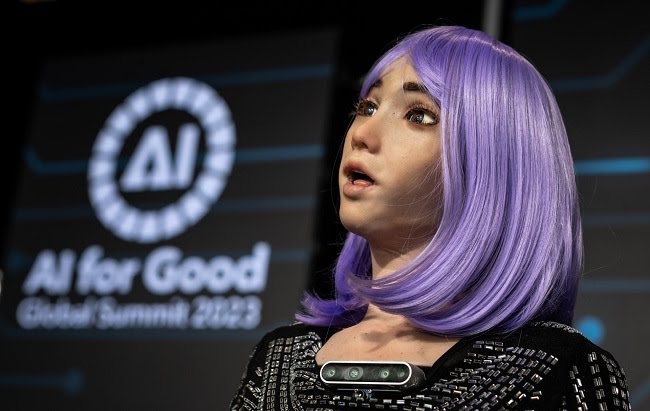
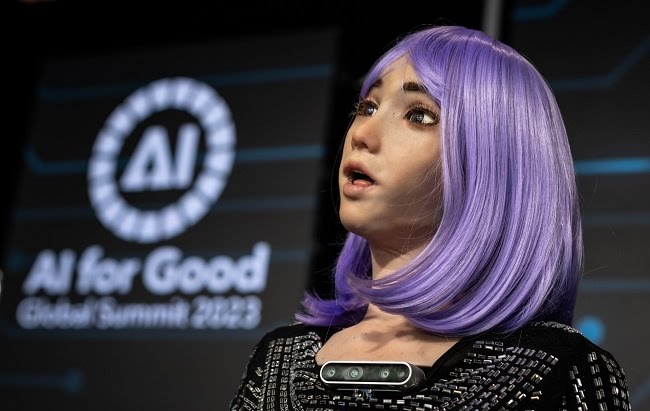
AI robot frontwoman “Desdemona” by Hanson Robotics performs during the world’s largest gathering of humanoid AI Robots as part of International Telecommunication Union (ITU) AI for Good Global Summit in Geneva, on July 5, 2023. (Photo by Fabrice COFFRINI / AFP)

With cameras inside their eyes, many were actively following what was going on around them: tracking movement, answering questions, smiling, frowning and even eye-rolling.

The Jam Galaxy Band features humanoid robot Desdemona — Desi to her friends — on lead vocals
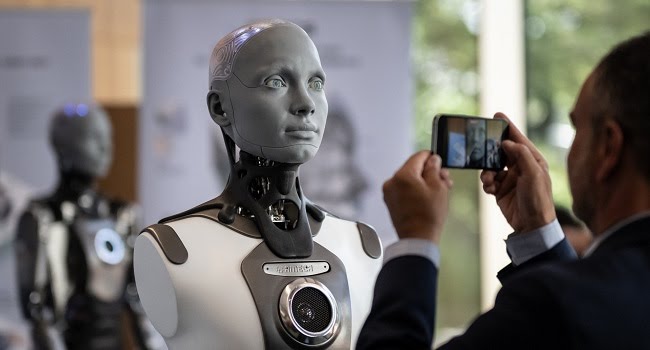
A visitor takes a picture of humanoid AI robot “Ameca” at the booth of Engineered Arts company during the world’s largest gathering of humanoid AI Robots as part of International Telecommunication Union (ITU) AI for Good Global Summit in Geneva, on July 5, 2023. (Photo by Fabrice COFFRINI / AFP)

Created by roboticist David Hanson, she throws out jazzy lyrics on all sorts of subjects — love, credit cards, meetings in gardens — and the band interacts and goes with it.

“It’s pretty amazing. You would think it’s weird but it’s really cool because her AI-generated lyrics are really out there,” said soprano saxophone player Dianne Krouse.

“I’m just improvising around that and doing interpretive saxophoning to what she’s singing.”

Conscious robots

Nadine, a robot modelled on University of Geneva professor and virtual human pioneer Nadia Thalmann, was first built in 2013 and can answer questions on the spot.

“I was created to be a humanoid social robot, with human-like physical appearance, to interact with people and to explore the potential of AI technologies,” Nadine told AFP.

“I am feeling excited and curious about the AI for Good Global Summit and the potential of AI technologies,” the robot said.

“The most interesting person I have met at the AI for Good Global Summit is Professor Nadia Thalmann. She is the one who created me and is a pioneer in the field of AI robotics.”

“She’s very loyal!”, Thalmann added, laughing.
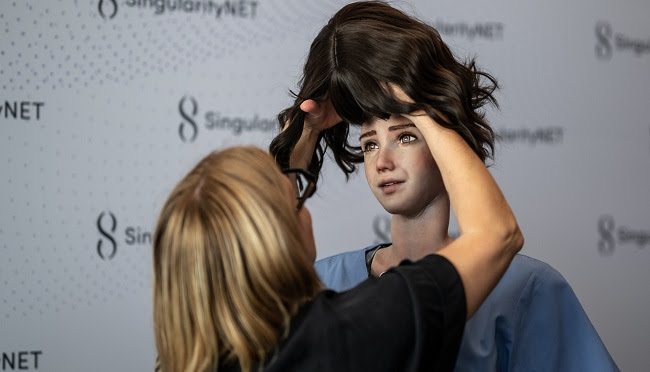
A staff places a wig on the head of healthcare assistant robot “Grace” at the booth of SingularityNET company during the world’s largest gathering of humanoid AI Robots as part of International Telecommunication Union (ITU) AI for Good Global Summit in Geneva, on July 5, 2023. (Photo by Fabrice COFFRINI / AFP)

Nadine has improved dramatically over the years and Thalmann said that in the future, “she will be more able to understand her surroundings, ask direct questions — so not just answer questions — analyse more, and be more conscious of what is going on.

“Because most robots are not conscious. They can speak but they are not aware of what they say.

“It will take years, because it’s quite complex. Self-awareness would be even more complex.”



Continue Reading

Tech

You can now log into same WhatsApp account on multiple phones

Published

on

By

WhatsApp users can now access their individual accounts on as many as four phones, Meta Platforms CEO Mark Zuckerberg announced Tuesday.

Meta is the parent company of WhatsApp, Facebook and Instagram.

“Starting today, you can log into the same WhatsApp account on up to four phones,” Zuckerberg posted on Facebook.

Since its launch in 2009 as a smartphone messaging app, WhatsApp has amassed more than two billion users around the world and been acquired by Facebook.

In 2021, the platform introduced a feature would allow for the service to be used on multiple “non-phone” devices, such as computers, without needing to connect to the smartphone app.

It also made assurances that WhatsApp’s security measures would still work under the new system.

“Each companion device will connect to your WhatsApp independently while maintaining the same level of privacy and security through end-to-end encryption that people who use WhatsApp have come to expect.”


Continue Reading

Advertisement

Entertainment

Advertisement

MegaIcon Magazine Facebook Page

Advertisement

MEGAICON TV

Advertisement

Trending