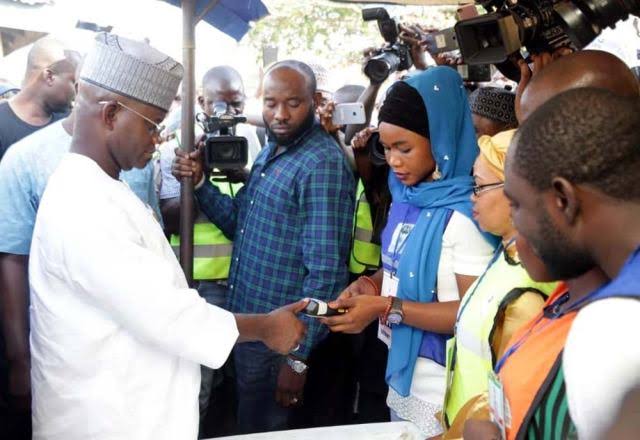
Three things appear very tragic in last week’s Kogi governorship/senatorial elections. They are, first, the video that went viral of the young Kogi ladies chanting the panegyrics of Governor Yahaya Bello at a pre-election rally in the state; the violence that ended the lives of some people and the “anyone who is aggrieved should go to the courts” reaction of President Muhammadu Buhari to the “victory” of Bello.
Two of those tragedies are of Hiroshima and Nagazaki proportion; they are what I call the euphemization of violence, delivered in a melodious tune by those Kogi ladies and the mockery that lies behind Buhari’s almost comedic and unstatesmanly statement. Viewed as a collective, the three statements, to my mind, can be well captured by that famous letter written by Irish playwright, novelist, poet and late nineteen century London celebrity, Oscar Wilde, to his gay partner, Sir Alfred Douglas, called De Profundis or Letter to Sir Alfred Douglas.
Wilde was renowned for his flamboyant attires which showed him as a witty eccentric and typecast him as a man who lived an unpredictable lifestyle. This lifestyle also put him at odds with what obtained in Victoria England at the time and especially, because homosexuality was a major crime in the England of the time. He was on trial in 1895 for “gross indecency” after the father of Sir Douglas, his gay partner, a British aristocrat, unscrewed the lid of the scandal which thus became public knowledge.
Wilde, writing from his H. M. Prison, Reading in January, 1897, had said of his alliance with Douglas, “our ill-fated and most lamentable friendship has ended in ruin and public infamy for me.”
Electoral monitoring organizations, European election monitors and even their Nigerian partners, have submitted that no sensible nation should use the Kogi election as a yardstick for measuring electoral politics. What is more, Nigerians’ encounters electorally in the last four years or so of the current government may yet be an eerie projection of what will happen subsequently and in the 2023 elections.
With all these prognoses, it may not be a dip into doomsday prophesy to conclude that, with bloodcurdling electoral politics that is fast becoming a testament of party politics in Nigeria under this government, Nigerians may, with the Kogi election, have stared at the proverbial head of the Medusa and their once soft hearts may have turned into stones.
Participation in voting or even coming out on the day of an election where stray bullets may fell them while recipients of the juices of the elections flee to Aso Rock to go have wild celebrations with the President, may have to be considered seriously.
Greek mythology explains the head of Medusa thus: Medusa was reputed to be a monster or a Gorgon whose feature was that of a winged human being but who was a female. Rather than the female longish hairs, Medusa had venomous snakes making each of the strands of her hairs. Anyone who looked at these scary snakes that made up Medusa’s hairs instantly turned into stone. After being in existence for centuries, Medusa was said to have died on an island that was called Sapedon, near Cisthene. She was decapitated but even after she was beheaded, her head still retained the ability to turn anyone who looked at her into stone.
Some writers have located this Cisthene where Medusa died to be somewhere in present day Libya. Herodotus, an ancient Greek historian, linked the Medusa myth to the religion of Libya’s Berbers. Thus, in comparing Nigeria’s electoral process with the head of Medusa, I am saying that, right now, the muffled anger, disdain and angst that Nigerians have towards elections in the country, aftermath the Kogi violent election, are enough indices to announce the path that the country would tread in 2023.
Delivered in a local dialect, the highly melodious song of the Kogi ladies had said, inter alia: Who is saying that Yahaya will not be Governor?// Dem go hear am ta-ta-ta-ta-ta//What are you saying?//What are you talking?//What a tyranny4+4. Enraptured by the very rhythmic song, you would almost lose track of the fact that the young ladies were ratifying and justifying the violence and murders which eventually engulfed Kogi in the melee of the elections.
While I listened to it, I didn’t know the time I got sucked into the beautiful song and began to wriggle my body to the melody. The beautiful ladies delivering the song and their apparent mastery of the art of dancing also blithely delivered the parcel of electoral intolerance. Ta-ta-ta-ta-ta was undoubtedly the unfriendly rhythm of a rifle.
Do the ladies know or realize that ta-ta-ta-ta-ta means that votes will not count? Did they bother at all? Did they know that ta-ta-ta-ta-ta is sorrow for some persons’ children? Do they care?
It was as if the choristers of death were presaging what would be parceled to the world shortly after, a broth of political hatred, blood and outright disdain for the sanctity of electoral politics. The ta-ta-ta-ta-ta caught me gasping for breath. Like the euphemism that it was, it cushioned the blow of bloody electoral reality that it portended. But, why would a people give political, cultural and societal stamp to gangsterism and violence like this in Bello’s Kogi and Buhari’s Nigeria?
At several fora where I was asked what hope Nigeria had to navigate from her current stasis, groping for an answer without one, I turned to electoral sanctity. All other escape routes appeared very sterile and non-feasible. While coup is outdated and should not be encouraged by any one, the other most practicable path, I told my listeners, was to have a benevolent dictator emerge through the electoral box. The most visible impracticability of this is that the man with honest intention to deliver the country from her morass would never be allowed to wriggle themselves out of the very tumultuous electoral process that is corrupt, corrupted and laced with thorns and briers. You also needed to have amassed amounts that only corruption will midwife, so as to have enough financial brawn to fight for a position of consequence that can in turn salvage the people. This dilemma of a Nigeria looking for a messiah through the ballot box is akin to the egg and chicken equation that does not give itself up to an easy answer.
Yes, there have always been electoral violence, corruption and political gangsterism in virtually all Nigerian elections; yes, violence has become almost a paterfamilias of our electoral contests but last week’s “election” in Kogi was in a class of its own. Diplomatic Watch, a body with an umbrella of observers from Austria, European Union delegation, Germany, Ireland, Netherlands, United Kingdom and the United States, which has consistently monitored Nigerian elections for ages, expressed huge concerns about the conduct and conditions of the elections.
In a joint statement issued by it and others, the body raised alarm over widespread incidents of violence and intimidation, which it said its team witnessed in Kogi. Viral videos of violence, shooting and snatching of ballot boxes were all traded with brazen immunity. I listened to witnesses of the electoral infamy that was orchestrated in the so-called Confluence State and one could not but weep for the electoral future of Nigeria. How did Nigeria get to this electoral sorry pass?
Till date, no one can say with precision the number of persons who were martyred for the so-called “victory” that Governor Bello celebrates with juvenile excitement, neither can anyone count on the finger tips how many homes lapsed into sorrow on account of the election which President Buhari gleefully thumped his party’s chest with a drunk-like abandon. The most horrifying of the violence was the one that consumed Acheju Abuh. Abuh, the Women Leader of the Peoples Democratic Party (PDP) in Wada/Aro Campaign Council, was set ablaze in her residence at Ochadamu in Ofu local government area of Kogi on Monday, November 18. From accounts of Abuh’s gruesome murder, the killers are identifiable.
It was a permanent scar that the election that reportedly produced Bello for a second term bears. Rather than exhibit some measure of sobriety, given the murder of Abuh and some others in his state, the trio of Bello, his “father” and Adams Oshiomhole, have been throwing disgraceful saturnalia over this shameful “win.”
With all the accounts of electoral violence that occurred in Kogi, ordinarily, President Buhari should be acutely worried. His worry should stem from widespread negative comments – both within and without – that have trailed the Kogi election. There were rumours of one of the political parties securing the services of a top police officer who sat in a helicopter which threw tear gas canisters at polling booths where the opposing party held sway; there were also reports of votes from the opposing party’s strongholds blocked from getting to the collation centres. These reports, no doubt, are on the President’s table.
Why would Buhari now celebrate this “victory” with such nauseating glee and make a muffled noise of himself examining Bello’s election certificate like a compromised father whose son had just brought home an examination result slip in an examination that he abetted in getting teachers to favour the son? So when Buhari told anyone who was aggrieved with the Kogi result to go to court, Nigerians took it that he was pouring salt on their injury. Is it not the same court where his lackey drives an airplane?
If we do not know, compromised electoral results are one of the issues dragging this country down and preventing her from getting to its place of glory. First is the spirituality of compromised elections. Because the bulk of people we purportedly elect into political offices get there by bolekaja methods, they cannot connect with the spiritual essences of those offices. Physically, they cannot get the offices’ blessings nor the unseen glory that comes from it. They thus do not respect the electorate or their constituents because it was not their votes that brought them into such offices.
As a country, we cannot connect with the spiritual essences of the offices because there is a disconnect between the offices, the occupiers and the people. We thus grope in the dark, moving in circuitous shuttles between the bad, the worst and the ugly. It probably is why we do not reap the visible harvests of democratic rule.
Even in its most physical manifestation, we cannot get a Messiah who would lead the country out of the dark if we continue to have compromised electoral results of the caliber of Kogi. The highest bidder, the ones who have access to violence, will continue to carry the day. The ones with genuine intentions, who have the gravitas and bravura to lead the country would stay away for fear of the blood of politics splattering on their white apparels. They would not have access to governmental compromise of the kind of N10 billion Buhari released to his so-called godson at the twilight of the election and they would not have governmental paraphernalia of coercion that was at the beck and call of Bello.
Thus, we would continue to have the Bellos at the helms of affairs, with their shallow reading of leadership and jejune understanding of governance and government. More fundamentally, our complaints of electors being far between at polling booths will grow worse as genuine voters will keep away for their lives and will not want to waste their time and lives for an election where votes do not count.
For 2023 and the elections that remain in some states, it is frightening.
The Bello model would be the most fascinating to governors. I project that any subsequent election that the All Progressives Congress (APC) is going to be involved in that has no Bello as an adviser would be unadvisable. Once the kingpin is brought in, the ta-ta-ta-ta-ta political methodology would be on loan to the states that desire it. And Nigeria will continue her walk in the dark.