Connect with us

News

Jill Biden reinvents role of US first lady

Published

on

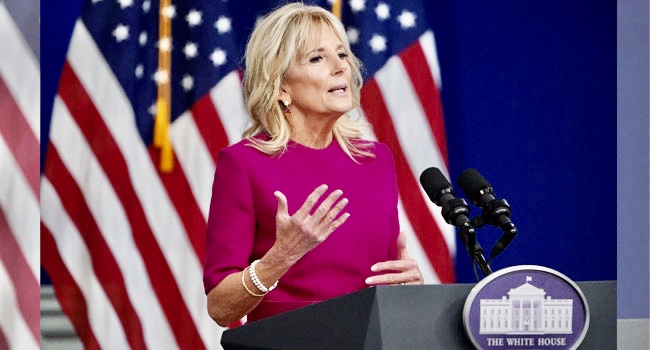
US First Lady Jill Biden speaks during a Tribal Nations Summit in the South Court Auditorium of the Eisenhower Executive Office Building, next to the White House, in Washington, DC on November 15, 2021. PHOTO: MANDEL NGAN / AFP

Jill Biden promotes Covid vaccines and takes part in political rallies — but only when her college professor schedule allows.

In her quiet way, Jill Biden is reinventing the traditional role of the First Lady of the United States.

Attending a former governor’s funeral last week, President Joe Biden had to apologize for his wife’s absence.

“The reason Jill is not with me today is she’s teaching today, full-time as a professor at Northern Virginia Community College,” the president said.

The announcement in September that the first lady was resuming face-to-face instruction at her college made headlines in the American press.


Never before had a presidential spouse had a professional career outside the White House.

Jill Biden, now 70, married Joe Biden in 1977, when he was a widowed senator with two young boys. The couple later had a daughter together.

A member of the national teachers’ union with a doctorate degree in education, Jill Biden continued teaching while her husband served as vice president under Barack Obama.
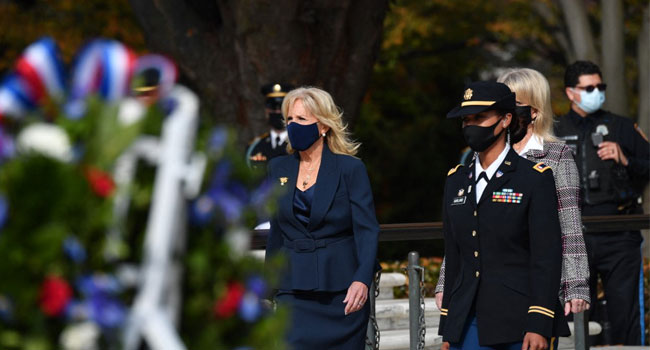
US First Lady Jill Biden attends a Veterans Day event at The Tomb of the Unknown Soldier at Arlington National Cemetary in Arlington, Virginia on November 11, 2021. PHOTO: Nicholas Kamm / AFP

Like most educators in the United States, she taught remotely during the coronavirus pandemic, before returning to in-person instruction this fall. She now teaches English and writing two days a week.

When she is not in the classroom, the slim, blond-haired Biden can be seen by the president’s side at private and public events, but also, more and more often, alone on stage.

– Vaccination –

The first lady is traveling around the country urging Americans to get vaccinated against Covid-19 and — ever since vaccines were approved for teenagers and younger kids — to also immunize their children.

She has also campaigned in support of a Democratic candidate in a local election, attended the Tokyo Olympics and was seen in a cafe with Brigitte Macron, the French president’s wife, as Washington was caught in a diplomatic crisis with Paris.

“She certainly has been sort of picking up the pace of her public appearances lately,” said Tammy Vigil, associate professor of media science at Boston University’s College of Communication.

“In the modern era, it’s extremely expected of first ladies that they become more and more publicly active.”

Jackie Kennedy sought to preserve America’s cultural heritage and famously redecorated the White House. Nancy Reagan campaigned against drug use. And Michelle Obama launched a major movement promoting healthy eating and exercise among American children.

By contrast, Michelle Obama’s successor Melania Trump “got into a lot of trouble because she wasn’t as active as she should be in terms of public service,” Vigil said.

Unlike Michelle Obama, who faced openly racist and sexist attacks, Jill Biden has so far been largely spared aggression — even in today’s tense political climate.

That said, she still came under considerable scrutiny.

Earlier this year CNN published a column on its website urging her to exhibit more “restraint” in her fashion choices, after she was seen wearing a black leather skirt and patterned black tights.

“It’s part of her high-profile, first lady job to look dignified. And gracious,” psychologist Peggy Drexler opined in the piece.

And in late 2020, the conservative-leaning Wall Street Journal published an opinion piece, calling into question Biden’s academic credentials.

“Any chance you might drop the “Dr.” before your name?” the columnist asked. “Dr. Jill Biden” sounds and feels fraudulent, not to say a touch comic.”

The piece caused a public uproar for its message and  condescending tone.

“The First Ladyship has been behind the times as far as representing what American women do and how they really live,” said Vigil, the Boston University professor.

But while Biden pushes the boundaries of her role, she also tries to tread a careful line, mindful that the US first lady is not an elected official and does not possess official powers or duties.

She does not openly meddle in politics, although some commentators see her as the inspiration behind Joe Biden’s short-lived initiative to offer two years of free community college to young Americans.

In her day, Hillary Clinton faced sharp criticism for being too active in promoting health care reforms while her husband was president.

If the family life of a US president and the role of first lady are still subject to “conservative” views in America, Vigil said that other members of Biden’s administration are pushing the boundaries in different ways.

Among them is Vice President Kamala Harris, whose spouse Doug Emhoff is the first-ever “Second Gentleman” of the United States. There is also Transportation Secretary Pete Buttitieg, who happily talks about the infant twins he has with his husband.

Comments

News

Oseni mourns ex-Oyo lawmaker Akeem ‘Able’, says Oyo APC has lost loyal progressive

Published

on

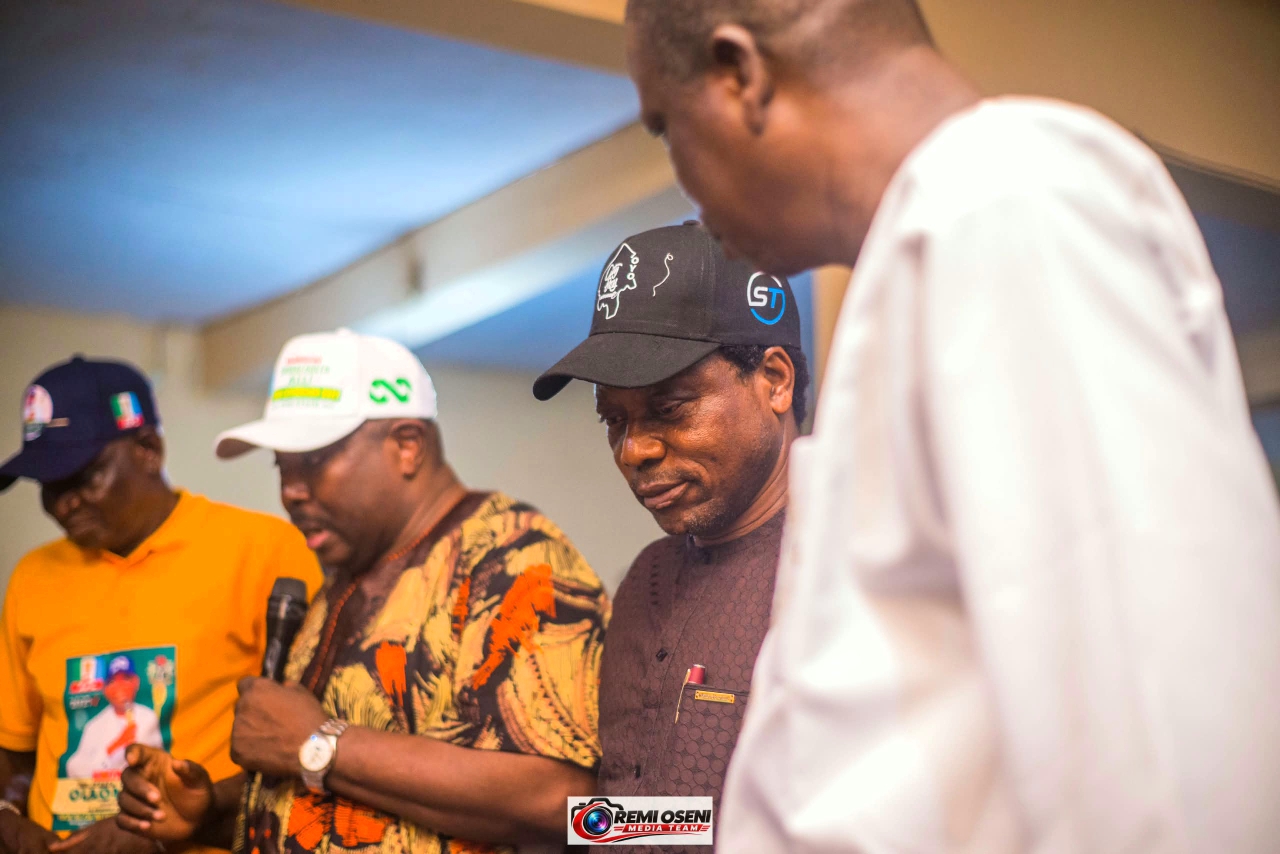
The lawmaker representing Ibarapa East/Ido Federal Constituency in the House of Representatives, Engr. Aderemi Oseni, has mourned the death of a chieftain of the All Progressives Congress (APC) in Oyo State and former member of the Oyo State House of Assembly, Hon. Akeem Abimbola Oladipupo, popularly known as Able, describing his demise as a painful loss to the progressive family.

Oladipupo, who represented Ibadan North-West Constituency in the Oyo State House of Assembly, was widely regarded as a grassroots politician and committed party loyalist until his passing.

Oseni, who is also the Chairman, House Committee on Federal Roads Maintenance Agency and the APC candidate for Oyo South Senatorial District, said the late politician’s death had created a vacuum within the party and among those who benefitted from his unwavering commitment to public service.

In a condolence statement issued on Monday by his Media Aide, Idowu Ayodele, and made available to journalists in Ibadan, the Oyo State capital, the federal lawmaker described the late Oladipupo as a dependable progressive, humble political actor and loyal party stalwart whose impact would remain indelible.

He said the deceased dedicated his life to serving humanity, strengthening the progressive movement and supporting the aspirations of many at the grassroots.

Oseni said, “The death of Hon. Akeem Abimbola Oladipupo (Able) came to me as a rude shock. Oyo State and the progressive family have indeed lost a committed, loyal and selfless leader whose passion for service, humility and dedication to the people stood him out.

“He was not just a politician but a bridge-builder, a dependable ally and a grassroots mobiliser who believed strongly in the ideals of our great party. His contributions to the growth of the APC in Oyo State and his service to humanity will remain unforgettable.”

The APC senatorial candidate noted that the late former lawmaker remained steadfast in promoting peace, unity and political development, adding that his simplicity and accessibility endeared him to many across political divides.

According to Oseni, the late politician’s legacy of service and sacrifice would continue to inspire younger politicians and party faithful.

He, however, urged members of the APC, associates and family members of the deceased to take solace in the remarkable life he lived and the positive impact he made during his lifetime.

Oseni also prayed for the repose of the deceased’s soul and for God to grant his family the fortitude to bear the painful loss.

Continue Reading

News

Governors Push N100,000 Minimum Wage to Ease Workers’ Economic Burden

Published

on

State governors have proposed a new national minimum wage of N100,000 for Nigerian workers as part of efforts to cushion them from the biting effects of inflation and the rising cost of living.

Governor AbdulRahman AbdulRazaq of Kwara State, who is also the Chairman of the Nigeria Governors’ Forum (NGF), disclosed the proposal on Saturday in a post by the state government’s official Facebook page. He said the move aims to improve workers’ welfare while ensuring that government finances remain sustainable.

“State governments recognise the urgent need to improve workers’ welfare in response to the current economic realities facing Nigerians,” AbdulRazaq said.

“We are actively engaging with the Federal Government and organised labour to arrive at a wage structure that is fair to workers and sustainable for government finances.”

The NGF chairman explained that ongoing discussions are focused on balancing the need to boost workers’ purchasing power with the capacity of governments to deliver essential public services and development projects.

“The goal is to improve the living conditions of workers while ensuring that states can continue to meet their obligations and sustain projects that directly impact citizens,” he added.

The proposed N100,000 minimum wage is expected to intensify national debates on salaries, inflation, and broader economic reforms as Nigerians continue to contend with rising food prices, transportation costs, and other living expenses.

Currently, Nigeria’s statutory minimum wage stands at N70,000 per month. Some states, including Lagos, Rivers, and Imo, are already paying above the national benchmark to support workers amid the country’s economic challenges.

Meanwhile, the Nigeria Labour Congress (NLC) has continued to call for a comprehensive review of salaries, insisting that workers deserve a living wage that reflects present-day economic realities rather than merely guaranteeing survival.

Continue Reading

News

Petrol hits N1,533/litre as cooking gas prices jump nationwide

Published

on

The average retail price paid by consumers for Premium Motor Spirit, popularly known as petrol, rose to N1,532.93 per litre in April 2026, representing a 23.69 per cent increase compared to the N1,239.33 recorded in the corresponding period of 2025, findings by the National Bureau of Statistics (NBS) have shown.

The sharp rise in petrol prices came amid mounting inflationary pressure and worsening living costs, with Nigerians grappling with soaring transportation and food expenses that have continued to shrink household purchasing power.

The NBS disclosed this in its Premium Motor Spirit (Petrol) Price Watch for April 2026, released on Friday.

The report further showed that on a month-on-month basis, petrol prices rose by 18.97 per cent from N1,288.54 recorded in March 2026, underscoring persistent volatility in the downstream petroleum market.

A breakdown of prices across states revealed that Yobe recorded the highest average retail price for petrol at N1,599.05 per litre during the review period.

Edo and Bauchi followed closely with average prices of N1,595.74 and N1,589.07, respectively.

However, Niger residents paid the least for petrol at an average of N1,403.89 per litre, while Sokoto and Katsina recorded N1,404.16 and N1,406.28 respectively.

At the zonal level, the South-South recorded the highest average retail price at N1,566.76 per litre, while the North-West posted the lowest at N1,508.81.

The latest petrol price increase comes as millions of Nigerians continue to battle the ripple effects of rising inflation, with higher energy costs worsening transportation fares and the prices of essential commodities.

Similarly, the NBS said the average retail price for refilling a 5kg cylinder of Liquefied Petroleum Gas, also known as cooking gas, rose by 13.73 per cent month-on-month to N8,706.93 in April 2026 from N7,655.73 recorded in March.
On a year-on-year basis, the price increased by 10.42 per cent from N7,885.60 recorded in April 2025.

Lagos recorded the highest average price for refilling a 5kg cylinder at N9,745.10, followed by Nasarawa at N9,451.70 and Bayelsa at N9,422.74.

In contrast, Anambra recorded the lowest average price at N7,204.76, while Ondo and Ogun followed with N7,239.49 and N7,825.75, respectively.

At the regional level, the North-West recorded the highest average retail price for refilling a 5kg cylinder at N9,025.07, followed by the North-East at N8,847.16, while the South-East posted the lowest average price at N8,224.37.

Also, the average retail price for refilling a 12.5kg cylinder of cooking gas increased by 13.89 per cent month-on-month to N22,382.20 in April 2026 from N19,652.83 in March.

Compared to April 2025, the price rose by 10.43 per cent from N20,268.06.

According to the NBS LPG Price Watch for April, Katsina recorded the highest average retail price for refilling a 12.5kg cylinder at N25,596.71, followed by Kogi at N24,558.25 and Gombe at N24,438.97.

Ogun recorded the lowest average price at N19,564.36, while Bauchi and Anambra followed at N20,178.87 and N20,511.90 respectively.

The North-West recorded the highest zonal average retail price for refilling a 12.5kg cylinder at N23,276.95, followed by the North-Central at N22,865.29, while the South-East posted the lowest average at N21,060.92.

The latest figures signal growing pressure on household energy costs, raising concerns over the implications for inflation and the cost of living in the coming months.

Continue Reading

Advertisement

Entertainment

Advertisement

MegaIcon Magazine Facebook Page

Advertisement

MEGAICON TV

Advertisement

Trending