News
IS leader blows himself up during US special forces raid – Biden


President Joe Biden said Thursday a global “terrorist threat” was removed when the head of the Islamic State blew himself up after US special forces swooped on his Syrian hideout in an “incredibly challenging” nighttime helicopter raid.
Biden said he had ordered an assault by troops rather than an air strike in order to minimize civilian casualties, even though this meant “much greater risk to our own people.” There were no casualties among the US forces.
The death of Abu Ibrahim al-Hashimi al-Qurashi is the biggest setback to the IS jihadist group since his predecessor, the better-known Abu Bakr al-Baghdadi, was killed in a US commando raid in the same Syrian region of Idlib in 2019.
“Last night’s operation took a major terrorist leader off the battlefield. And sent a strong message to terrorists around the world. We will come after you and find you,” Biden said in nationally televised remarks.
In the brief, somber address from the White House’s Roosevelt Room, Biden said the house targeted overnight in the town of Atme contained “families, including children.”
“As our troops approached to capture the terrorist, in a final act of desperate cowardice, with no regard to the lives of his own family or others in the building, he chose to blow himself up,” Biden said.
Qurashi detonated the entire top floor, Biden said, “taking several members of his family with him.”
The three-level building of raw cinder blocks bore the scars of an intense battle, with torn window frames, charred ceilings and a partly collapsed roof.
AFP correspondents shot photographs that show a simple room with little more than foam mattresses, blankets, colorful clothes and children’s toys.
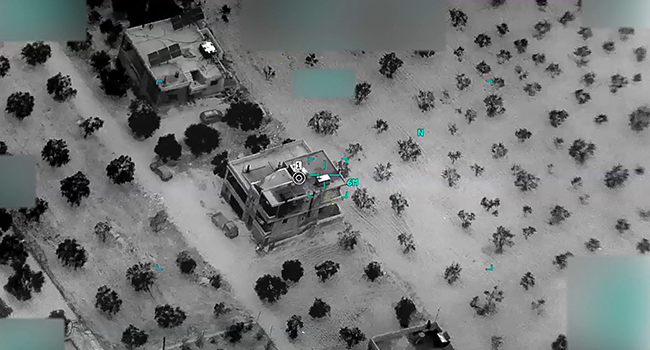
This image released by the US Department of Defense shows the compound housing ISIS emir Al-Qurayshi in northwest Syria prior to a raid executed by US forces, February 2, 2022. US Department of Defense / AFP
An Iraqi from the Turkmen-majority city of Tal Afar, Qurashi was also known as Amir Mohammed Said Abd al-Rahman al-Mawla. He replaced Baghdadi after he too blew himself up in a US raid in October 2019.
The US government had offered a $10 million reward for information leading to Qurashi.
The Syrian Observatory for Human Rights said seven civilians were among at least 13 people killed in the operation, four of them children.
Pentagon spokesman John Kirby said at least three civilians died — Qurashi’s wife and their two children.
Rent paid
Atme residents were shocked to hear that their neighbor in the modest house surrounded by olive trees was in fact the leader of the Islamic State.
One of the world’s most wanted men was living there with his family and his sister.
Even his landlord, Mohamed al-Sheikh, was perplexed by the news. He thought he had leased the house to a cab driver.
“This man lived here for 11 months. I did not notice anything strange about him,” al-Sheikh said. “He would pay me rent and leave.”
Footage after the operation showed a black plume of smoke billowing out of the damaged house. Inside, blood was splattered on the wall and the floor.
A witness told AFP he woke to the sound of helicopters.
“Then we heard small explosions. Then we heard stronger explosions,” said Abu Ali, a displaced Syrian living in Atme, adding the United States blasted messages to reassure residents.
He heard American forces say “don’t worry. We’re just coming to this house… to rid you of the terrorists.”
The American helicopters took off from a military base in the Kurdish-controlled city of Kobani, Abdel Rahman said.
Elite, US-trained members of the Kurdish-led Syrian Democratic Forces joined the operation, Rahman said.
One of the helicopters had to be destroyed after developing mechanical problems, according to a senior US official, and its smouldering remains were photographed in the village of Jinderes in northern Aleppo province.
Farhad Shami, who heads the media office of the US-backed SDF, said the operation targeted “the most dangerous international terrorists.”
Kurdish forces had also taken part in the raid against Baghdadi in 2019.
Fierce battle
Atme is home to a huge camp for families displaced by the decade-old conflict and which experts have warned was being used by jihadists as a place to hide among civilians.
US special forces have carried out several operations against high-value jihadist targets in the area in recent months, with the military on October 23 announcing the killing of senior Al-Qaeda leader Abdul Hamid al-Matar.
The area, the last enclave to actively oppose the government of Bashar al-Assad, is mostly administered by a body loyal to Hayat Tahrir al-Sham, a group led by former members of what was once Al-Qaeda’s franchise in Syria.
The death of the IS leader comes two weeks after the group staged a huge attack to spring its fighters from a Kurdish-run prison in northeastern Syria.
Hundreds were killed in what was IS’s most high-profile operation since the demise of its “caliphate” nearly three years earlier.


Traditional rites, medical outreach, sporting events and youth competitions feature in weeklong celebration
AGO-IWOYE came alive with cultural displays, sporting activities and community development initiatives as indigenes and residents gathered for the 2026 Ago-Iwoye Day celebration.
The weeklong programme, which began on Monday, October 5, brought together indigenes from across Nigeria and the diaspora to celebrate the town’s cultural heritage and promote unity and grassroots development.
The celebration opened with the traditional Woro Plucking Programme at Ojuade Olooto at 7am on Monday. This was followed by intellectual and strategy games at the Ebumawe Palace, where participants competed in chess, draughts, Scrabble and Ayo Olopon.
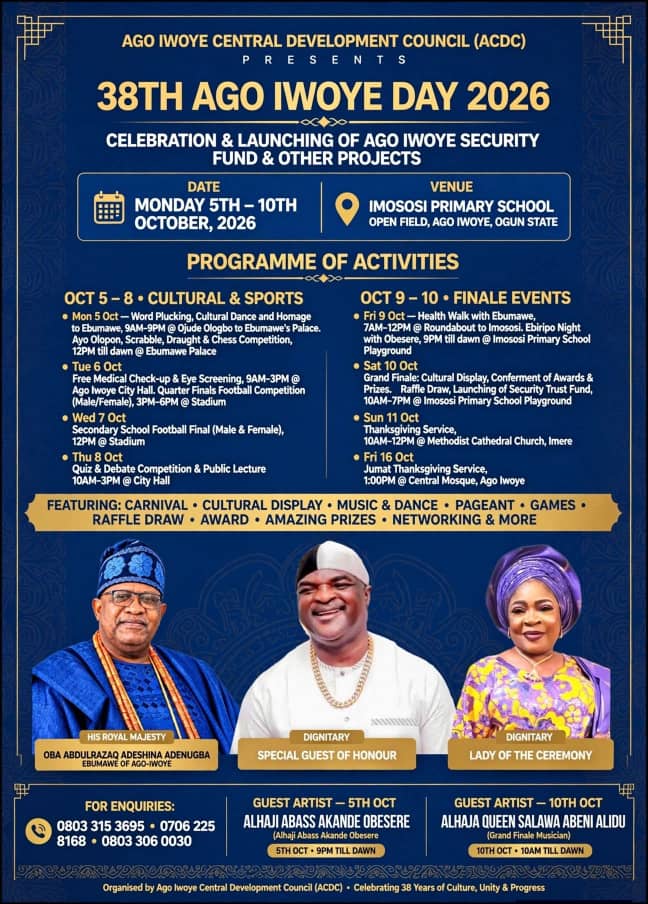
Health and sports featured prominently on Tuesday, October 6, as residents took part in a medical check-up and eye screening exercise at the Ago-Iwoye City Hall.
At the Ago-Iwoye Stadium, sports enthusiasts watched the table tennis finals and the final of the Quarters Football Competition.
The activities continued on Wednesday, October 7, with the finals of the secondary school football competition for male and female categories at the stadium.
Students returned to the spotlight on Thursday, October 8, for a quiz and debate competition at the City Hall. The academic activities were complemented by a public lecture on sustainable community development and youth empowerment.
On Friday, October 9, the Ebumawe of Ago-Iwoye led a health walk from the Omoedumare Roundabout at 7am, drawing residents into another activity designed to promote healthy living and community participation.
The day ended with Ebiripo Night at the Imososi Primary School Field, where music, dance and folklore accompanied celebrations around the town’s popular local delicacy.
The grand finale is scheduled for today, Saturday, October 10, at the Imososi Primary School Field, with traditional performances, civic honours and fundraising activities on the programme.
A thanksgiving service at the Methodist Cathedral, Imere, Ago-Iwoye, is expected to bring the celebration to a close on Sunday, October 11.
Speaking on the significance of the event, the Secretary of the Planning Committee, Dr Samuel O. Awobona, said the turnout demonstrated the commitment of indigenes and residents to preserving the town’s identity and advancing its development.
He said, “This weeklong celebration underscores our collective resolve to preserve our identity while driving grassroots development. The massive turnout across all generations reflects the enduring spirit of Ago-Iwoye.”
The annual celebration provides an opportunity for the community to showcase its traditions while bringing residents, young people and indigenes in the diaspora together around shared cultural and developmental goals.

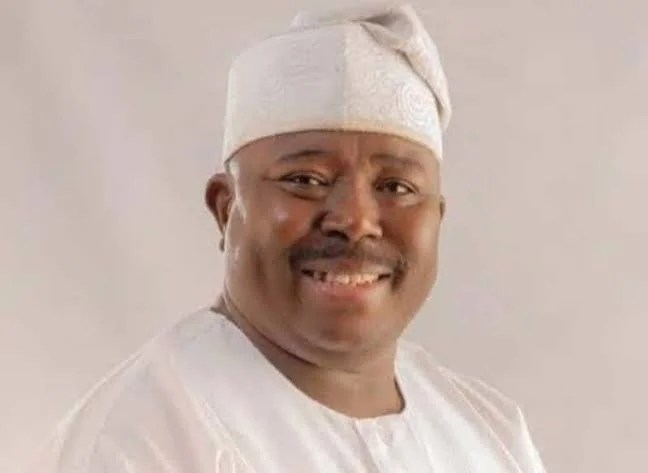

Ago-Iwoye Comes Alive as Community Celebrates Cultural Heritage

Two-Term Ex-Oyo Lawmaker Dumps APM, Accuses Makinde Govt Of Neglect

2027: Ibarapa will deliver massive votes for APC, Ayandele tells Makinde’s commissioner



-
 Politics3 weeks ago
APM Rally: APC Tackles Makinde Over Use of ‘CAF-Rejected’ ₦5.5bn Stadium
-
News4 weeks ago
Oyo South: Oseni Approves N100m for Ibadan Community Road Rehabilitation
-
Metro4 weeks ago
Ondo alcohol deaths: 29 die, 60 affected
-
Politics4 weeks ago
Ibarapa East/Ido: I’ll sustain quality representation, development, says Osuolale