Connect with us

Opinion

APC’s Long Night | By Lasisi Olagunju

Published

on

I saw two bearded, bitter members of the All Progressives Congress (APC) on Channels TV late last week lamenting. They said ex-PDP leaders were taking over the house they built. They fretted and lamented what was about to happen to their tendency at the party’s national convention. I pitied them. It is not everyone who builds that lives in the house they built. They’ve probably not heard it said before that “fools build houses, and wise men live in them.” It is in Alan Benjamin Cheales’ Proverbial Folk-Lore (1875). W.F. Butler, in his 1911 autobiography, injects a benign variant of that saying: “Fools build houses for other men to live in.” I also saw it somewhere that the men who built the big house of Empire for England “usually get the attic for their own lodgment.” J. Ray in his ‘English Proverbs’ (1670) has an even more ghastly slant: “Fools build houses, and wise men buy them.” Yet, there is at least one more person, J. Kelly who asserts in his ‘Scottish Proverbs’ (1721) that he knew a gentleman who bought land, built a house upon it, and then sold “both house and land to pay the expenses of his building.” All these are contained and explained in the Oxford Dictionary of Proverbs. Visit them.

So, which of the above sayings would you say fits the unhappy creators of the APC and the party’s new chief occupants? The founding members are unhappy because Abdullahi Adamu is the national chairman and Iyiola Omisore is the national secretary. They have a reason to be sad. They are in the rains; the people they thought they defeated are in their victory house, warm and well. The enemy even holds the yam and the knife now. Adamu was PDP governor of Nasarawa (1999 to 2007), secretary of PDP’s highest organ, the Board of Trustees and was elected PDP Senator in 2011. He left the party in 2014. Omisore was PDP Senator (Osun East) from 2003 to 2011 and an influential member of that party until he left it in 2018. Isaac Kekemeke, the party’s new National Vice Chairman was Secretary to the Ondo State Government under PDP’s Segun Agagu’s governorship. The list is longer than this. These three and more will run the affairs of Nigeria’s ruling party until such a time those who put them on the throne say enough!

Presidential democracy is about two or more cats chasing one mouse. It is also about two or more dogs setting at one bone. The strongest and smartest goes home with satiated belly. It is interesting that ex-PDP men have taken very firm control of the ruling party. Some defanged interests are sulking; they are not happy – but they are quiet – weighing options. Politics has a synonym in the word ‘conundrum’, something my Yoruba people would say means ‘adiitu’ (untieable knot). Why would Muhammadu Buhari strike down his old comrades-at-arms and enthrone Adamu, an old foe? They say it is politics, raw. Politicians would not mind to eat their enemy’s food if it contains the nutrients needed to sprint to power. Morality and talks of integrity have no place in power politics and in the politics of power. That is what happened on Saturday with the APC. The party has enlarged its coast with the strength (and stench) of the enemy so that its cat could catch more mice; and so its dogs could have smoother access to the bones of Nigeria. APC’s rival, the PDP, recently did something almost like that too. PDP’s new national chairman, Iyorchia Ayu, was a foundation member of APC’s main content, the Action Congress of Nigeria (ACN); he is also forever a bosom friend of APC’s mafia don, Senator Bola Tinubu. And both do not hide the cosiness of their joint duvet. Political incest and electoral adultery are in-built in such amoral structures.

Politics is war by other means. Politicians operate across enemy lines; they exploit so much the power of darkness to rule their game. Do soldiers in war ever help the enemy? They do guidedly and to their own peril. But politicians do it if it pays them. Own goals are never matters of shame to them. Anything that works, no matter how despicable, is correct and applauded in our politics. But what can we do? Our husbands are the politicians, and they are pragmatists of the darkest hue. And pragmatism teaches its students that life is lived in peace and in full when you pick your strike force from a pool of friends and from the enemy’s bedroom. Hitler did it with his friends and allies during the Night of the Long Knives. The pragmatist in the Nigerian politician sees nothing wrong in eating across enemy lines – and in feeding friends to enemy crocodiles. We won’t, however, be tired of telling him that it is an ill bird that fouls its own nest. Sometimes the Nigerian politician eats the leftovers of the enemy; sometimes he drops food for the enemy. He does this while the stupid children of the poor die fighting his cause. An APC devotee reportedly died in Abuja on Saturday while trekking to the convention venue. His death was reported without a name attached to him. He had no name and will have no memory. He was simply a tool that dropped into the silted bottom of politics.

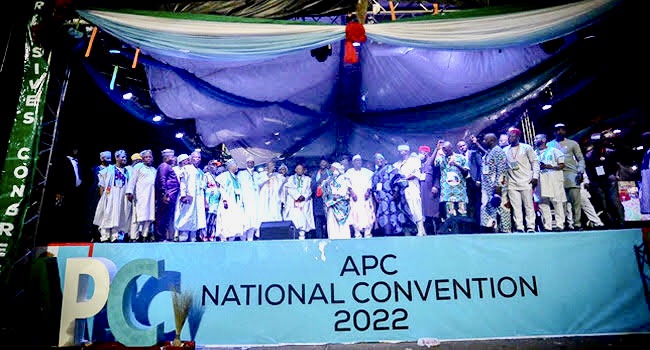
I listened throughout APC’s Saturday Night of the Long Knives. I laughed as the recalcitrance of unfavoured aspirants melted. One after the other, they spoke to the microphone renouncing their ambitions and praising ‘democratic’ Buhari whose cold-blooded politics aborted their dreams. The contestants plagiarized one another in a competition of obsequity at the feet of the president: I withdraw from this race because of my love for our father, the president; I drop my ambition in deference to our hardworking president; I am no longer interested in this post because the president calls for consensus. Then came the bearded ex-minister from Oyo State who emerged at two minutes to 2am on Sunday to do what he had vowed never to do: He dropped out of the race for Omisore as the secretary of the party. He said it was for the president. They all elevated the president’s wish to that of their party. The gathering was a pageant of absurdity.

The Eagle Square parade had a parallel in ancient Rome. Historians call it ‘The Roman Triumph,’ a riotous rite of victory started by Rome’s legendary founder, Romulus. It involved the near-deification of the triumphator and an endorsement of his wiles and whims. You heard them on Saturday: the president is divine in everything he does. Everyone who spoke at the event had great things to say about their president. Senate President Ahmed Lawan’s speech was very instructive. He said Buhari’s persona was the fortune they all enjoyed. He said the old man “may not be on the ballot” next year. He paused and readjusted his words: “Let me be explicit, you will not be on the ballot in 2023, but you will remain the leading light and moral compass of APC even after your tenure finishes. And, therefore, Mr. President, I’m sorry, you will have little rest, because we will never allow you to go away.” What exactly did Lawan mean by the APC would not let Buhari rest even after his tenure? He could only mean that the party would forever need the incumbent president’s stone celts to strike at enemies and retain his luck to win unthinking votes. But that would not be original. Everything that happened on Saturday was taken from PDP’s operations manual. When it was in power, PDP made sure Obasanjo did no wrong just as today’s APC Buhari. That time, PDP said Obasanjo was their father and mentor forever; even the founders of the APC, including this same Buhari, went to the former president in Abeokuta in 2014 and begged him to come and be their “moral compass” – the exact words which Lawan used for Buhari at the Eagle Square. Try and view again the footage of weekend’s festival of flattery. What can you see there? What is Buhari’s reaction to those rains of blandishments? The cameramen did a very good job focusing on the General with an unsmiling mien. There he is: the president sits straight, looks straight; his deputy, beside him sits, looks not away, but down; his fingers fiddling endlessly with his iPad. The president is probably wiser than his palace bards.

The APC looks increasingly a personal monument to Buhari – for as long as he reigns. Exactly a month ago, I wrote about what I called “APC’s Kabiyesi Politics.” I have had to go back and read the piece all over again. In it, I said Kabiyesi means ‘we dare not question him.’ I added that, indeed, kabiyesiism isn’t strictly an APC doctrinal monopoly. I argued that the philosophy has been the guardian angel of all Nigerian presidents since 1999. I said the president is big and powerful and he is beyond query. I noted that whatever he does or whatever he does not do is very right and very good. I warned that you walk on the edge of his sword at your peril and to your sorrow. Everything played out last week climaxing with Saturday’s crowning of the president’s choices as the minders of the ruling party. The president’s word was the only law that guided the convention.

What does it mean to be the only consequential star in the firmament? There is this evocative genre of Yoruba oral literature called Oriki. Karin Barber, ex-professor of African Cultural Anthropology at the University of Birmingham, United Kingdom, describes Oriki as “a master discourse” which she further says are enigmatic formulations that “commemorate personalities, events and actions.” My mother’s ancestral roots are in the intrepid palace of the Ijesa of Western Nigeria. There is a line in the Ijesa prince/princess’ Oriki which fits the narrative here: omo oni’bo kan, Ibo kan t’o ju oni’bo merindinlogun (child of the owner of one lone vote that is more than 16 votes of others). I donate this line to the children of Nigeria’s Caesar; their father’s vote was the only vote that mattered yesterday; it is the only one that will matter when APC’s presidential primary holds in two months’ time – and, maybe, at our presidential election. If you’ve been visiting palaces and shrines in search of APC ticket for the coming elections, please, stop and do a redirection of your compass. The only prayer that will be answered is the one offered to the real leader of the party, the president. That is the only lesson from weekend’s national convention of the APC and its outcomes.

But that cannot be the democracy people died for. The English say a dry cough is the trumpeter of death. Whatever is poisonous cannot give life. The line of sanity between APC and PDP – and others – is blurred forever by the reigning amorality of anything goes that works. Warwick Chipman, in his ‘Pragmatism and Politics’ (1911) argues that “a democracy forgetting freedom and a philosophy careless of principles…go hand in hand together.” And they are a couple of evil. Chipman deplores the crude practicality of a democracy that threatens to entrammel men; he told “lovers of liberty” that they “must see that a philosophy without a standard, a wisdom that will not criticise, a doctrine that will not lead, is the greatest foe of all that they have to fight.” Everything he describes in that quote is in what we call democracy here. Nigeria’s battle for freedom has not started.


Lasisi Olagunju, celebrated columnist writes 

Comments

Opinion

Repete or Regret: APC’s Moment of Truth in Ibadan North

Published

on

File photo of Hon. Khalil Mustapha Adegboyega (Repete)

The All Progressives Congress (APC) in Oyo State stands on the edge of a consequential decision—one that may define not only its fortunes in Ibadan North Federal Constituency but also its broader political relevance in the state.

As the countdown to the party primaries intensifies, the question before APC leaders is no longer routine. It is strategic. It is urgent. And it is decisive: will the party align with the clear preference of the people or risk repeating costly political miscalculations?

At the centre of this debate is Hon. Khalil Mustapha Adegboyega, widely known as Repete—a name that has, over time, evolved from a political identity into a grassroots phenomenon.

A Candidate Rooted in the People

In contemporary Nigerian politics, where voter awareness is rising and expectations are shifting, candidates are increasingly judged not by promises but by presence. On this scale, Adegboyega stands tall.

His political journey is marked by consistent engagement with constituents—far beyond the optics of election seasons. From youth empowerment initiatives that provide practical skills and startup support, to sustained interventions in healthcare access for the elderly and indigent, his footprint across Ibadan North reflects a model of leadership anchored on service.

Unlike the transactional approach that often defines political relationships, Adegboyega’s connection with the people appears organic—built on trust, accessibility, and continuity. These are not mere campaign attributes; they are political assets.

The Danger of Political Disconnect

History offers the APC a clear lesson: parties that ignore grassroots sentiment often pay a heavy electoral price. The imposition of candidates perceived as distant or untested has, in several instances, resulted in voter apathy, internal dissent, and eventual defeat at the polls.

Ibadan North presents no exception.

With opposition parties closely monitoring the APC’s internal dynamics, any misstep in candidate selection could provide a ready opening. A divided house, coupled with a candidate lacking widespread acceptance, is a formula the opposition is well-positioned to exploit.
The implication is straightforward: this is not merely about party loyalty; it is about electoral viability.

Echoes from the Grassroots

Across the length and breadth of Ibadan North—markets, motor parks, religious centres, and community gatherings—a consistent pattern emerges in political conversations. The name “Repete” resonates with familiarity and acceptance.

Such organic support is not easily manufactured. It is cultivated over time through visible impact and sustained presence. For a party seeking electoral certainty in a competitive environment, this level of grassroots validation is not just desirable—it is critical.

A Test of Leadership and Judgment

For the APC leadership in Oyo State, the moment calls for clarity of purpose. Decisions driven by narrow interests, personal alignments, or short-term calculations may carry long-term consequences.

The task, therefore, is to balance internal considerations with external realities. Elections are ultimately decided by voters, not by party caucuses. A candidate who commands public confidence offers the strongest pathway to victory.

The Stakes Are Clear

Ibadan North is too strategic a constituency for experimentation. The cost of error is not limited to a single seat; it extends to party cohesion, credibility, and future positioning within the state’s political landscape.

In this context, the argument for Adegboyega is less about sentiment and more about strategy. His visibility, acceptability, and record of engagement place him in a strong position to consolidate support and mobilise voters effectively.

Conclusion: A Choice with Consequences

As the APC moves closer to its primaries, the decision before it is both simple and significant: align with a candidate who reflects the mood of the electorate or risk conceding advantage to a watchful opposition.

In politics, moments such as this often separate foresight from hindsight.
For APC in Ibadan North, this may well be one of those defining moments.


Aderibigbe Akanbi, a political analyst, writes from Ibadan.

Continue Reading

Opinion

Ibarapa East: Yusuf Ramon’s Quest for Responsive Representation

Published

on

Hon. Yusuf Abiodun Ramon

As the road to 2027 gradually unfolds across Oyo State, political conversations are shifting from routine permutations to deeper questions about competence, generational leadership, and measurable impact. In Ibarapa East, that conversation has found a new voice in Yusuf Abiodun Ramon — a Lanlate-born technocrat whose entry into the race for the State House of Assembly is redefining what representation could mean for the constituency.

In a political environment often dominated by familiar faces and conventional calculations, Ramon presents a profile shaped by technical discipline, structured thinking, and solution-driven engagement. His professional background, anchored in analytical precision and systems management, forms the foundation of his public service aspiration.

For him, representation must move beyond ceremonial presence to practical responsiveness — laws that reflect local realities, oversight that protects public resources, and advocacy that translates into visible development.

Ramon argues that the future of Ibarapa East lies in leadership that listens deliberately, plans strategically, and delivers measurably. He speaks of strengthening rural infrastructure, expanding youth-driven economic opportunities, and institutionalising transparency as core pillars of his agenda. In his view, governance must not merely be symbolic; it must be structured, accountable, and people-centred.

Rooted in Ile Odede, Isale Alubata Compound, Ward Seven of Ibarapa East Local Government, and maternally linked to Ile Sobaloju, Isale Ajidun Compound, Eruwa, Ramon’s story is not one of distant ambition but of lived experience. He is, in every sense, a son of the soil — shaped by the same roads, schools, and economic realities that define daily life in Ibarapa East.

“I was born here. I grew up here. I understand our struggles, our strengths, and our untapped potential,” he says. “Representation must go beyond occupying a seat; it must translate into preparation, competence, and genuine commitment to development.”

His academic journey mirrors that philosophy of steady growth. He began at Islamic Primary School, Lanlate (1995–2001), proceeded to Baptist Grammar School, Orita Eruwa (2001–2007), and later earned a National Diploma in Mechanical Engineering Technology from Federal Polytechnic, Ilaro, between 2009 and 2011. Refusing to plateau, he advanced his intellectual horizon and is now completing a Bachelor of Science in Business Administration at the University of Lagos. “Education,” he reflects, “is continuous capacity building. Leadership today requires both technical knowledge and administrative insight.”

That blend of engineering precision and managerial training has defined a professional career spanning more than a decade. Shortly after his diploma, Yusuf joined Mikano International Limited as a generator installer, gaining hands-on experience in industrial power systems — a sector central to Nigeria’s infrastructural backbone. He later transitioned into telecommunications at Safari Telecoms Nigeria Limited, where he received specialized training in Industrial, Scientific, and Medical radio bands, strengthening his expertise in network operations.

In 2013, he became a Field Support Engineer at Netrux Global Concepts Ltd., then a leading ISM service provider in Nigeria. Over four formative years, he immersed himself in telecom infrastructure deployment and maintenance, mastering field coordination, logistics management, and real-time technical problem-solving.

Since July 2017, he has served as a Field Support Engineer with Specific Tools and Techniques Ltd., a power solutions firm providing services to major operators including MTN Nigeria and Airtel Nigeria. In that capacity, he operates at the frontline of ensuring energy reliability and network uptime — responsibilities that demand discipline, accountability, and systems thinking.

For political observers in Ibarapa East, this trajectory matters. It reflects more than résumé credentials; it speaks to a mindset anchored in efficiency, coordination, and measurable outcomes — qualities increasingly demanded in legislative representation.

Beyond the private sector, Ramon’s political exposure is neither sudden nor superficial. A loyal member of the progressive political family in Lagos, he once served as a personal assistant to a former lawmaker, gaining practical insight into legislative procedure and constituency engagement. Within his community, he has quietly extended financial support to small-scale entrepreneurs and students — modest but consistent interventions rooted in personal responsibility.

“My interest is my people,” he states firmly. “Ibarapa East deserves strategic, responsive, and capable leadership at the State Assembly. We must move from rhetoric to results.”

Across the constituency — from Lanlate to Eruwa — development priorities remain clear: youth employment, vocational empowerment, rural road rehabilitation, stable power supply, agricultural value-chain expansion, improved educational standards, and stronger lawmaking that directly reflects community needs.

Political analysts argue that Ramon’s technocratic background positions him uniquely at the intersection of policy formulation and practical implementation. At a time when national discourse increasingly favours competence over grandstanding, his profile resonates with a broader generational shift toward performance-driven governance. His engineering discipline reinforces problem-solving; his business training strengthens administrative understanding; his grassroots roots anchor his empathy.

For Ibarapa East, the 2027 election cycle may represent more than a routine democratic exercise. It may mark a recalibration of expectations — a demand for representation that understands both the soil beneath its feet and the systems that drive modern development. As political alignments gradually crystallize in Oyo State, Yusuf Abiodun Ramon’s declaration signals the arrival of a candidate seeking to translate private-sector structure into public-sector impact.

One thing is clear: the conversation about the future of Ibarapa East has begun — and it is now framed around competence, credibility, and capacity.


Oluwasegun Idowu sent in this piece from Eruwa, Ibarapa East LG, Oyo State

Continue Reading

Opinion

Flying on Trust: How Ibom Air’s Reliability Became Its Winning Strategy

Published

on

An Ibom Air aircraft at the airport.

“In a sky where delays are normal, one airline flies with precision and trust. Ibom Air shows that reliability can be a strategy”.

In Nigeria’s skies, where flight delays and cancellations are often taken as routine, Ibom Air has quietly rewritten the rules. From the moment it launched in June 2019, the Akwa Ibom State–owned carrier has treated reliability not as a bonus, but as a core strategy—turning punctuality, discipline, and operational excellence into a competitive edge that passengers can count on.

While most airlines chase rapid expansion or flashy promotions, Ibom Air has chosen consistency. Flights depart on schedule, disruptions are minimal, and communication with passengers is clear and timely. This predictability has quickly earned the airline a loyal following among business travellers, professionals, government officials, and families for whom time is invaluable.

The airline’s approach is methodical. Every flight is treated as a commitment, and operational decisions are guided by structured planning, not improvisation. This discipline underpins everything from scheduling to fleet management, ensuring passengers experience flying without surprises.

Central to this model is Ibom Air’s modern fleet. Its Airbus A220-300 and Bombardier CRJ-900 aircraft are fuel-efficient, comfortable, and rigorously maintained to meet both manufacturers’ specifications and the regulatory standards of the Nigerian Civil Aviation Authority and international aviation bodies. Safety here is a culture, not a compliance exercise.

Cabin cleanliness and aircraft health are equally prioritized. Passengers consistently step into neat, hygienic, and professionally maintained cabins, reinforcing confidence and comfort even before take-off. In a sector where small details signal operational quality, Ibom Air’s standards speak volumes.

Technology quietly drives reliability across operations. From booking and check-in to flight coordination and customer service, modern systems enhance efficiency, reduce disruptions, and ensure smooth communication. These tools allow the airline to anticipate challenges rather than merely react.

R–L: Dr. Solomon Oroge, a consultant, and Mr. Idowu Ayodele, journalist and media practitioner, aboard an Ibom Air flight.

Service delivery follows the same disciplined pattern. Pilots, cabin crew, engineers, and ground staff operate under strict professional standards. Courtesy is paired with efficiency, and calm, structured service ensures passengers feel confident throughout their journey.

The Ibom Flyer loyalty programme reflects this structured approach, rewarding consistent passengers and fostering long-term engagement. It turns reliability into a tangible benefit for frequent flyers.

From its hub at Victor Attah International Airport, Uyo, Ibom Air serves major Nigerian cities including Lagos, Abuja, Port Harcourt, Calabar, and Enugu, while extending its reach to West Africa with flights to Accra, Ghana. Expansion is deliberate, prioritizing sustainability over rapid growth that could compromise service quality.

Measured growth allows the airline to maintain operational excellence and service consistency even as demand increases—a strategy that contrasts sharply with competitors whose rapid expansion often strains resources.

Mr. Idowu Ayodele, journalist and media practitioner, pictured inside an Ibom Air aircraft.

Beyond commercial success, Ibom Air has become a national example. It has created employment, stimulated tourism, and strengthened regional connectivity, projecting a positive image of Nigerian aviation at a time when confidence in the sector is often fragile.

The airline has also challenged assumptions about government-owned enterprises. By combining professional management with operational autonomy, it demonstrates that public investment can achieve efficiency, accountability, and competitiveness.

Reliability, in the case of Ibom Air, is than a promise—it is a deliberate business philosophy. It shapes operations, informs decisions, and builds passenger trust consistently.

Technology, discipline, and attention to detail converge to produce an airline that works. Every element, from fleet maintenance to cabin service, supports the promise that Ibom Air delivers what it advertises—without surprises.

In a market where uncertainty has been the norm, Ibom Air has shown that consistency can be a strategic advantage. Passengers no longer fly with anxiety; they fly with confidence, knowing their schedules will hold and service will meet expectations.

Ultimately, Ibom Air is not just an airline—it is a model of operational excellence in Nigerian aviation. By prioritizing reliability over spectacle, discipline over improvisation, and planning over shortcuts, it sets a benchmark for the industry and a standard for passengers: in the skies, predictability is priceless


Idowu Ayodele – Journalist, Ibadan, Oyo State
0805 889 3736 | megaiconpress@gmail.com


Continue Reading

Advertisement

Entertainment

Advertisement

MegaIcon Magazine Facebook Page

Advertisement

MEGAICON TV

Advertisement

Trending