
Opinion
Alimajiranci: One Hell of Ideology in 21st Century | By Adediji Wasiu



Now that the Northern elite has united behind a holistic drive to abolish and discredit the ideology of an abusive system that gives birth to extremists, fanaticism who in turn pick arm against the society to get what the society has denied them by all means and, resist those who oppose them with ferocity.
This is the first step towards starving terrorist organisation like bokoharam, the reason to exist, they are the most targeted group for terrorist organization. Since the alimajiri run errands for strangers, scavenges left overs food, sleep on sidewalks and street pavements, they are easy to lure against their own will by bokoharam as bomb carrier, thus, endangered population. So, this approach must be pursued holistically and not in half measures else it becomes a “riverboat gambling.”
Furthermore, the parallel between progressive culture and retrogrssive one must draw, the so called Alimajiri system left children vulnerable to an environment of hopelessness and in their desperation to find food, they often end up become available tool for terrorist group and often adopted as foot soldier, suicide bombers to strike the society. Should such culture continue?
Each time there is an attempt to reform alimajiri system in other to do away with the abuses associated with it, people often mistaken this to be fight against Islam and northern culture, against this background I ask what are the benefits of this system to Islam In fact it has continued to give the religion bad image and majorly the Islamic cleric produced through this method in most cases are half baked cleric, given all sort of opinion that is contradicting to the known established sunnah and ayat of Quran.
Undoubtedly, Islam encourages learning as exemplified in the first Surah of Quran revealed to Prophet Muhammad ( Peace be upon him) says “Iqra Bismillaih Rabbikallazi Khalaq, khalaqal insaana min Alaq, Iqra wa Rabbuka Akram Allazii allama bil Qalam Allama insaana maa ya lam” (read in the name of your lord of your Lord, who created man from clot, read and the Lord is the most bounteous, Who teach with pen, Teachth man that which he knew knot) this emphasis the importance of knowledge , however, we know that through civilizations, different kinds of knowledge, has brought the progresses of man in different fields pivot on the existence of the ‘pen’ thus this surah encourage learning, because learning has always been a part of every intellectual society.
However, learning must be done in a way that promotes both the basic human and society values in conformity with modern style and this can’t be achieved by subjecting the children to physical, sexual, and intellectual abuse.
In my view, Alimajiri system have out leave it usefulness in this age of globalization, or else it’s married with modern learning technique to bring the uniqueness of the system if there is any. Almajiri originally set up as part of the wider Islamic practice of dedication to learning, intention of the Almajiri system of education cannot be faulted due to religious and socio-cultural needs of the society committed through learning by heart but today due to poor infrastructure, lack of government firm control and abysmal quality of teachers in alimajiri system, the failure of this system became more acute pronounced thus it has become synonymous to seeking alms, begging, and sometimes engaging in criminal activity as a result of their basic survival needs not being met.
Undoubtedly, the ideologies of Alimajiri is what give birth to terrorism in the northern region and and to extinguish fanaticism and terrorism, it cannot be prevent by the use of force alone, it root causes must be address by placing emphases on education of the destitute in the society towards creating a balance system that offers mind lifting teachings before reuniting them back to the society.
We must acknowledge that the Boko Haram, banditry etc wars that have raged in Borno, Maiduguri, Yobe, and other northeast state has being on because there is nexus between the Boko Haram organization and alimajiri, of which the military approach alone have proven not to be a total solution despite huge amount billions of budgeted each year since the war started, it’s time we adopt intellectual approach by targeting it’s root causes.
It’s time to redefine the context of alimajiri in today’s global knowledge economy by reengaging the almajiri children in a productive endeavor in other to end this abusive system that has continue to make them a suspectible tool in the hand of bokoharam against their wishes.
To defeat this embodiment of a malicious ideology, it is first necessary to define exactly what is the relationship between alimajirci and slow pace of human development index in the north, what future this moribund system has to offer in the near future, and why is it necessary to get rid of it or to continue. I leave you to answer those questions in the best objectively.
The solution has three components, the first approach is winning the battle using intellectual approach this begin by concerted political will to totally do away with alimajiri system. Notwithstanding, the solution can’t be achieved without the cooperation of the district heads, traditional rulers, ulama , parents, civil society organisations and the government. The north can’t afford to fold it arm, ignore the danger on the horizon, another vicious cycle of war won’t do the region any better than self destruction.
Also, setting them up for greatness, It’s by counter this abusive and malignant ideology through proper rehabilitation by enlightened and open up their minds through counselling before reuniting them back to the society, else doing otherwise will impacts the society, the extent to which no one can predict, such flames know no borders. Only one thing can stop a mind who is ready to die for fictional seven (7) virgin, a stronger ideology and counseling that convinces him that such ideology or believe have no place in Islam.
Lastly, the region is home to more than 70 million young people , this period offers government the opportunity to inspire them with hope and do everything necessary to improve the quality of life by flatten the poverty curve in the region, and improve the quality of education. it’s not enough to build fine structures without capacity to run it and to create economic opportunities for their sustainable development.
In my view, this is the most sustainable answer and alternative to alimajiri. I am optimistic, because I know that the people of the north with their hardworking derserves stability and prosperity that are stronger and more enduring than opportunistic and destructive alimajiri ideas.


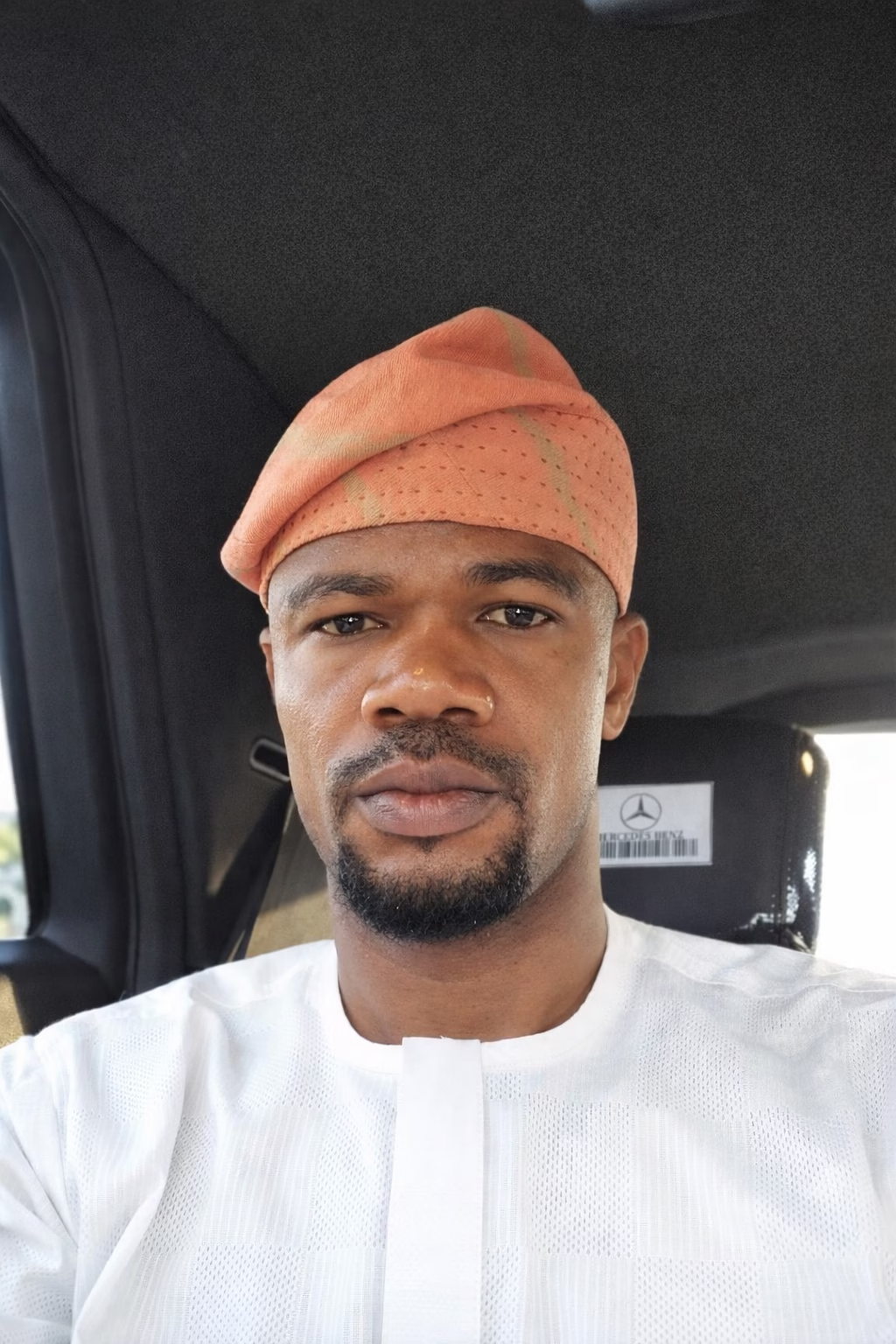
As the road to 2027 gradually unfolds across Oyo State, political conversations are shifting from routine permutations to deeper questions about competence, generational leadership, and measurable impact. In Ibarapa East, that conversation has found a new voice in Yusuf Abiodun Ramon — a Lanlate-born technocrat whose entry into the race for the State House of Assembly is redefining what representation could mean for the constituency.
In a political environment often dominated by familiar faces and conventional calculations, Ramon presents a profile shaped by technical discipline, structured thinking, and solution-driven engagement. His professional background, anchored in analytical precision and systems management, forms the foundation of his public service aspiration.
For him, representation must move beyond ceremonial presence to practical responsiveness — laws that reflect local realities, oversight that protects public resources, and advocacy that translates into visible development.
Ramon argues that the future of Ibarapa East lies in leadership that listens deliberately, plans strategically, and delivers measurably. He speaks of strengthening rural infrastructure, expanding youth-driven economic opportunities, and institutionalising transparency as core pillars of his agenda. In his view, governance must not merely be symbolic; it must be structured, accountable, and people-centred.
Rooted in Ile Odede, Isale Alubata Compound, Ward Seven of Ibarapa East Local Government, and maternally linked to Ile Sobaloju, Isale Ajidun Compound, Eruwa, Ramon’s story is not one of distant ambition but of lived experience. He is, in every sense, a son of the soil — shaped by the same roads, schools, and economic realities that define daily life in Ibarapa East.
“I was born here. I grew up here. I understand our struggles, our strengths, and our untapped potential,” he says. “Representation must go beyond occupying a seat; it must translate into preparation, competence, and genuine commitment to development.”
His academic journey mirrors that philosophy of steady growth. He began at Islamic Primary School, Lanlate (1995–2001), proceeded to Baptist Grammar School, Orita Eruwa (2001–2007), and later earned a National Diploma in Mechanical Engineering Technology from Federal Polytechnic, Ilaro, between 2009 and 2011. Refusing to plateau, he advanced his intellectual horizon and is now completing a Bachelor of Science in Business Administration at the University of Lagos. “Education,” he reflects, “is continuous capacity building. Leadership today requires both technical knowledge and administrative insight.”
That blend of engineering precision and managerial training has defined a professional career spanning more than a decade. Shortly after his diploma, Yusuf joined Mikano International Limited as a generator installer, gaining hands-on experience in industrial power systems — a sector central to Nigeria’s infrastructural backbone. He later transitioned into telecommunications at Safari Telecoms Nigeria Limited, where he received specialized training in Industrial, Scientific, and Medical radio bands, strengthening his expertise in network operations.
In 2013, he became a Field Support Engineer at Netrux Global Concepts Ltd., then a leading ISM service provider in Nigeria. Over four formative years, he immersed himself in telecom infrastructure deployment and maintenance, mastering field coordination, logistics management, and real-time technical problem-solving.
Since July 2017, he has served as a Field Support Engineer with Specific Tools and Techniques Ltd., a power solutions firm providing services to major operators including MTN Nigeria and Airtel Nigeria. In that capacity, he operates at the frontline of ensuring energy reliability and network uptime — responsibilities that demand discipline, accountability, and systems thinking.
For political observers in Ibarapa East, this trajectory matters. It reflects more than résumé credentials; it speaks to a mindset anchored in efficiency, coordination, and measurable outcomes — qualities increasingly demanded in legislative representation.
Beyond the private sector, Ramon’s political exposure is neither sudden nor superficial. A loyal member of the progressive political family in Lagos, he once served as a personal assistant to a former lawmaker, gaining practical insight into legislative procedure and constituency engagement. Within his community, he has quietly extended financial support to small-scale entrepreneurs and students — modest but consistent interventions rooted in personal responsibility.
“My interest is my people,” he states firmly. “Ibarapa East deserves strategic, responsive, and capable leadership at the State Assembly. We must move from rhetoric to results.”
Across the constituency — from Lanlate to Eruwa — development priorities remain clear: youth employment, vocational empowerment, rural road rehabilitation, stable power supply, agricultural value-chain expansion, improved educational standards, and stronger lawmaking that directly reflects community needs.
Political analysts argue that Ramon’s technocratic background positions him uniquely at the intersection of policy formulation and practical implementation. At a time when national discourse increasingly favours competence over grandstanding, his profile resonates with a broader generational shift toward performance-driven governance. His engineering discipline reinforces problem-solving; his business training strengthens administrative understanding; his grassroots roots anchor his empathy.
For Ibarapa East, the 2027 election cycle may represent more than a routine democratic exercise. It may mark a recalibration of expectations — a demand for representation that understands both the soil beneath its feet and the systems that drive modern development. As political alignments gradually crystallize in Oyo State, Yusuf Abiodun Ramon’s declaration signals the arrival of a candidate seeking to translate private-sector structure into public-sector impact.
One thing is clear: the conversation about the future of Ibarapa East has begun — and it is now framed around competence, credibility, and capacity.
Oluwasegun Idowu sent in this piece from Eruwa, Ibarapa East LG, Oyo State

“In a sky where delays are normal, one airline flies with precision and trust. Ibom Air shows that reliability can be a strategy”.
In Nigeria’s skies, where flight delays and cancellations are often taken as routine, Ibom Air has quietly rewritten the rules. From the moment it launched in June 2019, the Akwa Ibom State–owned carrier has treated reliability not as a bonus, but as a core strategy—turning punctuality, discipline, and operational excellence into a competitive edge that passengers can count on.
While most airlines chase rapid expansion or flashy promotions, Ibom Air has chosen consistency. Flights depart on schedule, disruptions are minimal, and communication with passengers is clear and timely. This predictability has quickly earned the airline a loyal following among business travellers, professionals, government officials, and families for whom time is invaluable.
The airline’s approach is methodical. Every flight is treated as a commitment, and operational decisions are guided by structured planning, not improvisation. This discipline underpins everything from scheduling to fleet management, ensuring passengers experience flying without surprises.
Central to this model is Ibom Air’s modern fleet. Its Airbus A220-300 and Bombardier CRJ-900 aircraft are fuel-efficient, comfortable, and rigorously maintained to meet both manufacturers’ specifications and the regulatory standards of the Nigerian Civil Aviation Authority and international aviation bodies. Safety here is a culture, not a compliance exercise.
Cabin cleanliness and aircraft health are equally prioritized. Passengers consistently step into neat, hygienic, and professionally maintained cabins, reinforcing confidence and comfort even before take-off. In a sector where small details signal operational quality, Ibom Air’s standards speak volumes.
Technology quietly drives reliability across operations. From booking and check-in to flight coordination and customer service, modern systems enhance efficiency, reduce disruptions, and ensure smooth communication. These tools allow the airline to anticipate challenges rather than merely react.
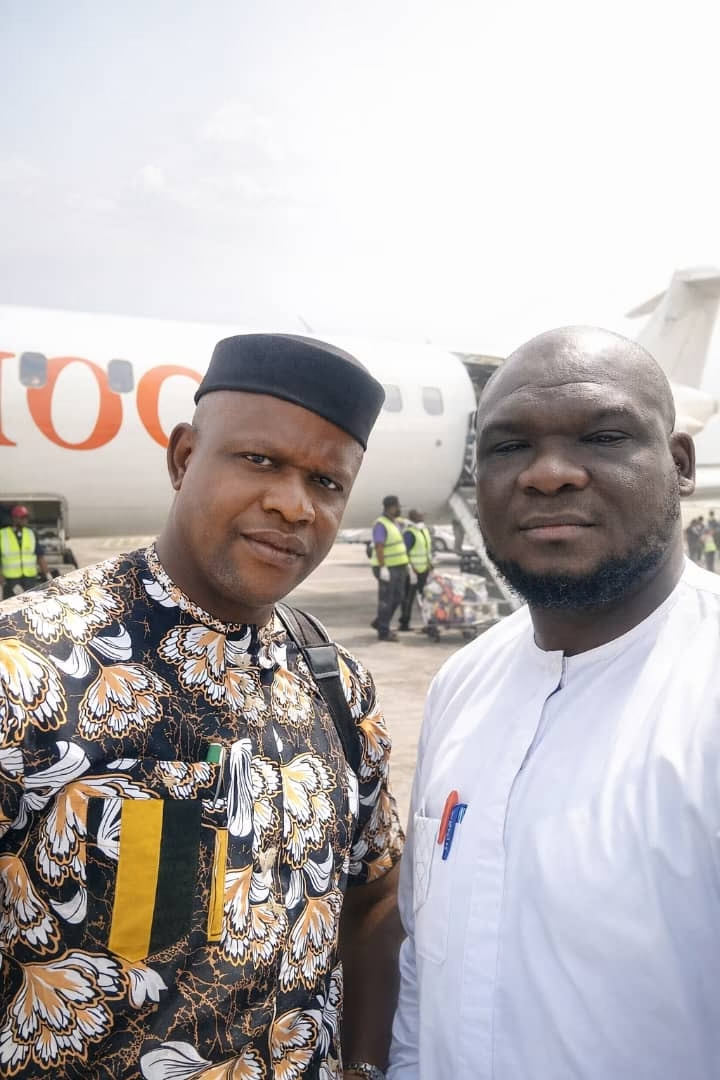
R–L: Dr. Solomon Oroge, a consultant, and Mr. Idowu Ayodele, journalist and media practitioner, aboard an Ibom Air flight.
Service delivery follows the same disciplined pattern. Pilots, cabin crew, engineers, and ground staff operate under strict professional standards. Courtesy is paired with efficiency, and calm, structured service ensures passengers feel confident throughout their journey.
The Ibom Flyer loyalty programme reflects this structured approach, rewarding consistent passengers and fostering long-term engagement. It turns reliability into a tangible benefit for frequent flyers.
From its hub at Victor Attah International Airport, Uyo, Ibom Air serves major Nigerian cities including Lagos, Abuja, Port Harcourt, Calabar, and Enugu, while extending its reach to West Africa with flights to Accra, Ghana. Expansion is deliberate, prioritizing sustainability over rapid growth that could compromise service quality.
Measured growth allows the airline to maintain operational excellence and service consistency even as demand increases—a strategy that contrasts sharply with competitors whose rapid expansion often strains resources.

Mr. Idowu Ayodele, journalist and media practitioner, pictured inside an Ibom Air aircraft.
Beyond commercial success, Ibom Air has become a national example. It has created employment, stimulated tourism, and strengthened regional connectivity, projecting a positive image of Nigerian aviation at a time when confidence in the sector is often fragile.
The airline has also challenged assumptions about government-owned enterprises. By combining professional management with operational autonomy, it demonstrates that public investment can achieve efficiency, accountability, and competitiveness.
Reliability, in the case of Ibom Air, is than a promise—it is a deliberate business philosophy. It shapes operations, informs decisions, and builds passenger trust consistently.
Technology, discipline, and attention to detail converge to produce an airline that works. Every element, from fleet maintenance to cabin service, supports the promise that Ibom Air delivers what it advertises—without surprises.
In a market where uncertainty has been the norm, Ibom Air has shown that consistency can be a strategic advantage. Passengers no longer fly with anxiety; they fly with confidence, knowing their schedules will hold and service will meet expectations.
Ultimately, Ibom Air is not just an airline—it is a model of operational excellence in Nigerian aviation. By prioritizing reliability over spectacle, discipline over improvisation, and planning over shortcuts, it sets a benchmark for the industry and a standard for passengers: in the skies, predictability is priceless
Idowu Ayodele – Journalist, Ibadan, Oyo State
0805 889 3736 | megaiconpress@gmail.com

In Homer’s epic poem The Odyssey, the concept of the “Greek gift” was invented. The Trojan Horse became the undoing of Troy, ending a decade-long war in which many Greeks had perished, including the mighty Achilles. The Trojans accepted the Greeks’ gift, and the rest, as they say, is history.
In the past few days, both social and conventional media have been agog with reactions to President Donald J. Trump’s threat to the Nigerian government regarding terrorism. In his words, Nigeria must “address the genocide against Christians in the North and Middle Belt, or else the U.S. will cut aid to the country and, in addition, come into the country guns blazing in an attempt to flush out the terrorists.”
Sincerely speaking, the tweet made by the U.S. President sounded a bit comical to me, as did many other commentaries that followed. Comical not in a ridiculous sense, but in a comedic sense.
This piece is not written to support or oppose any particular view, but to lay down facts in the most succinct and objective manner, thereby allowing for the independence of a balanced position.
In 2009, a terror group named Jama’at Ahl al-Sunna li al-Da’wa wa al-Jihad (popularly referred to as Boko Haram) emerged with the aim of establishing Islamic rule across Nigeria. According to the group, Sharia was the only path to true progress, and any faith other than Islam was haram (forbidden).
Soon after, this group began launching vicious attacks against Christians and Christian places of worship. From singularly attacking Christians, their targets shifted to government institutions and facilities, and on 28 November 2014, one of the greatest attacks against fellow Muslims occurred with the bombing and mass shooting of Juma’at worshippers at the Kano Central Mosque. Over 120 worshippers were killed and another 260 critically injured.
The point here is to underscore the fact that Boko Haram—and indeed all other extremist groups in Nigeria—are not targeting Christians alone, as earlier claimed, but are pursuing a more sinister agenda of land grabbing with the colouration of economic, psychological and socio-political domination of conquered territories, with intentions of spreading across the country.
From the Northeast, the activities of wanton killing and destruction perpetrated by terrorists spread to the North Central region, particularly Plateau and Benue States. What originally began as farmer–herder clashes metamorphosed into full-blown village and community sackings, where Fulani invaders razed entire communities, leaving hundreds dead or wounded while survivors were displaced and left with harrowing experiences in IDP camps.
This wave of destruction continued, with one of the bloodiest in recent times occurring in Yelwata, Guma Local Government Area of Benue State, on the night of 13–14 June 2025. According to Amnesty/CE/UN/NGO, over 200 people were gruesomely massacred, several houses burnt to ashes, and about 3,000 people displaced and rendered homeless. In 2025 alone, Amnesty reported more than 10,000 additional people displaced in Benue across several local governments, ranging from Gwer West to Agatu, Ukum/Gbagir, Logo, Kwande and Guma.
From the North Central, terrorism—or better still, banditry—also found its way to the North West. The activities of bandits, kidnappers and other criminal elements were consistently reported in Zamfara, Kaduna, Kebbi, Sokoto, Kano, and even Katsina, which was once regarded as the true home of hospitality, as its state slogan depicts, and as I can also attest considering how much I enjoyed the peace and serenity of the state during my days therein as a Youth Corps member. Reuters.ng reports that as of 2025, approximately 2,456 people had been killed in the North West region across multiple states. In addition to this, about 7,260 people, including schoolchildren and commuters on highways, had been abducted, with several millions of naira collected by kidnappers as ransom payments. Some parts of the South West, South East and South South have not been spared the atrocities of terrorists and bandits.
Therefore, it is safe to say that the entire country has, at one time or the other, experienced the activities of bandits, terrorists and kidnappers. The intensity of attack, however, differs from region to region.
Late General Sani Abacha once said that “if any insurgency lasts for more than 24 hours, a government official has a hand in it.” This saying more or less amplifies the complexity of the terrorism–banditry–kidnapping problem in Nigeria. Nigeria is a country abundantly blessed with all manners of rich mineral resources. Apart from the vast arable land required for productive agriculture, there is virtually no region of the country that does not possess one valuable solid mineral or another.
From iron ore in Zamfara, Kogi and Enugu; gold in Kaduna, Kebbi and Osun; lithium in Nasarawa, Kwara, Oyo and the FCT; bitumen in Ondo, Edo and Ogun; plus other industrial minerals like gypsum, kaolin and limestone, with deposits of over one billion tonnes across many states—Nigeria is sitting on an incredibly underutilised treasure worth billions of dollars. The government’s inability to adequately manage these vast potentials provides fertile grounds for opportunistic scrambling, illegal mining, chaos and its attendant conflicts.
One can therefore boldly say that the chaos and violence camouflaged as terrorism and banditry is indeed a calculated campaign driven not just by Islamic extremism but by land grabbing and occupation for the purpose of blood mineral extraction and illicit mining.
Thus, a sophisticatedly armed radical Islamic Fulani ethnic militia, often operating under political protection, carries out multiple killings, displacements and kidnappings across the Northeast, North Central and North West, after which reports reveal that foreign miners appear following the death and displacement of indigenes to exploit the lands.
Amnesty International has also reported that Nigeria loses over $9 billion annually to illicit mining of gold, tin and lithium, with a significant portion—estimated at 10%—funding violence and corruption. The report further revealed that the involvement of some government elements in this corruption is not in doubt, as eyewitness reports of survivors and satellite surveillance footage revealed the connivance of certain government personnel. Some survivors have also repeatedly claimed that they witnessed helicopters in the middle of the night dropping weapons and ammunition for the bandits—a disclosure corroborated by Professor Bolaji Akinyemi in an interview on African Stream earlier this year.
So, it is right to say that the violence and carnage are just a smokescreen and a catalyst to a far-reaching economic, psychological and socio-political agenda of certain influential elements in the country. This is part of the reason why the billions of naira spent on security to equip the military to better fight insurgency have not yielded much result to date.
In addressing the threat of President Donald Trump, I would like to start by recounting a little history about the 47th President of the United States and his previous antecedents. In January 2018, at a news conference in the White House, President Trump referred to Haiti and some African countries—including Nigeria—as “shithole countries” that should not be accorded immigrant status in the U.S.
Furthermore, his government’s stern immigration policies and visa restrictions clearly reflect a hostile stance towards Africa and some other Global South countries. In light of this, it is hard to understand where the sudden genuine concern for Nigerian Christians is coming from—more so when a U.S. congressman earlier this year revealed that USAID played a significant role in the funding of Boko Haram and other terrorist groups. This concern was never mentioned when Late President Muhammadu Buhari visited the White House a few months after the “shithole” saga and was praised by the same Trump for his valiant efforts in fighting Boko Haram and ISWAP, despite staggering reports of attacks and killings in the Northeast and North Central during that period.
Under the erudite scholarship of Professor Kunle Ajayi, I learnt several years ago, in one of our Politics of Global Economic Relations lectures, that in world politics and global socio-economic relations, the overriding determinant of states’ decisions and actions is strategic interest. Altruism is hardly ever a factor.
Present realities of Nigeria’s economic relations are fast approaching self-sufficiency—particularly in the oil sector, where Nigeria was once a major importer of finished petroleum products from the U.S. The Dangote refinery, having begun domestic refining and production of petroleum products, is fast taking over a market once dominated by imports from the U.S. This shift, no doubt, is taking jobs away from American oil workers—no cheering news for the country’s oil conglomerates. Secondly, China has since replaced the United States as Nigeria’s foremost trading partner.
According to Nairametrics (2025), the value of trade between Nigeria and China between 2023–2025 totals approximately $50 billion compared to an estimated $30 billion with the U.S. This paradigm shift would certainly not be palatable to the U.S. or her president, who happens to be a dogged businessman that hates the word “no”. From this perspective, it is not difficult to see where President Trump is coming from.
Be that as it may, I think Nigeria needs to employ shrewd diplomacy in dealing with the U.S. under a president like Donald Trump. Regardless of international law and conventions, the U.S. has repeatedly proven itself willing to take unilateral military action against countries, defying the rule of law and popular global opinion. So those hinging on Nigeria’s sovereignty as a deterrent to the U.S. are not good students of history.
What is, however, more important in all of this is that global attention is once again drawn to the horrible atrocities of these criminal elements in Nigeria. The country cannot continue to behave as though it is normal headline news when people are slaughtered daily, and families and homes are torn apart.
I believe this is an opportunity for the government to rejig the entire security architecture of the country, with the needed political will, to once and for all end these killings. Strategic partnership with the United States in this regard is not a bad idea. With its extensive experience in counter-terrorism operations and access to sophisticated military technology and intelligence, the U.S. can assist in identifying and eradicating the major financiers and enablers of terrorism and banditry. It is not rocket science that when the financing of terrorists ends, terrorism ceases to exist.
However, this should be done only on the basis of shared interest, mutual respect, trust, and understanding reflective of a healthy and balanced foreign policy relationship. By prioritising constructive diplomacy, dialogue and partnership, Nigeria can work with the United States in a strategic alliance to restore peace, security and confidence across the nation. That is the way to go.
Olusegun Hassan, Ph.D
Public Policy Analyst and Social Commentator







-

 Politics3 days ago
Ibarapa East Assembly Hopeful, Ramon Congratulates Ajiboye, Says Emergence Good for Oyo APC
-
 Politics1 week ago
Makinde: My Successor Must Be Loyal to Oyo, Not Me
-
 Politics3 days ago
2027: Former Oyo Deputy Governor Adeyemo Emerges APC Chairman (See Full List)
-

 Politics1 week ago
Fintiri Dumps PDP for APC, Moves with Cabinet, 14 Adamawa Lawmakers