Connect with us

Education

A manifesto to save Nigeria’s public university

Published

on

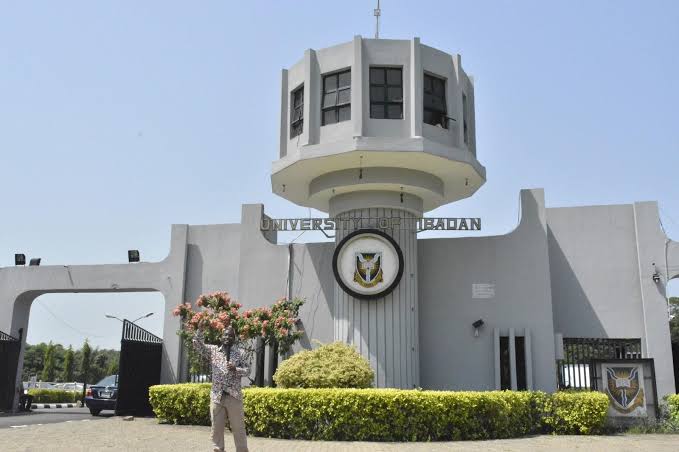
File photo of the University of Ibadan Entrance

The industrial dispute between the Academic Staff Union of Universities (ASUU) and the Federal Government of Nigeria (FGN) have dominated the media for many months. Throughout, ASUU leaders stated and restated the position of their members, often informing the public of the Memorandum of Understanding to Memorandum of Action – going back to 2009 – leading to the current demands. The representatives of the FGN have managed to perfect the act of “majoring-in-the-minor.”  They centre one issue this month and another the next. Their narrative villainises university lecturers as greedy, uncompassionate and unpatriotic.

While the dispute escalates, familiar blame trading and finger-pointing have resurfaced. Too many and confusing information and un/informed opinions are circulating. ASUU-greed experts and professional trolls with a massive following are packaging and disseminating decontextualised data and narratives on social media platforms, especially on Twitter.

University students and prospective ones are angry, depressed and anxious. They are also divided, unsure how to rescue themselves from the educational institution that has put their lives on hold. Parents’ voices seem drowned out or lost amid incoherence in the public space.

The Nigerian academic diaspora has been an active voice as well. While divided in their opinion, some loudest voices in this group are too obsessed with comparison: “In the US…”, “In the UK…”, “In America…”, “In Europe…”, “In Canada…”, “In South …” etc. Usually, these diaspora intellectuals ignore their privilege and the systemic nature of the crisis. They “talk at” striking lecturers as “greedy and lazy” people who do not contribute to national and global knowledge, innovation and progress. In this talk, Nigerian diaspora intellectuals suppressed why they left, stayed abroad, and couldn’t return to Nigeria as lecturers.

ASUU is persistent and determined to keep fighting. As a young researcher employed in the country’s foremost university, however, I sometimes ask myself: “why bother?” High-ranking professors in Nigerian universities are already encouraging their best students to leave and never look back. Many who returned to Nigeria after studying abroad in the 1970s and 1980s quickly tell their regrets to young faculty on department corridors. Some of the finest thinkers trained in the 1990s and 2000s did not stay long enough to have their spirits crushed. More so, from 2010 to date, young PhDs who entered the system are pursuing needless second PhDs abroad to escape the fast-crumbling university system. So, “why bother?”

I concluded that some people stayed back to train the next generation of Nigerians. They stayed even if it meant struggling through their careers to ensure the son and daughters of ordinary people had access to quality and globally competitive university education. Their struggle over the years is not just to save a critical social institution; they stayed to rescue the future and soul of a society. Their struggle is right. Their struggle is just. Their struggle is patriotic.

Again, ASUU is persistent and determined to keep fighting. Still, this struggle is not and cannot be a struggle for ASUU and allied organisations alone.

We must rally to build a unified voice against common enemies of our collective future: those who understand the depth of the crisis and choose to play politics. The common enemies comprise the state and the intelligent and crafty stooges, political appointees and mouthpieces who know but pretend and speak vacuously. They are the people who feel young people should be lined-up indefinitely at the altar of sacrifice for the benefit of the few. They are comfortable proposing that your early-career lecturer with a PhD in a specialised field resign from the university instead of complaining that ₦137,000 monthly take home – in 2022 – is not enough to take them home. They are the ones criminalising patriotism, faking elitism and truncating national progress.

Those at the top of university leadership should speak up and speak out. Your silence is complicity. The Deputy Vice Chancellor of the University of Ibadan has led the way by presenting a passionate and frank assessment of our bleeding ivory towers, the first at the highest level of Nigerian university leadership in a long time not hidden behind political-speak of “Council of VCs.” More leaders should speak up, keeping in mind that their position will end, and they will return to the rank and file of the demeaned and precarised workforce. You no longer have the luxury of playing the “bewildered generation.” It is no longer safe for you to ask, “How did we get here?”. When writing the letters, make a patriotic and sincere case for “Why we must leave here and move forward.” In the note, let the country know what you and your Bursars go through in Abuja.

Also, professors must resist the urge to keep super-dry skeletons standing. They need to help the Nigerian Universities Commission (NUC) to scrap courses lacking the required human resources by refusing to help glorified secondary schools disguise as universities. Those privileged as heads of government agencies should not sabotage their colleagues. If you cannot talk because your mouth is full, do not be a barrier to those trying to fight for a better system. I consider these simple steps without ignoring that they will come at a personal cost to you.

Statesmen and stateswomen should lend a voice. Before your departure, talk to your replacements. Remind them how we started as a nation and how far gone we are since making the wrong turn. Not tomorrow, but right now.

Politicians should know that there is more for all if we have a society that works. In a society where knowledge is valued, nurtured and accessible to all irrespective of their social status, there will be prosperity that will benefit all equitably.

Parents and students have important roles to play in all of this. As a parent, you are probably tired that your wards are not making that transition to adulthood as quickly as you hope. But delay is not denial. By seeing this struggle as your own and supporting it openly in whatever way you can, you are helping your wards have a solid foundation for their future. Your support is needed to ensure that the real bullies fail in their ploy to further impoverish university teachers. Remember also that your children will have children too, and they may not be able to japa.

To young Nigerians, students and those planning to go to university especially, your voice is more critical today than ever. By their advice that you sue ASUU, a suggestion unlikely to yield any meaningful result for you, they ask you to excuse their incompetence and mischief. It is shameful that they are demanding more sacrifices from you now. Your grandparents sacrificed. Your parents sacrificed so much. You have been making sacrifices since you were born in Nigeria as a Nigerian. Refuse to be the sacrificial goat. Secure your future.

Nigerian diaspora intellectuals should appreciate the delicate situation of university lecturers. As many of you as possible should speak truth to power and resist the urge to villainise ASUU. Take time to talk to your former colleagues and friends in Nigerian universities. Ask them questions, listen and reflect on where you are and where you could have been, and then speak based on conviction and truth. By all means, criticise ASUU, but ask the stooges and mouthpieces of the state on social media what they are gaining by demeaning, demoralising and degrading university lecturers.

To end, we should have an honest and public conversation about what we want for ourselves as a society and the role we want the university to play in it. In doing this, we must also ask what a fair working environment is to make the university play that role, given the required quality and cost of talents. This is how we can start the journey toward saving public universities in Nigeria. However, the journey must start today, now – not tomorrow.


Dr Adebayo is a Research Fellow at the Institution of African Studies, University of Ibadan, Nigeria

Comments

Education

‎Federal Poly Ayede’s Rector Abdul-Hameed bags national award

Published

on

By

The Rector of the Federal Polytechnic, Ayede (FEDPA), Oyo State, Dr. Taofeek Abdul-Hameed, has been honoured with the Leadership Excellence and Education Icon Award in recognition of his contributions to the education sector and national development.

The award was presented by Bollyjoe Media Communications Ltd, a media and communications firm based  in Abuja, the nation’s capital on Wednesday.

Presenting the award, the Managing Director/Chief Executive Officer of the firm, Joseph Uzuakpundu Bollyjoe, said Abdul-Hameed was recognised for his selfless service and transformative leadership within Nigeria’s polytechnic education system.

He noted that under the Rector’s stewardship, the Federal Polytechnic, Ayede, had witnessed strategic reforms aimed at strengthening academic standards and promoting institutional stability.

‎According to him, the Rector’s policies have repositioned the institution for sustainable growth and aligned its technical education programmes with global best practices.

Since assuming office, the Rector has prioritised infrastructural development, administrative discipline and innovation-driven governance, earning commendations from stakeholders.

‎Reacting to the honour, Abdul-Hameed, described the award as a motivation to further deepen reforms and consolidate on existing achievements.

‎“This recognition is not just personal; it reflects the dedication of our management, staff and students who share the vision of building a globally competitive institution,” the Rector  said.

He added that the polytechnic would remain committed to excellence, integrity and continuous development in line with national educational aspirations.

Continue Reading

Education

Tinubu hails Ayede Polytechnic’s growth as 325 graduates

Published

on

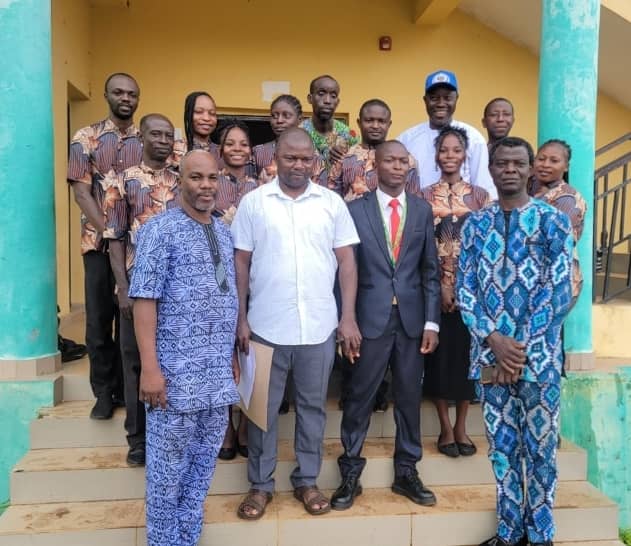
(L-R) , The Rector, Federal Polytechnic Ayede, Dr. Taofeek Abdul-Hameed, Chairman, Governing Council, Hon. Yakubu Dati, representative of Dr. Abubakar Isa, one of the awardees, and the Director, Polytechnics and Allied Institutions (Ministry of Education), Dr. Usman Ejeh at the convocation event, last Thursday

President Bola Tinubu on Thursday described the Federal Polytechnic Ayede as the best-performing among federal polytechnics established in 2021, commending its infrastructural expansion and academic stability as the institution graduated 325 students at its maiden convocation ceremony.

Tinubu, who is the Visitor to the institution, was represented by the Director, Polytechnics and Allied Institutions, Dr. Usman Ejeh. He said the polytechnic’s achievements within five years were “remarkable and strategic,” adding that its growth aligns with the Federal Government’s reform agenda for technical and vocational education.

“The Federal Polytechnic Ayede has distinguished itself among its peers established in 2021. Its commitment to infrastructure, skills acquisition, and academic stability clearly positions it as a model institution,” he said.

The President noted that his administration had introduced key reforms, including the students’ loan scheme under the Nigerian Education Loan Fund, curriculum modernisation, infrastructural renewal, and digital skills expansion to reposition the education sector.

“We are determined to build institutions that will produce innovators, entrepreneurs, and solution providers for our economy,” he added, urging the management to consolidate on existing gains.

Earlier, the Rector, Dr. Taofeek Abdul-Hameed, described the combined convocation for the 2023/2024 and 2024/2025 academic sessions as a defining milestone in the institution’s history.

“We gather here today to officially present to the world the first set of graduates produced by the Federal Polytechnic Ayede. This indeed calls for celebration,” he said.

The rector expressed appreciation to Tinubu for policies aimed at strengthening technical education and acknowledged the support of regulatory and funding agencies, including the National Board for Technical Education and the Tertiary Education Trust Fund, for accreditation and infrastructural interventions that accelerated the institution’s development.

He disclosed that 138 students graduated in the 2023/2024 session and 187 in the 2024/2025 session, bringing the total number of graduands to 325.

According to him, Miss Taiwo Ibukunoluwa Arinola of Science Laboratory Technology and Mr. Olapese Quadri Ayofe of Agricultural Technology emerged as the overall best graduating students for their respective sessions with a cumulative grade point average of 3.96.

Beyond the award of National Diploma certificates, Abdul-Hameed said each graduand obtained at least two additional vocational certifications through the Centre for Skills Acquisition and Entrepreneurship Development.

“Our graduates are not just job seekers but employers of labour. We have deliberately equipped them with relevant entrepreneurial and technical competencies,” he said, adding that 68 major projects had been executed across the temporary and permanent sites through TETFund interventions, Federal Government appropriations, and donor support.

The projects, he said, include a main administrative building, ICT centre, health centre, engineering workshops, and improved power infrastructure, while the institution also recorded over 64 research projects and nine TETFund-supported fabrication innovations. He also reaffirmed the polytechnic’s resolve to relocate fully to its permanent site in Ayede, Ogo-Oluwa Local Government Area, and appealed for improved access roads and hostel accommodation.

In his remarks, the Chairman of the Governing Council, Hon. Yakubu Dati, described the ceremony as a celebration of vision and collective commitment, urging government, corporate organisations, and well-meaning Nigerians to support the institution with critical infrastructure, particularly road networks and student hostels, through direct intervention or Public-Private Partnership arrangements. He commended the Federal Government, the Oyo State Government, and the host community for sustaining a peaceful environment, and appreciated the Executive Chairman of the Nigeria Revenue Service, who was also the guest lecturer, Dr. Zacch Adedeji, for supporting the construction of an access road to the institution.

Fellowship awards were conferred on the Speaker of the House of Representatives, Tajudeen Abbas; the Executive Chairman of the Nigeria Revenue Service, Dr Zacch Adedeji; and Dr Abubakar Isa.

The event attracted traditional rulers, including the Soun of Ogbomosoland, Oba Afolabi Ghandi Olaoye; the Timi of Ede, Oba Adesola Munirudeen Lawal; and the Aresa of Iresapupa, Oba Moses Olayiwola Ajiboye, as well as Senators Ayo Adeseun, Abdulfatai Buhari, prominent Ogbomoso leaders, rectors of sister polytechnics, scholars, and other dignitaries.

Continue Reading

Education

Oyo: Speaker Abbas, NRS Chair, Adedeji to Attend Ayede Polytechnic’s Maiden Convocation as 325 Set to Graduate

Published

on

The Speaker of the House of Representatives, Rt Hon Tajudeen Abbas, and the Executive Chairman of the Nigeria Revenue Service (NRS), Dr. Zacch Adelabu Adedeji, will on Thursday grace the maiden combined convocation ceremony of the Federal Polytechnic, Ayede, Oyo State, where no fewer than 325 students will be awarded National Diploma certificates.

The Pioneer Rector of the Polytechnic, Dr. Taofeek Abdul-Hameed, disclosed this on Monday during a pre-convocation press conference at the institution’s Permanent Site in Ayede, describing the event as “a defining milestone” in the history of the young federal institution.

“This is the first convocation of the Federal Polytechnic, Ayede, since its establishment on January 19, 2021, and it marks our transition from take-off to consolidation,” the Rector said.

Abdul-Hameed said the speaker would chair the convocation lecture, while the NRS boss, Adedeji would deliver the lecture titled, ‘The Role of Technology in Implementing Nigeria’s New Tax Laws: Challenges and Prospects’, noting that the calibre of invited dignitaries reflected the institution’s rising national profile.

“The presence of the Speaker of the House of Representatives and the Executive Chairman of the Nigeria Revenue Service underscores the growing relevance of the Polytechnic in national development discourse,” he said.

According to the Rector, the combined convocation covers the 2023/2024 and 2024/2025 academic sessions and will span six days, featuring a novelty football match, convocation lecture, award of National Diploma certificates, and the conferment of fellowship honours.

He disclosed that 138 students completed their programmes in the 2023/2024 academic session, while 187 students graduated in the 2024/2025 session, bringing the total number of graduands to 325.

On academic expansion, Abdul-Hameed said the Polytechnic commenced academic activities in 2023 with four National Diploma programmes but has grown to run 13 fully accredited ND programmes across five schools.

“We currently operate across the Schools of Engineering, Environmental Technology, Management Sciences, Science and Technology, and Agricultural Technology, all with full NBTE accreditation,” he stated.

The Rector attributed the institution’s rapid growth to sustained support from the Federal Government under the Renewed Hope Agenda of President Bola Ahmed Tinubu, alongside interventions from the Federal Ministry of Education, the National Board for Technical Education, and the Tertiary Education Trust Fund.

“These interventions have strengthened our capacity in programme accreditation, staff development, and infrastructure delivery,” he said.

Abdul-Hameed further revealed that the Polytechnic had executed 68 major infrastructural, ICT, and utility projects across its Permanent and Temporary campuses, adding that work was ongoing on the access road linking the Permanent Site from Idi-Araba.

“While we have made significant progress, we still require support in access roads, student hostels, power supply, water facilities, and digital infrastructure to sustain our growth,” the Rector appealed.

Continue Reading

Advertisement

Entertainment

Advertisement

MegaIcon Magazine Facebook Page

Advertisement

MEGAICON TV

Advertisement

Trending