Connect with us

Opinion

Responsibility to Protect and Zamfara ‘Self-Defence’ Democracy

Published

on

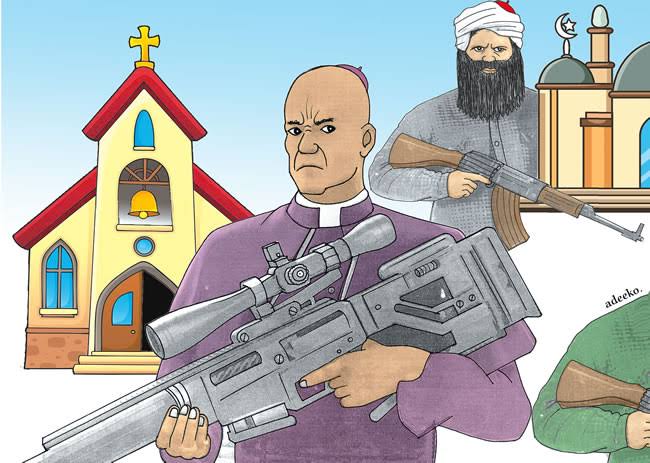
Zamfara State, the hotbed of banditry/ terrorists  in Northwest Nigeria announced last week the deregulation of weapon ownership to willing and mentally healthy individuals to defend themselves against rampaging criminals from within Nigeria and their international collaborators. This ‘self-defence’ call does not only trash the social contract between the government and the citizens which is that the former protects lives and properties while the latter submits their power and obey them, it also queries the willingness of the Commander-in-Chief of the Armed Forces of Nigeria to live up to the constitutional oath of defending Nigerians and its territorial integrity from internal insurrection and external aggression.

It is sad that the last seven years have seen more ungoverned spaces in Nigeria taken over by internal and external criminals who wreak havoc and compete over communities to maintain dominance where Nigerians are forced to pay to stay alive. Civilians in these troubled communities also guarantee their own safety by supplying information to criminals because the Nigeria State has been irresponsible to protect them on time. This is sad but only the person who wears the shoe know where it pinches.

While there has been argument for and against such policy direction, this piece presents the principle of Responsibility to Protect (R2P) adopted in 2005 during United Nations World Summit. Just like a father as the head of his household is saddled with the responsibility to provide and shield his family from harm, the constitution of the Federal Republic of Nigeria empowers the State (National or sub-national levels) to protect the citizens and residents within their geographical territories. R2P came into existence when world leadership felt they had been irresponsible in World War 1, World War 2 and the Rwanda Genocide with over 20 million dead from the violence. R2P, according to International Commission on Intervention and State Sovereignty is “the idea that sovereign states have a responsibility to protect their own citizens from avoidable catastrophe – from mass murder and rape, from starvation – but that when they are unwilling or unable to do so, that responsibility must be borne by the broader community of states”. With different forms of violence and insecurities facing Nigeria, has Nigeria with its federal security architecture demonstrated the responsibility to protect her citizens from banditry, terrorism, kidnapping, cattle rustling among others? The realities on ground today answer in the negative. What can be responsible for the irresponsibility of Nigeria to protect her people?

Responsibility to protect rests on three pillars. One, it is the responsibility of a state to protect her citizens; two, the wider international community has the responsibility to encourage and assist individual states in meeting that responsibility; three, if a state is manifestly failing to protect its populations, the international community must be prepared to take appropriate collective action, in a timely and decisive manner and in accordance with the UN Charter. States in the southwest demonstrated it by setting up Amotekun but because the approval resides with federal agency, the caliber of weapons approved for their use is insufficient in fighting the violent criminals they were set up to check. Criminals use Ak 47 without taking approval from government and they use it wickedly but legally backed security outfits cannot. Why is their politicization of Nigeria’s National security? Responsibility to protect rests on three responsibilities: responsibility to prevent (there must be political WILL to check transnational criminals from moving into Nigeria, poverty, unemployment and disarticulated youth population must be attended to); responsibility to react (how did Zamfara, Nigeria and other states react to the criminality of terrorists, criminal herders? With kid gloves?); and responsibility to rebuild (states must rebuild after every military intervention but at what cost to the national budget?).

While crimes are local, Nigeria sustains centralized approach to security against contemporary evolution of crimes. Some Governors like Nasir El-rufai have made a case for international support and mercenaries but the approval will have to come from “almighty” federal government whose body language has been one of unwillingness. We also have to clearly define the type of international support we are calling for going by our experience with the procurement of Super Tucano attack aircraft and the control imposed by the seller on how to use and not to use it. We have to decide to protect Nigeria. No external help will do that for us without taking other things in return.

Apart from the cost of acquiring arms, it is dangerous to empower poor populace with weapons because it may become their meal tickets like the bandits and the terrorists. Sadly, there is no structure in place to do weapon control and tracking with the weapon audit revelation that 178,459 firearms could not be accounted for by the Nigerian police.

I have had the rare privilege of speaking with those who labour day and night to protect Nigeria and Nigerians. I mean those in the Armed Forces, Police, Nigerian Civil Defense Corps, Correction Service, Immigration, Nigeria Customs service, the Department of State Service among others on why it is difficult to end terrorism, banditry among others. I typically ask them whether they lack capacity or are just unwilling to end the insecurity? Their responses point not to lack of capacity even with the weapons they have but to lack of political will to end it. Those who have been at the frontline spoke about “orders from above” which renders them incapacitated from advancing to conquer. Some told me about how their “oga at the top” instructs them to “defend and not attack”. How do you record victory if your instruction is only to wait to be attacked (sometimes killed) and the only thing you can do is to defend? Robert Greene in the 33 Laws of Power says wipe out your enemies totally. Our men are capable, majority are willing but without directives from “above”, nothing will happen. Does this explain why Kaduna that has the presence of Military formations gets attacked by Bandits at will with no superior counter force from the federal government who controls and issues orders? What happens is the lamentation of Governor Nasir El-rufai about how security agencies know the location of the attackers but he does not understand why they fail to take them out.    

There is nothing novel in what Zamfara government just pronounced. People in terror zones have always reacted in three ways: they flee from such places once they see that the state is unable to protect them. Some submit to the authority of bandits and terrorists and kidnappers agreeing to abide with the terms for their safety and the third category of responders are those who deploy self-help. When citizens cry of insecurity and they do not see the appropriate response from government, they enter self-defense mode and begin jungle justice. Government must take charge. Our insecurity is caused mainly by Nigerians with external collaborators. I salute our security men and women working hard to defend Nigeria despite poor welfare system and terrible conditions of service. I ask, can those who themselves are not secured secure others? Can those who arm thugs for political gains withdraw the arms from their cronies after elections? Is there a possibility of reworking the ECOWAS protocol on free movement of persons which is partly compromising the security of our country? The United States of America will not compromise her people. She will go to any country to defend her people and that is why Americans love their country. Rather than pronouncing a policy which will not work for poor civilians in Zamfara, the State government should join in amplifying the calls for State police. If Zamfara has its police system, it will not need to wait for the Inspector General to deploy one tactical squad located in Abuja to work and return to Abuja. We may seek external collaborations but I doubt if those who sell weapons will be happy for conflict to end. Our service Chiefs should depoliticize security and stand to defend the Constitution. Nigeria is what they swore to defend not political office holders. Our men are ready to defend Nigeria if they are given the ‘lawful order from above’. We can’t run gun-democracy and escalate the present state of insecurity by arming civilians. States should support State policing. States geographically contiguous in northwest and northeast need to harmonize security policies to avoid trans-territorial backlashes. Our security agencies must collaborate to achieve national security. In the interim, we must empower and restructure policing. We need to recruit more men because we lose our frontline fighters daily. We must take care of the families of fallen gallant security men and women so that their children will not carry arms against the country in future. We need to invest in technology and reduce moles in our security outfits. We created the problems and we only can decide when it should end. Nigerians must defend Nigeria!


Dr Tade, a criminologist wrote via dotad2003@yahoo.com

Comments

Opinion

State Police, Local Government Autonomy: Answers to Nigeria’s Lingering Questions | By Titilope Gbadamosi

Published

on

File photo of Dr. Titilope Gbadamosi, the Special Assistant on Youth Initiatives (Monitoring and Delivery) to President Bola Ahmed Tinubu.

Almost every democratically elected administration in Nigeria has had to grapple with pockets of insecurity in one form or another. Nigerians have watched uprisings metamorphose into banditry and terrorism, as though every administration had its own uniquely tailored brand of insecurity, defined by the modus operandi of these vicious elements.

The faces change, the methods change, but the burden on whoever occupies the highest office in the land has remained heavy and constant.

Just two administrations ago, during President Goodluck Jonathan’s tenure, we witnessed the horror of the abduction of the Chibok girls and explosives going off in public spaces in Abuja, the nation’s capital. Every well meaning Nigerian was worried, and nowhere felt truly safe. The President’s seat was not the most desirable at the time, and it was clearly a difficult job.

President Muhammadu Buhari’s administration had its own share, mostly in the form of clashes between farmers and herders, driven by grazing routes lost to farming, droughts pushing herders toward greener pastures, and old accommodations between communities slowly breaking down.

I recall quite vividly, while serving as Special Assistant to the former Governor of Oyo State, the late Senator Abiola Ajimobi, joining the head of our team in several peace talks with farmers, traditional rulers, and the Hausa and Fulani community in the state. One lesson from those rooms has stayed with me ever since. The people who understood the grievances, the terrain, and the actors were all local, yet the command of security sat far away in Abuja. That gap is the question every administration has struggled to answer.

Today, President Bola Ahmed Tinubu is in charge, and Nigerians who are students of history watched to see what shape insecurity would take and, more importantly, what this President would do differently. In recent development, the country received an answer that previous decades only debated.

On June 11, following the President’s formal request to the National Assembly to restructure our security architecture, the House of Representatives passed the constitutional amendment to establish state police, with 289 members voting in support and barely a voice against, while the Senate works to complete passage before year end. Today June 12th,2026, in his Democracy Day address, the President spoke plainly: the insecurity we face is partly the product of collapsed grassroots governance, and his administration remains committed to financial autonomy for our 774 local government councils. There it is, a two pronged solution: state police and true local government autonomy.

The first prong closes the gap I saw in those Oyo State peace talks. The amendment to Section 214 of the Constitution creates a dual policing structure under which each state may establish its own force. Security decisions will now be taken by those who know the terrain, the actors, and the grievances at first hand.

To his credit, the President did not merely champion the idea; he asked the National Assembly to institute controls to prevent abuses, the mark of a leader interested in a reform that endures rather than one that backfires. All of this rides on the largest security investment in our history, a 5.41 trillion naira commitment in the 2026 budget and over 50,000 new police officers approved for recruitment.

The second prong puts resources where the new responsibility will live. Since the Supreme Court ruled in July 2024 that federation allocations belonging to local governments must reach them directly, monthly allocations to the 774 councils have grown from roughly 387 billion naira in March 2025 to nearly 530 billion naira by September 2025. The money has never been the problem; control of it was. By pressing autonomy to its conclusion, this administration is returning both funds and accountability to the communities where insecurity actually begins, so that the grassroots governance whose collapse the President identified can finally be rebuilt.

So who wins in all of these? Nigerians win, because security decisions and development funds will finally live where the people live. Governors win the powers they have long demanded, and with them the responsibility they can no longer pass to Abuja. And the country wins a President willing to attempt what others only discussed. The President reminded us on Democracy Day that Nigerians bend and bleed but do not break. With these two reforms, we may finally stop having to prove it so often.


Dr. Titilope Gbadamosi  is the Special Assistant on Youth Initiatives (Monitoring and Delivery) to President Bola Ahmed Tinubu.

Continue Reading

Opinion

Nigeria’s Insecurity: Why the System Rewards Reaction, Not Prevention

Published

on

The most foolish person in a burning house is not the one who cannot find the exit. It is the one who knew the house would burn, watched it happen, and only ran when the ceiling collapsed. That is Nigeria’s governance posture toward insecurity—a pattern so consistent that it has become normalized.

“Ikú tó pa ojúgbà ẹni, òwe ló fi pa. (The death that kills your neighbour is a proverb directed at you).

The bandits did not simply arrive. They sent warnings ahead of them through a trail of violence that crossed state lines and appeared in every massacre headline we filed away as someone else’s problem.

When Insecurity Was Still “Someone Else’s Problem”

When the North was burning and the Middle Belt bleeding, the South West treated it as distant noise. Kwara became the first warning sign—the bridge between North and South—slowly slipping under the shadow of insurgency. The question every serious observer should have asked was simple: what happens when it crosses the border?

South West governors issued statements—careful, brief, and reactive. None moved with the urgency the threat demanded. Before long, violence arrived at our doorstep: herder brutality in Oke-Ogun, attacks in Oyo and Ekiti, kidnappings along the Ibadan–Ijebu-Ode expressway, and forest camps emerging in Ondo.

The warning signs had matured into reality, yet we were still searching for an exit strategy that should have been built years earlier.

The Problem: We Only Count the Dead

In safety performance management, there is a critical distinction between lagging indicators—outcomes after failure (deaths, destruction, losses)—and leading indicators, which measure prevention before failure occurs.

Aviation, oil and gas, and other high-risk industries understand this clearly: a system that obsesses over lagging indicators will always arrive after the accident.

Nigeria’s security governance is built almost entirely on lagging indicators. We count attacks after they happen. We rebuild after a collapse. We mourn after preventable deaths.

We rarely ask:

How many attacks were prevented this quarter?

How many threats were neutralized before execution?

How many cells were dismantled at the planning stage?

We do not know the answers—because we are not measuring them. The system was never designed to prevent. It was designed to respond: loudly, visibly, expensively, and always too late.

Another Base. The Same Question Nobody Asks

The presidency is reportedly considering a military base in Oriire Local Government Area of Oyo state. It is a familiar pattern: a major security incident, public outrage, and an institutional response designed to signal seriousness.

But the critical question remains unanswered: what has been the leading-indicator performance of existing bases?

How have long-standing military formations in places like Jos, Benue, and Zamfara—some active for over two decades—actually shifted the security outcome?

A military base without actionable intelligence is a stationary slaughter ground for soldiers. It does not prevent attacks; it often becomes a reactive outpost in a repeating cycle: attack, deployment, statement, investigation, and then silence—while underlying threat networks remain intact.

The Incentive Structure Behind the Chaos

The deeper issue is not the capability of security forces. It is the incentive structure of the system.

When leadership is judged only by incidents that have already occurred, governance shifts from prevention to performance management of failure. The objective becomes managing optics, not reducing probability.

Nigeria’s security budget has grown significantly over the past decade, yet insecurity has worsened. Kidnappings have become more brazen. Why? Because funding is justified by the persistence of the crisis, not its resolution.

If the problem is solved, what justifies the next budget cycle?

For years, decentralization has been proposed as the structural reform that could change the system—but it remains trapped in political rhetoric. Why? Because decentralization disperses power, and power in Nigeria’s political economy is not dispersed. It is concentrated.

Sixteen Days. Full Stop.

Forty-six children and teachers were kidnapped in Oriire. It reportedly took sixteen days for the presidency to authorize a specialized rescue framework.

Sixteen days before the Commander-in-Chief treated the abduction of forty-six human beings as a crisis requiring formal executive activation.
But responsibility in moments like this is not singular.

The Oyo State Governor, by constitutional convention regarded as the Chief Security Officer of the state and a recipient of security votes, also occupies a central coordinating role in the security architecture of the state. Within a crisis of this scale, expectations of rapid intergovernmental coordination, visible command urgency, and sustained pressure on federal response mechanisms are not optional, hey are inherent to the office.

Yet, the response cycle, from abduction to high-level coordinated action and physical engagement with affected communities, unfolded at a pace that raised legitimate public concern about the speed and intensity of institutional reaction.

By the time visible field visits and coordinated engagements occurred, the delay had already become part of the public record of the crisis itself—shaping perception as much as the incident shaped fear on the ground.

In a functional security system, crisis response is measured in hours, not days. Not for symbolism, but because time directly affects outcomes: every passing hour in an active kidnapping reduces the probability of safe recovery and increases the leverage of perpetrators.

Sixteen days, therefore, is not merely a lapse in timing. It reflects a deeper structural problem—where urgency is often declared after pressure builds, rather than operationalized when intelligence first breaks.

And in that gap between incident and action, citizens are left to absorb the consequences of delayed coordination across all tiers of authority.

The Verdict

Nigeria does not primarily need more military bases. It needs a new security measurement architecture—one that prioritizes intelligence conversion rates, early-warning response times, and pre-emptive disruption metrics over post-incident operations.

Every threat must be treated as time-sensitive, where minutes and hours determine outcomes—not weeks and statements.

Most importantly, citizens must shift the accountability question:

Not only “why did the attack happen?”

But “why was it not prevented?”

Nigeria’s security challenge is ultimately a leadership and systems failure—an institutional preference for reaction over prevention, because prevention is politically invisible.

You cannot hold a press conference about the attack that never happened.

Until this reality is named and confronted with precision, the cycle will continue.

Continue Reading

Opinion

Why Ibadan North youths are rooting for Repete

Published

on

Growing support has continued to trail a youthful politician and technology advocate, Hon. Khalil Mustapha Adegboyega, popularly known as Repete, as many youths in Ibadan North Federal Constituency expressed confidence in his leadership style and vision for development.

Across several communities within the constituency, residents, particularly students, artisans and young professionals, described Repete as one of the emerging political figures with strong grassroots appeal and a passion for youth empowerment.

Supporters said his growing popularity stems from his consistent advocacy for innovation, entrepreneurship and skills development aimed at addressing unemployment and creating opportunities for young people.

As an engineer and technology enthusiast, Repete is also said to possess a deep understanding of the evolving digital economy and the need to position youths for global competitiveness.

Many of his supporters noted that his approach to leadership focuses on practical solutions, mentorship and capacity-building initiatives capable of helping young people become self-reliant and economically productive.

Some community stakeholders who spoke on his rising profile said his humility, accessibility and relationship with the grassroots have continued to endear him to many residents within the constituency.

They added that Repete’s engagement with youths and community groups reflects his commitment to inclusive governance and people-oriented representation.

Observers within the constituency also maintained that the increasing support for the politician reflects a growing desire among residents for a new generation of leaders driven by innovation, competence and accountability.

According to them, many young people see Repete as a symbol of hope and progressive leadership capable of contributing meaningfully to the development of Ibadan North Federal Constituency.

Continue Reading

Advertisement

Entertainment

Advertisement

MegaIcon Magazine Facebook Page

Advertisement

MEGAICON TV

Advertisement

Trending